Romantic Phrases in Japanese: 25+ Ways to Flirt, Compliment, and Say 'I Love You'
Quick Answer
The most natural romantic phrases in Japanese are usually indirect, like '好きだよ' for affection, '会いたい' for longing, and specific compliments like '素敵だね.' Use '愛してる' rarely, because it can sound heavy. This guide gives 25+ lines with mora-accurate pronunciation, IPA, and when each one fits.
| English | Japanese | Pronunciation | Formality |
|---|---|---|---|
| I like you. (affectionate) | 好きだよ | skee dah-yoh | casual |
| I like you. (polite, serious) | 好きです | skee dehss | polite |
| I love you. (very strong) | 愛してる | AH-ee-shee-teh-roo | casual |
| I want to see you. (I miss you) | 会いたい | AH-ee-TAH-ee | casual |
| You are cute. | かわいい | kah-wah-EE | casual |
| You are beautiful. | きれい | kee-REH-ee | casual |
| You look great today. | 今日、すごくいいね | kyoh, soo-GOH-koo EE neh | casual |
| That suits you. | 似合ってるね | nee-AHT-teh-roo neh | casual |
| You are wonderful. | 素敵だね | SU-teh-kee dah neh | casual |
| I like being with you. | 一緒にいると楽しい | ees-SHOH-nee EE-roo toh tah-NOH-shee | casual |
| Can we meet again? | また会える? | mah-tah ah-EH-roo | casual |
| Do you want to go out to eat sometime? | 今度ごはん行かない? | KOHN-doh goh-hahn ee-kah-NAH-ee | casual |
| Do you have a boyfriend/girlfriend? | 彼氏(彼女)いる? | kah-REH-shee (kah-NOH-joh) EE-roo | casual |
| I want to hold your hand. | 手、つないでもいい? | teh, tsoo-NAH-ee deh-moh EE | casual |
| Can I kiss you? | キスしてもいい? | KEE-soo sheh-teh-moh EE | casual |
| I am happy. | 嬉しい | oo-REH-shee | casual |
| Thank you for today. | 今日はありがとう | kyoh-wah ah-ree-GAH-toh | casual |
| Good night. (sweet) | おやすみ | oh-YAH-soo-mee | casual |
The most natural romantic phrases in Japanese are usually indirect and situation-based, like 好きだよ (skee dah-yoh, /sɯ̟ᵝkʲi da jo/) for affection, 会いたい (AH-ee-TAH-ee, /a i ta̠i/) for missing someone, and concrete compliments like 似合ってるね (nee-AHT-teh-roo neh, /nʲi a̠tːe̞ ɾɯ̟ᵝ ne̞/) for “That suits you.” You can say 愛してる (AH-ee-shee-teh-roo, /a i ɕi te ɾɯ̟ᵝ/), but it often sounds heavy, so most couples rely on lighter, more frequent lines.
Japanese is spoken by roughly 123 million people worldwide (Ethnologue, 27th edition, 2024), and Japanese-language learning is widespread across many countries through formal education and pop culture (Japan Foundation, accessed 2026). That mix is why learners often pick up “dramatic” lines from media, then get surprised when real-life dating language is softer and more contextual.
If you want a broader baseline for everyday tone, start with how to say hello in Japanese and how to say goodbye in Japanese, then add romance on top.
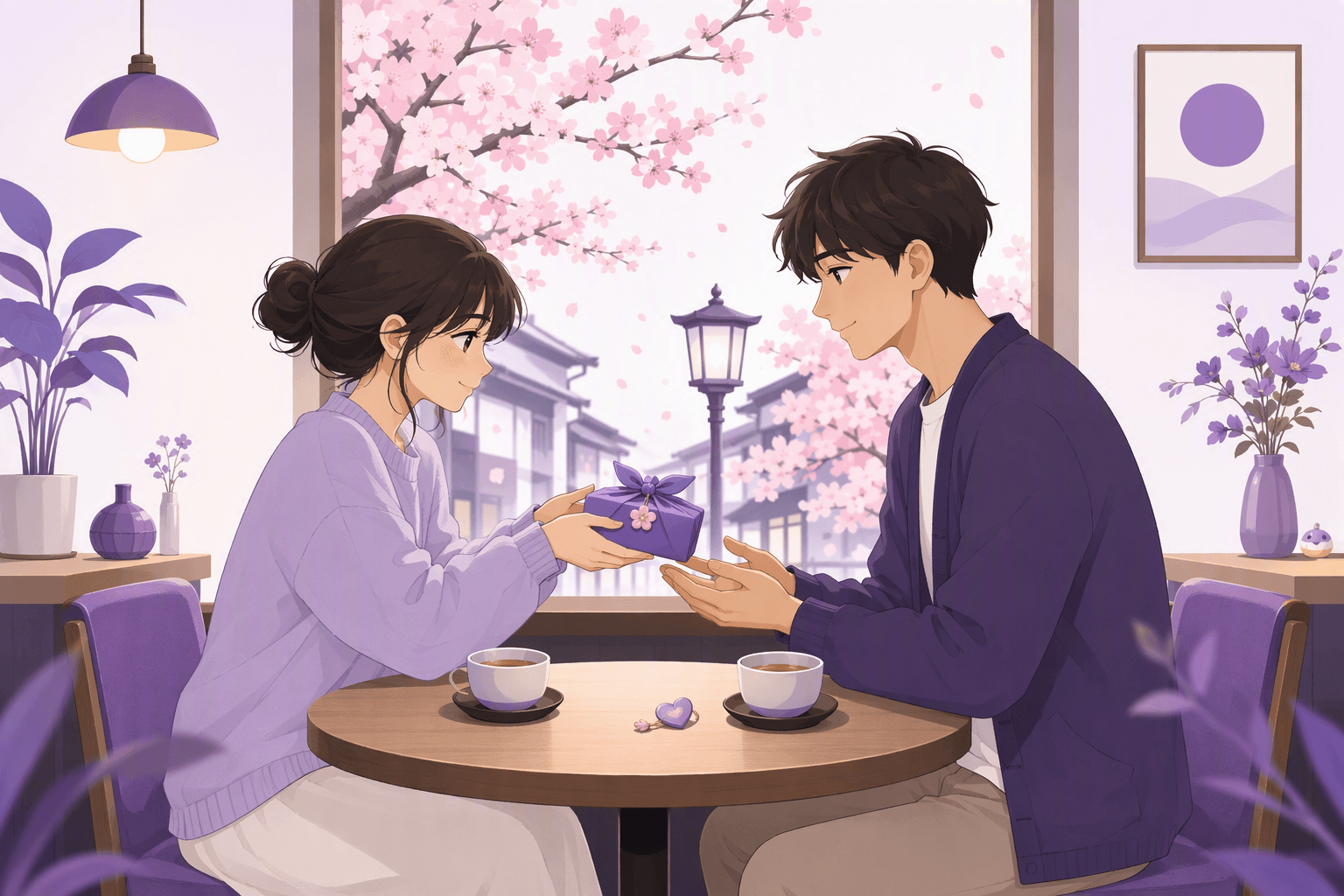
Why Japanese romance often sounds indirect (and why that is a good thing)
Many romantic lines in Japanese are built to protect the other person’s comfort, especially early on. You will hear more “I enjoy being with you” than “I am obsessed with you,” and more specific compliments than global judgments.
This matches what linguist Haru Yamada describes in Different Games, Different Rules when comparing conversational expectations across cultures: Japanese interaction often prioritizes harmony and reading the room over explicit self-assertion. In romance, that means your timing and softness matter as much as the words.
Also, Japanese has clear formality choices. A small switch from だよ to です can change the vibe from intimate to careful.
💡 Romance tip that works in real life
If you are unsure, choose a specific compliment plus a small invitation. It feels natural, and it gives the other person an easy way to respond without pressure.
How to pronounce romantic Japanese naturally (mora timing)
Japanese is mora-timed, so rhythm matters. If you compress morae, your line can sound rushed or like a different word.
Here are common romance-problem patterns:
- 会いたい is a-i-ta-i, four morae: /a i ta̠ i/
- きれい is ki-re-e, three morae: /kʲi ɾe̞ e̞/
- 今日 (きょう) is kyo-o, two morae: KYOH, long vowel /kʲo̞ː/
- 似合ってる has a small っ, which is a pause plus doubled consonant: /a̠tːe̞/
If you want a deeper pronunciation foundation, pair this article with our Japanese pronunciation guide.
The core romantic phrases (what people actually say)
好きだよ
好きだよ (skee dah-yoh, /sɯ̟ᵝkʲi da jo/) is the everyday romantic “I like you.” It is warm and direct, but not overly dramatic.
Use it when you already have some closeness. If you say it too early, it can feel like a confession.
/skee dah-yoh/
Literal meaning: Literally 'I like (you),' with a casual, intimate ending.
“好きだよ。今日会えて嬉しい。”
I like you. I am happy I got to see you today.
A common couple phrase. The ending よ adds emphasis, like you are making it clear and sincere.
好きです
好きです (skee dehss, /sɯ̟ᵝkʲi desɯ̟ᵝ/) is polite and serious. It is common in a confession scene, but it is also usable in real life when you want to sound respectful.
It can feel slightly formal between established couples, but it is not wrong.
/skee dehss/
Literal meaning: Polite form of 'I like you.'
“ずっと前から好きです。”
I have liked you for a long time.
Often used when you want to be clear and respectful. It can feel like a 'confession' line, so choose your moment.
大好き
大好き (dye-SKEE, /da̠isɯ̟ᵝkʲi/) means “really like,” often closer to “love” in everyday English. It is common with partners, close friends, and even family.
Because it is used broadly, it feels less intense than 愛してる.
/dye-SKEE/
Literal meaning: Literally 'big like,' meaning 'really like.'
“大好き。ずっと一緒にいたい。”
I really like you. I want to be together forever.
Very common and emotionally strong, but not as heavy as 愛してる. You will hear it in couples and in pop lyrics.
愛してる
愛してる (AH-ee-shee-teh-roo, /a i ɕi te ɾɯ̟ᵝ/) is real Japanese, but it is not the default daily “I love you.” It can sound like a major declaration.
Think of it as a “big moment” line. If you want the everyday version, use 好きだよ or 大好き.
For a full breakdown, see our dedicated guide to how to say I love you in Japanese.
/AH-ee-shee-teh-roo/
Literal meaning: A strong declaration of love.
“愛してる。これからも一緒にいよう。”
I love you. Let's stay together from now on too.
Often feels dramatic in everyday conversation. Many couples rarely say it out loud, even if they feel it.
“I miss you” and longing (the natural Japanese way)
会いたい
会いたい (AH-ee-TAH-ee, /a i ta̠i/) is the workhorse phrase for missing someone. It literally means “I want to see you,” which is exactly how it feels in Japanese.
You can scale it up or down:
- ちょっと会いたい: a gentle “I kinda miss you”
- すごく会いたい: strong longing
/AH-ee-TAH-ee/
Literal meaning: Literally 'I want to meet/see you.'
“会いたいな。今週どこかで会える?”
I miss you. Can we meet somewhere this week?
Very common in texts. Adding な softens it and makes it sound more wistful.
寂しい
寂しい (sah-BEE-shee, /sa̠bʲiːɕiː/) means “I feel lonely.” It can be romantic, but it can also feel emotionally heavy if you use it as pressure.
Use it carefully. In early dating, it can sound like you are asking the other person to fix your mood.
⚠️ Avoid accidental pressure
Lines like 寂しい can be sincere, but they can also feel like guilt-tripping if the other person is busy. If you want a lighter vibe, use 会いたい plus a concrete plan.
Compliments that land well (and don’t sound like a script)
Japanese compliments tend to be most natural when they are specific and tied to the moment. This aligns with what sociolinguist Sachiko Ide discusses in her work on discernment and social expectations in Japanese politeness: appropriateness is often about fitting the situation, not just being “nice.”
似合ってるね
似合ってるね (nee-AHT-teh-roo neh, /nʲi a̠tːe̞ ɾɯ̟ᵝ ne̞/) is one of the safest compliments you can give. It means “That suits you.”
It works for clothes, hairstyles, and even glasses.
/nee-AHT-teh-roo neh/
Literal meaning: It suits you.
“その色、すごく似合ってるね。”
That color really suits you.
A natural, low-pressure compliment. The ending ね invites agreement and keeps the tone friendly.
素敵だね
素敵だね (SU-teh-kee dah neh, /sɯ̟ᵝte̞kʲi da ne̞/) is “You’re wonderful,” “That’s lovely,” or “That’s great.” It is flexible and not overly intimate.
Use it for someone’s vibe, taste, or behavior, not only looks.
かわいい
かわいい (kah-wah-EE, /ka̠wa̠iː/) is “cute.” It is common, but context matters.
Saying it about a partner is normal. Saying it repeatedly to a stranger can feel childish or like you are commenting on them as an object.
きれい
きれい (kee-REH-ee, /kʲi ɾe̞ː/) can mean “pretty” or “clean.” When used about a person, it often feels more “beautiful” than かわいい.
It is also used for scenery and objects, so it can feel elegant rather than intense.
🌍 Cute vs beautiful in Japanese dating talk
かわいい often signals approachable charm, while きれい can signal a more polished, adult beauty. Many couples use both, but if you want to sound less like an anime script, attach the compliment to something specific: 今日の髪型、かわいい or 今日の服、きれいだね.
Invitations that sound natural (and not pushy)
A lot of flirting is simply creating a next moment together. In Japanese, soft invitations are common, especially early on.
今度ごはん行かない?
今度ごはん行かない? (KOHN-doh goh-hahn ee-kah-NAH-ee, /ko̞ndo̞ ɡo̞ha̠ɴ ika̠na̠i/) is a classic: “Want to go eat sometime?”
It is casual, low pressure, and easy to say yes or no to.
また会える?
また会える? (mah-tah ah-EH-roo, /ma̠ta̠ a̠e̞ɾɯ̟ᵝ/) means “Can we meet again?” It is direct, but still light.
If you want even softer, add かな: また会えるかな.
もう少し一緒にいたい
もう少し一緒にいたい (moh oo-SOH-shee ees-SHOH-nee ee-TAH-ee, /mo̞ː so̞ɕi iɕːo̞ nʲi i ta̠i/) means “I want to stay together a bit longer.”
It is a good end-of-date line because it expresses desire without demanding.
Physical affection: what is okay to say (and when)
Physical lines exist in Japanese, but they are more context-sensitive than many learners expect. If you are not sure about comfort, ask softly.
手、つないでもいい?
手、つないでもいい? (teh, tsoo-NAH-ee deh-moh EE, /te̞ t͡sɯ̟ᵝna̠i de̞mo̞ iː/) is “Can I hold your hand?”
It is straightforward and respectful. It also gives the other person a clean exit.
キスしてもいい?
キスしてもいい? (KEE-soo sheh-teh-moh EE, /kʲisɯ̟ᵝ ɕi te̞mo̞ iː/) is “Can I kiss you?” It is direct, so use it only when the vibe is clearly there.
If you want softer, add かな: キスしてもいいかな?
🌍 Media vs real life
Japanese dramas often skip verbal consent lines because they rely on cinematic cues. In real life, asking is not weird, especially if you are dating across cultures. A simple してもいい? is clear and not overly formal.
Sweet everyday lines that build intimacy
These are the phrases that make you sound like a real person, not a translated pickup line.
一緒にいると楽しい
一緒にいると楽しい (ees-SHOH-nee EE-roo toh tah-NOH-shee, /iɕːo̞ nʲi iɾɯ̟ᵝ to̞ ta̠no̞ɕiː/) means “I have fun when I’m with you.”
It is a strong relationship line because it praises the shared experience, not just the person’s looks.
嬉しい
嬉しい (oo-REH-shee, /ɯ̟ᵝɾe̞ɕiː/) is “I’m happy.” It is simple, but it lands well when you attach it to a reason.
Example: 会えて嬉しい, “I’m happy I got to see you.”
今日はありがとう
今日はありがとう (kyoh-wah ah-ree-GAH-toh, /kʲo̞ː wa̠ a̠ɾʲiɡa̠to̞ː/) is “Thanks for today.” It is a classic end-of-date line.
If you want a more polite version: 今日はありがとうございました (kyoh-wah ah-ree-GAH-toh goh-zah-ee-MAHSS).
おやすみ
おやすみ (oh-YAH-soo-mee, /o̞ja̠sɯ̟ᵝmʲi/) is casual “good night.” Couples often add ね or よ: おやすみね, おやすみだよ.
For more options, see goodbyes in Japanese, since bedtime talk often overlaps with farewell language.
What not to say (common learner mistakes)
Overusing 愛してる too early
If you use 愛してる on a first date, it can sound like you are performing a role. It is not “wrong Japanese,” it is just socially intense.
A safer ladder is: いいな (nice) → 好きかも (might like you) → 好きだよ (I like you) → 大好き (really like you) → 愛してる (big declaration).
Copying aggressive pickup lines from subtitles
Subtitles often compress nuance. A line that looks romantic in English can be pushy in Japanese if you say it with confidence too soon.
If you want to learn from media, use short clips and pay attention to who says what to whom. Our dual subtitles guide helps you catch the difference between the Japanese line and the translated vibe.
Mixing politeness levels randomly
Switching between です and だ in the same breath can sound unstable unless you are doing it intentionally. Early dating often starts polite, then gradually becomes casual as closeness grows.
If you want to keep it simple, match the other person’s level.
Learning romantic Japanese from movies and dramas (without sounding unnatural)
Romance language is high-frequency in TV, but you need filtering. Paul Nation’s work on vocabulary learning emphasizes repeated, meaningful encounters with language, and romance scenes provide repetition, but only if you reuse the lines in real contexts.
A practical method:
- Pick one show you can tolerate rewatching.
- Save 10 short, everyday lines (ありがとう, 会いたい, 似合ってる).
- Practice them as responses, not as monologues.
If you are building an immersion routine, start from our learn Japanese page and combine it with how to learn a language with movies.
A quick “romance script” you can adapt (texting to second date)
Use this as a template, not a memorized speech:
- 今日はありがとう。 (Thanks for today.)
- すごく楽しかった。 (It was really fun.)
- また会いたいな。 (I want to see you again.)
- 今度ごはん行かない? (Want to grab food sometime?)
Each line is short, natural, and gives the other person room to respond.
One last cultural note: sweetness is often shown through actions
In Japanese relationships, affection is frequently communicated through reliability, small care, and timing, not only verbal declarations. That is one reason “big words” can be rarer in daily speech.
If you want to explore the opposite register, the stuff people say when they are angry or jokingly rude, compare with our guide to Japanese swear words. The contrast helps you hear how strongly romance language stands out.
Practice with Wordy (one simple routine)
Pick 5 phrases from the Quick Reference table and listen for them in real clips. Pause, repeat with mora timing, then swap one word (今日, 今度, すごく) to make the line yours.
That is how romantic Japanese stops being “phrases you know” and becomes “things you can actually say.”
Frequently Asked Questions
What is the most common way to say 'I like you' romantically in Japanese?
Is 愛してる really used in Japan?
How do you flirt in Japanese without sounding creepy?
What is a natural Japanese compliment for someone's appearance?
How do you say 'I miss you' in Japanese in a romantic way?
Sources & References
- Ethnologue: Languages of the World, Japanese language entry (27th edition, 2024)
- The Japan Foundation, Japanese-Language Education Overseas (survey report, accessed 2026)
- Agency for Cultural Affairs (文化庁), Japanese language policy and usage resources (accessed 2026)
- NHK Broadcasting Culture Research Institute, language and communication resources (accessed 2026)
- Kenkyusha, Japanese-English dictionary resources (accessed 2026)
Start learning with Wordy
Watch real movie clips and build your vocabulary as you go. Free to download.


