Quick Answer
You can learn a language with movies if you treat them as structured listening practice: pick level-appropriate scenes, use subtitles in stages, repeat short clips, and turn lines you hear into vocabulary you review. This method works because films provide authentic speech, emotion, and context, which improves comprehension and memory when paired with deliberate repetition and spaced review.
Learning a language with movies works when you stop treating films as background entertainment and start using them as repeatable listening material: pick level-appropriate scenes, use subtitles in stages, replay short clips until you can hear the words, and review the vocabulary and lines you mined from those scenes.
Movies are not a magic shortcut, but they are one of the most efficient ways to train real listening. You hear connected speech, reductions, interruptions, and emotion, which textbooks often sanitize.
If your goal is English, start with our curated list of the best movies to learn English, then use the method below to turn each film into a week of structured practice.
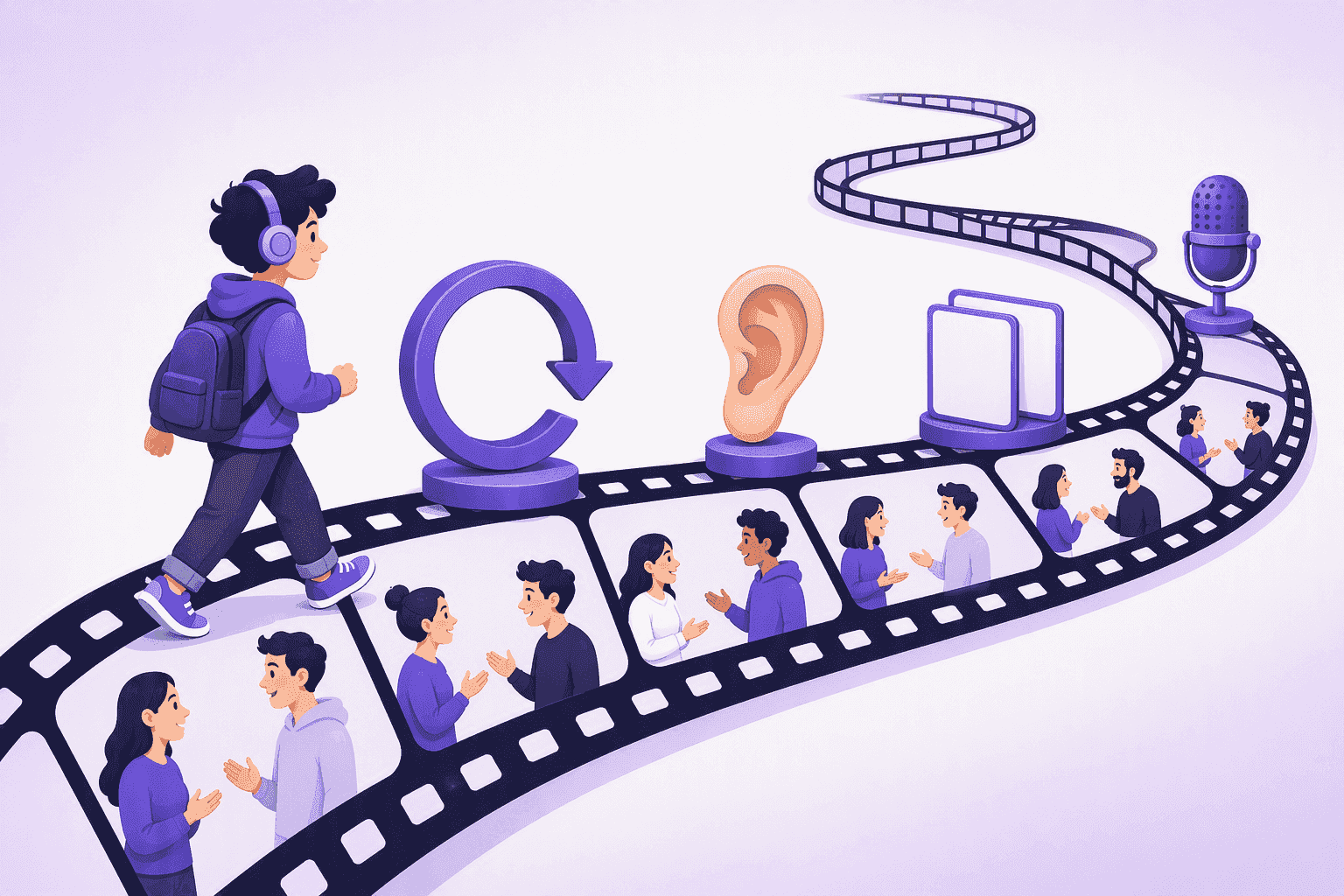
Why movies help, and why most people fail with them
Movies help because they combine meaning, sound, and memory cues. A line lands because you see the face, the situation, and the consequence, not because you memorized a translation.
Most people fail because they watch too much and repeat too little. You can watch 30 hours and still not hear common reductions like "gonna" or "kinda" clearly, because your brain never got the chance to compare, replay, and adjust.
The hidden skill you are training: segmentation
Listening is not only "knowing words". It is hearing where one word ends and the next begins.
In fluent speech, words blend. Movies force you to deal with that reality, especially in casual scenes.
Movies give you authentic input, but you still need a plan
Stephen Krashen’s work on comprehensible input is often summarized as: you improve when you understand messages in the target language. Movies can provide that input, but only if the material is close enough to your level that you can follow the story.
When the gap is too big, you are not getting input, you are getting noise. Your plan is what closes the gap.
A reality check on time and outcomes
If you are learning English, you are joining a huge global community. Ethnologue estimates roughly 1.5 billion English speakers worldwide (native plus second-language speakers), and English has official or major institutional roles in dozens of countries (Ethnologue, 27th ed., 2024).
That scale matters because it means you have endless media, accents, and registers. It also means you need to choose what "English" you are targeting: US workplace English, UK university English, international English for travel, and so on.
The CEFR framework is useful here because it separates skills. You might be B1 in reading but A2 in listening. Movies mainly push listening and conversational vocabulary, not formal writing (CEFR, Council of Europe, accessed 2026).
💡 A good movie-based goal
Aim for: "I can follow the plot without translating every sentence, and I can repeat key lines with the same rhythm." That is a listening goal you can measure weekly.
Step 1: Pick the right movie and the right audio conditions
Your first win comes from choosing material that is easy to hear. A great film with terrible audio mix is a bad learning tool.
Choose modern, dialogue-heavy, low-noise films
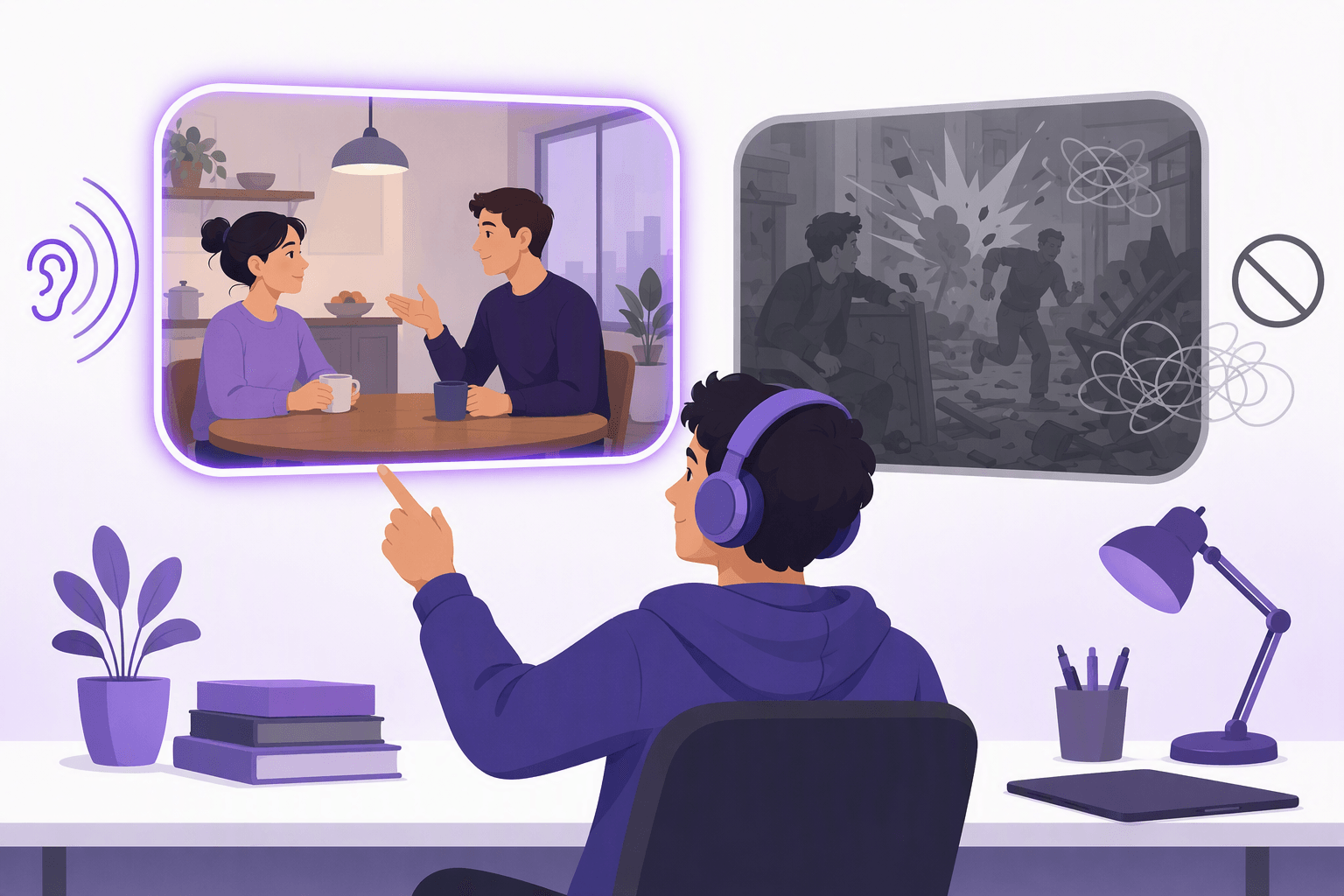
Start with scenes in apartments, offices, schools, cafes, and family dinners. You want clear speech, repeated topics, and predictable turns.
Avoid early on: war films, superhero battles, and anything with constant music under dialogue. You will spend your energy fighting the sound design.
Prefer one accent at first
English is not one sound system. If you mix US, UK, Australian, and Irish films in week one, your ear has no stable target.
Pick one "home accent" for 4 to 6 weeks. Then add variety.
If you want a clear overview of differences, see American vs British English.
Set up your environment like a listening lab
Use headphones if possible. Turn off background noise.
If you can, watch on a device that lets you easily rewind 5 to 10 seconds. That rewind button is your best teacher.
Step 2: Use subtitles in stages (not all the time)
Subtitles are a tool, not a religion. The right subtitle choice depends on your goal for that session.
Stage A: Target-language subtitles for mapping sound to spelling
If you are learning English, that means English subtitles. This stage is about connecting what you hear to what it looks like.
This is where you notice reductions and contractions. You see "did you" while you hear "didja".
Stage B: No subtitles for pure listening
Once you can follow the scene with subtitles, remove them and replay. Your brain now has a hypothesis about the words, and it can test that hypothesis against the audio.
This is where listening skill grows, because you are forced to segment the stream of sound.
Stage C: Native-language subtitles only as a rescue
Native-language subtitles are useful when you are completely lost and need the plot. They are not ideal for training listening, because your brain will read instead of listen.
If you use them, use them briefly, then return to target subtitles or no subtitles.
⚠️ The 'I watched with subtitles' trap
If you always use native-language subtitles, you can finish a whole season and still struggle with real conversation. Your reading improved, not your listening.
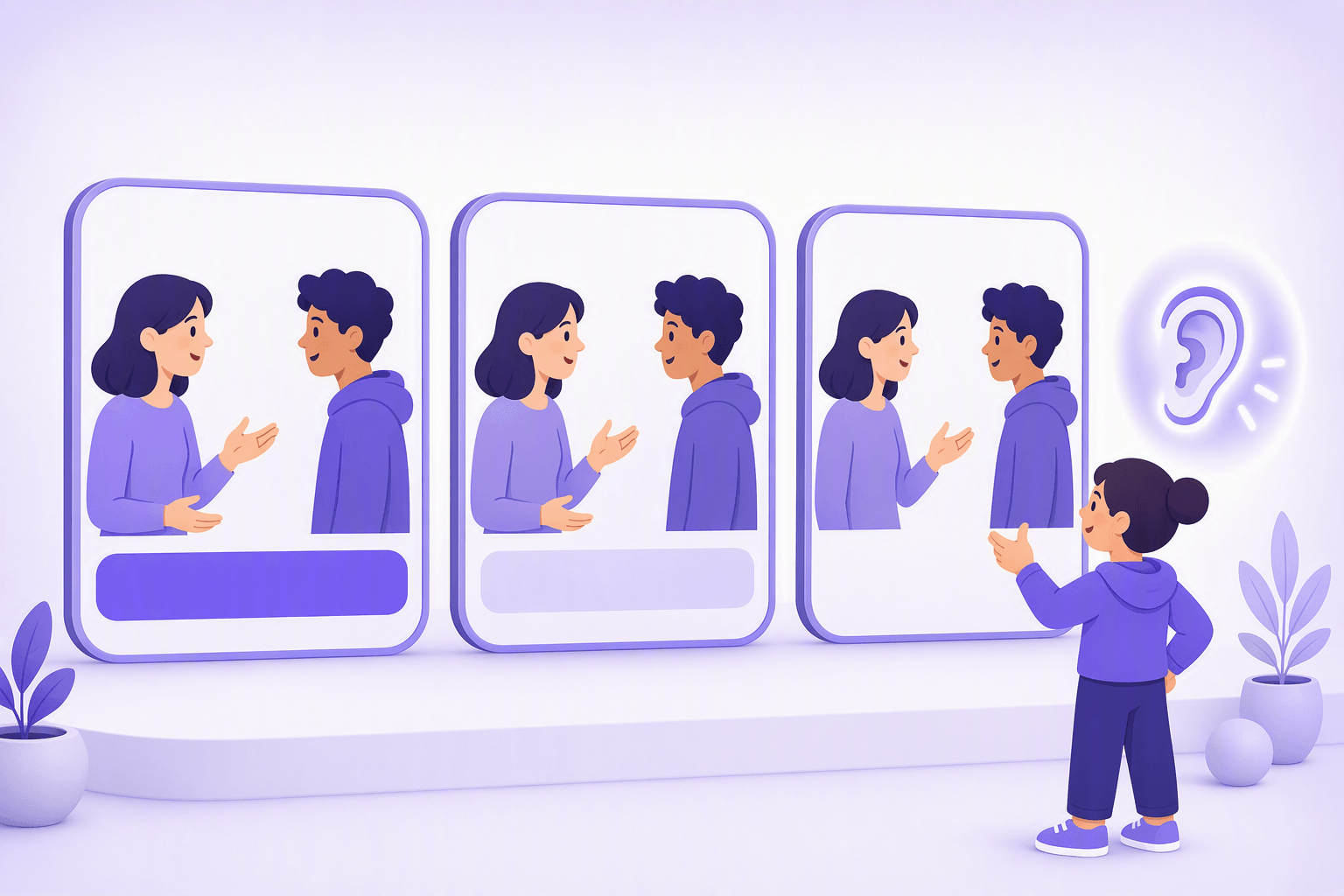
Step 3: The 3-pass method for a single scene
A scene is your unit of learning. Not a whole movie, not a whole episode.
Pick a clip that is 30 seconds to 2 minutes long. Short clips are repeatable, and repeatable is learnable.
Pass 1: Watch for meaning
Watch once with target-language subtitles. Do not pause.
Your job is to understand who wants what, and why.
Pass 2: Watch for sound
Replay the same clip with no subtitles. Pause only when you truly cannot hear a phrase.
Try to write what you think you heard. Even if it is wrong, you are training your ear.
Pass 3: Confirm and mine
Turn subtitles back on. Confirm the exact wording.
Now mine 3 to 7 items: a useful phrase, a verb pattern, a pronunciation reduction, and maybe one slang term.
If you want extra help interpreting slang when it appears, keep a reference like our English slang guide, but do not turn every scene into a slang hunt.
Step 4: What to write down (and what to ignore)
Your notebook should not become a dictionary. Movies contain a lot of low-value vocabulary for learners.
Save chunks, not isolated words
Instead of saving "appointment", save "I have an appointment at 3."
Instead of saving "mind", save "Do you mind if I sit here?"
This aligns with how usage-based approaches to language learning describe fluency: you retrieve patterns, not single items. Diane Larsen-Freeman’s work on grammar as a dynamic system is a good reminder that "knowing grammar" is often knowing how forms behave in real contexts (Larsen-Freeman, Teaching Language: From Grammar to Grammaring, Heinle).
Ignore names and one-time plot words
Character names, fictional places, and rare technical terms are usually not worth it.
If a word appears once and never again, it is probably not a priority.
Track pronunciation features you actually hear in movies
In English, movies are full of:
- Reduced "to" as "tuh" in "want to"
- Flapped T in American English, "water" sounding like "WAH-der"
- Dropped sounds in fast speech, "next day" blending together
For focused pronunciation work, pair movie practice with targeted drills like those in our English pronunciation tips.
Step 5: Build a weekly routine that does not burn you out
A movie-based plan fails when it becomes too heavy. The routine below is realistic for busy adults.
The 5-day clip cycle
Day 1: Choose a clip, do the 3-pass method.
Day 2: Replay with no subtitles, shadow the lines.
Day 3: Replay faster, focus on reductions and rhythm.
Day 4: Watch the surrounding scene for context, then return to the clip.
Day 5: Record yourself repeating the clip, compare, adjust.
On the weekend, watch a longer segment for enjoyment. Enjoyment keeps you consistent.
How much time per day?
20 to 40 minutes of focused work is enough for steady progress. If you have more time, add more clips, not longer passive watching.
If you want to add structured review, spaced repetition is the natural partner to movie learning. Our Anki guide explains how to review mined phrases without drowning in cards.
Step 6: Shadowing, the missing link between listening and speaking
Shadowing means repeating immediately after the audio, matching timing and rhythm.
It is uncomfortable at first. That discomfort is useful feedback.
How to shadow a movie line
- Listen once.
- Repeat with the actor, even if you are late.
- Repeat again, trying to match pauses and stress.
- Repeat one last time alone.
David Abercrombie’s classic work on rhythm and connected speech is a reminder that sounding natural is often about timing, not perfect individual sounds (Abercrombie, Elements of General Phonetics, Edinburgh University Press).
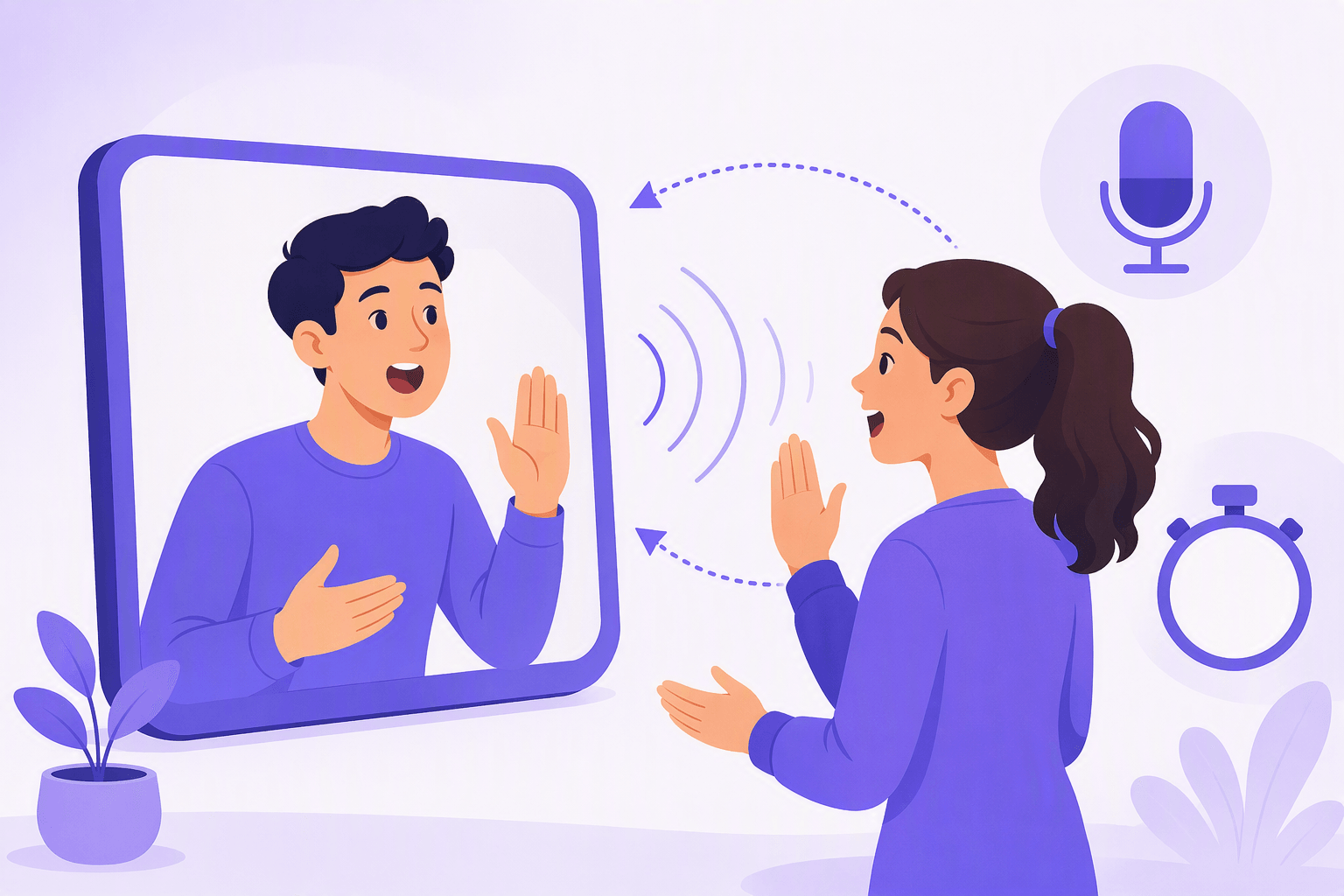
Shadowing is also confidence training
Movies give you socially complete lines: greetings, refusals, jokes, apologies. When you shadow them, you are practicing not only sounds, but social moves.
That matters because real conversation is fast. You need ready-made phrasing.
Step 7: Subtitles vs dubbing, and what to do with each
Many platforms offer both original audio and dubbed audio. Each has a different learning use.
Original audio is best for real listening
Original audio gives you the language as it is performed. You hear how people actually reduce, interrupt, and overlap.
If you are learning English, original audio also exposes you to register differences: casual talk vs workplace talk vs formal speech.
Dubs can be useful for beginners, but treat them carefully
Dubs are often clearer and more standardized. That can help at A1 to A2.
But dubbing can also create unnatural timing, because the translation must fit mouth movements. Use it as a stepping stone, not a destination.
🌍 A cultural detail learners notice late
In many countries, dubbing is normal and high-quality, and people grow up with it. In the US and UK, dubbing is less common for live-action, so many native English speakers find dubs distracting. That difference affects what your English-speaking friends assume you watched.
Step 8: Handling slang and swearing without learning the wrong lesson
Movies and TV are full of taboo language. Learners often copy it because it is memorable.
The problem is not the words, it is the social cost of using them wrong.
Learn recognition first, production later
It is useful to understand swearing, because you will hear it. It is rarely useful to use it early.
If you want a clear severity and context guide, see English swear words. Treat it like road signs: you should recognize them, not collect them.
Slang ages fast and is scene-specific
A line that sounds cool in a 2004 teen comedy can sound strange in 2026. Movies also exaggerate slang to signal character type.
Use slang you hear repeatedly across different shows, not one iconic quote.
Step 9: Measuring progress without guessing
Movie learning feels fuzzy unless you track something.
Three metrics that actually reflect improvement
- Clip comprehension: Can you understand the clip with no subtitles?
- Dictation accuracy: Can you write 70 to 90% of the words you hear?
- Shadowing match: Can you match timing and stress for key lines?
Track one clip per week as your benchmark. Revisit it after a month.
Use CEFR as a guide, not a scoreboard
CEFR descriptors are helpful for choosing material. They are not a daily measurement tool.
If you want a practical skill check, the British Council’s listening resources can help you compare your comprehension across levels (British Council, accessed 2026).
A practical 30-day plan (movie-based, realistic)
This plan assumes you are learning English, but the structure works for any language.
Week 1: Build the habit and your first clip library
- Pick one movie with clear dialogue.
- Extract 5 clips (one per day).
- Do the 3-pass method for each clip.
- Start a small review list of 20 to 30 phrases.
Week 2: Add shadowing and reduce subtitle dependence
- Revisit Week 1 clips with no subtitles.
- Shadow each clip 3 times.
- Add 5 new clips, but keep your review list small.
Week 3: Expand to longer segments
- Watch 15 to 25 minutes for enjoyment, then pick one clip from it.
- Practice that clip deeply.
- Start noticing repeated structures, not just words.
Week 4: Mix accents lightly and test yourself
- Add one new source with a different accent, but keep your main accent.
- Do one dictation test: write a clip with no subtitles, then check.
- Record yourself shadowing, compare, adjust.
💡 Where numbers practice fits naturally
Movies are full of dates, prices, times, and phone numbers. When you hear them, pause and repeat them out loud. If you need a structured refresher, use numbers in English alongside your movie routine.
Common mistakes (and quick fixes)
Mistake 1: Choosing material that is too hard
If you cannot follow the plot with target subtitles, it is too hard for learning. Save it for later enjoyment.
Fix: choose a simpler movie, or choose a calmer scene within the same movie.
Mistake 2: Saving too much vocabulary
If you save 30 items from one clip, you will review none of them.
Fix: cap it at 3 to 7 items per clip, and prefer phrases.
Mistake 3: Never repeating the same scene
Repetition feels boring, but it is where your ear changes.
Fix: repeat one clip across 5 days. Your brain needs time to rewire.
Mistake 4: Treating subtitles as a crutch forever
Subtitles are training wheels. Keep them, then remove them.
Fix: schedule "no subtitle" passes, even if they feel messy.
How Wordy fits into a movie-based method (without replacing it)
Movie learning works best when clips are easy to replay, subtitles are interactive, and vocabulary review is built in. That is why clip-based tools exist.
Wordy’s approach is to turn real movie and TV moments into short, level-appropriate practice, so you can do the 3-pass method without spending half your time searching and rewinding. If you prefer full-length viewing, you can still use the same routine with any streaming platform.
For more options, compare video-based tools in best language learning apps that work with Netflix.
Conclusion: the method in one sentence
Pick short scenes you can understand, use subtitles strategically, repeat until you can hear the words, then review the lines you mined until they become automatic.
If you want a ready-made starting point, begin with the best movies to learn English, choose one film, and build your first 5 clips this week.
Frequently Asked Questions
Can you really learn a language just by watching movies?
Should I use subtitles in my native language or the target language?
How many minutes per day should I study with movies?
What kind of movies are best for language learners?
How do I turn movie lines into vocabulary I actually remember?
Sources & References
- Webb, S. & Rodgers, M.P.H., Applied Linguistics article on lexical coverage of movies
- Krashen, S., *The Input Hypothesis: Issues and Implications*, Longman
- Ethnologue, 27th edition, 2024
- British Council, English language and learning resources, accessed 2026
- CEFR, Council of Europe, Common European Framework of Reference for Languages, accessed 2026
Start learning with Wordy
Watch real movie clips and build your vocabulary as you go. Free to download.


