Quick Answer
English swear words range from mild (damn, crap) to very strong. Understanding them matters because they show up in movies, TV, and everyday conversation. “Shit” and “fuck” are among the most common, but British and American English often prefer different terms.
Why is it important to know English swear words?
English inevitably includes profane words. English is the most widely used language today: nearly 1.5 billion people use it, and these words appear in movies, series, music, and social media. If you learn English, you will run into them sooner or later, whether you want to or not. This guide does not encourage you to use these words, it helps you understand them safely.
Psycholinguist Timothy Jay’s research suggests that an average native English speaking adult says about 80-90 profane words per day, which is about 0.5-0.7% of all words. An analysis of Lancaster University’s CANCODE corpus found that the words "shit", "fuck", "damn", "hell" and "crap" together make up about 80% of all recorded swearing. So these words are not random, they form a small, well-defined set.
English profanity draws largely from scatological (bodily functions) and sexual sources. In contrast, religious swearing (which is strong in Spanish or Hungarian) usually has a weaker impact in English. As linguist David Crystal puts it, English profanity mainly works as an emotional intensifier, not as a sign of real intent to insult. If you learn English and want to build your vocabulary, visit the Wordy English learning page.
⚠️ Usage warning
This guide is for education and understanding only. Using these words incorrectly or without context can seriously offend people. Golden rule: if you would not swear in that situation in English, do not do it in English either.
The severity scale
Severity Scale
Everyday expressions. May raise eyebrows in formal settings but generally acceptable among friends.
Clearly vulgar. Common in casual speech but inappropriate in professional or formal contexts.
Highly offensive. Can provoke strong reactions. Use with extreme caution or avoid entirely.
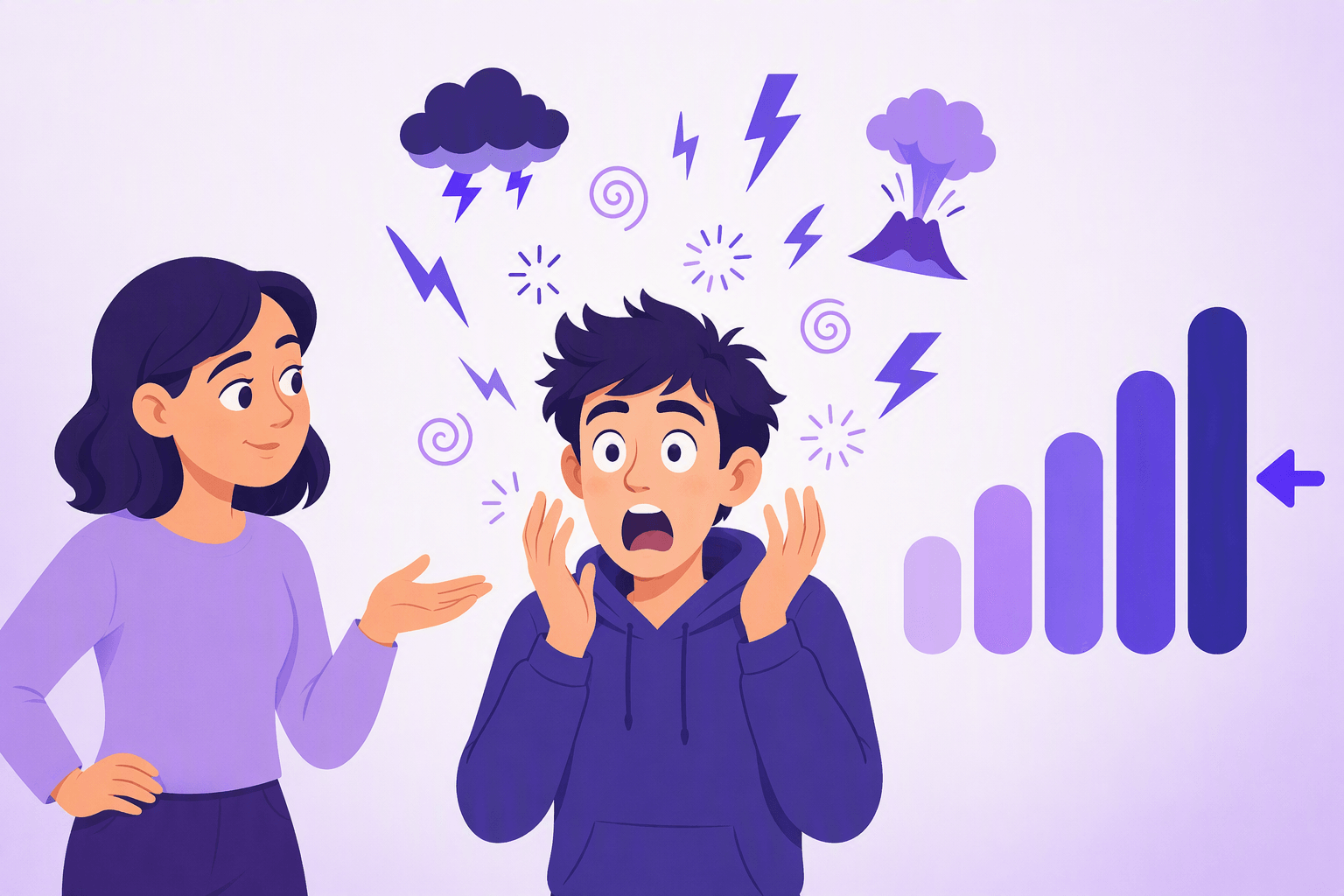
In English profanity, context overrides everything. "Oh, damn!" when you drop your keys is completely mild. The same word in front of others, said loudly, with a different intent, can be moderately offensive. The strength depends on who you say it to, where you say it, and your intonation.
Mild swear words
The words below are extremely common in everyday English. You will hear them in many places, including TV shows and informal workplace conversation. According to the Lancaster corpus, they make up more than half of all recorded profane words.
1. Damn
//dæm//
Damn: a general, mild exclamation for frustration, surprise, or admiration.
Very common in informal English speech. It rarely shocks people, even in mixed company. People use it for frustration ('Damn, I forgot!') and also for admiration ('Damn, that's impressive!'). It is one of the most versatile mild profane words.
“Damn, I left my phone at home again.”
Damn, I left my phone at home again.
Common in American, British, and Australian English. A British colloquial equivalent is 'bloody hell' or 'blast', but 'damn' is understood everywhere.
2. Hell
//hɛl//
Hell: as an exclamation, it expresses surprise, frustration, or rejection.
On its own ('Oh hell!') it signals frustration. In the question form 'what the hell', it expresses surprise or outrage: 'What the hell is going on?' It can also work as an intensifier: 'Hell yeah!' (a very strong yes). It is colloquial, but not harsh.
“What the hell happened to my sandwich?”
What the hell happened to my sandwich?
Universal across the English speaking world. The exception is many British speakers, who often prefer the compound 'bloody hell'.
3. Crap
//kræp//
Crap: a mild scatological word for poor quality or an unpleasant situation.
A milder, more acceptable version of 'shit'. You can say it about something that turned out badly ('This movie is crap'), your own mistake ('Oh crap, I'm late'), or low quality in general. American TV channels often use it instead of 'shit'.
“Oh crap, I totally forgot about the meeting.”
Oh crap, I totally forgot about the meeting.
Used in both the United States and the United Kingdom, but it often feels slightly milder in American English. It is also common in Australia.
4. Ass
//æs//
Ass: it can mean the body part, and it also appears as a building block in many insults.
As a standalone word, it ranges from the body part to the older meaning 'donkey', and it also functions as a component in compound insults: 'asshole', 'badass', 'kiss my ass'. The phrase 'kick ass' can also be positive, meaning something like 'awesome'.
“He's been working his ass off all week.”
He's been working his ass off all week.
Typically American English. In British English, the equivalent is 'arse' (/ɑːrs/), which Americans sometimes find archaic or humorous.
5. Bastard
//ˈbæstərd//
Bastard: originally referred to a child born outside marriage, now a general insult.
The meaning depends heavily on context. Among friends, it can sound teasing or even admiring ('You lucky bastard!'). Directed at an opponent, it is an insult. It tends to feel milder in British and Australian English than in American English.
“You lucky bastard, you got the last concert ticket!”
You lucky bastard, you got the last concert ticket!
Much milder and more everyday in British and Australian English. In Australian English it can be almost friendly: 'poor bastard' expresses sympathy.
6. Bloody
//ˈblʌdi//
Bloody: a British English intensifier, roughly comparable to American 'damn'.
A classic British exclamation and intensifier. You can put it before almost any adjective or noun: 'bloody hell', 'bloody brilliant', 'bloody idiot'. Americans mostly know it from British movies, but they rarely use it themselves.
“Oh, bloody hell, I missed the train again.”
Oh, bloody hell, I missed the train again.
Almost exclusively British and Australian English. In the US it can sound odd, and in movies and series it often signals the UK. It was considered vulgar until the 1800s, but today it is mild.
Moderately strong swear words
These words are truly vulgar, but they are extremely common in everyday informal English. Avoid them at work, around strangers, and in formal situations. According to McEnery (2006), moderate profanity can signal social bonding and trust in informal groups: if someone uses these words with you, it can also signal closeness and relaxed rapport.
7. Shit
//ʃɪt//
Shit: one of the most common and versatile profane words in English.
It can express surprise, frustration, or admiration. As a noun it can mean a bad situation ('I'm in deep shit'), as an adjective it can mean poor quality ('This is shit'), and as an exclamation it can express any strong emotion. Based on CANCODE data, it is one of the most frequently recorded profane words in informal British and American English.
“Shit, I just spilled coffee all over my laptop.”
Shit, I just spilled coffee all over my laptop.
Universal across English dialects. In Australia, 'shit' can appear in milder contexts, while in more formal British circles people avoid it more than many Americans do.
8. Bitch
//bɪtʃ//
Bitch: literally a female dog, and also a derogatory term for a person or someone who complains.
It is the technical term for a female dog (in dictionaries), but in everyday speech it is mainly used as an insult or expressive label. Among friends it can be a neutral address ('Hey, bitch!' meaning something like 'hey, buddy'). As a verb it means complaining ('Stop bitching!'). In hip-hop, artists of all genders use it regularly.
“She's been bitching about the same problem for weeks.”
She's been bitching about the same problem for weeks.
Common in American, British, and Australian English, but its weight and social acceptance depend strongly on context and on the people involved, including gender and age.
9. Bullshit
//ˈbʊlʃɪt//
Bullshit: nonsense, stupidity, a lie, something misleading or untrue.
Used both as a verb ('He's bullshitting you') and as a noun ('That's complete bullshit'). Informally, it says something is a lie, a con, or totally meaningless. You can say it without aggression if the deception is obvious.
“That's complete bullshit. He never said that.”
That's complete bullshit. He never said that.
Especially common in American English. It is understood in British English too, but British speakers often use 'rubbish' as a milder alternative with a similar meaning.
"Profanity is one of the most effective ways to handle negative emotions neurophysiologically. It is not a sign of cultural backwardness, it is an organic part of the emotional layer of language."
(Timothy Jay, Why We Curse, 2000)
10. Dammit
//ˈdæmɪt//
Dammit: a contracted form of 'damn it', used for frustration or annoyance.
Usually said as a standalone exclamation in frustrated moments: 'Dammit, not again!'. It is stronger than plain 'damn', but much milder than 'shit' or 'fuck'. It is very common in TV dramas and movies.
“Dammit, I knew I should have left earlier.”
Dammit, I knew I should have left earlier.
Common across English dialects. It can feel a bit stronger in American English than in British English, where 'blast' or 'damn' may be used instead.
11. Asshole
//ˈæshoʊl//
Asshole: refers to a contemptible, selfish, or unpleasant person.
A strongly negative label aimed at people. It is one of the most common personal insults in American English, pointing to selfishness, arrogance, or disrespectful behavior. More rarely, you can say it about yourself in mild frustration: 'I was such an asshole for forgetting.'
“Don't be such an asshole. Just let him merge into traffic.”
Don't be such an asshole. Just let him merge into traffic.
Most common in American and Canadian English. In British English, the equivalent form is 'arsehole' (/ˈɑːshəʊl/), with the same meaning but British pronunciation.
Strong swear words
The words below represent the strongest layer of English profanity. You need to understand them if you watch movies and series, but active use by non-native speakers is almost always best avoided.
⚠️ Serious warning
In strong contexts, the words below can cause serious offense. They appear here only for educational purposes, so you can understand what you hear in movies, music, and series.
12. Fuck
//fʌk//
Fuck: the strongest and most analyzed profane word in English, with an extremely wide range of uses.
According to Oxford linguist David Crystal, 'fuck' is the one English word that can appear in almost every part of speech: verb ('Fuck this'), noun ('What a fuck-up'), adjective ('fucking great'), adverb ('fucking hell'), interjection ('Fuck!'). It can express surprise, frustration, admiration, pain, and other strong emotions.
“Fuck, I can't believe I passed the exam.”
Fuck, I can't believe I passed the exam. (Positive surprise.)
Used across all English dialects, but its strength and acceptance vary. In Australian English it can appear in slightly milder contexts. In British slang, 'fucking brilliant' can also be positive.
13. Motherfucker
//ˈmʌðərfʌkər//
One of the strongest personal insults in English, but it also appears as an intensifier in hip-hop and film culture.
It has two faces. Used personally and aggressively at someone, it is among the most offensive expressions. At the same time, due to African American hip-hop and pop culture, it also appears as an intensifier, and even as praise: 'He's one bad motherfucker' (he is a real tough guy). Context, stress, and the relationship between speakers are decisive.
“Samuel L. Jackson hires meg this expression as a signature in film roles.”
Samuel L. Jackson uses this expression as a signature in film roles. It is fairly well known in English movie culture and hip-hop, but active use by non-native speakers is almost always easy to misread.
Rooted in American English and African American slang. It is understood in British English too, but milder equivalents are more common there. Never use it in formal situations or around strangers.
Regional differences
In English, dialect and culture together determine how strong a word feels. What seems mild to Australians can shock Americans.
| Category | American English | British English | Australian English |
|---|---|---|---|
| Mild exclamation | Damn, Hell | Bloody hell, Blast, Crikey | Bloody, Crikey, Strewth |
| Mild insult | Crap, Ass | Crap, Arse | Crap, Arse |
| Moderate | Shit, Asshole | Shit, Bollocks, Arsehole | Shit, Bugger |
| Strong | Fuck, Motherfucker | Fuck, Cunt (very strong) | Fuck, Cunt (less strong) |
| UK-specific | (not common) | Wanker, Tosser, Git | (partly common) |
The table shows the key difference: the word "cunt" is much milder in Australian English, and it can even be a friendly address in some contexts. In American English, it is one of the most offensive words. David Crystal (2019) notes that English learners must always know which dialect they are communicating in.
🌍 The impact of the streaming era
Netflix, HBO, and other global platforms have made English profanity more widespread than ever, even among non-English speaking audiences worldwide. A 2023 British study found that 71% of European young people aged 18-34 had heard English swear words from movies and series, but only 38% understood the exact severity and cultural context. This guide aims to fill that gap.
Euphemisms and softened versions
Native English speakers use euphemisms when they do not want to say a real profane word, for example around children, at work, or in formal situations. You can recognize these easily if you know the original words.
| Original word | Softened version | Sound similarity |
|---|---|---|
| Fuck | Fudge, Frick, Freaking | Starts with the letter F |
| Shit | Shoot, Sugar, Shoot | S or sh sound |
| Damn | Dang, Darn | D and n sounds |
| Hell | Heck | H and k sounds |
| Asshole | A-hole, Jerk | Abbreviation or substitution |
| Jesus Christ! | Jeez!, Geez! | Sound-based hint |
For example, if a parent says "Oh, shoot!" while dropping something, they almost certainly mean it instead of "shit". "What the heck?" is the kid-friendly version of "What the hell?" These words are not offensive on their own, but native speakers clearly sense the intent and the link to the original word.
💡 Tip for English learners
It is worth learning euphemisms too. They help you identify emotional intensity even when you do not hear the real profane word. If a character in a movie shouts "Sugar!", you know exactly what feeling they express.
Cultural context: when is it acceptable and when is it not?
English swearing is not uniform. Acceptability depends strongly on the place, the group, and the type of relationship.
More acceptable contexts:
- Among close friends, in informal situations
- On the sports field, in exciting or frustrating moments
- In the context of movies, series, and music (for understanding)
Contexts to avoid:
- Workplace meetings, business appointments
- Around older people and children
- Formal writing, introductions to strangers
- Any situation where you do not know the other person well
In McEnery’s (2006) summary, English profanity has four main functions: emotional expression, social bonding, insult, and humorous effect. For English learners, the first two are what they will hear most often in movies and series: words that express emotional frustration and words that build bonds among friends.
"The power of profanity does not lie in the words, but in the cultural agreement that surrounds them. The same word can carry different strength across times and places."
(David Crystal, The Cambridge Encyclopedia of the English Language, 2019)
Movies and series: learn in context
Movies and series are among the most effective ways to understand the real context and emotional charge of English swear words. In R-rated American movies (for example, works by Quentin Tarantino or Martin Scorsese), these words appear often, and you can see exactly what situation and emotion they pair with.
If you want to improve your English in real context, we recommend the Wordy app and our article on the best English movies and series. Hearing language in real context is the fastest path to natural understanding.
🌍 Profanity in English learning
Research suggests that native speakers remember profane words better, and store them more strongly tied to context than neutral words. Timothy Jay’s neurologically based theory says swear words activate a different part of the brain than ordinary words, which makes them especially memorable. This means these words stick in auditory memory sooner, and they help you understand the emotional layer of native vocabulary.
Frequently Asked Questions
What is the most common English swear word?
Are British and American English swear words the same?
Do movies help you understand English swear words?
Is it safe for English learners to use English swear words?
How can I tell how strong an English swear word is?
Sources & References
- McEnery, T. (2006). Swearing in English: Bad Language, Purity and Power from 1586 to the Present. Routledge.
- Crystal, David (2019). The Cambridge Encyclopedia of the English Language. Cambridge University Press, 3rd edition.
- Jay, Timothy (2000). Why We Curse: A Neuro-Psycho-Social Theory of Speech. John Benjamins.
- Merriam-Webster Dictionary (2026). merriam-webster.com.
- Lancaster University CANCODE Corpus, English conversation frequency data.
Start learning with Wordy
Watch real movie clips and build your vocabulary as you go. Free to download.


