Spaced Repetition for Language Learning: The Practical Guide That Actually Sticks
Quick Answer
Spaced repetition for language learning is a review method that shows you words and phrases again at increasing intervals, right before you would forget them. It works because memory strengthens through retrieval over time, not cramming. Use it best with short daily reviews, high-quality example sentences, and audio from real speech.
Spaced repetition for language learning is a way to remember vocabulary and phrases long-term by reviewing them right before you forget them, with the time between reviews gradually increasing. Done well, it replaces cramming with short daily recall, and it turns random exposure from reading and listening into words you can actually use.

Why spaced repetition works (in plain English)
Your brain forgets fast when you learn something once and never retrieve it again. Spaced repetition forces retrieval, then waits, then forces retrieval again, which strengthens memory more than rereading.
This idea goes back to Hermann Ebbinghaus and his work on forgetting curves. Modern research on distributed practice and spaced learning, including large syntheses by researchers like Nicholas Cepeda, consistently finds that spacing reviews beats massed practice for long-term retention.
Retrieval beats recognition
A common mistake is reviewing by looking at a list and thinking, "Yeah, I know that." That is recognition.
Spaced repetition works when you have to produce the answer from memory, even if it is slow at first.
Time is part of the memory
If you review a word five times in one day, you get good at remembering it for that day. If you review it across a week and then a month, you get good at remembering it when you need it.
That is why the schedule matters more than the total number of repetitions.
What spaced repetition is (and what it is not)
Spaced repetition is a scheduling method, not a complete learning plan. It is best at keeping known items available, not at teaching brand-new concepts from zero.
It also is not the same as "flashcards." You can do spaced repetition with flashcards, but you can also do it with short audio clips, sentence prompts, or cloze deletions.
💡 The one-sentence definition
Spaced repetition is reviewing with increasing intervals, guided by your performance, so you spend time on what you are about to forget and less time on what is already stable.
The language-learning payoff: what it helps you do faster
Spaced repetition is not about memorizing a dictionary. It is about keeping high-frequency language ready so real input becomes easier.
When your core vocabulary is available, you understand more of what you hear, which makes listening practice more enjoyable, which increases total exposure. That feedback loop is the real win.
It is especially useful for English learners
English is the most widely learned second language in the world, and it is used as an official or de facto working language across many international contexts. Ethnologue estimates roughly 1.5 billion total English speakers worldwide (Ethnologue, 27th edition, 2024).
That scale matters because English learners are constantly exposed to English in media, work, and online spaces. Spaced repetition helps convert that constant exposure into stable, usable language.
If you are building practical English, pair this guide with 100 Most Common English Words so your reviews focus on what you will meet every day.
The core mechanics: intervals, difficulty, and forgetting
Most spaced repetition systems do three things:
- Show you a prompt.
- Ask you to recall.
- Schedule the next review based on how hard it felt.
If you get it right easily, the interval grows. If you fail, the interval shrinks.
A simple interval model you can actually follow
You do not need perfect math to benefit. A beginner-friendly schedule looks like this:
- Same day: quick recheck after 10 to 30 minutes
- Day 1
- Day 3
- Day 7
- Day 14
- Day 30
- Day 60+
Apps automate this, but the logic is the same: early reviews are close together, later reviews spread out.
Why "hard" cards are expensive
A card that feels hard every time will keep coming back. That is not discipline, it is bad design.
Your goal is to rewrite hard cards until they become easy, or delete them if they are low-value.
What to put into your spaced repetition deck (high ROI only)
The fastest way to burn out is to add everything. The fastest way to improve is to add only what you will actually meet again.

Choose items that satisfy two tests
Test 1: You have seen or heard it at least twice in real input.
Test 2: You can imagine yourself using it in a sentence this month.
For English learners, that often means everyday verbs, connectors, and common phrases, not rare synonyms.
If you want modern, real-life vocabulary, add a small number of items from English slang, but only if you also add a full example sentence and a usage note.
Avoid "museum vocabulary"
Words you only meet in word lists do not get reinforced by life. Spaced repetition can keep them alive, but you will pay for it in review time.
Instead, build around what you watch and read. If you are learning through shows, use movies and TV picks for English learners and mine your deck from lines you genuinely enjoy repeating.
Card design rules that prevent review overload
Good spaced repetition is mostly card writing. This is where many learners fail, especially when importing huge premade decks.
Rule 1: One card, one idea
If a card tests two things, you will miss it for two different reasons. Then the scheduler cannot help you.
Bad: "Explain the difference between 'say' and 'tell' and give two examples."
Better: "I told him the truth. Why is it 'told' and not 'said' here?"
Rule 2: Prefer prompts that force production
Recognition cards are okay for spelling or quick checks. But production is what makes conversation easier.
Examples of production prompts:
- Translate a short sentence into English.
- Fill a blank in a sentence.
- Hear audio, then type what you heard.
Rule 3: Add context, not trivia
A single word without context is fragile. A word inside a sentence has grammar, collocation, and tone attached.
This aligns with how usage-based linguistics treats learning: language is acquired through repeated exposure to constructions, not isolated entries. Researchers like Joan Bybee have argued that frequency and repeated patterns shape what becomes fluent.
Rule 4: Keep answers short
If the back of the card is a paragraph, you will stop reviewing. Keep it tight.
If you need an explanation, put it in a short note, not in the answer you must reproduce.
A practical deck structure for language learners
You can keep this simple with three card types:
- Sentence cloze: one missing word or phrase.
- Audio first: listen, then recall meaning or transcript.
- Minimal pair or confusion fix: one card for one common mistake.
Sentence cloze example
Front: "I can't ___ it." (meaning: tolerate)
Back: "I can't stand it."
This teaches the phrase as a chunk, not a dictionary entry.
Audio-first example
Front: audio clip of "Are you kidding me?"
Back: "Are you kidding me?" plus meaning: disbelief, annoyance, or playful shock.
Audio-first cards are especially powerful if your goal is real listening. They also reduce the habit of translating everything.
How to use spaced repetition with movies and TV clips
Spaced repetition is strongest when you feed it from authentic input. Movies and TV are ideal because they repeat everyday situations, and you get emotion, timing, and intonation.
This is also where cultural nuance shows up. English complaints, sarcasm, and teasing often rely on intonation more than vocabulary.
A three-step workflow that stays realistic
- Watch a scene with subtitles.
- Pick 1 to 3 lines you would actually say.
- Turn each line into one card, ideally with audio.
If you do this while watching content you like, your deck becomes a personal "best of" of real language.
🌍 Why quotes stick
A line tied to a character and a moment is easier to recall than a word list. That is not magic, it is memory: emotion and narrative create extra retrieval cues, which makes spaced repetition more efficient.
Keep slang and swearing in a separate deck
If you are learning informal English, you will run into strong language. It is useful for comprehension, but risky for production.
Create a separate "understand only" deck for taboo language, and treat it as listening practice. If you want a reference for meaning and severity, use English swear words, but do not make your main speaking deck sound like a comment section.
How many new cards per day?
Most people fail because they add too many new cards. The scheduler is honest: if you add 50 new cards daily, future-you will pay.
A stable range for many learners is:
- Beginners: 5 to 10 new cards/day
- Intermediate: 10 to 20 new cards/day if card quality is high
- Advanced: fewer new cards, more sentence and audio refinement
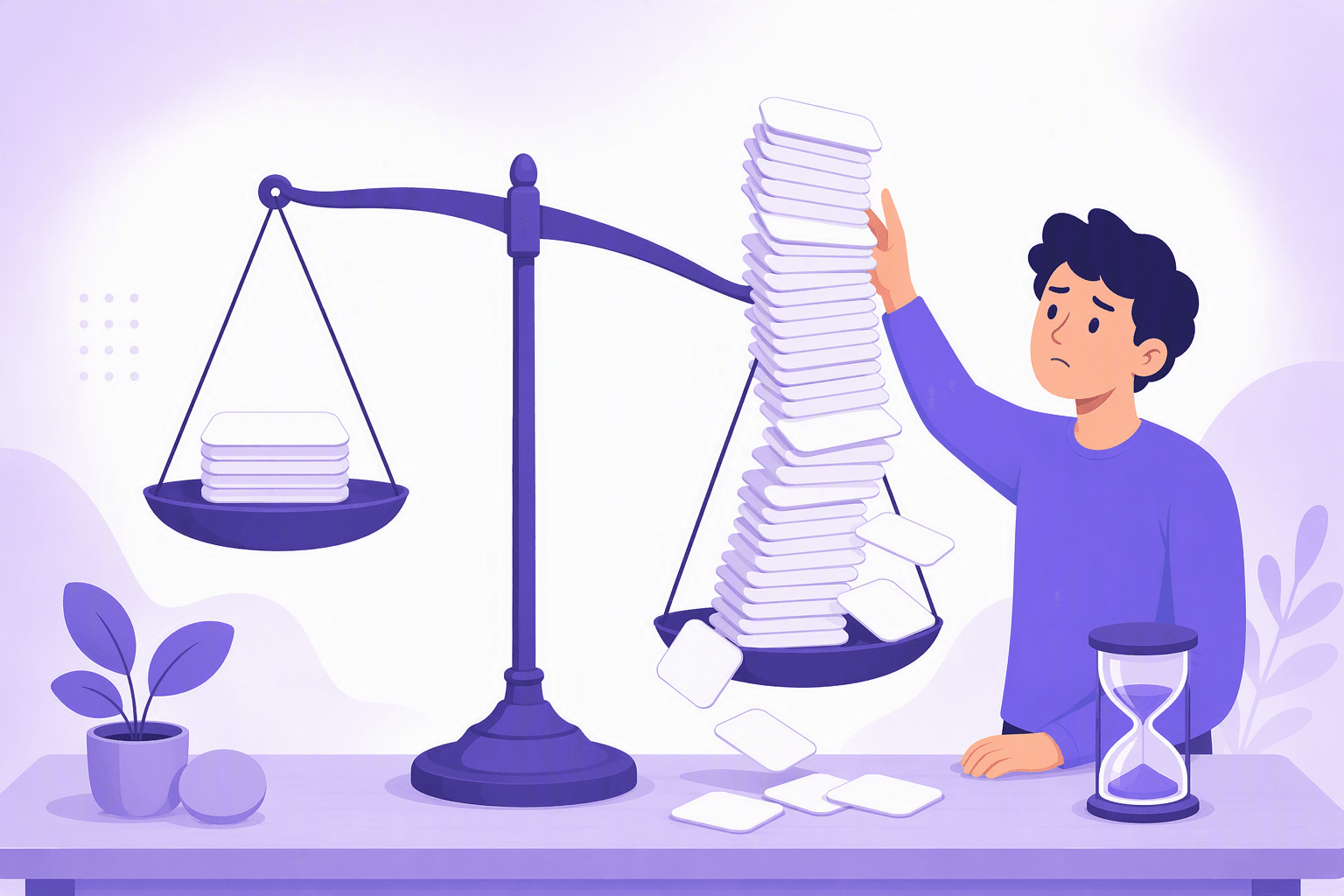
The math of backlog (why it sneaks up)
Even if each card takes only 8 seconds, 300 reviews is 40 minutes. And reviews are rarely that fast when cards are hard.
If you want spaced repetition to be a habit, design it to fit into a real day.
The best time of day to review (and why it matters)
There is no universal best time, but there is a universal best trigger: a time you can repeat daily.
Many learners succeed with "coffee reviews" or "commute reviews" because the context is stable.
Micro-sessions beat weekend marathons
A 12-minute daily review is better than a 90-minute weekend catch-up. Spacing is part of the effect, and consistency keeps the intervals meaningful.
Common mistakes (and how to fix them fast)
Mistake 1: Translating everything
If every card is "native language to English," you train translation, not English.
Fix: switch half your cards to English-only prompts, cloze deletions, or audio-first.
Mistake 2: Keeping bad cards out of guilt
A deck is not a museum. If a card is low-value, delete it.
Fix: once a week, suspend or rewrite the top 20 hardest cards.
Mistake 3: Studying rare numbers, dates, and trivia too early
Numbers matter, but you do not need every pattern at once.
Fix: learn the basics with English numbers, then add only the number patterns you personally use, like prices, dates, and phone numbers.
Mistake 4: Importing huge premade decks
Premade decks can help, but they often include unnatural sentences, missing audio, or vocabulary you will never see.
Fix: if you import, prune aggressively. Keep only items you recognize from your own input.
A 15-minute spaced repetition routine (beginner to intermediate)
This routine is designed to be boring in a good way. It is predictable, and it scales.

Minute 1 to 10: Reviews only
Do not add new cards first. Clear reviews while your attention is fresh.
If you are tired, do fewer reviews rather than rushing and pressing "easy" on everything.
Minute 10 to 15: Add 3 to 7 new cards
Add from something you watched or read that day. Keep each card small.
If you did not consume input, do not add new cards. Spaced repetition is not a substitute for input.
⚠️ Do not let new cards drive the schedule
If your review count is rising week to week, your system is telling you to slow down. Reduce new cards until reviews feel stable again.
Spaced repetition and motivation: the cultural trap
Spaced repetition feels productive because it is measurable. That can become a trap.
In many online learning communities, streaks and deck size become status. But language is social, and your goal is understanding and speaking, not maintaining a perfect queue.
Claire Kramsch, in her work on language and culture, emphasizes that meaning is tied to context and identity. If your deck is disconnected from real contexts you care about, motivation drops even if your stats look good.
Use spaced repetition to support identity, not replace it
If you want to sound natural at work, build work cards. If you want to understand comedy, build humor cards.
A deck that matches your life is easier to maintain than a deck that matches someone else's curriculum.
Tools: what matters more than the app
People argue about apps, but the method is bigger than the tool.
What you need is:
- Active recall (you must attempt an answer)
- Spaced scheduling (intervals change based on performance)
- Easy editing (so you can fix bad cards quickly)
- Audio support (if listening matters to you)
If you want a deeper walkthrough of one popular tool, see our Anki guide for language learning.
How to know if spaced repetition is working
Look for these signs after 3 to 6 weeks:
- You recognize words faster in listening.
- You start predicting phrases in subtitles.
- You reuse chunks you reviewed, without thinking.
- Reviews feel steady, not exploding.
If you only see higher review counts and no improvement in comprehension, your cards are probably too isolated or too translation-heavy.
Putting it all together: the balanced plan
Spaced repetition is best as the glue between exposure and memory. A balanced week looks like:
- Daily: 10 to 20 minutes spaced repetition
- Most days: 20 to 60 minutes of input (shows, podcasts, reading)
- Weekly: one speaking session (tutor, exchange, or self-recording)
If you want more ideas for building an input habit, browse the Wordy blog and pick one media-based plan that you can repeat.
A final rule that saves most learners
If you miss a day, do not "make up" by doubling new cards. Just return to reviews.
Spaced repetition rewards consistency, and it forgives imperfection as long as you come back.
If you want a simple way to turn real dialogue into reviewable material, Wordy is built around short movie and TV clips with repeatable lines and vocabulary tracking. Keep it small, keep it daily, and let the spacing do the work.
Frequently Asked Questions
How long should I do spaced repetition each day?
Is Anki the best spaced repetition app for language learning?
Should I learn single words or full sentences with spaced repetition?
Why do my reviews explode and become overwhelming?
Can spaced repetition help with listening and pronunciation?
Sources & References
- Ebbinghaus, H., Memory: A Contribution to Experimental Psychology
- Cepeda, N. J., et al., Distributed Practice in Verbal Recall Tasks: A Review and Quantitative Synthesis, Psychological Bulletin
- Kang, S. H. K., Spaced Repetition Promotes Efficient and Effective Learning, Policy Insights from the Behavioral and Brain Sciences
- Ethnologue, 27th edition, 2024
- Duolingo, Duolingo Effectiveness Research Summary, accessed 2026
Start learning with Wordy
Watch real movie clips and build your vocabulary as you go. Free to download.


