Quick Answer
The most popular modern English slang words: "lit" (awesome/cool), "GOAT" (greatest of all time), "no cap" (seriously/not lying), "slay" (do something amazingly), "vibe" (mood/atmosphere). Much of today’s slang comes from African American Vernacular English (AAVE) and internet culture.
Short answer
If you do not understand modern English slang, you only scratch the surface as an English learner today. Words like lit, slay, or no cap feel as natural in everyday speech for native English speakers as greetings. They are not just “street” expressions, they are part of real English-speaking culture.
According to the Oxford English Dictionary, it adds more than 1,000 new words each year, and slang changes the fastest. Based on Ethnologue’s 2024 data, nearly 1.5 billion people worldwide learn English, and none of them can fully follow post-2000 Netflix shows, TikTok videos, and Instagram posts without today’s slang.
With the Wordy app, you can learn these expressions in real context through subtitles from movies and series, not from boring word lists.
What makes English slang special?
English slang is the fastest-spreading informal vocabulary in the world. It draws from two main sources.
African American Vernacular English (AAVE) is the most productive source of slang. Sociolinguist Cecelia Cutler says most mainstream English slang came from African American communities, then spread globally through hip hop culture and later the internet. “Slay”, “vibe”, “lit”, “flex”, “no cap”, and “GOAT” all come from this source.
Internet culture, especially TikTok, Twitter/X, and Reddit, spreads slang at a speed that David Crystal, author of the Cambridge Encyclopedia, says has no earlier parallel in language history. A word can go global in weeks.
“The internet does not just speed up the spread of slang, it also creates completely new word-formation mechanisms that no earlier communication tool made possible.”
(David Crystal, Language and the Internet, Cambridge University Press)
English slang also varies by region. In this guide, we focus on modern slang most used by Americans, and we note British and other differences where relevant.
Quick overview: English slang at a glance
| English | English | Pronunciation | Formality |
|---|---|---|---|
| Cool / Awesome | Cool | /kuːl/ | casual |
| Brilliant / Awesome / Fire | Lit | /lɪt/ | slang |
| Seriously / I'm not lying | No cap | /noʊ kæp/ | slang |
| The greatest of all time | GOAT | /ɡoʊt/ | casual |
| Mood / Atmosphere | Vibe | /vaɪb/ | casual |
| To impress / To crush it | Slay | /sleɪ/ | slang |
| Fantastic / Awesome | Fire | /faɪər/ | slang |
| Awesome (in a good way) | Sick | /sɪk/ | slang |
| Lie / Liar | Cap | /kæp/ | slang |
| Sure / Okay | Bet | /bɛt/ | slang |
| Kind of / Secretly | Lowkey | /ˈloʊkiː/ | slang |
| Ruthless / Unfiltered | Savage | /ˈsævɪdʒ/ | slang |
| Over the top / Dramatic | Extra | /ˈɛkstrə/ | slang |
| Mad / Bitter | Salty | /ˈsɔːlti/ | slang |
| Influence / Fame | Clout | /klaʊt/ | slang |
Positive reactions and excitement
These words show that something or someone is great, impressive, or cool. In modern English, this is one of the most common slang layers.
Cool
//kuːl//
Literal meaning: Cool / Cold
“That jacket is so cool. Where did you get it?”
That jacket is so cool. Where did you get it?
A timeless piece of English slang that comes from the jazz era. Merriam-Webster notes that 'cool' in a positive sense has been recorded since the 1940s, and hip hop culture helped make it global from the 1990s. Everyone understands it across ages and across English-speaking countries.
Cool is the one slang word that never went out of style. Slang researcher Jonathon Green documents in Green's Dictionary of Slang that the positive meaning of “cool” stayed almost unchanged for 80 years. That is rare in slang history.
Lit
//lɪt//
Literal meaning: Lit / Illuminated
“That party last night was absolutely lit. We stayed until 3 AM.”
That party last night was absolutely lit. We stayed until 3 AM.
A word with AAVE roots that began building its positive meaning in 1990s hip hop. It originally meant drunk, then shifted to 'awesome', 'brilliant', 'fire'. From the mid-2010s, it became fully mainstream slang in English.
The literal meaning of lit is “set on fire.” That leads to the figurative meaning: if something is lit, it is so cool it almost glows. The Oxford English Dictionary added this positive informal meaning in 2017, which signaled that the word moved beyond subculture.
Fire
//faɪər//
Literal meaning: Fire
“Have you heard her new album? It's straight fire from track one.”
Have you heard her new album? It's straight fire from track one.
It comes from hip hop culture, where 'fire' has described outstanding quality since the 1990s. 'Straight fire' is an intensified form. Today people use it for music, outfits, food, photos, and more.
Fire and lit are close siblings in slang, and you can often swap them. The difference is subtle: fire stresses quality, while lit stresses vibe. This beat is fire or This party is lit are typical uses.
Sick
//sɪk//
Literal meaning: Sick
“Dude, did you see that trick? That was sick!”
Dude, did you see that trick? That was sick!
A classic example of opposite-meaning slang: it literally means 'ill', but in slang it means 'awesome' or 'cool'. It spread from skate and surf culture from the 1980s. It is especially common in the US and Australia, while Brits often say 'wicked' for the same idea.
Sick is a great example of slang reversal: something is so good it feels “sick.” Similar logic appears in other slang. Wicked (British), gnarly (extreme sports), and nasty (AAVE) all turned negative words into positive slang.
Slay
//sleɪ//
Literal meaning: To kill / To slaughter
“She walked into that meeting and absolutely slayed. They gave her the promotion on the spot.”
She walked into that meeting and absolutely slayed. They gave her the promotion on the spot.
It comes from AAVE and LGBTQ+ ballroom culture (Harlem, 1980s). Beyoncé's use of 'slay' and the show Drag Race helped make it global from the 2010s. Today people also use it as praise: 'Slay!' (Go for it.)
Slay is one of the words that moved from ballroom culture, drag communities, and hip hop into TikTok mainstream. Beyoncé’s 2011 song Who Run the World (Girls) and the series RuPaul's Drag Race strongly boosted its spread.
GOAT
//ɡoʊt//
Literal meaning: Goat (acronym: Greatest Of All Time)
“Michael Jordan is the GOAT. Nobody can argue with that.”
Michael Jordan is the GOAT. Nobody can argue with that.
Short for 'Greatest Of All Time'. Muhammad Ali's wife, Lonnie Ali, trademarked it in 1992, and rapper LL Cool J also used it. It spread most in sports, but today people use it for musicians, movies, food, and more.
The interesting thing about GOAT is that the acronym (G.O.A.T.) came before the word as a spoken term. It started in 1990s sports reporting. Now it marks the highest praise in any field.
Truth and authenticity slang
These words signal that someone speaks honestly and seriously, or the opposite.
No cap
//noʊ kæp//
Literal meaning: No cap (literally)
“That movie made me cry three times, no cap. It hit different.”
That movie made me cry three times, no cap. It hit different.
An expression with AAVE roots. 'Cap' in African American slang has meant 'a lie' since at least the 1990s. So 'no cap' means 'I'm not lying', and 'cap' alone means 'you're lying'. It went mainstream online in the late 2010s.
The cap / no cap pair is one of the cleanest slang mechanisms. One word can assert (no cap) and one word can deny (that's cap). The origin is debated, but Green's Dictionary of Slang notes that “cap” carried a “lie” meaning in African American slang as far back as the 1940s.
Cap
//kæp//
Literal meaning: Cap (literally)
“He said he'd be there at 8. That's cap, he's always late.”
He said he'd be there at 8. That's cap, he's always late.
The counterpart to 'no cap'. If you reject someone's claim, you can say 'cap!' (you're lying). People also use it on its own: 'He's capping' (he's lying). A related slang gesture is a finger on the lips shaped like a 'B', linked to 'bussin'.
Bet
//bɛt//
Literal meaning: Bet
“Can you pick me up at 7? / Bet, I'll be there.”
Can you pick me up at 7? / Bet, I'll be there.
A word with AAVE roots that can show agreement, confirmation, or even a challenge, depending on tone. A 'bet' is a wager, and the message is 'I'll bet on it'. Today it often replaces a simple 'okay', especially in texts.
Bet is a typical AAVE word that hip hop and social media pushed into global English. Its punchy brevity made it popular. Where you once needed a three-word reply, one bet now works.
Lowkey
//ˈloʊkiː//
Literal meaning: Low key (music)
“I lowkey love that song, even though it's embarrassing to admit.”
I lowkey love that song, even though it's embarrassing to admit.
It means someone does not really advertise the feeling, they feel it quietly or secretly. 'Highkey' is the opposite: openly and strongly. The contrast is one of the most nuanced slang pairs in modern English.
The lowkey / highkey pair is one of the most refined tools in today’s English slang. Lowkey adds nuance to emotion. It does not deny it, but it signals restraint. I lowkey want to go means you kind of want to go, but you would not say it loudly.
Social slang
These words describe how people act with each other, who is cool, who is dramatic, who feels offended.
Savage
//ˈsævɪdʒ//
Literal meaning: Savage / Cruel
“She told him exactly what she thought without sugarcoating it. Total savage.”
She told him exactly what she thought without sugarcoating it. Total savage.
It has a double meaning. It can mean someone is brutally honest and ignores social filters, but it can also praise a ruthlessly cool style. In hip hop it works as a positive, strong adjective. Rihanna's 'Savage' clothing helped make it iconic.
Savage now appears in both positive and negative contexts. If someone went savage in an argument, it means they argued ruthlessly but skillfully. If people say it about an outfit, it is praise.
Extra
//ˈɛkstrə//
Literal meaning: Extra / Unnecessary / Too much
“She showed up to a casual dinner in a ballgown. She's so extra.”
She showed up to a casual dinner in a ballgown. She's so extra.
People say it about someone who acts in a dramatic, attention-seeking way: too much effort, too loud, too much need for attention. It can be playful teasing or real criticism, depending on tone. It comes from AAVE and drag culture vocabulary.
Salty
//ˈsɔːlti//
Literal meaning: Salty
“Why are you so salty about losing one game? It's not a big deal.”
Why are you so salty about losing one game? It's not a big deal.
It comes from nautical slang. Sailors used 'salty' for grumpy, bitter crewmates. Today it means someone feels offended or angry and shows it clearly. 'Don't be salty' is a common phrase.
Salty moved from nautical slang into hip hop, then onto the internet. The link between salty taste and bitter emotion fits so well that the word feels intuitive. Jonathon Green’s research notes that sailor-slang words can be surprisingly durable.
Clout
//klaʊt//
Literal meaning: Blow / Power (old English)
“She only posts those videos for clout, not because she actually cares.”
She only posts those videos for clout, not because she actually cares.
It comes from an old English word meaning a blow or power. In the social media era it means online fame, follower count, influence. A 'clout chaser' uses others to grow their own influence.
Flex
//flɛks//
Literal meaning: To bend / To flex a muscle
“Driving your Ferrari to a grocery store is such a flex.”
Driving your Ferrari to a grocery store is such a flex.
It moved from bodybuilding (flexing muscles) into hip hop, where it means showing off or bragging. 'To flex' as a verb means someone intentionally shows what they have (money, status, talent). It can be ironic or serious.
Internet and social media slang
These expressions live mostly online, on TikTok, Twitter, and in chats. If you watch content in English online, you see them daily.
W and L
//ˈdʌbəljuː/ / /ɛl//
Literal meaning: Win / Loss
“She aced the exam without studying. Massive W. / He forgot his phone at home on the first day of work. Huge L.”
She aced the exam without studying. Massive W. / He forgot his phone at home on the first day of work. Huge L.
It spread from gaming culture and sports commentary. Today people use it on social media for any positive or negative event. 'Take the L' means accept the loss.
FOMO
//ˈfoʊmoʊ//
Literal meaning: Fear Of Missing Out
“I have serious FOMO every time I see their vacation photos.”
I have serious FOMO every time I see their vacation photos.
A term coined in 2004 by Patrick McGinnis, a Harvard MBA student, then made global by the internet. The Oxford English Dictionary now includes it. It is one of the most discussed psychological side effects of social media.
FOMO now appears in psychology writing too. Merriam-Webster added it in 2013. It did not come from street slang. It came from a business essay, yet it still lives globally as slang.
TBH
//tiː biː eɪtʃ//
Literal meaning: To Be Honest
“TBH, I didn't enjoy that party as much as I pretended to.”
TBH, I didn't enjoy that party as much as I pretended to.
It spread in texts and social media in the late 2000s. People now say it out loud too: 'tee bee aitch'. It often introduces a slightly surprising or unexpected honesty. A softer option is 'lowkey', and a stronger one is 'I'm not gonna lie' (INGL).
British vs. American slang: the main differences
English slang is not uniform at all. What feels natural in London can sound odd in New York, and vice versa.
| Meaning | American slang | British slang |
|---|---|---|
| Fantastic / Brilliant | Lit, Fire, Sick | Wicked, Proper, Mint |
| Very / Really | Hella, Super, Lowkey | Proper, Dead, Well |
| Cool person | Baddie, G | Legend, Sound |
| Down / Sad | Salty, Pressed | Gutted, Wound up |
| Addressing a friend | Dude, Bro, Homie | Mate, Bruv, Geeza |
| To have a great time | Have a blast, Turn up | Have a proper laugh, Go mental |
| Party | Kickback, Function | Sesh, Do, Rave |
British slang is its own world. Wicked means brilliant. Gutted means totally crushed. Mate is the classic British way to address a friend, and you hear it everywhere.
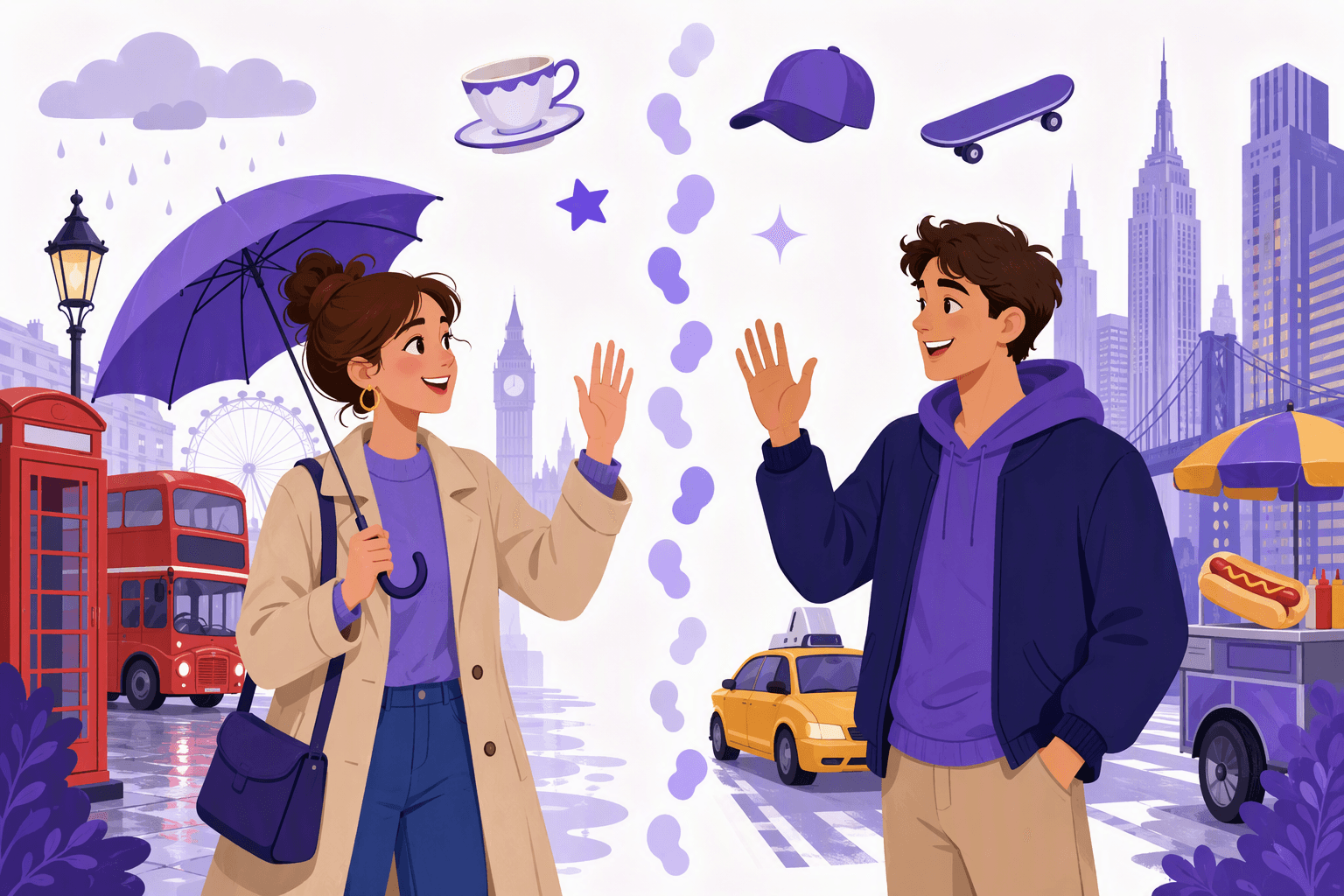
🌍 Australian slang is its own category
Australian slang is so unique that even Brits from England can get lost in it. A few key words: “arvo” (afternoon), “servo” (petrol station), “brekkie” (breakfast), “no worries” (no problem), “she'll be right” (everything will be fine). Australians shorten almost every word and add “-o” or “-ie” endings.
AAVE and learning slang
🌍 Why does it matter where slang comes from?
Most modern English slang comes from African American Vernacular English (AAVE). This is not just an academic point. It means that when you learn slang, you step into a living cultural tradition. “Slay”, “vibe”, “lit”, “no cap”, “bet”, “flex”, and “GOAT” all come from African American communities. Sociolinguist Cecelia Cutler says AAVE is one of the most creative and dynamic sources in English vocabulary, and mainstream media undervalued it for a long time. Respect should come with knowledge of slang.
When you should NOT use slang
⚠️ Avoid slang in formal situations
English slang feels natural with friends, on social media, and in informal messages. Avoid it in these situations because it can sound unprofessional or even disrespectful:
- Job interviews and business meetings
- Emails to strangers or to your managers
- Academic essays and presentations
- Communication with older people
- Medical or legal situations
One small exception: tech startups and creative industries often have a more relaxed culture, and some slang (like “cool”, “bet”) can be acceptable. If you feel unsure, always choose standard English.
Movies and series: the best way to learn slang
Learning English slang from books is like learning to swim while sitting by the pool. Real learning comes from authentic material: movies, series, YouTube videos, and TikTok.
A few recommended series for modern slang: Euphoria (HBO) has lots of youth slang, The Fresh Prince of Bel-Air shows classic AAVE slang, Brooklyn Nine-Nine has everyday informal English, and Fleabag is full of British slang.
With the Wordy app, you can watch any English-language series and movie with interactive subtitles. Tap any slang expression and you instantly see its meaning, pronunciation, and cultural context. This is the most natural way to make slang stick in your vocabulary, not just stay on paper.
In our list of the best movies to learn English, you will find specific recommendations and tips on how to learn English through movies.
Frequently Asked Questions
What is the most popular English slang word in 2026?
Where does modern English slang come from?
Is English slang the same in the US and the UK?
How can I learn English slang naturally?
Can I use English slang in professional situations?
Sources & References
- Cutler, Cecelia (1999). Yorkville Crossing: White Teens, Hip Hop, and African American English. Journal of Sociolinguistics.
- Crystal, David (2006). Language and the Internet. Cambridge University Press, 2nd edition.
- Green, Jonathon (2010). Green's Dictionary of Slang. Chambers.
- Merriam-Webster Dictionary (2026). merriam-webster.com.
- Oxford English Dictionary, New Words (quarterly updates, oed.com).
Start learning with Wordy
Watch real movie clips and build your vocabulary as you go. Free to download.


