Quick Answer
English numbers from 1 to 12 are all different, so you need to memorize them. From 13 to 19, the “-teen” ending helps (thirteen, fourteen...). From 20, compound numbers are logical: twenty-one, twenty-two... For ordinals, 1st, 2nd, and 3rd are special (first, second, third), then you add “-th”.
English is the most widely learned second language in the world. According to Ethnologue’s 2024 data, nearly 1.5 billion people speak it as a first or second language. Numbers are one of the first things every learner needs, prices, time, phone numbers, dates, they show up everywhere.
The good news is that the English number system is much simpler than, for example, French, where 80 = “four twenties.” There is no grammatical gender, no conjugation, and no agreement. The only challenge is memorizing the basic numbers from 1 to 12, a few pronunciation traps, and irregular ordinal forms.
"English number words are among the most morphologically transparent in the Germanic family, once the base forms are learned, the compounding rules apply with remarkable consistency."
(David Crystal, The Cambridge Encyclopedia of the English Language, 3rd edition, 2019)
This guide walks you through every number from 1 to 100, introduces ordinal numbers, covers large numbers, and shows you how to use them in everyday life.
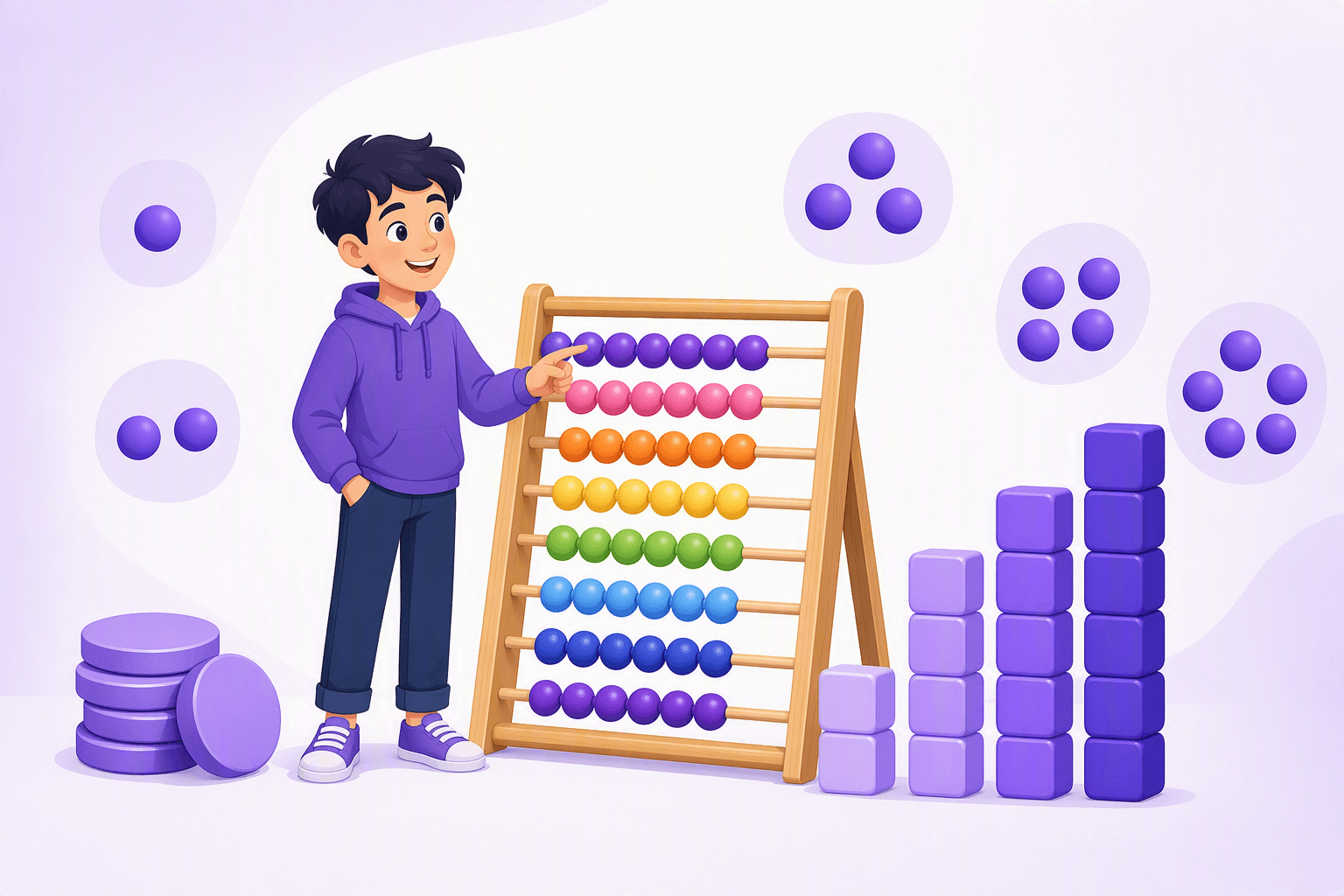
Numbers 1-10: The basics
The first ten numbers have completely unique forms. You just have to learn them, there is no rule behind them. The good news is that these are the most common numbers, so they stick quickly in daily use.
| English | Pronunciation | Note |
|---|---|---|
| one | wʌn | Irregular pronunciation: /wʌn/, not 'ohn' |
| two | tuː | Silent 'w', pronounce it: 'tuː' |
| three | θriː | The 'th' is pronounced with your tongue between your teeth |
| four | fɔːr | Pronounce it like 'for' (the preposition) |
| five | faɪv | Pronounce it: 'fahyv', not 'fiv' |
| six | sɪks | Short 'i' sound: 'siks' |
| seven | ˈsevən | Stress on the first syllable |
| eight | eɪt | Silent 'gh', pronounce it: 'ayt' |
| nine | naɪn | Pronounce it: 'nayn' |
| ten | ten | Short 'e' sound |
💡 The three hardest pronunciations
For many learners, the biggest challenge is three (/θriː/), because many languages do not have the “th” sound. Place your tongue lightly between your upper and lower teeth, then breathe out. Practice gradually: “th-th-three.” The other two traps are two (pronounce it “tuː”, the 'w' is silent) and eight (pronounce it “ayt”, the 'gh' is silent).
Numbers 11-20: The teens
11 and 12 have unique forms and are completely irregular. Numbers from 13 to 19 use the “-teen” ending, but there are a few important exceptions worth remembering.
| English | Pronunciation | Note |
|---|---|---|
| eleven | ɪˈlevən | Completely unique form |
| twelve | twelv | Completely unique form |
| thirteen | θɜːrˈtiːn | Not 'threeteen', irregular |
| fourteen | fɔːrˈtiːn | Regular: four + teen |
| fifteen | fɪfˈtiːn | Not 'fiveteen', it becomes fif- |
| sixteen | sɪksˈtiːn | Regular: six + teen |
| seventeen | ˌsevənˈtiːn | Regular: seven + teen |
| eighteen | eɪˈtiːn | Not 'eightteen', spelled with one t |
| nineteen | ˌnaɪnˈtiːn | Regular: nine + teen |
| twenty | ˈtwenti | The base for the tens |
⚠️ The irregular -teens: thirteen, fifteen, eighteen
Three numbers do not follow the expected pattern. Thirteen is not threeteen, the word three gets shortened. Fifteen is not fiveteen, five becomes fif-. Eighteen is not eightteen with a double t, it is spelled with a single t. Memorize these separately, because they are the most common mistakes.
Tens: 20 to 90
The word for twenty is unique, but after that the pattern is fully consistent. You need to learn each “tens” word, but compound numbers form easily with a hyphen.
| English | Pronunciation | Note |
|---|---|---|
| twenty | ˈtwenti | Base for 21-29 |
| thirty | ˈθɜːrti | Not 'threety' |
| forty | ˈfɔːrti | NEVER 'fourty', that is a spelling mistake! |
| fifty | ˈfɪfti | Not 'fivety', fif- form |
| sixty | ˈsɪksti | Regular: six + ty |
| seventy | ˈsevənti | Regular: seven + ty |
| eighty | ˈeɪti | Not 'eightyy', simple form |
| ninety | ˈnaɪnti | Regular: nine + ty |
⚠️ The most common English spelling mistake: 'fourty'
Forty in English is forty, not fourty. Even though it comes from four, the 'u' disappears in the tens form. Merriam-Webster and the Oxford English Dictionary both record the same spelling: only forty is correct. This is one of the most common mistakes, even in native writing.
Numbers 21-99: Compound numbers
Tens form + hyphen + ones form, this pattern works consistently across the entire 21-99 range. This is one point where English is more mathematically logical than many other European languages.
The rule is simple: tens + hyphen + ones.
| English | English | Pronunciation |
|---|---|---|
| twenty-one | twenty-one | /ˌtwentiˈwʌn/ |
| twenty-two | twenty-two | /ˌtwentiˈtuː/ |
| twenty-three | twenty-three | /ˌtwentiˈθriː/ |
| thirty-five | thirty-five | /ˌθɜːrtiˈfaɪv/ |
| forty-seven | forty-seven | /ˌfɔːrtiˈsevən/ |
| fifty-eight | fifty-eight | /ˌfɪftiˈeɪt/ |
| sixty-three | sixty-three | /ˌsɪkstiˈθriː/ |
| seventy-nine | seventy-nine | /ˌsevəntiˈnaɪn/ |
| eighty-two | eighty-two | /ˌeɪtiˈtuː/ |
| ninety-six | ninety-six | /ˌnaɪntiˈsɪks/ |
You should always write the hyphen in compound numbers (twenty-one, thirty-five). That is the English spelling rule. Leaving it out is not a serious mistake in everyday communication, but formal writing requires it.
💡 Stress in compound numbers
In compound numbers, the stress falls on the ones part: twenty-one /ˌtwentiˈwʌn/. This helps you tell apart similar-sounding pairs: thirteen (13) vs. thirty (30), fourteen (14) vs. forty (40). On the phone, if you did not hear something clearly, always ask: „Did you say thirteen or thirty?"
Ordinal numbers: first, second, third...
Ordinal numbers show the position of something in a sequence. The first three are completely irregular. After that, the “-th” suffix applies consistently, but with a few sound changes.
| English | Pronunciation | Note |
|---|---|---|
| first | fɜːrst | 1st, completely unique form |
| second | ˈsekənd | 2nd, completely unique form |
| third | θɜːrd | 3rd, completely unique form |
| fourth | fɔːrθ | 4th, four + th |
| fifth | fɪfθ | 5th, not 'fiveth', fif- form |
| sixth | sɪksθ | 6th, six + th |
| seventh | ˈsevənθ | 7th, seven + th |
| eighth | eɪtθ | 8th, eight + h (not 'eightth') |
| ninth | naɪnθ | 9th, not 'nineth', the silent 'e' disappears |
| tenth | tenθ | 10th, ten + th |
| eleventh | ɪˈlevənθ | 11th, eleven + th |
| twelfth | twelfθ | 12th, twelve loses the 'e' |
| twentieth | ˈtwentiəθ | 20th, twenty → twentieth |
⚠️ Three irregular ordinals: fifth, eighth, ninth
Most learners forget these sound changes. Fifth is not fiveth, the final 've' changes to 'f'. Eighth is not eightth with a double th, it is simply eighth. Ninth is not nineth, nine loses its silent 'e'. Among these, eighth and ninth cause the most confusion in writing.
People usually write ordinal numbers in abbreviated form like this: 1st, 2nd, 3rd, 4th, 5th. From 21 upward: 21st, 22nd, 23rd, 24th, 25th, the ending depends on the last two letters: anything ending in “first” takes 1st, anything ending in “second” takes 2nd, anything ending in “third” takes 3rd, and the rest take “th”.
Large numbers: hundred, thousand, million
The English system for large numbers is base-10 and consistent. It has no special case like French. The key words are: hundred, thousand, million, billion.
| English | Pronunciation | Note |
|---|---|---|
| one hundred | wʌn ˈhʌndrəd | 100, 'a hundred' is also correct |
| two hundred | tuː ˈhʌndrəd | 200 |
| two hundred and fifty-three | tuː ˈhʌndrəd ənd ˌfɪftiˈθriː | 253, in British English you add 'and' after hundred |
| one thousand | wʌn ˈθaʊzənd | 1,000, 'a thousand' is also correct |
| one thousand and one | wʌn ˈθaʊzənd ənd wʌn | 1,001 |
| ten thousand | ten ˈθaʊzənd | 10,000 |
| one hundred thousand | wʌn ˈhʌndrəd ˈθaʊzənd | 100,000 |
| one million | wʌn ˈmɪljən | 1,000,000 |
| one billion | wʌn ˈbɪljən | 1,000,000,000, English 'billion' = 10⁹ |
| one trillion | wʌn ˈtrɪljən | 1,000,000,000,000, 10¹² |
🌍 The meaning of 'billion' in English
This matters for learners: in modern English, billion means 10⁹. In older British English, billion used to mean 10¹², but today British English also follows the American system, where 10⁹ = billion. The Oxford English Dictionary dates this shift to the 1970s. So if someone says, “I have a billion dollars,” they mean 1,000,000,000 dollars, not 1,000,000,000,000.
When reading large numbers aloud, British English often includes “and” after the hundreds: two hundred and fifty-three. In American English, you can omit “and”: two hundred fifty-three is also correct. Both forms are understood by any native English speaker.
Numbers in everyday situations
You truly learn numbers when you start using them in real contexts. Here are the most common situations:
Phone numbers, number by number
English speakers say phone numbers digit by digit, in groups: zero one seven, three four five, six seven eight nine (017-345-6789). For the digit “0,” British English often says oh, while American English more often says zero. Do not say the whole phone number as one number, it sounds unnatural in English.
Years, century split
People pronounce years in two-digit groups: 1995 → nineteen ninety-five, 2026 → twenty twenty-six. The years 2000-2009 are exceptions: 2005 → two thousand and five (not “twenty oh five”). From the 2010s, the two-digit pattern returns: 2010 → twenty ten, 2024 → twenty twenty-four.
Prices and money, pound, dollar, cent
When saying prices, you say the whole number, then the currency name, then the decimals: $15.99 → fifteen dollars and ninety-nine cents (formal), fifteen ninety-nine (everyday). Always read price tags in English this way: whole dollars/pounds + cents/pence, not “fifteen point ninety-nine.”

Measurements and distances, feet and miles
In the imperial system, you will see foot/feet instead of meters, and mile instead of kilometers: 5 feet 11 inches (= about 180 cm), 26.2 miles (= about 42 km, the marathon distance). If you are in a British or American setting, it helps to know the rough conversions.
🌍 Numbers in British vs. American English
There are a few small differences between British and American English when saying numbers. Americans tend to say “one hundred” more often than “a hundred.” British English can use “nought” for zero, while American English prefers “zero.” For the thousands separator, Americans use a comma (1,000), while British usage may use a space or a dot (1 000 or 1.000). For decimals, both varieties use a dot (3.14), unlike the comma used in some other languages (3,14).
Practice with real English content
Learning numbers takes regular listening and repetition. In real English content, news, podcasts, movies, numbers appear in natural contexts: prices, dates, statistics, phone numbers. This speeds up real memorization.
Wordy helps you practice English numbers in real situations, with interactive subtitles in English movies and series. When a number appears in dialogue, tap it to see the written form, pronunciation breakdown, and context. This method is one of the most effective ways to reinforce vocabulary.
Also check our guide to the best movies for learning English, with curated picks that work especially well for understanding everyday English vocabulary, including numbers, by listening.
Frequently Asked Questions
How do you say the numbers 1 to 10 in English?
How do you form the numbers 13 to 19 in English?
How do you count by tens in English?
How do you say first, second, third, etc. in English?
How do you say large numbers in English?
Sources & References
- Crystal, David (2019). The Cambridge Encyclopedia of the English Language. Cambridge University Press, 3rd edition.
- Merriam-Webster Dictionary (2026). merriam-webster.com.
- Oxford English Dictionary (2025). oed.com.
- American Heritage Dictionary of the English Language, 5th edition (2020).
Start learning with Wordy
Watch real movie clips and build your vocabulary as you go. Free to download.


