Quick Answer
Advanced English slang is less about memorizing trendy words and more about using the right tone, context, and social distance. This guide teaches 35+ high-signal phrases (from 'I’m dead' to 'say less') with pronunciation, meaning, and when not to use them, so you can sound natural without overdoing it.
Advanced English slang is the set of modern, high-context phrases that native speakers use to signal tone, closeness, humor, and attitude, especially in texting and casual speech. If you want to sound natural, focus on slang that is stable, widely understood, and easy to place in a sentence, then learn the social rules that make it land.
English is spoken by roughly 1.5 billion people worldwide when you count native and second-language speakers (Ethnologue, 27th edition, 2024). That scale is why slang spreads fast, but it also means slang is uneven: what sounds normal on US TikTok can sound strange in a UK office or an international group chat.
If you want a lighter starter set first, read our English slang basics. If you learn best through dialogue, pair this guide with movies to learn English so you hear how slang actually sits inside a line.
What makes slang feel "advanced" (and why learners get it wrong)
Advanced slang is usually not hard vocabulary, it is hard pragmatics. The same phrase can be friendly, sarcastic, or rude depending on timing and relationship.
Linguist Penelope Eckert’s work on communities of practice is useful here: people pick language features to show belonging in a group, not just to communicate information. Slang is often that feature, a quick badge that says "I’m one of you," or "I’m joking," or "I’m not taking this seriously."
David Markman and Herbert Clark’s research on conversational common ground also explains why slang can fail. Slang assumes shared context, and when that common ground is missing, the listener hears it as confusing or try-hard.
💡 A safe rule for learners
Use slang to respond, not to lead. Replying with a slang phrase that matches someone else’s tone is safer than opening with slang in a new group.
The 4 rules that keep slang from sounding forced
1) Match social distance
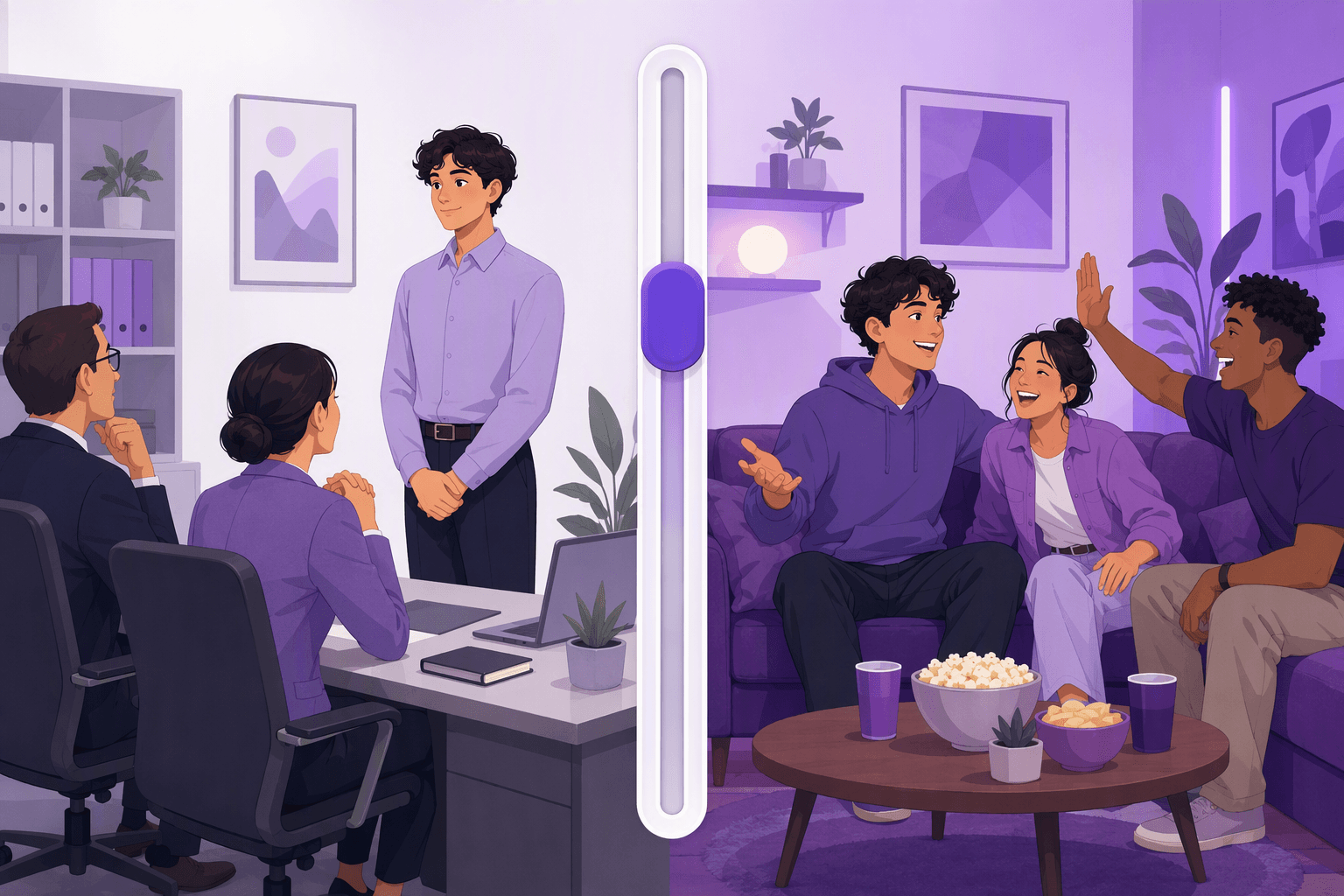
Slang is strongest with friends, peers, and people your age group. With strangers, customers, teachers, or managers, slang can read as disrespectful or immature.
If you need a reminder of what is risky in mixed company, our English swear words guide breaks down severity and context.
2) Use complete "chunks," not isolated words
Native speakers often use slang as a whole line: "Say less" or "I’m dead" or "That’s wild." If you only copy one word, you can end up with odd grammar.
3) Keep it one notch below the room
If everyone is formal, use mild casual language, not meme slang. If everyone is joking hard, you can go a bit stronger.
4) Prefer slang that survives outside one platform
Some slang is platform-specific. If you only see it in comment sections, it might not work in real conversation.
Pew Research Center’s reporting on social media use helps explain why TikTok, YouTube, and Instagram accelerate slang spread, but also why it can be age-segmented (Pew Research Center, accessed 2026).
35+ advanced English slang phrases you can actually use
Below are phrases that are common enough to be understood, but "advanced" enough to make you sound current. Pronunciations are General American approximations.
I’m dead
Pronunciation: "im DED"
Meaning: Something is extremely funny. It is a hyperbole, you are not literally dead.
Use it when: Reacting to a joke, a clip, or a ridiculous situation.
Avoid when: Serious topics, workplace chats, or with people who dislike dramatic humor.
Example: "I’m dead, that edit is so good."
I can’t
Pronunciation: "eye KANT"
Meaning: Short for "I can’t deal with this," usually because it is funny, cute, or overwhelming.
Use it when: Reacting to something adorable or absurd.
Avoid when: It could be interpreted as refusing a request. Add context if needed.
Example: "I can’t, the dog’s little boots."
That’s wild
Pronunciation: "thats WYLD"
Meaning: That is surprising, extreme, or unbelievable.
Use it when: Someone tells you a story and you want a strong reaction without swearing.
Example: "They did that on a first date? That’s wild."
That’s crazy
Pronunciation: "thats KRAY-zee"
Meaning: Similar to "that’s wild," often more common and less internet-coded.
Note: Some people avoid "crazy" for mental health sensitivity, especially in certain workplaces.
Example: "You finished the whole project in one night? That’s crazy."
I’m weak
Pronunciation: "im WEEK"
Meaning: That is so funny I’m losing it. Similar to "I’m dead," slightly less dramatic.
Example: "I’m weak, why would he say that out loud."
I’m crying
Pronunciation: "im KRY-ing"
Meaning: That is extremely funny or emotionally intense. Often used humorously, not literal.
Example: "I’m crying, the caption is perfect."
No shot
Pronunciation: "noh SHAHT"
Meaning: No way, impossible. Often used for disbelief.
Example: "No shot you met her at the airport."
Say less
Pronunciation: "say LESS"
Meaning: I understand, you do not need to explain more. Also implies agreement and readiness.
Use it when: A friend suggests a plan and you are in.
Avoid when: Someone is sharing feelings or a serious explanation. It can sound dismissive.
Example: "Wings at 8? Say less."
Bet
Pronunciation: "BET"
Meaning: Okay, agreed, sounds good. Common in casual US speech.
Example: "Meet you there at 6." "Bet."
I got you
Pronunciation: "eye GAHT yoo"
Meaning: I will help you, I will handle it, you can rely on me.
Example: "Can you send the file?" "Yeah, I got you."
It’s giving
Pronunciation: "its GIV-ing"
Meaning: It resembles, it has the vibe of. Often followed by a noun or adjective phrase.
Example: "This outfit is giving 90s rom-com."
Main character energy
Pronunciation: "MAYN KAR-ik-ter EN-er-jee"
Meaning: Someone is acting confident, dramatic, or like life is a movie.
Example: "Walking in late with sunglasses is main character energy."
NPC
Pronunciation: "EN-pee-SEE"
Meaning: A person acting scripted, passive, or unaware, from gaming "non-player character."
Avoid when: You are insulting someone directly. It can be harsh.
Example: "He just repeats the same line every meeting, NPC behavior."
Touch grass
Pronunciation: "tuhch GRASS"
Meaning: Go outside, get offline, reconnect with real life. Usually teasing.
Avoid when: Someone is genuinely upset. It can sound cruel.
Example: "You’ve been arguing in comments for two hours, touch grass."
Chronically online
Pronunciation: "KRAHN-ik-lee ahn-LYN"
Meaning: Someone’s opinions and language are shaped by internet culture more than real life.
Example: "That take is chronically online."
Lowkey
Pronunciation: "LOH-kee"
Meaning: Quietly, kind of, secretly, or mildly. Often softens a statement.
Example: "I lowkey want to leave early."
For more nuance, see our deep explanation of lowkey.
Highkey
Pronunciation: "HY-kee"
Meaning: Openly, strongly, not subtle. Often used for emphasis.
Example: "I highkey love this song."
I’m down
Pronunciation: "im DOWN"
Meaning: I agree, I’m interested, I will join.
Example: "Movie tonight?" "I’m down."
I’m not mad at it
Pronunciation: "im naht MAD at it"
Meaning: I do not hate it, it is better than expected. Mild approval.
Example: "Pineapple on pizza? I’m not mad at it."
It hits different
Pronunciation: "it HITS DIF-er-ent"
Meaning: It feels special or emotionally stronger in this context.
Example: "That song hits different at night."
If you want a full breakdown, read what 'hits different' means.
Rent-free
Pronunciation: "RENT-free"
Meaning: Something stays in your mind without effort, often annoyingly.
Example: "That line is living rent-free in my head."
Living for it
Pronunciation: "LIV-ing for it"
Meaning: I love it, I’m enjoying it a lot.
Example: "I’m living for this drama."
I’m here for it
Pronunciation: "im HEER for it"
Meaning: I support this, I like this, I approve.
Example: "A shorter meeting agenda? I’m here for it."
Not gonna lie (NGL)
Pronunciation: "naht GUN-uh LY"
Meaning: Honest introduction, sometimes used lightly before an opinion.
Example: "Not gonna lie, that was impressive."
The math isn’t mathing
Pronunciation: "thuh MATH IZ-unt MATH-ing"
Meaning: Something does not make sense, the logic fails.
Example: "He says he’s broke but he’s traveling every weekend, the math isn’t mathing."
Sus
Pronunciation: "SUHS"
Meaning: Suspicious, questionable. Popularized widely through gaming culture.
Example: "That link looks sus."
More detail: what 'sus' means.
Cap / No cap
Pronunciation: "KAP" / "noh KAP"
Meaning: Cap means a lie, no cap means for real, no lie.
Example: "This is the best burger in the city, no cap."
More detail: what 'no cap' means.
Flex
Pronunciation: "FLEKS"
Meaning: To show off. Can be neutral, teasing, or critical.
Example: "Okay, new watch, I see you flexing."
Humblebrag
Pronunciation: "HUM-buhl-brag"
Meaning: A brag disguised as modesty.
Example: "Saying 'I’m so tired from all these awards' is a humblebrag."
Glow up
Pronunciation: "GLOH up"
Meaning: A noticeable improvement in appearance, confidence, or life situation.
Example: "She had a serious glow up after college."
Crash out
Pronunciation: "KRASH out"
Meaning: To lose control, overreact, or spiral. Often used in online talk about drama.
Avoid when: You are diagnosing mental health. Keep it about behavior, not identity.
Example: "He crashed out over a group chat message."
Cook / Let him cook
Pronunciation: "KUK" / "let him KUK"
Meaning: To do something well, or to let someone continue because they are on a roll.
Example: "Wait, his idea is actually good, let him cook."
Ate / You ate
Pronunciation: "AYT" / "yoo AYT"
Meaning: You did amazing, you nailed it. Often about style, performance, or a comeback.
Example: "That presentation? You ate."
Slay
Pronunciation: "SLAY"
Meaning: To do extremely well, look great, or impress.
Example: "You slayed that interview."
More detail: what 'slay' means.
Drag (someone)
Pronunciation: "DRAG"
Meaning: To criticize strongly, often publicly. Can be playful or harsh.
Example: "The replies dragged him for that comment."
Ratioed
Pronunciation: "RAY-shee-ohd"
Meaning: On platforms where likes on replies matter, your post gets fewer likes than a reply, implying public disagreement.
Use it when: Talking about online dynamics, not face-to-face life.
Example: "He posted a hot take and got ratioed instantly."
Soft launch
Pronunciation: "SAWFT lawnch"
Meaning: Subtly revealing something, often a relationship, without a clear announcement.
Example: "She soft launched her boyfriend with a hand photo."
Hard launch
Pronunciation: "HARD lawnch"
Meaning: A clear, explicit announcement, often with a full photo or statement.
Example: "Okay, that’s a hard launch, full couple pic."
IYKYK
Pronunciation: "eye-why-kay-why-kay"
Meaning: If you know, you know. A signal that only some people will understand the reference.
Example: "That cafe has the best cinnamon rolls, IYKYK."
How to choose the right slang for your accent and region
Slang travels, but accents and everyday vocabulary still differ. If you speak UK English, you can still use many internet phrases, but some US staples like "bet" can feel imported.
For a clear overview of regional differences, read American vs British English. It helps you avoid mixing a very British sentence frame with a very US slang tag in a way that sounds unnatural.
🌍 Why slang feels 'American' online
A lot of global slang feels American because major platforms amplify US creators, and US entertainment exports are huge. But English slang also moves through local scenes, schools, workplaces, and music, which is why the same word can feel normal in one city and weird in another.
The "danger zone": slang that can backfire fast
Some slang is high-risk because it is political, insulting, or tied to a specific community’s identity.
Politically loaded slang
Words like "woke" can be used neutrally in some contexts, but often carry strong political stance. If you are not sure how your group uses it, skip it.
Community-linked slang and appropriation
Some widely spread slang originates in Black American communities and AAVE. Using it without understanding can sound like performance, especially if you only use it when joking. If you are learning, prioritize phrases that are broadly mainstream and not identity-marked.
Profanity-adjacent slang
Even when it is not a swear word, slang can sit close to profanity in tone. If you want to calibrate, compare with the severity guidance in English swear words.
⚠️ If you only remember one warning
Do not use slang to insult people in a second language. The social cost is higher because you cannot fine-tune tone as precisely as a native speaker.
How to practice advanced slang with movies and TV (without copying mistakes)
Slang is easiest to learn as dialogue, not as a list. Movies and TV give you timing, facial expression, and relationship context.
Use this three-step loop:
- Watch the clip once for meaning.
- Rewatch and copy the whole sentence, including filler words and intonation.
- Swap one detail, keep the structure.
If you want curated options by level, start with our best movies to learn English. You will hear slang in scenes that also teach turn-taking, interruptions, and humor cues.
A quick self-test: does this slang fit my situation?
Ask yourself:
- Would I say this to a teacher or customer?
- Is this phrase doing a job, like agreeing, reacting, teasing, or praising?
- Do I understand the "opposite" tone, like when it becomes sarcasm?
- Have I heard at least three different people use it naturally?
If you cannot answer yes to most of these, keep it as recognition-only for now.
Mini cheat sheet: slang functions (so you stop guessing)
Here is what most of the phrases above do in conversation:
- Reacting to humor: "I’m dead," "I’m weak," "I’m crying"
- Agreeing fast: "bet," "say less," "I’m down"
- Softening opinions: "lowkey," "I’m not mad at it"
- Praising: "you ate," "slay," "let him cook"
- Calling out nonsense: "the math isn’t mathing," "sus"
- Internet dynamics: "ratioed," "chronically online"
If you want to build the rest of your everyday foundation, pair this with high-frequency basics like our 100 most common English words and practical sets like English numbers.
Final advice: sound natural first, trendy second
The goal is not to chase every new word. The goal is to sound like you understand the room.
If you learn through real dialogue, Wordy’s clip-based practice can help you hear slang with the exact timing and tone that makes it work. Start with one phrase, use it correctly twice, then add the next.
Frequently Asked Questions
What is 'advanced' slang in English?
Is it okay to use slang at work?
How do I know if slang is outdated?
What slang should English learners avoid?
How can I practice slang without sounding forced?
Sources & References
- Ethnologue, Ethnologue 27th edition, 2024
- Oxford English Dictionary, OED online (accessed 2026)
- Merriam-Webster, Merriam-Webster.com Dictionary (accessed 2026)
- Pew Research Center, Social Media Use (accessed 2026)
Start learning with Wordy
Watch real movie clips and build your vocabulary as you go. Free to download.


