American vs British English: Key Differences in Spelling, Pronunciation, and Everyday Words
Quick Answer
American and British English are the same language, but they differ in spelling (color vs colour), pronunciation (rhotic vs non-rhotic accents), vocabulary (truck vs lorry), and a few grammar preferences (gotten vs got). You can communicate perfectly in either variety, but knowing the differences helps you sound natural in the country, workplace, or media you use most.
American vs British English comes down to a few predictable differences, spelling (color vs colour), pronunciation (especially the 'r' sound), everyday vocabulary (truck vs lorry), and some grammar preferences (gotten vs got). You can speak either variety and be understood almost everywhere, but choosing one as your default makes you sound more natural and keeps your writing consistent.
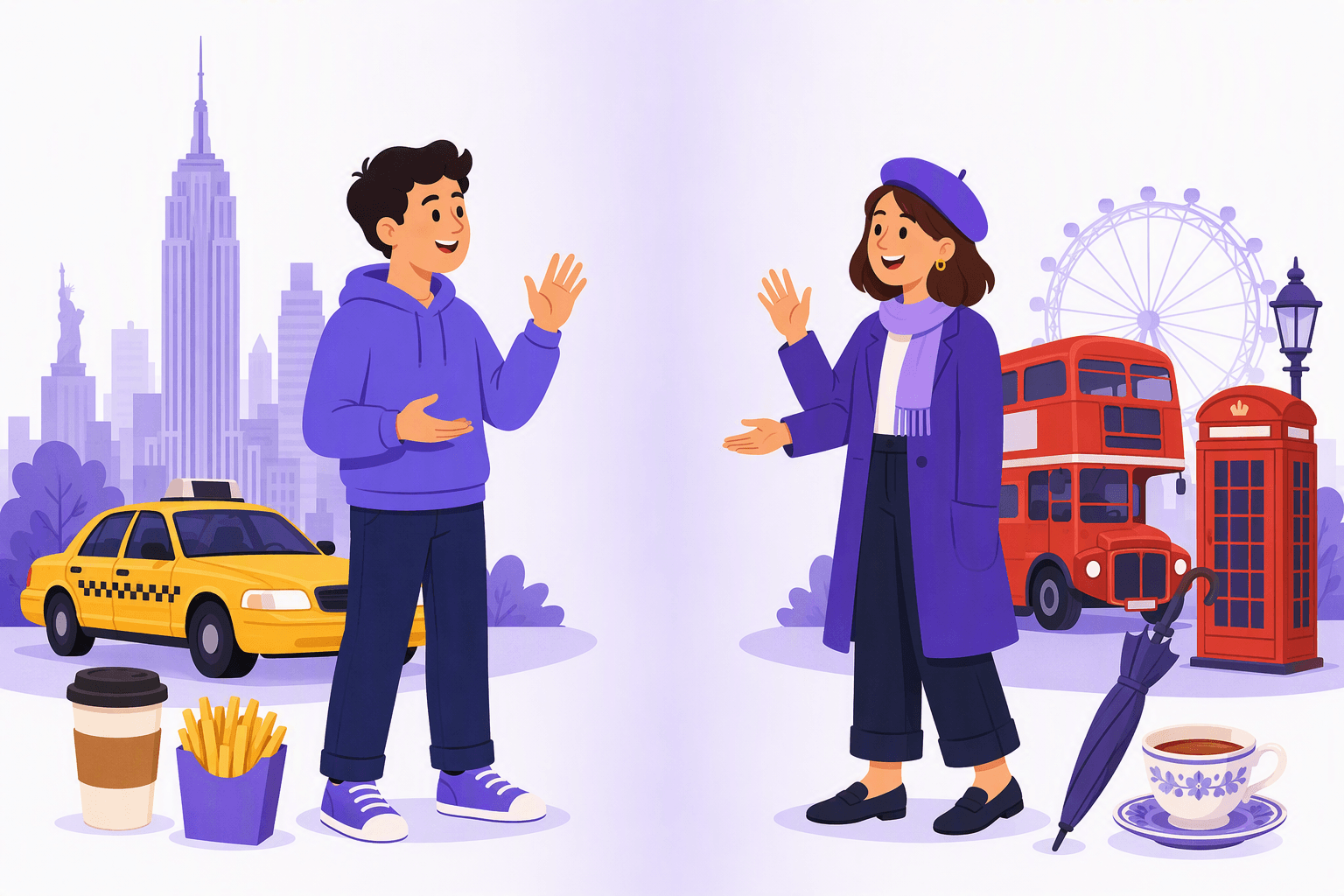
| English | English (US vs UK) | Pronunciation | Formality |
|---|---|---|---|
| Color vs colour | US: color | UK: colour | KUL-er | KUL-uh | formal |
| Truck vs lorry | US: truck | UK: lorry | TRUK | LOR-ee | casual |
| Apartment vs flat | US: apartment | UK: flat | uh-PART-ment | FLAT | casual |
| Fries vs chips | US: fries | UK: chips | FRYZE | CHIPS | casual |
| Vacation vs holiday | US: vacation | UK: holiday | vay-KAY-shun | HOL-ih-day | casual |
| Gas vs petrol | US: gas | UK: petrol | GASS | PET-rul | casual |
| Elevator vs lift | US: elevator | UK: lift | EL-uh-vay-ter | LIFT | casual |
| Sidewalk vs pavement | US: sidewalk | UK: pavement | SYDE-wawk | PAYV-ment | casual |
How big is the difference, really?
English is a single global language with multiple standard varieties, not two separate languages. American English and British English share the same core grammar and most of the same vocabulary, which is why movies, news, and business communication travel so easily.
The scale is massive: Ethnologue estimates about 1.5 billion total English speakers worldwide (including native and second-language speakers), with roughly 380 million native speakers (Ethnologue, 2024). That global spread is exactly why variation exists, English adapts to local history, institutions, and culture.
"A language is not a single entity but a family of related varieties, each with its own norms and social meanings."
David Crystal, linguist, The Cambridge Encyclopedia of the English Language (3rd ed., 2019)
If you are choosing what to learn, pick the variety that matches your goals. If you mainly watch US media, work with US colleagues, or plan to take a US-focused exam, default to American conventions. If your life is UK-centered, do the opposite.
For a broader view of how English works globally, see our English language overview.
Spelling differences you will see everywhere
Spelling is the most visible difference in writing, and it is also the easiest to standardize. The key is to recognize patterns so you do not have to memorize every word.
-or vs -our
American English often uses -or, British English often uses -our.
| Meaning | American spelling | British spelling |
|---|---|---|
| color/colour | color | colour |
| favor/favour | favor | favour |
| humor/humour | humor | humour |
Pronunciation tip: both are usually pronounced like "KUL-er" and "FAY-ver" in everyday speech. The extra letters are mostly historical and stylistic.
-er vs -re
American English often uses -er, British English often uses -re.
| Meaning | American spelling | British spelling |
|---|---|---|
| center/centre | center | centre |
| meter/metre | meter | metre |
| theater/theatre | theater | theatre |
Pronunciation tip: both are typically said like "SEN-ter" and "THEE-uh-ter". The spelling difference rarely changes how people speak.
-ize vs -ise
This one is tricky because British English is not perfectly uniform. Many UK publishers prefer -ise (organise), but -ize is also used in British contexts, including in some academic styles.
| Meaning | American spelling | British spelling (common) |
|---|---|---|
| organize/organise | organize | organise |
| realize/realise | realize | realise |
If you are writing for a UK school or employer, follow their house style. If you are writing internationally, pick one system and stay consistent.
Double consonants: traveling vs travelling
British spelling often doubles consonants where American spelling does not.
| Meaning | American spelling | British spelling |
|---|---|---|
| traveling/travelling | traveling | travelling |
| canceled/cancelled | canceled | cancelled |
Pronunciation tip: both are pronounced the same in normal speech, like "TRAV-uh-ling" and "KAN-suhld".
💡 Consistency beats perfection
In professional writing, mixed spelling looks careless even when every word is "correct" in some variety. Set your spellcheck to English (United States) or English (United Kingdom), then accept its suggestions consistently.
Pronunciation differences that change how you sound
Pronunciation is where learners feel the difference most, because it affects listening comprehension. The biggest differences are not about "right vs wrong", they are about accent systems.
Rhotic vs non-rhotic 'r'
Many American accents are rhotic, meaning the 'r' is pronounced in words like "car" (KAR) and "hard" (HARD). Many accents in England are non-rhotic, meaning the 'r' is often not pronounced unless a vowel follows, so "car" can sound closer to "KAH".
This is why "water" sounds like "WAH-ter" in many UK accents, but often like "WAH-der" (a soft 't' sound) in many US accents.
The 't' sound: "t" vs "flap"
In many American accents, a 't' between vowels becomes a quick flap, so "better" can sound like "BED-er". In many British accents, the 't' is more often a clear "T" sound, "BET-er", though there is huge variation across the UK.
If you want focused practice on hearing these differences, movie clips help because you can replay the same line. That is the logic behind learning with authentic speech on Wordy's English learning page.
Vowels: bath, lot, and schedule
Vowels differ more than consonants, and they vary by region. Still, a few words are famous:
| Word | Common US pronunciation | Common UK pronunciation |
|---|---|---|
| bath | "BATH" (rhymes with "math") | "BAHth" (longer vowel) |
| lot | "LAHT" | "LOT" (rounder vowel) |
| schedule | "SKED-jool" | "SHED-yool" (often) |
Pronunciation tip: treat these as listening targets, not rules. Even within the US and UK, accents differ widely.
Everyday vocabulary differences (the ones that cause real confusion)
Vocabulary is where misunderstandings actually happen, especially for travel and daily life. Most differences are about common nouns, food, and transportation.
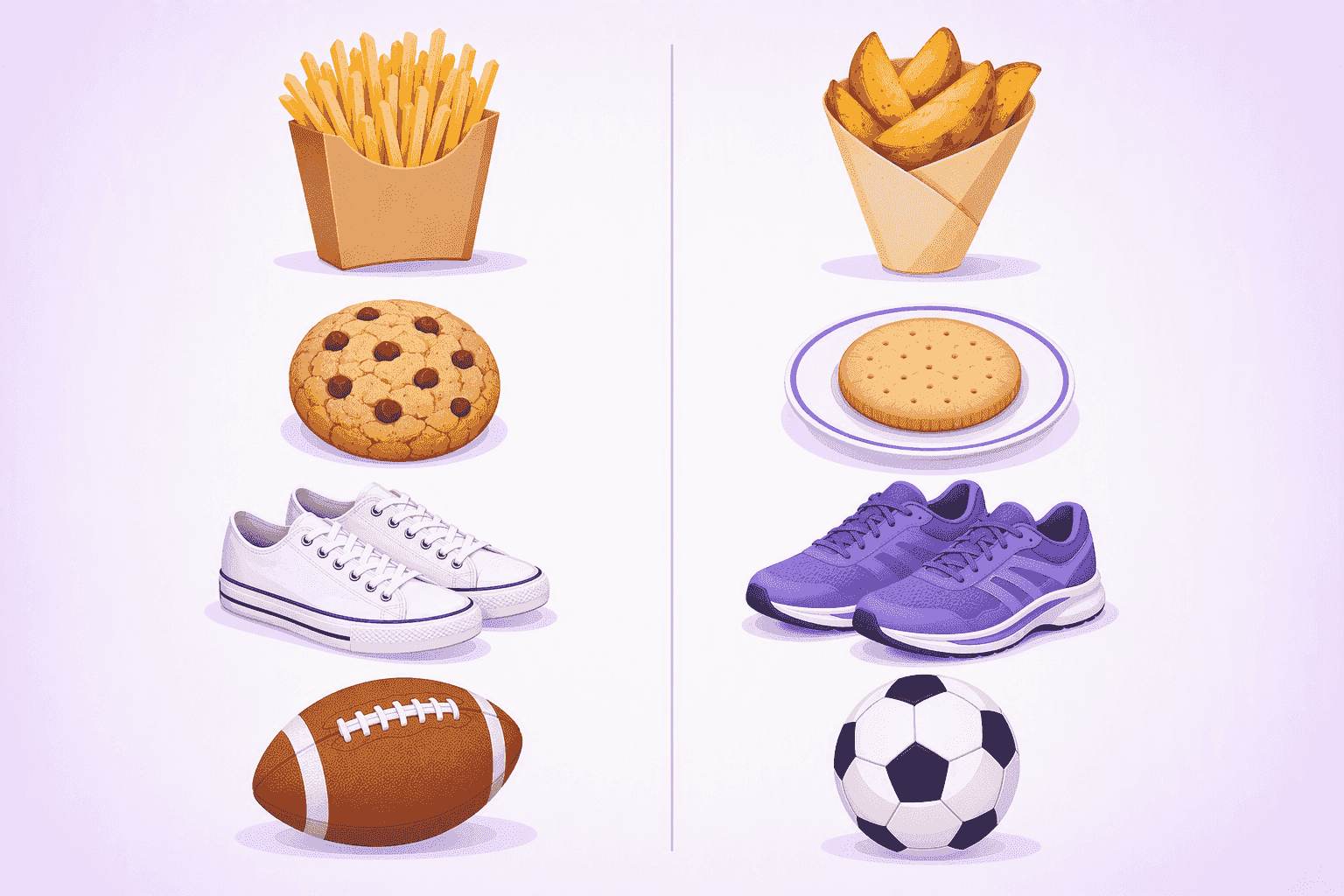
Food and restaurants
These are high-impact because you use them in real situations.
| Situation | American word | British word | Pronunciation |
|---|---|---|---|
| thin fried potato sticks | fries | chips | "FRYZE" vs "CHIPS" |
| crispy snack slices | chips | crisps | "CHIPS" vs "KRISPS" |
| cookie | cookie | biscuit | "KOO-kee" vs "BIS-kit" |
A classic cultural trap: in the UK, "chips" are thicker, closer to what Americans call "steak fries". In the US, "chips" are what the UK calls "crisps".
Transportation and cities
| Meaning | American word | British word | Pronunciation |
|---|---|---|---|
| large goods vehicle | truck | lorry | "TRUK" vs "LOR-ee" |
| subway | subway | underground / tube | "SUB-way" vs "TOOB" |
| line of cars | traffic jam | traffic jam / queue (context) | "TRAF-ik jam" vs "KYOO" |
In the UK, "queue" (KYOO) is common for any line of people. In the US, "line" is more common, though "queue" exists in formal or technical contexts.
Home and daily life
| Meaning | American word | British word | Pronunciation |
|---|---|---|---|
| place to live | apartment | flat | "uh-PART-ment" vs "FLAT" |
| garbage | trash | rubbish | "TRASH" vs "RUB-ish" |
| closet | closet | wardrobe | "KLOZ-it" vs "WAR-drohb" |
Cultural note: "wardrobe" in the UK can mean the whole storage unit, not just the clothing.
🌍 Why British 'pavement' surprises Americans
In the UK, "pavement" (PAYV-ment) means the walkway beside the road, what Americans call the "sidewalk". In the US, "pavement" usually means the road surface itself. This difference shows up constantly in street directions.
Grammar differences (smaller than people think)
Grammar differences exist, but they rarely block understanding. They matter most in formal writing and in sounding natural.
Present perfect vs simple past
British English often prefers the present perfect for recent events with a connection to now.
| Meaning | American style (common) | British style (common) |
|---|---|---|
| recent completion | "I just ate." | "I've just eaten." |
| recent experience | "Did you eat yet?" | "Have you eaten yet?" |
Both are grammatical in both varieties, but the preference differs. If you are learning for the UK, the present perfect will appear more often in everyday speech and writing.
Got vs gotten
American English commonly uses "gotten" as the past participle of "get". British English usually uses "got".
| Meaning | American | British |
|---|---|---|
| possession | "I've got a car." | "I've got a car." |
| change/obtain | "I've gotten better." | "I've got better." |
Pronunciation tip: "gotten" is "GOT-en" with a clear "t" or a soft American flap depending on accent.
Collective nouns: "the team are" vs "the team is"
British English often treats collective nouns as plural when emphasizing individuals.
| Meaning | American | British |
|---|---|---|
| team as one unit | "The team is winning." | "The team is winning." |
| team as individuals | less common | "The team are arguing." |
In US English, singular agreement is more typical in most contexts.
⚠️ Exam and workplace rule
If you are taking IELTS, Cambridge exams, or writing for a UK institution, follow British grammar preferences like present perfect usage and collective noun agreement. For TOEFL or US academic writing, American conventions are the safer default.
Punctuation and formatting: the quiet differences
These differences are subtle, but they stand out in professional writing.
Quotation marks
American style often uses double quotation marks and places commas and periods inside the quotes in many style guides. British style varies more, and many UK publishers use single quotes first, then double quotes inside.
Because style guides differ, the best practice is to follow the guide used by your school, publisher, or company.
Dates and numbers
Dates can cause genuine confusion because the order changes.
| Format | Example | How to read it |
|---|---|---|
| US month/day/year | 03/04/2026 | March 4, 2026 |
| UK day/month/year | 03/04/2026 | 3 April 2026 |
If you work internationally, write dates like "4 March 2026" or "2026-03-04" to avoid ambiguity.
For number formatting and how to say numbers clearly, see Numbers in English 1-100. For month names and date language, see Months in English.
Slang, swearing, and politeness: where culture matters most
A lot of "American vs British English" is really "American vs British communication style". The same words can feel more direct, more polite, or more humorous depending on the culture.
Directness and softeners
American customer service often uses upbeat friendliness and explicit positivity: "Hi! How are you?" and "Have a great day!" British service talk can be more understated, with politeness built into phrasing like "You alright?" (yoo aw-RYTE) and "Cheers" (CHEERZ) used as thanks.
Neither is better, but if you copy one style into the other context, you can sound oddly intense or oddly distant.
Slang differences move fast
Slang changes quickly, and US and UK slang often diverge because of different music scenes, social media communities, and youth subcultures. If you want a baseline of modern expressions, start with our English slang guide, then notice which terms appear in the shows you watch.
Swear words can be mismatched in strength
Some words have different severity levels across the Atlantic. A word that sounds mild in one country can sound much stronger in the other, and vice versa.
If you want to avoid accidental offense, read our English swear words guide and pay attention to regional notes.
🌍 A small word with big social meaning: 'mate'
In the UK, "mate" (MAYT) is a common friendly address, even between strangers, especially in casual settings. In the US, "mate" is less common and can sound playful, ironic, or Australian-coded. Using it in Britain can make you sound warmer fast, but overusing it can feel performative.
Which one should you use when learning with movies and TV?
Your input shapes your output. If most of your listening comes from US shows, you will naturally pick up American rhythm, vocabulary, and intonation. If you mainly watch UK series, you will absorb British patterns.
A practical approach is to choose a "home base" variety for writing and formal speaking, then learn to recognize the other variety passively. That is how many native speakers operate too, they understand both, but default to one.
A simple decision rule
- Choose American English if you plan to live, study, or work mainly in the US, or you mostly consume US media.
- Choose British English if your target is the UK, Ireland, or many Commonwealth contexts, or your exams and teachers are UK-based.
- Choose one for spelling and formal writing, but learn key vocabulary pairs so you can travel and understand media.
If you want structured listening practice with real dialogue, start from the clips that match your target accent on Wordy, then add the other variety later as "bonus input".
A high-impact list to memorize (20 words)
These are the differences that show up constantly in daily life. Pronunciations are English approximations.
| American | British | Pronunciation (US | UK) | |---|---|---| | apartment | flat | "uh-PART-ment" | "FLAT" | | elevator | lift | "EL-uh-vay-ter" | "LIFT" | | fries | chips | "FRYZE" | "CHIPS" | | chips | crisps | "CHIPS" | "KRISPS" | | cookie | biscuit | "KOO-kee" | "BIS-kit" | | gas | petrol | "GASS" | "PET-rul" | | truck | lorry | "TRUK" | "LOR-ee" | | trunk (car) | boot | "TRUNK" | "BOOT" | | flashlight | torch | "FLASH-lyte" | "TORCH" | | sweater | jumper | "SWET-er" | "JUM-per" | | pants | trousers | "PANTS" | "TROW-zerz" | | sneakers | trainers | "SNEE-kerz" | "TRAY-nerz" | | vacation | holiday | "vay-KAY-shun" | "HOL-ih-day" | | line | queue | "LYNE" | "KYOO" | | movie | film | "MOO-vee" | "FILM" | | cell phone | mobile | "SEL fohn" | "MOH-byle" | | restroom | toilet / loo | "REST-room" | "TOY-let" / "LOO" | | store | shop | "STOR" | "SHOP" | | soccer | football | "SAH-ker" | "FOOT-bawl" | | check (bill) | bill | "CHEK" | "BIL" |
💡 How to learn this list fast
Pick 5 pairs that match your real life, food, transport, and home. Then watch one episode of a US show and one episode of a UK show and listen for those exact words. Repetition in context is what makes them stick.
The bottom line: be consistent, then be flexible
American and British English are mutually intelligible, and the differences are mostly predictable patterns plus a set of everyday vocabulary pairs. Choose one variety for spelling and formal writing, train your ear for the other, and you will sound natural without limiting your ability to understand global English.
If you want to keep building practical English for real situations, browse the Wordy blog and use media-based practice to lock in what you learn.
Frequently Asked Questions
Is American English or British English more correct?
Which English should I learn for work or study?
Why do Americans spell words differently from the British?
What are the biggest pronunciation differences between US and UK English?
Will people misunderstand me if I mix American and British English?
Sources & References
- Ethnologue, English (27th edition), 2024
- Oxford English Dictionary (OED), Oxford University Press, ongoing
- Cambridge Dictionary, Cambridge University Press, ongoing
- British Council, LearnEnglish: UK and US English, ongoing
- Crystal, David. The Cambridge Encyclopedia of the English Language (3rd ed.), Cambridge University Press, 2019
Start learning with Wordy
Watch real movie clips and build your vocabulary as you go. Free to download.


