Quick Answer
In English, the months are always capitalized (January, February, etc.). The hardest to pronounce is often “February” (/ˈfɛbrjuɛri/ or /ˈfɛbjuɛri/), and like “Wednesday,” people often swallow the middle syllable. Dates are written two ways: in the US month-day-year (March 4, 2026), in Britain day-month-year (4 March 2026).
English is the most widely learned foreign language in the world. According to Ethnologue’s 2024 data, nearly 1.5 billion people speak it as a first or second language. The names of the months are one of the first vocabulary areas every learner needs, calendars, scheduling, letters, travel, and dates all use them.
The English months come directly from the Latin calendar, which the Roman Empire developed, then Julius Caesar reformed in 46 BCE, and Pope Gregory I refined in the 16th century. The names have barely changed over millennia. The same Latin gods, emperors, and numbers sit behind them. English also keeps the capital letter, this is one of the most basic spelling rules.
"The names of the months in English are among the oldest stratum of the Latin-derived vocabulary, direct loans that arrived with Christianity and Roman administrative culture, and have remained essentially unchanged for over a thousand years."
(David Crystal, The Cambridge Encyclopedia of the English Language, 2019)
This guide introduces all 12 months with pronunciation and Latin origin. It shows common abbreviations and seasons. It also explains the key difference between American and British date formats.

The 12 months in English
| English | Pronunciation | Note |
|---|---|---|
| January | JAN-yoo-erry | Janus, the two-faced god |
| February | FEB-yoo-erry | Februa, a purification festival |
| March | march | Mars, the god of war |
| April | AY-pril | Uncertain etymology |
| May | may | The goddess Maia |
| June | joon | The goddess Juno |
| July | joo-LY | Julius Caesar |
| August | AW-gust | Emperor Augustus |
| September | sep-TEM-ber | Septem = 7 (originally) |
| October | ok-TOH-ber | Octo = 8 (originally) |
| November | noh-VEM-ber | Novem = 9 (originally) |
| December | deh-SEM-ber | Decem = 10 (originally) |
The last four months, September, October, November, December, were named by number in Latin (7, 8, 9, 10). Today they are two months “late” compared to their current positions. This happened because the original Roman calendar started in March. Januarius and Februarius were added to the front later, and the last four names did not change.
January
It comes from the Latin Januarius. It honors Janus, the two-faced Roman god of doors, gates, beginnings, and transitions. One face looked back at the past year, the other looked forward to the new one. According to the American Heritage Dictionary, English inherited the word through Old English, where it appears as early as 11th-century texts.
February
It comes from the Latin Februarius, from the verb februare (to purify, to atone). For the Romans, February was the month of ritual purification. They held the festival of Lupercalia then. Its pronunciation is one of the most discussed difficulties in English. You can read more in the Pronunciation challenges section.
March
It comes from Latin Martius, from the name of Mars, the god of war. In the original Roman calendar, March was the first month. This explains why people celebrated the first day of the year in March for a long time. The word is one syllable: “march,” just like the verb “march” (to walk in step). That verb also got its name from Mars.
April
It comes from Latin Aprilis. The etymology is uncertain. Some researchers connect it to aperire (to open), referring to spring buds opening. Others trace it to the Etruscan name Apru, which may itself come from the Greek name Aphrodite. According to the Oxford English Dictionary, the first written English record dates to the 14th century.
May
It comes from Latin Maius. It honors Maia, the goddess of growth and fertility. In Greek mythology, she is one of the daughters of Atlas. It is one syllable, the shortest English month name, and also one of the easiest to pronounce.
June
It comes from Latin Junius, probably named after the goddess Juno. She is the protector of marriage and childbirth, and Jupiter’s wife. That is why June is traditionally seen as the month for weddings in English-speaking culture. It is one syllable: “joon.”
July
It comes from Latin Julius. People named it after Julius Caesar in 44 BCE, after his death. Before Caesar, this month was called Quintilis (fifth month, because it was in the original calendar). The stress is on the second syllable: “joo-LY.”
August
It comes from Latin Augustus, from the name of Emperor Augustus. The Senate named it in 8 BCE as a sign of respect connected to Julius Caesar. The stress is on the first syllable: “AW-gust.” This matters. In IPA it is /ˈɔːɡəst/, so the second syllable is short and unstressed.
September, October, November, December
These four months all come from Latin ordinal numbers: septem (7), octo (8), novem (9), decem (10). Although they are now the 9th, 10th, 11th, and 12th months, their names reflect positions 7 to 10. The stress is on the second syllable in each: sep-TEM-ber, ok-TOH-ber, noh-VEM-ber, deh-SEM-ber.
Abbreviations
English month names are regularly abbreviated in calendars, letters, and digital platforms. The three-letter abbreviation is the most common. It works in almost any context.
| English | English | Pronunciation | Note |
|---|---|---|---|
| January | Jan | jan | Most common abbreviation |
| February | Feb | feb | Most common abbreviation |
| March | Mar | mar | Most common abbreviation |
| April | Apr | ay-pr | Most common abbreviation |
| May | May | may | Not abbreviated, it is already short |
| June | Jun | jun | Sometimes left as June |
| July | Jul | jul | Most common abbreviation |
| August | Aug | awg | Most common abbreviation |
| September | Sep / Sept | sep | Both forms are accepted |
| October | Oct | okt | Most common abbreviation |
| November | Nov | nov | Most common abbreviation |
| December | Dec | dek | Most common abbreviation |
💡 February pronunciation: which one is correct?
“February” is one of the best-known pronunciation traps in English. The standard form in IPA is /ˈfɛbrjuɛri/ (FEB-roo-erry, four syllables). But Merriam-Webster and the Oxford Dictionary both also accept the common /ˈfɛbjuɛri/ (FEB-yoo-erry), where the first “r” almost disappears. Both pronunciations are correct. Still, knowing the more formal version helps in written exams and business communication.
Writing dates in English
Date formatting is one of the most important practical differences between American and British English. The two systems almost mirror each other. This can cause serious misunderstandings.
American English (MM/DD/YYYY)
In the United States, the order is: month, day, year.
- Spoken: March 4, 2026 (month name + day number, separated from the year by a comma)
- Numeric: 03/04/2026 (03 = March, 04 = day)
- Short: Mar 4 or 3/4
British English (DD/MM/YYYY)
In the United Kingdom and most European, Australian, and other English-speaking countries, the order is: day, month, year.
- Spoken: 4 March 2026 (day number + month name, no comma)
- Numeric: 04/03/2026 (04 = day, 03 = March)
- Short: 4 Mar or 4/3
⚠️ Where date confusion comes from: 04/03/2026
The written form 04/03/2026 means April 3 in the US (04 = April). In Britain, the same thing means March 4 (04 = day). This can cause real misunderstandings, for example with flight bookings, contracts, and emails. If you do not know which system someone uses, always write out the month name: “March 4, 2026” or “4 March 2026.” This removes all ambiguity.
Dates in sentences
| Situation | American English | British English |
|---|---|---|
| When? | on March 4th | on 4 March |
| Which year? | in 2026 | in 2026 |
| Which month? | in March | in March |
| Past | last January | last January |
| Future | next December | next December |
In English, days use ordinal forms (1st, 2nd, 3rd, 4th...), but spoken forms are also common: “March fourth” (US) or “the fourth of March” (UK).
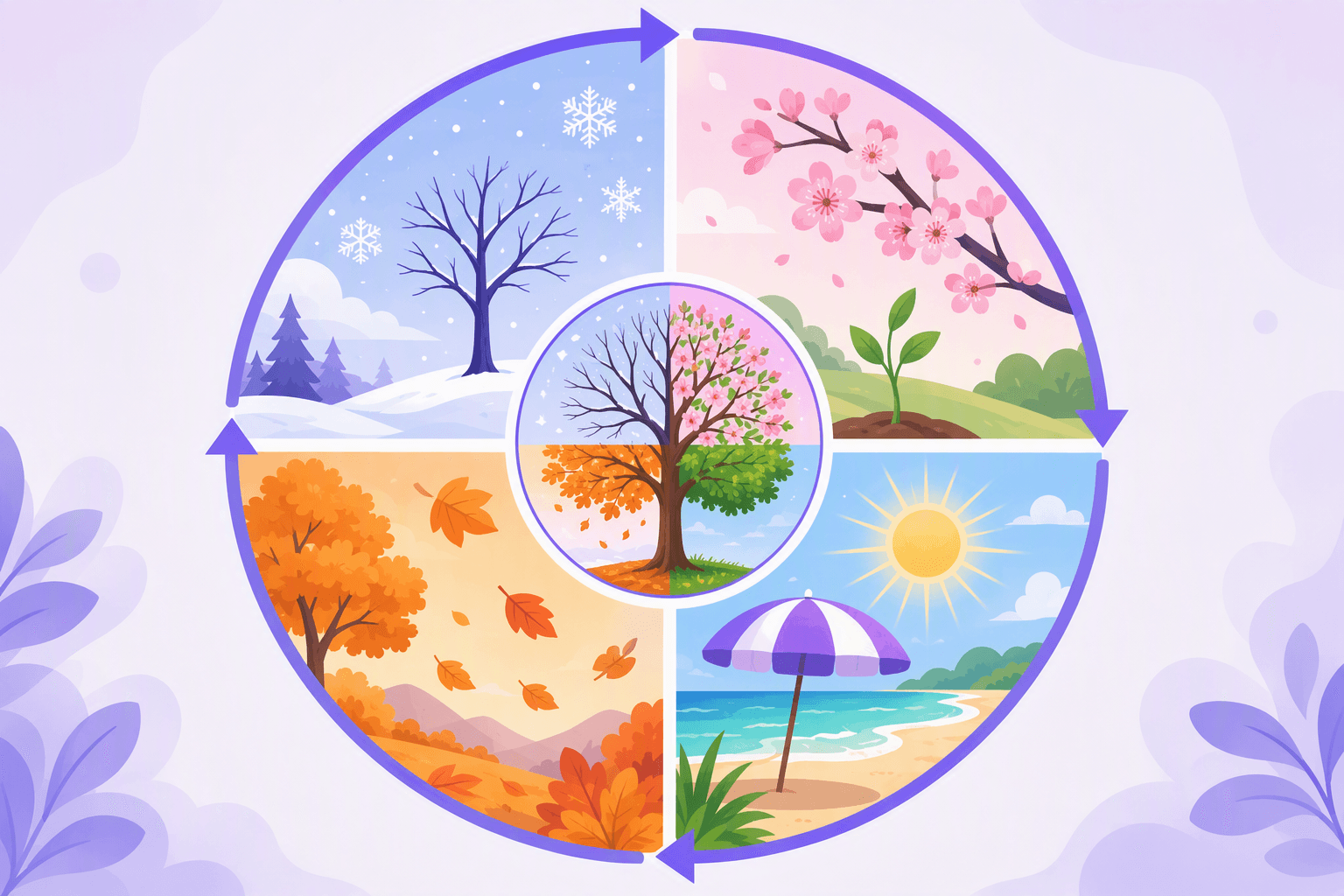
Seasons in English
| English | Pronunciation | Note |
|---|---|---|
| spring | spring | March, April, May |
| summer | SUM-mer | June, July, August |
| autumn / fall | AW-tum / fawl | UK: autumn, US: fall |
| winter | WIN-ter | December, January, February |
🌍 Autumn or fall: which should you use?
There are two fully accepted English names for the season. Autumn comes from the Latin autumnus and is the standard in British English. In American English, fall is more common. It refers to the verb “to fall,” meaning leaves falling. Both words are known and understood by all English speakers. But in a British context (United Kingdom, Australia, New Zealand), autumn sounds more natural. If you write or speak for an American audience, fall is the more natural choice.
In English, season names do not use capital letters, unlike month names. This confuses many learners:
- Correct: in spring, last summer, this winter
- Incorrect: in Spring, last Summer
Months, by contrast, must be capitalized: in January, last March, this December.
Months in sentences
The table below shows the most common month-related expressions. Learn them as fixed phrases.
| English | English | Pronunciation |
|---|---|---|
| in January | in January | in JAN-yoo-erry |
| on March 4th | on March 4th | on march fourth |
| next February | next February | next FEB-yoo-erry |
| last September | last September | last sep-TEM-ber |
| every December | every December | EV-ery deh-SEM-ber |
| at the beginning of January | at the beginning of January | at thuh beh-GIN-ing ov JAN-yoo-erry |
| at the end of May | at the end of May | at thuh end ov may |
| from June to August | from June to August | from joon tuh AW-gust |
| this month | this month | this munth |
| next month | next month | nekst munth |
One key rule: in English, use in before months, and on before days:
- in January (month)
- on January 15th (a specific day)
This difference often causes mistakes. “on January” and “in January 15th” are both wrong. Learning the right preposition is one of the most important steps for fluent date use.
Pronunciation challenges
English month pronunciation is usually easier than many other vocabulary areas. But a few common traps are worth knowing.
February, the missing r
“February” is one of the best-known pronunciation problems in English. The standard IPA form /ˈfɛbrjuɛri/ has four syllables: FEB-roo-erry. In everyday speech, the first “r” almost disappears: FEB-yoo-erry. Merriam-Webster explicitly marks both as accepted. If you hear native speakers say something like “feb-yoo-erry,” that is also correct.
August, stress on the first syllable
The IPA pronunciation of “August” is /ˈɔːɡəst/. The stress is on the first syllable (AW-gust). The second syllable is short and unstressed (-gust). Many learners put the stress on the second syllable, which is incorrect.
July, stress on the second syllable
“July” is the opposite. The second syllable is stressed: joo-LY /dʒuˈlaɪ/. Not “JOO-ly,” but “joo-LY.” Stress helps distinguish it from other similar-sounding words.
💡 Quick pronunciation reminder
If you are unsure about stress, a simple rule helps. In most English month names, the stress falls on the second-to-last syllable. Exceptions: January and February (first syllable), August (first syllable). Memorize these separately.
Capitalization, always
English month names always start with a capital letter, in the middle of a sentence, in lists, and in abbreviations. This is required in English. In languages like Hungarian, French, or Spanish, months are written with lowercase letters. If you write in English and skip the capital letter, it is a spelling mistake. It stands out even in informal emails or messages.
Practice with real English content
Learning months and dates requires regular listening and real context. News, weather reports, series, and films are full of calendar expressions. These are ideal learning situations because the words appear naturally.
Wordy lets you watch real English films and series with interactive subtitles. If a month name or date appears, you can tap once to see pronunciation, meaning, and context. This is one of the most effective ways to improve listening comprehension.
Also check our guide to the best movies to learn English, with curated picks across genres and difficulty levels. Real dialogues and situations help months and dates become automatic.
Frequently Asked Questions
How do you say the 12 months in English?
How do you pronounce “February” correctly?
How do you write dates in English?
How are the months abbreviated in English?
Why does September have “sept-” (seven) if it is the ninth month?
Sources & References
- Crystal, David (2019). The Cambridge Encyclopedia of the English Language. Cambridge University Press.
- Oxford English Dictionary (2025). oed.com, month etymologies.
- Merriam-Webster Dictionary (2026). merriam-webster.com.
- American Heritage Dictionary of the English Language, 5th edition (2020).
Start learning with Wordy
Watch real movie clips and build your vocabulary as you go. Free to download.


