Quick Answer
Japanese body language places strong value on modesty, awareness of others, and context. A small bow, restrained gesture, indirect eye contact, and careful use of personal space will usually communicate respect more effectively than trying to imitate every local custom.
Japanese body language is built around showing consideration without imposing on others: use a small bow instead of a big handshake, keep gestures contained, avoid prolonged staring, and give people room in conversation. You do not need perfect etiquette as a visitor. A calm, observant manner and a willingness to follow the other person’s lead will carry you far in Japan.
Japanese is spoken by roughly 123 million native speakers, primarily in Japan, according to Ethnologue’s 27th edition. Yet body language is not identical across every generation, workplace, city, or family. Tokyo office etiquette, Osaka friend groups, rural communities, and international settings all have their own rhythms.
For spoken basics to pair with these nonverbal signals, start with how to say hello in Japanese. A greeting feels much more natural when your words, posture, and timing agree.
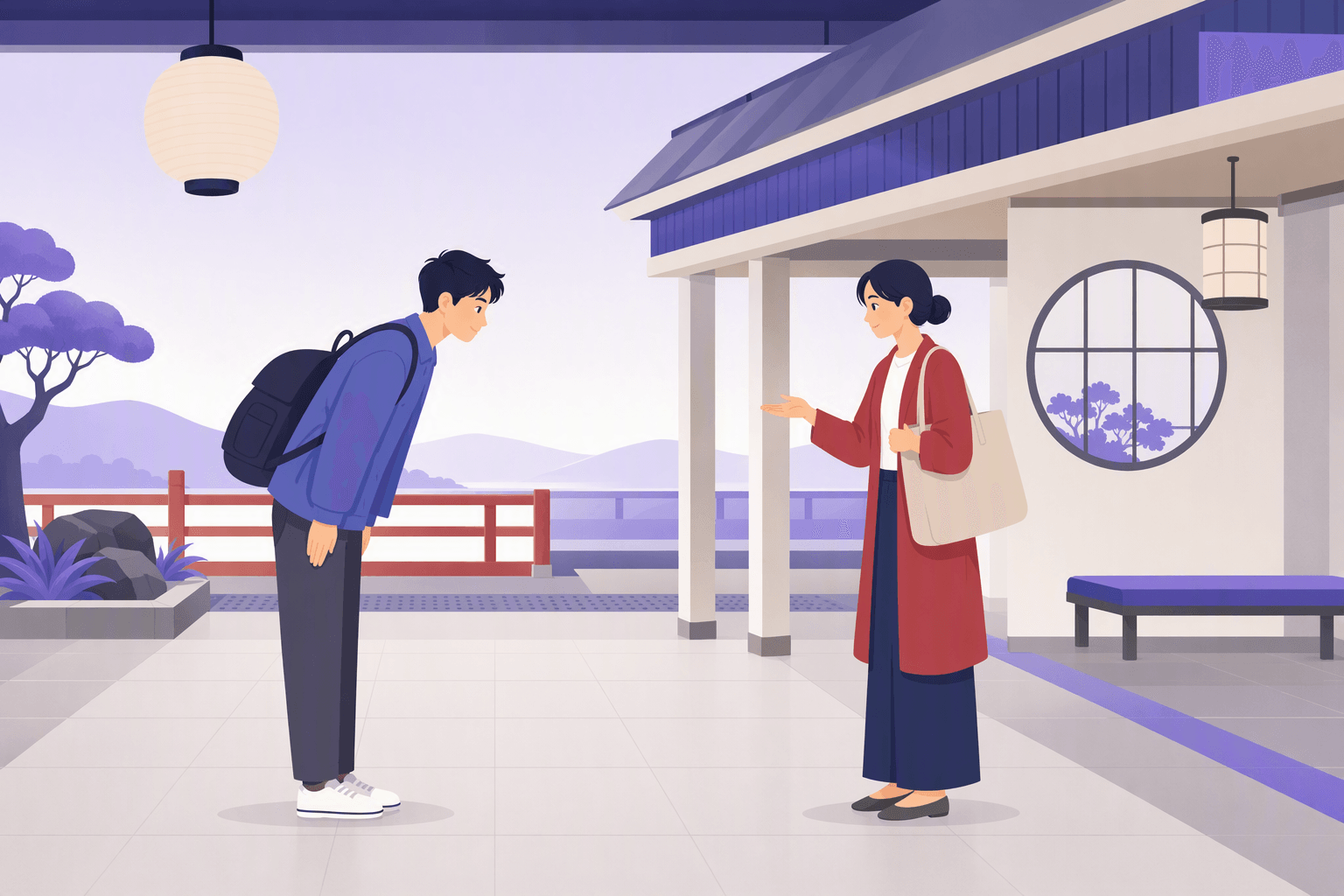
Why nonverbal communication matters in Japan
Japanese interaction often rewards attentiveness to context, or 空気 /kuː.ki/, literally “air.” The familiar expression 空気を読む /kuː.ki o jo.mu/, meaning to read the room, describes noticing what people need, what is left unsaid, and how direct one can be.
This does not mean Japanese people communicate mysteriously or never state what they want. It means that volume, pauses, facial expressions, hierarchy, setting, and group comfort may carry as much meaning as a literal sentence.
Anthropologist Takie Sugiyama Lebra examines this attention to social relationships in Japanese Patterns of Behavior. Her work helps explain why modest self-presentation and sensitivity to others can be valued in everyday exchanges, from a quick shop interaction to a workplace meeting.
🌍 The safest rule for visitors
When you are unsure, make your movements smaller, speak a little more softly, and observe the person with the highest social responsibility in the situation. Their behavior is often the best etiquette guide.
Bowing: the gesture visitors notice first
Bowing, お辞儀 /o.dʑi.ɡi/, is one of the clearest Japanese nonverbal signals. It can greet someone, thank them, apologize, acknowledge a customer, or close an interaction. It is not a single rigid ritual.
A slight bow from the waist, combined with a calm expression, is enough for most travelers. You will see shop staff bow deeply, office workers bow in formal greetings, and friends give quick nods that are closer to a polite acknowledgment.
お辞儀
お辞儀 /o.dʑi.ɡi/ works best when it is brief and natural. Keep your back relatively straight, look downward rather than directly into the other person’s face, and let your arms rest at your sides.
A shallow bow of roughly 15 degrees is suitable for ordinary greetings and thanks. A deeper bow communicates greater respect or a more serious apology, but visitors should not force a deep angle merely to appear polite.
Avoid bowing while walking away with your back already turned. Stop, face the person, bow, then leave. This small pause communicates that you are giving the interaction proper attention.
会釈
会釈 /e.ɕa.ku/ is a light nod or small bow used for casual acknowledgment. You may see it when neighbors pass each other, colleagues meet in a hallway, or someone thanks a cashier.
For a learner, it is the most useful bowing style. A small nod paired with こんにちは /koɴ.ni.tɕi.wa/ is more natural than an elaborate formal bow in an ordinary café.
お辞儀 is not a handshake replacement in every setting
In international business, hotels, universities, and meetings involving foreign visitors, Japanese people may offer a handshake. Follow their lead. If they extend a hand, shake it gently and briefly, then a small bow afterward is fine.
Trying to bow and shake hands at exactly the same moment can create an awkward collision. Choose one action first, then the other if the moment calls for it.
Eye contact, facial expression, and listening
Direct eye contact is not forbidden in Japan. The issue is intensity. Long, fixed eye contact can feel confrontational or overly familiar, particularly with a stranger, teacher, manager, or older person.
A comfortable pattern is to make eye contact while greeting someone or listening to a key point, then look away naturally. Looking toward the speaker’s forehead, chin, or general face area can also feel less intense than staring into their eyes.
うなずき
うなずき /u.na.dzu.ki/ means nodding. Japanese listeners may nod often while another person speaks, sometimes with small verbal responses such as はい /ha.i/ or うん /uɴ/.
These signals usually mean “I am listening” or “I follow you.” They do not always mean full agreement. Do not treat a nod as a final yes to a proposal unless the person explicitly confirms it.
The listening response known as 相槌 /a.i.dzu.tɕi/ includes nods, short sounds, and phrases that keep a conversation moving. In Japanese, silence with no acknowledgment can make a speaker wonder whether they are being understood.
表情
表情 /hjoː.dʑoː/, facial expression, tends to be more restrained in formal public settings than in highly animated conversational cultures. A warm but moderate smile is usually ideal.
This does not mean people are emotionally distant. Laughter, surprise, affection, and frustration are all visible, but their public expression may be softened depending on the setting. Joy Hendry’s Understanding Japanese Society emphasizes how social roles and contexts shape everyday conduct rather than dictating one fixed national personality.
Hands, pointing, and common gestures
Japanese gestures are often subtle, especially in formal environments. The goal is not to become motionless. It is to avoid gestures that draw unnecessary attention or seem too forceful.
指差し
指差し /ju.bi.sa.ɕi/ means pointing. Pointing directly at a person with one finger can sound accusatory or impolite. If you need to indicate a person, use an open hand with your fingers together.
For objects, a finger point is common enough, especially when you are asking about a menu item or a train platform. Still, an open palm looks gentler and is useful when you want to be extra polite.
手招き
手招き /te.ma.ne.ki/ is a beckoning gesture. In Japan, call someone toward you with your palm facing down and your fingers moving toward your body.
Many visitors instinctively use the palm-up motion common in North America and Europe. In Japan, that movement can be associated with calling an animal, so the palm-down version is the safer choice.
The nose gesture
When Japanese speakers refer to themselves, they may point lightly at their nose rather than their chest. This can surprise learners because Western gestures more commonly indicate the chest.
Do not worry about copying it perfectly. Just recognize it. If someone points to their nose while saying 私 /wa.ta.ɕi/, they mean “me,” not their literal nose.
The hand wave for “no”
A gentle side-to-side wave of one hand in front of the body can mean “no,” “not me,” “that is not necessary,” or “I cannot.” Context and facial expression matter.
For example, a host may wave a hand softly when you offer to pay for something. They may be refusing the offer politely, but social ritual can involve one or two offers before the answer is final.
🌍 Do not overread every gesture
A hand wave, nod, or smile has no single universal translation. In Japanese communication, the relationship, setting, and words around the movement determine the message. Notice patterns before making assumptions.
Personal space and public behavior
Japan’s trains can be extremely crowded, particularly in large metropolitan areas. Physical closeness in a packed commuter train is practical rather than personal. Outside those spaces, people often maintain a modest, respectful distance.
Public manners usually emphasize minimizing disturbance. This can include speaking quietly on trains, keeping phone calls off public transit, and avoiding large physical displays of frustration or affection.
静かに
静かに /ɕi.zu.ka ni/ means quietly. You may hear it in schools, libraries, museums, and public settings, but it also reflects a broader expectation that shared spaces belong to everyone.
On trains, phone calls are generally discouraged. Put your device on silent mode, and if a call is unavoidable, step off at the next stop or move to a designated area where available.
公共の場
公共の場 /koː.kjoː no ba/ means public place. In these spaces, body language that takes up a lot of room can feel inconsiderate: spreading bags across seats, blocking an escalator, standing in a doorway, or gesturing widely in a narrow restaurant.
On escalators, local conventions differ. In much of Tokyo, people often stand on the left and pass on the right. In Osaka, the traditional pattern has often been reversed, though safety campaigns increasingly encourage standing still on both sides. Follow posted signs rather than relying on a city stereotype.
Physical contact and affection
Physical contact between friends is generally less common in public than in many Mediterranean, Latin American, or North American settings. Hugs may occur between close friends, younger people, or internationally minded groups, but they are not the default greeting.
A handshake can be appropriate in business or cross-cultural contexts. Casual touching, such as repeatedly touching someone’s arm during conversation, may feel more intimate than intended.
恋人
恋人 /ko.i.bi.to/ means romantic partner. Couples in Japan do show affection, but public behavior is often low-key. Holding hands is common, while intense kissing or prolonged embracing may attract attention depending on the location and age group.
If you want to express affection verbally, see how to say I love you in Japanese. Japanese romantic communication often depends on timing and implication as much as on direct declarations.
頭
頭 /a.ta.ma/ means head. Avoid touching someone’s head, even affectionately, unless you know them very well and the situation clearly allows it. The head can be treated as a personal area, particularly with children and elders.
Also avoid stepping over someone’s belongings or using your feet to move an object toward them. Feet are not typically used to indicate things in polite interaction.
Silence is communication, not failure
A pause after a question can signal that someone is thinking carefully, considering group implications, or looking for a polite answer. Immediately filling that silence may make the interaction harder rather than easier.
This is especially relevant in meetings and with people who are speaking a second language. Give the other person time, and listen for a soft hesitation such as ちょっと /tɕo.tto/, literally “a little.” Depending on context, it may gently signal reluctance or refusal.
間
間 /ma/ refers to interval, timing, or the meaningful space between things. It appears in Japanese arts, conversation, comedy, and daily social rhythm.
In conversation, good 間 /ma/ means allowing a response to land. If someone pauses after your suggestion, wait. Their eventual answer may be more useful than a fast response prompted by pressure.
💡 A practical conversation habit
Ask your question, then pause for two or three seconds. If the person looks thoughtful, do not repeat it immediately. A calm wait communicates patience and gives their response room to form.
Hierarchy, age, and situational awareness
Age and role can influence posture, speech, and gesture. A student may wait for a teacher to initiate a greeting. A junior employee may use more restrained body language around a manager. Guests may be seated after a host indicates where to sit.
These patterns are not equally strong everywhere. Japan has diverse workplaces and increasingly informal social environments, especially among younger people. Still, showing awareness of seniority is generally safer than acting as though it does not exist.
The Japan Foundation’s global survey of Japanese-language education reflects the language’s broad international reach, with learners across many regions. That global interest means many Japanese people are accustomed to visitors who do not know every etiquette rule. Respectful effort matters more than flawless performance.
How to use body language while speaking Japanese
Pair simple spoken phrases with simple movements. When saying ありがとうございます /a.ri.ɡa.toː ɡo.za.i.ma.sɯ/, a small bow or nod makes the thanks feel complete. When apologizing with すみません /sɯ.mi.ma.seɴ/, a slight bow is appropriate.
When leaving, do not rush through your farewell while looking at your phone or walking away. Face the person, say 失礼します /ɕi.tsɯ.reː ɕi.ma.sɯ/, meaning “excuse me” in a polite departure context, and make a small bow.
For more useful endings, read how to say goodbye in Japanese. Choosing the right farewell matters, but the quiet pause and small bow that accompany it often matter too.
Mistakes visitors can stop worrying about
You will not offend someone simply because your bow is shallow, your nod is imperfect, or you do not know every gesture. Japanese people regularly interact with travelers, students, and colleagues from cultures with different norms.
The bigger problems are usually loudness, impatience, intrusive touching, or treating etiquette as a joke. Curiosity and restraint are much more useful than performing exaggerated versions of Japanese behavior.
Be especially cautious with insulting gestures and words. A gesture may seem playful in one culture but hostile in another, and swear words can carry more force than subtitles suggest. Our guide to Japanese swear words explains why context and relationship matter before you repeat language heard in films or anime.
A simple body language checklist for Japan
Before you enter a restaurant, meeting, home, or shop, remember these six habits:
- Greet people with a nod or small bow.
- Make natural, not prolonged, eye contact.
- Use an open hand rather than pointing directly at a person.
- Beckon with your palm down.
- Keep your voice and gestures moderate in public.
- Leave pauses for others to respond.
These habits are not a costume. They are practical ways to show that you notice the people around you. That awareness, more than any perfect bow angle, is at the center of respectful Japanese body language.
Frequently Asked Questions
Is it rude to make eye contact in Japan?
Do tourists need to bow in Japan?
What hand gestures should I avoid in Japan?
Why do Japanese people cover their mouths when laughing?
Is silence uncomfortable in Japanese conversation?
Sources & References
- Ethnologue, Japanese, 27th edition, 2024
- Japan Foundation, Japanese-Language Education Abroad Survey, accessed 2026
- Takie Sugiyama Lebra, Japanese Patterns of Behavior, University of Hawaii Press
- Joy Hendry, Understanding Japanese Society, Routledge
- Agency for Cultural Affairs, Japan, Cultural Affairs in Japan, accessed 2026
Start learning with Wordy
Watch real movie clips and build your vocabulary as you go. Free to download.


