Quick Answer
The most common way to say good night in Japanese is 'Oyasuminasai' (おやすみなさい, oh-yah-soo-mee-nah-sah-ee). It works in polite and semi-formal situations. For casual contexts with friends and family, the shortened 'Oyasumi' (おやすみ) is standard. Japanese also has unique evening farewell expressions tied to work culture, such as 'Otsukaresama deshita' (お疲れ様でした), which doubles as both a goodbye and a good-night wish among colleagues.
Beyond a Single Phrase
The most standard way to say good night in Japanese is Oyasuminasai (おやすみなさい, oh-yah-soo-mee-nah-sah-ee). It works in most polite situations, with family, acquaintances, hotel staff, and anyone you want to show basic respect to. Among close friends, the shortened Oyasumi (おやすみ) is the natural choice.
But Japanese good-night expressions run far deeper than a single phrase. The language has distinct expressions for leaving the office at night, wishing someone restful sleep, saying farewell in a group, texting a partner before bed, and acknowledging a long day of shared work. According to the Agency for Cultural Affairs' 2023 National Language Survey, Japanese speakers actively use different farewell expressions depending on the time of day, their relationship to the listener, and whether the context is personal or professional.
"Japanese farewell expressions are not interchangeable formalities. Each one encodes a specific social meaning: respect for effort, concern for well-being, or the intimacy of a close bond."
(Seiichi Makino, A Dictionary of Basic Japanese Grammar, The Japan Times, 1986)
This guide covers 16 essential good-night expressions in Japanese, organized by formality and context: standard polite forms, casual and friendly phrases, workplace farewells, bedtime and romantic expressions, and texting shortcuts. Each includes Japanese script, romaji pronunciation, and the cultural context you need to use it correctly.
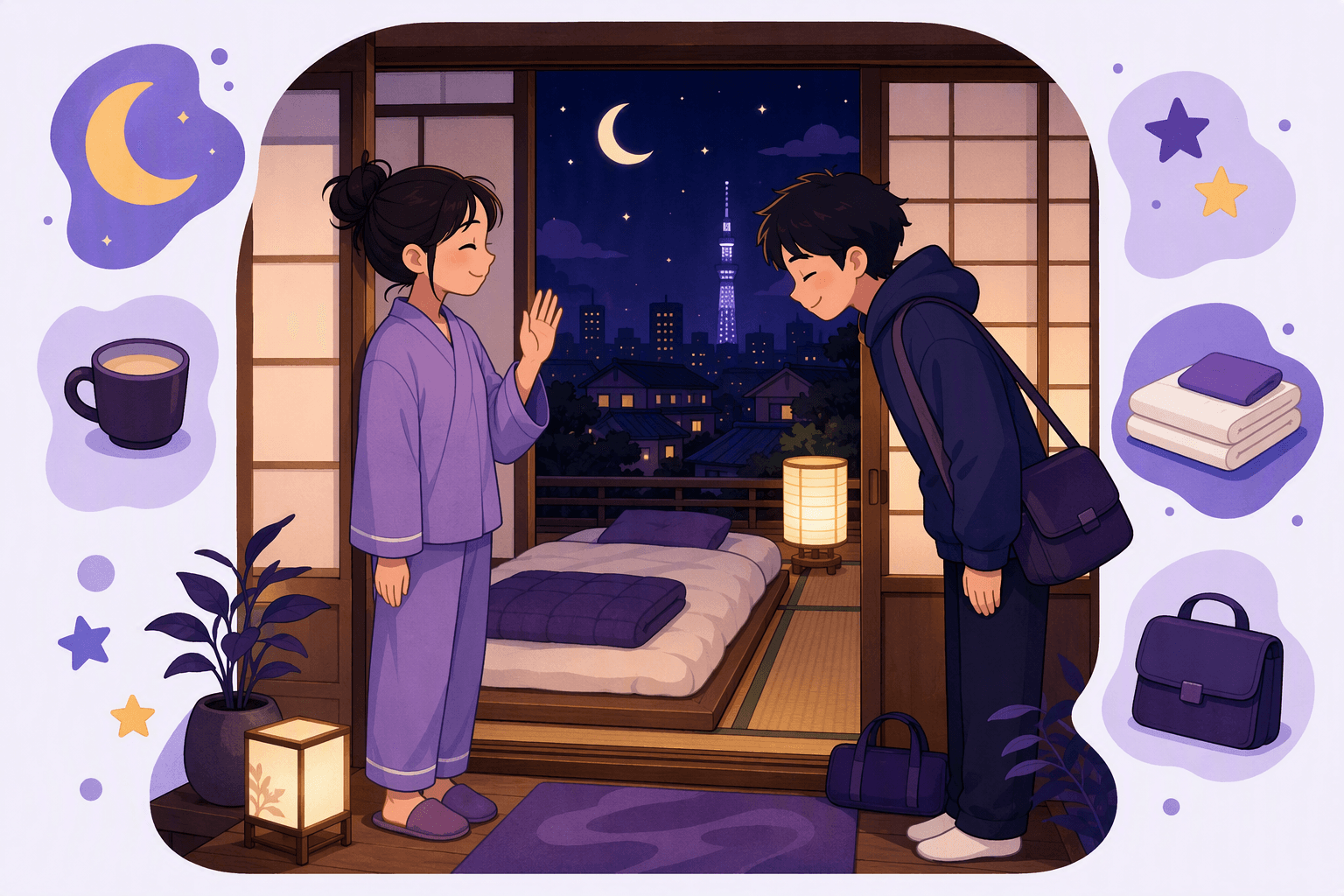
Quick Reference: Japanese Good Night Expressions at a Glance
| English | Japanese | Pronunciation | Formality |
|---|---|---|---|
| Good night (polite) | おやすみなさい (Oyasuminasai) | oh-yah-soo-mee-nah-sah-ee | polite |
| Good night (casual) | おやすみ (Oyasumi) | oh-yah-soo-mee | casual |
| Good night~ (playful) | おやすみ〜 (Oyasumi~) | oh-yah-soo-mee | casual |
| Good work today (evening farewell) | お疲れ様でした (Otsukaresama deshita) | oh-tsoo-kah-reh-sah-mah deh-shtah | polite |
| Sweet dreams | いい夢を (Ii yume wo) | ee yoo-meh woh | casual |
| Rest well | ゆっくり休んで (Yukkuri yasunde) | yook-koo-ree yah-soon-deh | casual |
| See you tomorrow | また明日 (Mata ashita) | mah-tah ah-shtah | casual |
| Have good dreams, okay? | いい夢見てね (Ii yume mite ne) | ee yoo-meh mee-teh neh | casual |
| I'm going to sleep now | もう寝るね (Mou neru ne) | moh neh-roo neh | casual |
| I'm leaving before you (work) | お先に失礼します (Osaki ni shitsurei shimasu) | oh-sah-kee nee shee-tsoo-reh shee-mahs | formal |
| Good night (very formal) | おやすみなさいませ (Oyasuminasaimase) | oh-yah-soo-mee-nah-sah-ee-mah-seh | very formal |
| Take care of yourself | 体に気をつけてね (Karada ni ki wo tsukete ne) | kah-rah-dah nee kee woh tsoo-keh-teh neh | casual |
| Good night (text slang) | おやすー (Oyasu-) | oh-yah-soo | slang |
| See you later | じゃあね (Jaa ne) | jah neh | casual |
| Well then, good night | それでは、おやすみなさい (Sore dewa, oyasuminasai) | soh-reh deh-wah oh-yah-soo-mee-nah-sah-ee | polite |
| Good night (Kansai dialect) | おやすみやす (Oyasumiyasu) | oh-yah-soo-mee-yah-soo | polite |
Standard Good Night Expressions
These are the core good-night phrases every Japanese learner needs. According to the Japan Foundation's 2021 survey on Japanese-language education abroad, greetings and farewells rank as the most-studied topic among the 3.8 million people learning Japanese worldwide, and good-night expressions are among the first farewell phrases taught.
おやすみなさい (Oyasuminasai)
/oh-yah-soo-mee-nah-sah-ee/
Literal meaning: Please rest (polite imperative)
“おやすみなさい、お母さん。明日は早いんだ。”
Good night, Mom. I have an early morning tomorrow.
The standard polite good-night expression. Works with family, acquaintances, hotel staff, teachers, and anyone you want to show basic respect to. Safe in virtually all non-workplace evening farewell situations.
Oyasuminasai is built from the verb yasumu (to rest), with the honorific prefix o- and the polite imperative nasai. You are literally saying "please rest" in a respectful way. It is the default good-night phrase in Japanese, the one you use when you are unsure which expression fits the situation.
Unlike English, where "good night" works universally, oyasuminasai occupies a specific politeness register. It is polite enough for your host family or a hotel receptionist, but among very close friends it can sound slightly stiff. Think of it as the equivalent of a warm but proper "good night" rather than a breezy "night!"
おやすみ (Oyasumi)
/oh-yah-soo-mee/
Literal meaning: Rest (casual)
“おやすみ!また明日ね。”
Good night! See you tomorrow.
The casual form used with friends, family, classmates, and romantic partners. Dropping 'nasai' signals familiarity and closeness. This is the good-night you hear most often in daily life among people who know each other well.
Simply drop the nasai from oyasuminasai and you have the casual good night. This mirrors the ohayou gozaimasu / ohayou pattern in morning greetings: the shorter form signals closeness and comfort. If you watch Japanese anime or dramas, oyasumi is the version you will hear most frequently in scenes between friends and family.
💡 The Formality Shortcut
A simple rule applies across many Japanese expressions: the shorter the phrase, the more casual it is. Oyasuminasai (polite) becomes Oyasumi (casual) becomes Oyasu- (slang). This pattern works for greetings, farewells, and many other daily phrases.
おやすみなさいませ (Oyasuminasaimase)
/oh-yah-soo-mee-nah-sah-ee-mah-seh/
Literal meaning: Please rest (very polite/honorific)
“おやすみなさいませ。ごゆっくりお休みくださいませ。”
Good night, sir/madam. Please rest at your leisure.
The highest formality level for good night. Used by hotel staff addressing guests, by ryokan (traditional inn) attendants, and in extremely formal situations. You will rarely say this yourself, but you may hear it directed at you in upscale Japanese hospitality settings.
This ultra-polite form adds -mase to the already polite oyasuminasai. You will encounter it primarily in Japanese hospitality: a ryokan attendant bidding you good night, a luxury hotel concierge, or high-end service environments. It reflects the Japanese concept of omotenashi (selfless hospitality), where the service provider elevates the guest through language.
Workplace Evening Farewells
Japanese work culture has its own distinct set of evening expressions. According to the Agency for Cultural Affairs' National Language Survey, over 90% of Japanese office workers use workplace-specific farewells rather than general good-night phrases when leaving the office. These expressions acknowledge shared effort and maintain workplace harmony.
お疲れ様でした (Otsukaresama deshita)
/oh-tsoo-kah-reh-sah-mah deh-shtah/
Literal meaning: You were honorably tired (past tense)
“お疲れ様でした!今日は本当に大変でしたね。”
Good work today! It was really tough today, wasn't it?
The standard end-of-workday farewell in Japan. It acknowledges the other person's effort and serves as both 'goodbye' and 'good night' in professional contexts. The past tense 'deshita' signals that the work period has ended.
Otsukaresama deshita is arguably the most important workplace phrase in Japanese. While oyasuminasai is for personal good nights, this expression is the evening farewell among colleagues. The past tense (deshita instead of desu) signals "the work is done for today," a subtle but meaningful distinction. You will hear it echoing through Japanese offices every evening as people leave.
🌍 Why Not 'Oyasuminasai' at the Office?
Saying oyasuminasai to a colleague when leaving work would sound odd, as it implies you are telling them to go to sleep, which is too personal for a workplace setting. Otsukaresama deshita is the culturally correct choice because it focuses on acknowledging work effort rather than personal rest.
お先に失礼します (Osaki ni shitsurei shimasu)
/oh-sah-kee nee shee-tsoo-reh shee-mahs/
Literal meaning: I will be rude by leaving before you
“お先に失礼します。お疲れ様でした。”
I'll head out first. Good work today.
Said when leaving the office before your colleagues are done working. The phrase is an apology for the perceived rudeness of leaving while others remain. It is often paired with 'Otsukaresama deshita' and reflects the deeply ingrained Japanese value of group harmony over individual convenience.
This phrase reveals a core aspect of Japanese work culture: leaving before your colleagues carries a faint sense of guilt. By saying osaki ni shitsurei shimasu (literally "I will commit the rudeness of going first"), you acknowledge that others are still working. It is not genuine guilt; it is a social ritual that maintains group cohesion. Colleagues who remain typically respond with otsukaresama deshita.
Casual and Friendly Good Night
These expressions are for close friends, classmates, and peers. They carry warmth and familiarity that would be inappropriate in formal settings.
おやすみ〜 (Oyasumi~)
/oh-yah-soo-mee/
Literal meaning: Good night~ (with trailing emphasis)
“じゃ、おやすみ〜。明日も頑張ろうね。”
Well then, good night~. Let's do our best tomorrow too.
The wave-mark (~) or elongation adds a soft, friendly, sometimes playful tone. Common in text messages and casual speech among friends and romantic partners. The tilde gives the word a gentle, drawn-out feeling that conveys warmth.
The trailing tilde (~) or nami-dash in Japanese adds a playful, gentle quality. In spoken Japanese, this manifests as a slightly elongated final vowel. In text messages and online chat, the tilde is ubiquitous among younger speakers. It softens the farewell and adds emotional warmth: the difference between a brisk "night" and a cozy "niight."
また明日 (Mata ashita)
/mah-tah ah-shtah/
Literal meaning: Again tomorrow
“楽しかったね。また明日!”
That was fun. See you tomorrow!
A casual farewell that works in the evening or at any time of day. Implies you will see the person the next day, commonly used among classmates, coworkers leaving together, and friends. Often combined with 'Oyasumi' for a complete evening farewell.
Mata ashita is the Japanese "see you tomorrow": simple, warm, and forward-looking. It pairs naturally with oyasumi for a complete casual farewell: Oyasumi! Mata ashita ne! (Good night! See you tomorrow!). The particle ne at the end adds a soft, confirming tone, like the English "right?" or "okay?"
じゃあね (Jaa ne)
/jah neh/
Literal meaning: Well then (see you)
“もう遅いし、じゃあね。おやすみ。”
It's getting late, so, see ya. Good night.
A general-purpose casual farewell that works at any time of day, including evenings. Often used as a transition into 'Oyasumi' when parting for the night. Very natural among friends and peers.
While not exclusively a nighttime expression, jaa ne is the casual "bye" that frequently precedes oyasumi when friends part in the evening. It establishes the farewell, and oyasumi seals it. In anime and Japanese films, this two-part structure (jaa ne followed by oyasumi) is one of the most common evening farewell patterns you will encounter. Our guide to the best movies for learning Japanese features titles packed with these natural exchanges.
Bedtime and Caring Expressions
These phrases go beyond a simple "good night" to express genuine care for the other person's rest and well-being. They are especially common between family members, close friends, and romantic partners.
いい夢を (Ii yume wo)
/ee yoo-meh woh/
Literal meaning: Good dreams (to you)
“おやすみ。いい夢を。”
Good night. Sweet dreams.
The Japanese equivalent of 'sweet dreams.' Often added after 'Oyasumi' to express warmth and affection. Common between romantic partners and close friends. The particle 'wo' implies 'may you have'; the full underlying sentence is 'Ii yume wo mite kudasai' (please see good dreams).
Ii yume wo is a truncated phrase; the complete version would be ii yume wo mite kudasai (please see good dreams). Japanese uses the verb miru (to see) with dreams, rather than "have" as in English. This creates a slightly more visual and poetic nuance: you are wishing someone beautiful visions in their sleep.
いい夢見てね (Ii yume mite ne)
/ee yoo-meh mee-teh neh/
Literal meaning: See good dreams, okay?
“今日は楽しかったね。いい夢見てね!”
Today was fun, wasn't it? Have sweet dreams!
A warmer, more complete version of 'Ii yume wo.' The ending particle 'ne' adds gentle encouragement. Particularly popular in text messages between couples and close friends. Carries a tender, slightly intimate tone.
This fuller form adds the verb mite (see/watch) and the soft particle ne, making it feel warmer and more personal than the abbreviated ii yume wo. It is the kind of phrase you would text a partner before sleep or say to a child at bedtime. The ne at the end functions like a gentle "okay?", inviting agreement and closeness.
ゆっくり休んで (Yukkuri yasunde)
/yook-koo-ree yah-soon-deh/
Literal meaning: Rest slowly / Rest at your leisure
“最近忙しかったでしょう?ゆっくり休んでね。”
You've been busy lately, right? Get some good rest.
Expresses genuine concern for someone's well-being. Often said to someone who has been working hard, is feeling unwell, or seems tired. It carries more emotional weight than a simple 'Oyasumi'; it shows you have noticed the other person's fatigue and care about their recovery.
Yukkuri means "slowly" or "at ease," and yasunde is the casual imperative of yasumu (to rest). Together, they convey "take your time resting," a phrase that shows attentiveness. In Japanese culture, noticing that someone is tired and explicitly encouraging their rest is a meaningful act of care. You might hear this in anime when one character is worried about another pushing themselves too hard.
もう寝るね (Mou neru ne)
/moh neh-roo neh/
Literal meaning: I'm going to sleep now, okay?
“もう寝るね。おやすみ!”
I'm heading to bed now. Good night!
A casual announcement that you are going to sleep, often used in text conversations or late-night chats as a way to signal the conversation is ending. Natural and common among friends and partners. The 'ne' softens it into a gentle notification rather than an abrupt cutoff.
This is less a farewell and more a bedtime announcement: "I'm going to sleep now." It works perfectly in late-night text exchanges where you want to signal that the conversation is winding down without being abrupt. The particle ne is essential here: without it, mou neru sounds blunt. With ne, it becomes a soft notification that invites a reciprocal oyasumi.
体に気をつけてね (Karada ni ki wo tsukete ne)
/kah-rah-dah nee kee woh tsoo-keh-teh neh/
Literal meaning: Please take care of your body, okay?
“風邪が流行ってるから、体に気をつけてね。おやすみ。”
Colds are going around, so take care of yourself. Good night.
Expresses concern for someone's physical health. Often paired with 'Oyasumi' when the other person is unwell, overworked, or during cold/flu season. Shows a deeper level of personal care than standard good-night phrases.
This expression extends beyond a simple good night into genuine concern for health. Japanese culture places high value on expressing care through practical concern, and telling someone to look after their body is one of the most common ways to do so. It is especially natural during seasonal changes, flu season, or when the other person has mentioned feeling unwell.
Texting and Digital Good Night
Younger Japanese speakers have developed shortened and stylized versions of good-night expressions for text messages, LINE (Japan's dominant messaging app), and social media.
おやすー (Oyasu-)
/oh-yah-soo/
Literal meaning: G'night (abbreviated slang)
“おやすー!また明日ね〜”
G'night! See ya tomorrow~
A texting abbreviation popular among younger Japanese speakers. Truncates 'Oyasumi' even further. Used exclusively in written digital communication; you would rarely say this out loud. Common on LINE, Twitter/X, and among high school and university students.
Just as English speakers shorten "good night" to "night" or "nite" in texts, Japanese speakers clip oyasumi down to oyasu-. The long dash (ー) represents the trailing vowel. This is strictly digital slang; you would not say it face to face. According to NHK's research on language trends, abbreviated expressions like this are increasingly common in digital communication among Japanese speakers under 30.
Regional and Formal Variants
おやすみやす (Oyasumiyasu)
/oh-yah-soo-mee-yah-soo/
Literal meaning: Please rest (Kansai/Kyoto dialect)
“ほな、おやすみやす。”
Well then, good night. (Kyoto dialect)
A Kyoto/Kansai dialect variant of 'Oyasuminasai.' The suffix '-yasu' replaces '-nasai' and is characteristic of traditional Kyoto speech. You will hear it in Kyoto's older neighborhoods, traditional businesses, and in media set in the Kansai region. It carries an elegant, slightly old-fashioned charm.
Kyoto dialect (Kyo-kotoba) replaces the standard -nasai ending with -yasu, giving good-night expressions a distinctly elegant and traditional sound. While not widely used outside the Kansai region, you will encounter it in period dramas, Kyoto-set stories, and from older residents of Kyoto. It reflects the city's long history as Japan's imperial capital and cultural center.
それでは、おやすみなさい (Sore dewa, oyasuminasai)
/soh-reh deh-wah oh-yah-soo-mee-nah-sah-ee/
Literal meaning: Well then, please rest
“今日はありがとうございました。それでは、おやすみなさい。”
Thank you for today. Well then, good night.
A complete, well-structured farewell used when formally closing an evening conversation or event. The 'Sore dewa' (well then) provides a polished transition. Common at the end of evening gatherings, dinner parties, and phone conversations.
Adding sore dewa (well then) before oyasuminasai creates a more structured, deliberate farewell. It signals that you are consciously wrapping up the interaction, appropriate for ending a dinner gathering, a phone call, or an evening meeting. It carries a sense of proper closure that a standalone oyasuminasai does not.
Good Night in Anime and Japanese Media
Japanese anime and dramas are a window into how good-night expressions function in natural contexts. Bedtime scenes appear frequently across genres, and the choice of expression reveals character relationships instantly.
In slice-of-life anime, family members exchange oyasumi or oyasuminasai depending on the household's level of formality. A child saying oyasuminasai to their parents and receiving an oyasumi back is a common pattern: the child uses the polite form upward, while the parent uses the casual form downward.
Romantic anime often feature ii yume wo or ii yume mite ne in emotionally charged scenes, where a character wishing their love interest sweet dreams becomes a moment of vulnerability and tenderness. Meanwhile, workplace anime like Aggretsuko or Servant x Service showcase otsukaresama deshita as the universal office farewell.
Wordy lets you watch these scenes with interactive subtitles. Tap on any good-night expression to see its romaji, meaning, formality level, and cultural context in real time. It is the fastest way to move from textbook knowledge to natural comprehension.
How to Respond to Good Night in Japanese
Responding correctly is just as important as initiating. Japanese good-night responses follow predictable patterns based on formality.
| They Say | You Say | Context |
|---|---|---|
| おやすみなさい (Oyasuminasai) | おやすみなさい (Oyasuminasai) | Echo the polite form back |
| おやすみ (Oyasumi) | おやすみ (Oyasumi) | Echo the casual form |
| お疲れ様でした (Otsukaresama deshita) | お疲れ様でした (Otsukaresama deshita) | Standard workplace echo |
| お先に失礼します (Osaki ni shitsurei shimasu) | お疲れ様でした (Otsukaresama deshita) | Acknowledge their departure |
| いい夢を (Ii yume wo) | ありがとう、おやすみ (Arigatou, oyasumi) | Thank them, then say good night |
| もう寝るね (Mou neru ne) | おやすみ!(Oyasumi!) | Acknowledge and wish them good night |
| ゆっくり休んで (Yukkuri yasunde) | ありがとう。おやすみ (Arigatou. Oyasumi) | Thank them for their concern |
🌍 The Echoing Principle
As with Japanese greetings, the safest response to a good-night expression is often to echo the same phrase back. This is not robotic in Japanese; it is the expected, respectful response. The key exception is Osaki ni shitsurei shimasu at work, where the correct reply is Otsukaresama deshita, not an echo.
Practice With Real Japanese Content
Reading about good-night expressions gives you the knowledge, but hearing them spoken naturally, with proper intonation, rhythm, and emotional tone, is what makes them stick. The difference between a flat oyasumi and a warm, drawn-out oyasumiii is something you can only learn from hearing native speakers in context.
Wordy lets you watch Japanese movies, anime, and shows with interactive subtitles that break down every phrase in real time. Tap on any good-night expression to see its meaning, romaji, formality level, and cultural notes. Instead of memorizing from a list, you absorb these phrases from authentic conversations.
For more Japanese language content, explore our blog for guides on everything from greetings to the best movies for learning Japanese. Start practicing with real content on our Japanese learning page today.
Frequently Asked Questions
What is the difference between 'Oyasuminasai' and 'Oyasumi'?
Is 'Oyasumi' rude to say in Japanese?
Why do Japanese coworkers say 'Otsukaresama deshita' instead of good night?
How do you say good night to a romantic partner in Japanese?
What do anime characters typically say for good night?
Can 'Konbanwa' be used to say good night in Japanese?
Sources & References
- Makino, S. & Tsutsui, M. (1986). 'A Dictionary of Basic Japanese Grammar.' The Japan Times.
- NHK World-Japan, Japanese Language Lessons: Greetings and Everyday Expressions
- Agency for Cultural Affairs, Japan, National Language Survey (2023)
- The Japan Foundation, Survey Report on Japanese-Language Education Abroad (2021)
Start learning with Wordy
Watch real movie clips and build your vocabulary as you go. Free to download.


