Japanese Holidays and Festivals: 12 Celebrations You’ll Actually See (and What People Say)
Quick Answer
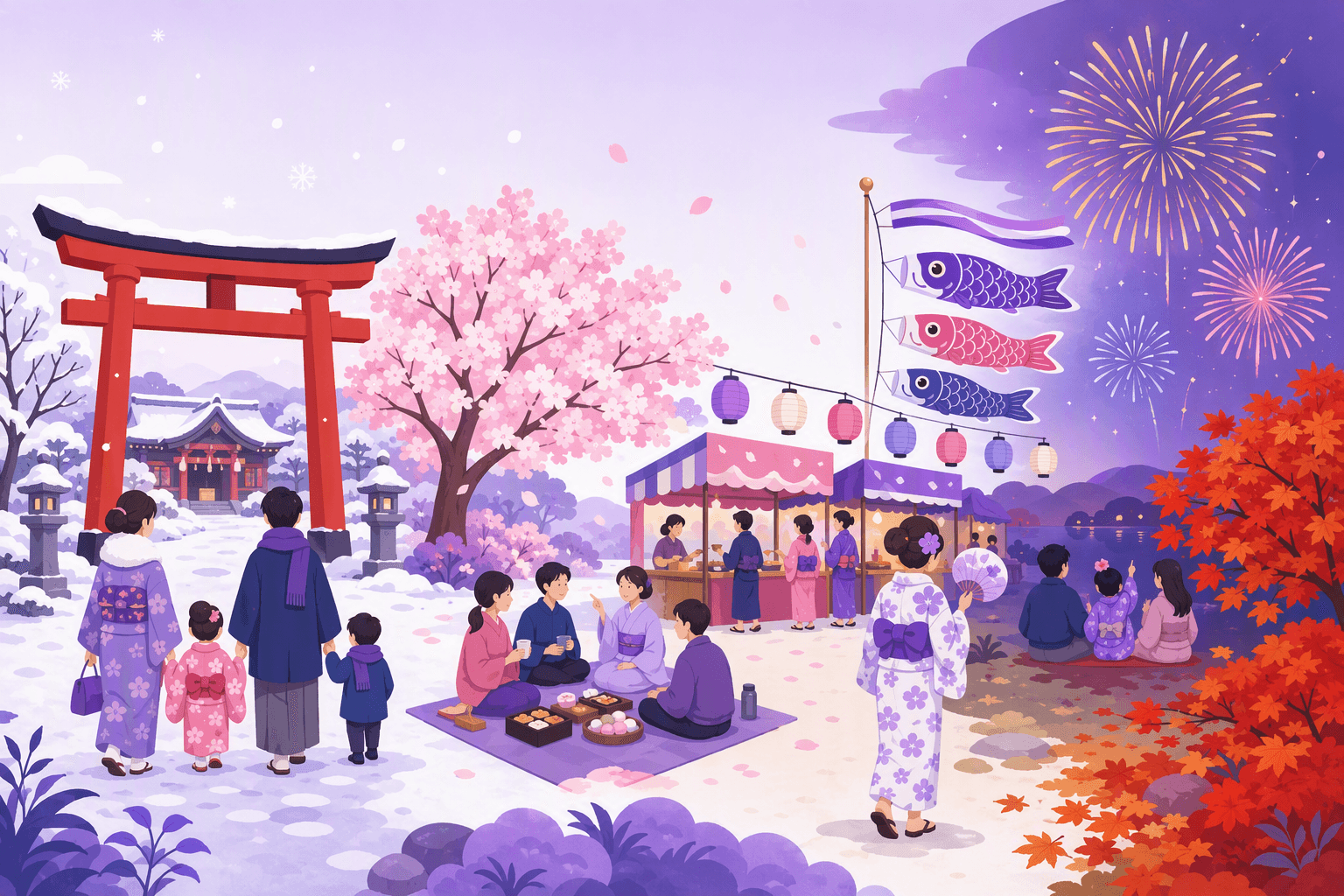
Japanese holidays and festivals follow a clear rhythm: New Year’s (Shōgatsu) is the biggest family holiday, spring brings hanami and Golden Week travel, summer is matsuri and Obon, and autumn to winter features harvest events and year-end parties. This guide explains what each celebration means, what you’ll see, and the natural Japanese phrases people actually say.
Japanese holidays and festivals are easiest to understand as a yearly cycle: New Year’s is the biggest family holiday, spring is blossom viewing and Golden Week travel, summer is matsuri and Obon, and autumn to winter brings harvest events, culture days, and year-end parties. If you know what happens in each season and the few set phrases people repeat, you can follow most celebrations without feeling lost.
Japan has about 125 million people, and Japanese is spoken by roughly 123 million speakers worldwide (Ethnologue, 27th edition, 2024). That means you will hear these holiday phrases constantly in real media, especially if you learn with clips from dramas, anime, and variety shows. If you want a warm-up for everyday greetings first, start with how to say hello in Japanese and come back here.
How Japanese holidays work (so dates make sense)
Japan has official public holidays set by law, plus major seasonal events that are not always public holidays but still change daily life. The Cabinet Office publishes the national holiday calendar (Cabinet Office, Government of Japan, accessed 2026), and those dates drive school schedules, travel peaks, and TV programming.
A second layer is matsuri (festivals) that are local, shrine-based, and often tied to a neighborhood or city identity. The Agency for Cultural Affairs and UNESCO both document traditional festivals and performing arts as cultural heritage (Agency for Cultural Affairs, accessed 2026; UNESCO, accessed 2026).
For language learners, this matters because “holiday Japanese” has two flavors: fixed greetings (especially New Year’s) and flexible reactions (food, fireworks, costumes, crowds).
💡 A simple rule for sounding natural
If you are not sure what to say, use short reactions plus politeness: すごい (SOO-goh-ee, “wow”), きれい (kee-REH-ee, “pretty”), おいしい (oh-EE-shee, “tasty”), and ありがとうございます (ah-ree-GAH-toh goh-zah-ee-MAHSS, “thank you”). These fit almost any festival moment.
12 Japanese holidays and festivals you’ll actually see
お正月
お正月 (Shōgatsu, “New Year’s”) is the biggest holiday season in Japan, closer in feel to a combined Christmas and New Year period in many Western countries. People return to their hometowns, eat osechi, and visit shrines or temples for hatsumōde (first visit of the year).
What you’ll see in media: family dinners, crowded stations, shrine visits, and characters saying formal greetings to coworkers.
What people say:
- あけましておめでとうございます (ah-keh-MAH-sheh-teh oh-meh-DEH-toh goh-zah-ee-MAHSS): “Happy New Year” (polite)
- 今年もよろしくお願いします (koh-TOH-shee moh yoh-roh-SHEE-koo oh-neh-GAH-ee-shee-mahss): “Please take care of me this year too” (a set phrase for relationships)
If you want to recognize the rhythm of polite Japanese, this is a great season to practice, because the same phrases repeat across shows and real life.
初詣
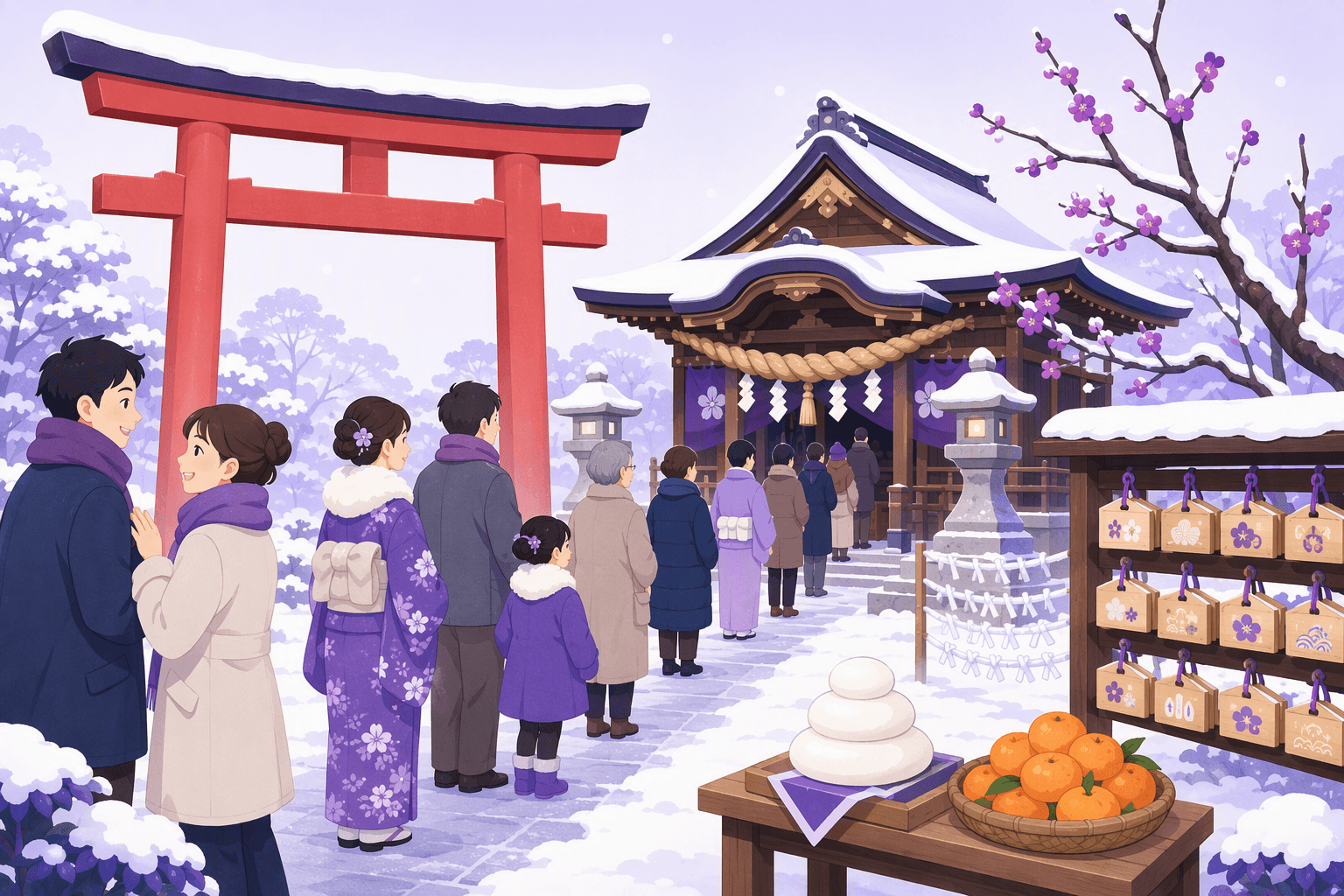
初詣 (hatsumōde, “first shrine or temple visit”) is technically part of New Year’s, but it is so culturally visible that it deserves its own slot. People line up to pray for health, exams, work success, or relationships, then buy omikuji fortunes and protective charms.
You’ll hear a lot of quiet, polite language here, plus small talk about fortunes. If someone gets a bad fortune, the common move is tying it up at the shrine and laughing it off.
Cultural note: Linguist Haruo Shirane, in his work on Japanese seasonal culture and literature, emphasizes how strongly seasonality structures Japanese aesthetics and social life. Hatsumōde is a modern example of that seasonal “reset” feeling.
節分
節分 (Setsubun, “seasonal division”) is usually in early February and is famous for bean-throwing to drive out bad luck. The chant is short and memorable: 鬼は外, 福は内.
What you’ll see: kids throwing beans at a parent wearing an oni mask, and people eating ehōmaki (a thick sushi roll) facing a lucky direction.
What people say:
- 鬼は外 (oh-NEE wah SOH-toh): “Demons out”
- 福は内 (foo-koo wah oo-CHEE): “Fortune in”
ひな祭り
ひな祭り (Hinamatsuri, “Doll Festival”) on March 3 celebrates girls and is marked by hina doll displays. In homes, schools, and shops, you’ll see tiered dolls representing the imperial court.
In dramas, it often appears as a seasonal background detail that signals “early spring.” The language around it is simple, usually just naming the event and commenting on the dolls.
花見
花見 (hanami, “flower viewing”) is not a public holiday, but it is one of the most visible seasonal customs. People picnic under cherry blossoms, often with coworkers or friends, and parks get crowded.
What you’ll hear: people praising the blossoms and the weather, and a lot of casual invitations.
Useful reactions:
- きれい (kee-REH-ee): “So pretty”
- 満開だね (mahn-KAI dah neh): “They’re in full bloom, huh”
If you are learning through media, hanami episodes are great listening practice because the setting forces repeated, concrete vocabulary (trees, petals, wind, food, photos).
ゴールデンウィーク
ゴールデンウィーク (gōruden wīku, “Golden Week”) is a late April to early May cluster of public holidays. It is one of Japan’s biggest domestic travel peaks, so prices rise and transport gets packed.
The key holidays inside it include:
- 昭和の日 (Shōwa Day)
- 憲法記念日 (Constitution Memorial Day)
- みどりの日 (Greenery Day)
- こどもの日 (Children’s Day)
The Cabinet Office holiday calendar is the authoritative reference for the exact dates each year (Cabinet Office, Government of Japan, accessed 2026).
こどもの日
こどもの日 (Kodomo no Hi, “Children’s Day”) on May 5 is famous for carp streamers (koinobori) and samurai helmet displays. It is historically connected to boys’ celebrations, but today it is framed as a day for children’s happiness in general.
What you’ll see: koinobori outside houses and in parks, and sweets like kashiwa mochi.
What people say is usually straightforward: こどもの日だね, and comments about the carp streamers.
七夕
七夕 (Tanabata) is the star festival, associated with Orihime and Hikoboshi. People write wishes on tanzaku paper strips and hang them on bamboo branches.
Pronunciation note: Tanabata is ta-NAH-bah-tah, with each beat clear.
What you’ll see: colorful streamers, wish strips, and summer decorations in shopping streets.
What people say:
- 願い事書いた (neh-GAH-ee-goh-toh KAI-tah): “I wrote a wish”
- 叶うといいね (kah-NAH-oo toh EE-neh): “Hope it comes true”
夏祭り
夏祭り (natsu matsuri, “summer festivals”) is a category more than a single date. This is the world of yukata, food stalls, goldfish scooping, and fireworks.
The Japan National Tourism Organization highlights major festivals and seasonal events for travelers (JNTO, accessed 2026). Even if you never attend a famous one, local summer matsuri are common across the country.
Language you will actually use:
- 浴衣着た (yoo-KAH-tah KEE-tah): “I wore a yukata”
- 屋台行こう (yah-TAI ee-KOH): “Let’s go to the stalls”
If you want to avoid awkward moments, keep your language polite and neutral. Save edgy vocabulary for close friends, and if you are curious about what not to say, see our guide to Japanese swear words.
お盆
お盆 (Obon) is a mid-August season for honoring ancestors. Families travel back to their hometowns, visit graves, and in many places attend bon odori dances.
It is not a single nationwide public holiday, but it strongly affects travel and business schedules. In media, Obon often signals “going home,” family dynamics, and quiet emotional scenes.
Cultural note: Anthropologist Joy Hendry, in her writing on Japanese society and ritual, treats seasonal observances as a key place where social roles become visible. Obon is a clear example, because it pulls people back into family and hometown networks.
紅葉
紅葉 (kōyō, “autumn leaves”) is another seasonal event rather than a public holiday. Like hanami, it creates travel spikes and lots of photo-taking, especially in Kyoto and mountain areas.
Pronunciation: koh-YOH, with the long oh.
What you’ll hear:
- 紅葉きれい (koh-YOH kee-REH-ee): “The leaves are beautiful”
- 見に行きたい (mee-nee ee-KEE-tai): “I want to go see them”
大晦日
大晦日 (Ōmisoka, “New Year’s Eve”) is the year-end wrap-up day. People clean, finish work, eat toshikoshi soba, and watch year-end TV programs. At midnight, many visit shrines or temples.
Work culture note: year-end parties (忘年会, bōnenkai) often happen in December. Even if you skip alcohol, you can still participate socially with simple phrases and polite thanks.
If you are learning relationship language for this season, pair this guide with how to say goodbye in Japanese, because you will hear end-of-year farewells and “see you next year” lines constantly.
What people actually say at festivals (without sounding like a textbook)
Japanese “festival talk” is often less about long sentences and more about short, shared reactions. This matches what sociolinguist Shigeko Okamoto has described in her research on Japanese style and gendered speech: speakers choose small, socially meaningful options rather than “one correct sentence.”
すごい
すごい (SOO-goh-ee) is the all-purpose “wow.” It can mean impressive, intense, or unexpectedly good, depending on tone.
Use it for fireworks, dances, costumes, crowds, and even food.
きれい
きれい (kee-REH-ee) is “pretty” or “beautiful,” and it is perfect for blossoms, lanterns, illuminations, and summer festival nights.
It is also safe, because it does not force you into slang or over-familiarity.
おいしい
おいしい (oh-EE-shee) is “tasty.” At festivals, it is one of the most natural things to say because you are constantly eating.
If you want to sound extra natural, add a softener:
- おいしいね (oh-EE-shee neh): “It’s good, huh”
いただきます
いただきます (ee-tah-dah-kee-MAHSS) is said before eating. It is not “bon appétit” exactly, but it fills that social role at the table or even standing by a stall.
You will hear it constantly in food scenes, so it is a high-return phrase for learners.
Regional reality: “Japanese festivals” are local first
It is tempting to think of Japan as having one shared festival calendar. In practice, many of the most intense matsuri are local, tied to a shrine, a neighborhood association, and a city’s history.
That is why travel resources like JNTO organize festivals by region and season rather than pretending there is one national lineup (JNTO, accessed 2026). It is also why UNESCO’s Intangible Cultural Heritage entries often describe specific communities and transmission practices, not just a generic “festival” label (UNESCO, accessed 2026).
🌍 Why you keep hearing 'matsuri' in shows
Matsuri scenes are an easy storytelling device: they put characters in public, in yukata, with food and games, and they create a reason for chance meetings. If you learn Japanese with clips, matsuri episodes give you repeated listening practice with the same setting vocabulary.
A practical way to learn holiday Japanese with movie and TV clips
If your goal is to understand holidays in real Japanese, aim for three skills: recognize the event name, catch the set greeting (New Year’s), and respond with short reactions.
A simple routine:
- Watch one clip from a holiday episode and write down 5 words you heard.
- Rewatch and shadow the short reactions (すごい, きれい, おいしい).
- Add one “relationship phrase” you can reuse, like よろしくお願いします.
For greeting-heavy scenes, review how to say hello in Japanese. For emotional holiday episodes, it helps to know how affection is actually expressed, so how to say I love you in Japanese is a useful companion.
⚠️ Avoid the 'festival Japanese' trap
Learners sometimes overuse anime-style lines or harsh slang at festivals because it feels fun. In real public settings, especially around families and shrines, neutral polite language is the safest default. If you are unsure, keep it simple and polite.
Mini phrasebook: holiday and festival words you will see on signs
These are not “magic phrases,” but they help you decode posters, station ads, and episode titles.
- 祭り (maht-soo-ree): festival
- 屋台 (yah-tai): food stall
- 神社 (jin-jah): Shinto shrine
- お寺 (oh-teh-rah): Buddhist temple
- 花火 (hah-nah-bee): fireworks
- 浴衣 (yoo-kah-tah): summer kimono
- 願い事 (neh-gah-ee-goh-toh): wish
- 参拝 (sahn-pai): shrine visit, worship visit
If you want broader everyday vocabulary to support listening, work through the 100 most common Japanese words alongside holiday episodes.
Closing: what to remember
If you remember only four anchors, you can follow most Japanese holiday talk: Shōgatsu is the big family season, Golden Week is the big travel block, summer is matsuri plus Obon, and hanami and kōyō are the two “go look at nature” seasons. Add a few short reactions, and you will sound present and polite even when you do not know every word.
To practice this in real context, learn with short scenes that include crowds, food, and greetings, then repeat the same phrases until they feel automatic. You can browse more learning guides on the Wordy blog and build a seasonal playlist of clips that match the time of year.
Frequently Asked Questions
What is the biggest holiday in Japan?
What is Golden Week in Japan?
What is Obon, and is it a national holiday?
Do Japanese people celebrate Christmas?
What should I say at Japanese festivals and holidays?
Sources & References
- Agency for Cultural Affairs (Japan), Cultural Heritage and Festivals pages, accessed 2026
- Japan National Tourism Organization (JNTO), Festivals and Events, accessed 2026
- Cabinet Office, Government of Japan, National Holidays (国民の祝日), accessed 2026
- UNESCO, Intangible Cultural Heritage lists (Japan entries), accessed 2026
- Ethnologue, 27th edition, 2024
Start learning with Wordy
Watch real movie clips and build your vocabulary as you go. Free to download.


