Quick Answer
The most common way to say hello in Japanese is 'Konnichiwa' (こんにちは, kohn-nee-chee-wah). It works in most everyday situations. But Japanese has a rich system of greetings tied to time of day, social hierarchy, and setting; from the casual 'Yaa' (やあ) among close friends to the ultra-polite 'Ohayou gozaimasu' (おはようございます) in business contexts.
The Short Answer
The most common way to say hello in Japanese is Konnichiwa (こんにちは, kohn-nee-chee-wah). It covers most daytime situations and is universally understood. But Japanese greetings go far deeper than a single word. The language has an entire system of politeness levels that determine which greeting you should use and when.
Japanese is spoken by approximately 125 million people, the vast majority in Japan, according to Ethnologue's 2024 data. Unlike many Western languages where one "hello" fits most contexts, Japanese culture demands careful attention to social hierarchy, time of day, and the relationship between speakers. The Japan Foundation's 2021 survey found that greetings are the single most-studied topic among the 3.8 million people learning Japanese worldwide, because getting them right is essential.
"In Japanese communication, the greeting is not merely a social formality but a statement of your understanding of the relationship. Choosing the wrong level of politeness can create more discomfort than saying nothing at all."
(Seiichi Makino, A Dictionary of Basic Japanese Grammar, The Japan Times, 1986)
This guide covers 17 essential Japanese greetings organized by category: universal, casual, formal and business (keigo), phone greetings, and homecoming expressions. Each includes the Japanese script, romaji pronunciation, and cultural context so you know exactly when and where to use it.

Quick Reference: Japanese Greetings at a Glance
| English | Japanese | Pronunciation | Formality |
|---|---|---|---|
| Hello (daytime) | こんにちは (Konnichiwa) | kohn-nee-chee-wah | polite |
| Good morning (polite) | おはようございます (Ohayou gozaimasu) | oh-hah-yoh goh-zah-ee-mahs | polite |
| Good morning (casual) | おはよう (Ohayou) | oh-hah-yoh | casual |
| Good evening | こんばんは (Konbanwa) | kohn-bahn-wah | polite |
| Hey / Hi | やあ (Yaa) | yah | casual |
| Hey (masculine) | おっす (Ossu) | ohss | slang |
| How are you? | お元気ですか (Ogenki desu ka) | oh-gehn-kee dehs-kah | polite |
| Thanks / Hey (casual) | どうも (Doumo) | doh-moh | casual |
| Long time no see | お久しぶりです (Ohisashiburi desu) | oh-hee-sah-shee-boo-ree dehs | polite |
| Hello? (phone) | もしもし (Moshi moshi) | moh-shee moh-shee | casual |
| Welcome (to a shop) | いらっしゃいませ (Irasshaimase) | ee-rahs-shah-ee-mah-seh | formal |
| I'm home | ただいま (Tadaima) | tah-dah-ee-mah | casual |
| Welcome home | おかえり (Okaeri) | oh-kah-eh-ree | casual |
| Pleased to meet you | はじめまして (Hajimemashite) | hah-jee-meh-mah-shteh | polite |
| Please take care of me | よろしくお願いします (Yoroshiku onegaishimasu) | yoh-roh-shee-koo oh-neh-gah-ee-shee-mahs | formal |
| Thank you for your hard work | お疲れ様です (Otsukaresama desu) | oh-tsoo-kah-reh-sah-mah dehs | polite |
| Excuse me / Hello | すみません (Sumimasen) | soo-mee-mah-sehn | polite |
Universal Greetings
These greetings are understood across all of Japan and work in most everyday situations. According to NHK World-Japan's language education materials, mastering these three time-based greetings covers the vast majority of daily interactions.
こんにちは (Konnichiwa)
/kohn-nee-chee-wah/
Literal meaning: As for this day (abbreviated from a longer classical phrase)
“こんにちは、田中さん。いい天気ですね。”
Hello, Tanaka-san. Nice weather, isn't it?
The all-purpose daytime greeting. Works from late morning through early evening. Appropriate with strangers, acquaintances, and in most public situations.
Konnichiwa is the greeting most foreigners learn first, and for good reason: it covers the broadest range of situations. It originates from the classical phrase konnichi wa gokiken ikaga desu ka (How are you feeling today?), which was shortened over centuries to just konnichiwa.
One important note: among close friends, konnichiwa can actually sound too formal and distant. If you are greeting a good friend, yaa or ossu (covered below) would be more natural. Think of konnichiwa as equivalent to a polite "hello" rather than a casual "hey."
おはようございます (Ohayou gozaimasu)
/oh-hah-yoh goh-zah-ee-mahs/
Literal meaning: It is early (polite form)
“おはようございます、先生。今日もよろしくお願いします。”
Good morning, teacher. Thank you for today as well.
The standard morning greeting used with colleagues, strangers, and superiors. In workplaces, this is mandatory regardless of your relationship; even the CEO says it to the janitor.
This is the polite morning greeting, used from waking hours until around 10-11 AM. The word hayou comes from hayai (early), so you are literally saying "it is early" in a respectful way. In Japanese workplaces, ohayou gozaimasu is the universal morning greeting, and skipping it would be considered rude, according to the Agency for Cultural Affairs' National Language Survey.
🌍 The Entertainment Industry Exception
In the Japanese entertainment and broadcasting industries, ohayou gozaimasu is used as a greeting at ANY time of day, even at midnight. If you walk onto a film set at 10 PM, you still say ohayou gozaimasu. This quirk has spread to other creative industries in Japan.
こんばんは (Konbanwa)
/kohn-bahn-wah/
Literal meaning: As for this evening
“こんばんは。今夜の会議に参加できますか?”
Good evening. Can you attend tonight's meeting?
Used from late afternoon/early evening onward. Like Konnichiwa, it works across formality levels but is more polite than casual. The exact switch time from Konnichiwa to Konbanwa is flexible, roughly when the sun starts setting.
The evening counterpart to konnichiwa. The transition point is flexible, but most Japanese speakers switch to konbanwa around sunset or 5-6 PM. Like konnichiwa, it originated from a longer classical phrase: konban wa gokigen ikaga desu ka (How are you feeling this evening?).
Casual Greetings
These are the greetings you will hear among friends, classmates, and people of similar age and status. Japanese casual speech drops the polite suffixes and uses shorter, more direct forms.
やあ (Yaa)
/yah/
Literal meaning: Hey
“やあ、久しぶり!最近どう?”
Hey, long time no see! How have you been?
A casual, friendly greeting used between close friends. Gender-neutral and warm. Think of it as the Japanese equivalent of a quick 'hey' or 'hi' in English.
Yaa is as casual as Japanese greetings get. It works at any time of day but only with people you know well. Using it with a stranger or superior would be a significant social misstep. You will hear it frequently in anime and Japanese films. Check out our guide to the best movies for learning Japanese for authentic examples.
おっす (Ossu)
/ohss/
Literal meaning: Contraction of 'Ohayou gozaimasu'
“おっす!今日、サッカーやる?”
Hey! Are we playing soccer today?
Originally from martial arts dojos, now common among young men as a casual hello. Traditionally masculine, though usage is slowly broadening among younger generations.
Ossu originated as a contraction of ohayou gozaimasu in martial arts dojos, where it was barked as a sharp acknowledgment. It migrated into casual young male speech and is now a common greeting among friends, particularly in sporty or informal settings.
おはよう (Ohayou)
/oh-hah-yoh/
Literal meaning: It is early (casual)
“おはよう!朝ごはんもう食べた?”
Morning! Have you eaten breakfast yet?
The casual version of 'Ohayou gozaimasu,' stripped of the polite suffix. Use with friends, family, and people your age or younger.
Simply drop the gozaimasu and you have the casual morning greeting. This is what you would say to a roommate, sibling, or close friend. The shift between ohayou and ohayou gozaimasu is one of the clearest examples of Japanese politeness levels in action.
どうも (Doumo)
/doh-moh/
Literal meaning: Somehow / Indeed / Very much
“あ、どうも。ちょうど電話しようと思ってた。”
Oh, hey. I was just about to call you.
An incredibly versatile word. It functions as a casual greeting, a quick thank-you, and an informal acknowledgment. Often combined: 'Doumo doumo' for emphasis.
Doumo is one of the most versatile words in Japanese. It can mean "hello," "thanks," "sorry," or "indeed" depending on context. As a greeting, it functions as a casual, low-key acknowledgment, something like "hey" or a quick nod in English. You will often hear doumo doumo (doubled for emphasis) between acquaintances who bump into each other.
Formal and Business Greetings (Keigo)
Japanese keigo (敬語, honorific language) is a structured system of politeness that permeates the language. According to the Agency for Cultural Affairs' 2023 National Language Survey, 89% of Japanese adults consider proper keigo essential in workplace communication. These greetings reflect that cultural priority.
お元気ですか (Ogenki desu ka)
/oh-gehn-kee dehs-kah/
Literal meaning: Are you well/healthy?
“お元気ですか?お変わりないですか?”
How are you? Have you been well?
Unlike the English 'How are you?', this is NOT used as a routine greeting with people you see daily. Reserve it for people you haven't seen in a while. Using it with a coworker you saw yesterday would sound strange.
A critical cultural difference: unlike the English "how are you?" which is a daily throwaway greeting, ogenki desu ka carries genuine weight. It implies you have not seen the person recently and are sincerely asking about their well-being. The prefix o- adds politeness to genki (health/energy).
⚠️ Common Mistake
Do not use Ogenki desu ka as a daily greeting like the English "How are you?" Japanese people greet daily contacts with time-of-day greetings instead. Reserve Ogenki desu ka for reunions or people you see infrequently.
はじめまして (Hajimemashite)
/hah-jee-meh-mah-shteh/
Literal meaning: It is the beginning / For the first time
“はじめまして。山田太郎と申します。”
How do you do. My name is Taro Yamada.
Used exclusively when meeting someone for the very first time. Always followed by your self-introduction and 'Yoroshiku onegaishimasu.' Using it with someone you've already met would be awkward.
Hajimemashite is the opening line of every Japanese self-introduction. It signals "this is our first meeting." The standard formula is: Hajimemashite (How do you do) + your name + desu (I am) + Yoroshiku onegaishimasu (Please take care of me).
よろしくお願いします (Yoroshiku onegaishimasu)
/yoh-roh-shee-koo oh-neh-gah-ee-shee-mahs/
Literal meaning: I humbly request your favorable regard
“新しいプロジェクトでご一緒できて嬉しいです。よろしくお願いします。”
I'm glad to work together on the new project. I look forward to working with you.
One of the most important phrases in Japanese. Used when meeting people, starting jobs, beginning projects, and countless other situations. There is no clean English equivalent; it expresses humility and a request for goodwill.
This phrase has no direct English translation. It roughly means "please treat me favorably" or "I look forward to working with you," but it carries layers of humility, respect, and social commitment that no English phrase captures. According to Makino and Tsutsui's A Dictionary of Basic Japanese Grammar, it is among the most frequently used expressions in the language.
お疲れ様です (Otsukaresama desu)
/oh-tsoo-kah-reh-sah-mah dehs/
Literal meaning: You are honorably tired
“お疲れ様です。今日の会議はいかがでしたか?”
Good work today. How was the meeting?
The quintessential Japanese workplace greeting. Used when encountering colleagues during or after work. It acknowledges shared effort and functions as both 'hello' and 'good job.' Heard constantly in Japanese offices.
If you work in Japan, you will say and hear this phrase dozens of times daily. It acknowledges the other person's effort and serves as a greeting, a goodbye, and a thank-you all at once. Between colleagues passing in a hallway, otsukaresama desu is often the only exchange needed.
すみません (Sumimasen)
/soo-mee-mah-sehn/
Literal meaning: It does not end (my indebtedness)
“すみません、この席は空いていますか?”
Excuse me, is this seat available?
While primarily meaning 'excuse me' or 'sorry,' Sumimasen frequently functions as a greeting when approaching strangers: in shops, on the street, or to get someone's attention. It is often the first word in any interaction with someone you don't know.
Sumimasen straddles the line between apology and greeting. When approaching a stranger for directions, entering a small shop, or getting a waiter's attention, sumimasen is often the natural first word, functioning exactly like "hello" in those contexts.
Phone Greetings
もしもし (Moshi moshi)
/moh-shee moh-shee/
Literal meaning: I say, I say (from the verb mousu)
“もしもし、佐藤ですが、田中さんはいらっしゃいますか?”
Hello, this is Sato. Is Tanaka-san available?
The standard phone greeting for personal calls. In business contexts, people answer with their company name instead: '[Company name] no [your name] desu.' Never use 'moshi moshi' in person; it is exclusively for phone calls.
Moshi moshi is derived from the verb mousu (to say, humble form). According to NHK World-Japan, the doubled form became standard in Japan's early telephone era. One popular folk explanation is that supernatural beings (youkai) in Japanese folklore cannot repeat words, so saying moshi moshi proved you were human.
In business phone calls, moshi moshi is replaced by a more formal opening: Hai, [company name] no [your name] de gozaimasu (Yes, this is [name] from [company]).
Welcome and Homecoming Greetings
Japanese has a unique set of paired greetings for entering shops and returning home. These have no direct equivalents in English and reflect deeply embedded cultural rituals.
いらっしゃいませ (Irasshaimase)
/ee-rahs-shah-ee-mah-seh/
Literal meaning: Please come in (honorific)
“いらっしゃいませ!何名様ですか?”
Welcome! How many in your party?
Shouted by staff when customers enter any shop, restaurant, or business in Japan. It is a one-directional greeting; customers are NOT expected to respond. A nod or smile is sufficient.
Walk into any shop, restaurant, or convenience store in Japan and you will immediately hear Irasshaimase!, often shouted enthusiastically by the entire staff. This is a deeply ingrained service ritual. The greeting uses the honorific form of irassharu (to come/go/be), elevating the customer. You do not need to reply.
ただいま (Tadaima)
/tah-dah-ee-mah/
Literal meaning: Just now (I have returned)
“ただいま!今日は遅くなってごめんね。”
I'm home! Sorry for being late today.
Said when arriving home. It is one half of a ritual pair: the person at home responds with 'Okaeri' or 'Okaerinasai.' This exchange is so culturally embedded that it appears in virtually every anime and Japanese drama that features a home scene.
Tadaima is short for tadaima kaerimashita (I have just now returned). It is always said upon entering one's home and triggers the automatic response okaeri or okaerinasai from whoever is inside. This call-and-response pattern is one of the most iconic aspects of Japanese daily life.
おかえり (Okaeri)
/oh-kah-eh-ree / oh-kah-eh-ree-nah-sah-ee/
Literal meaning: You have returned (welcome back)
“おかえりなさい!ごはん、もうできてるよ。”
Welcome back! Dinner is already ready.
The response to 'Tadaima.' 'Okaeri' is casual (family, close friends), while 'Okaerinasai' is the slightly more polite form. Together, the Tadaima-Okaeri exchange embodies the Japanese concept of 'uchi' (inside/home) as a place of belonging.
The tadaima / okaeri pair is more than a greeting; it is a daily affirmation of belonging. The word okaeri comes from kaeru (to return), with the honorific o- prefix. The longer form okaerinasai adds a layer of warmth and politeness.
🌍 Uchi and Soto: Inside and Outside
Japanese culture distinguishes sharply between uchi (inside, home, in-group) and soto (outside, out-group). The tadaima/okaeri exchange marks the transition from soto to uchi. This inside-outside distinction affects nearly every aspect of Japanese communication, from greetings to gift-giving to how you speak about your own family members versus someone else's.
Reunion Greetings
お久しぶりです (Ohisashiburi desu)
/oh-hee-sah-shee-boo-ree dehs/
Literal meaning: It has been a long time (polite)
“お久しぶりです!お元気でしたか?”
Long time no see! Have you been well?
Used when you haven't seen someone for a significant period. The casual form 'Hisashiburi' drops the polite prefix and suffix. In business, the very formal 'Gobusata shite orimasu' (I have been neglectful in keeping in touch) is sometimes used instead.
Ohisashiburi desu fills the same role as "long time no see" in English, but with more emotional weight. The casual version, hisashiburi, drops both the honorific o- prefix and the polite desu ending. In very formal business situations, some speakers use gobusata shite orimasu, a humble expression meaning "I have been neglectful in staying in touch."
How to Respond to Japanese Greetings
Knowing how to respond is just as important as knowing how to initiate. Japanese greeting responses follow predictable patterns.
Responses to Time-Based Greetings
| They Say | You Say | Notes |
|---|---|---|
| おはようございます (Ohayou gozaimasu) | おはようございます (Ohayou gozaimasu) | Echo the same greeting back |
| こんにちは (Konnichiwa) | こんにちは (Konnichiwa) | Echo it back, optionally add a comment |
| こんばんは (Konbanwa) | こんばんは (Konbanwa) | Echo the same greeting |
Responses to Casual Greetings
| They Say | You Say |
|---|---|
| やあ (Yaa) | やあ (Yaa) / おう (Ou) |
| お元気ですか (Ogenki desu ka) | はい、おかげさまで (Hai, okagesamade), "Yes, thanks to you" |
| お久しぶり (Ohisashiburi) | お久しぶり!元気だった? (Ohisashiburi! Genki datta?), "Long time! Were you well?" |
Responses to Formal Greetings
| They Say | You Say |
|---|---|
| はじめまして (Hajimemashite) | はじめまして (Hajimemashite) + self-introduction + よろしくお願いします |
| よろしくお願いします (Yoroshiku onegaishimasu) | こちらこそ、よろしくお願いします (Kochira koso), "Likewise, please take care of me" |
| お疲れ様です (Otsukaresama desu) | お疲れ様です (Otsukaresama desu) |
💡 The Power of Echoing
Japanese greeting etiquette relies heavily on echoing (repeating the same greeting back). Unlike English, where responding to "Good morning" with "Good morning" can sound robotic, in Japanese it is the expected and correct response in most situations.
🌍 Bowing: The Physical Greeting
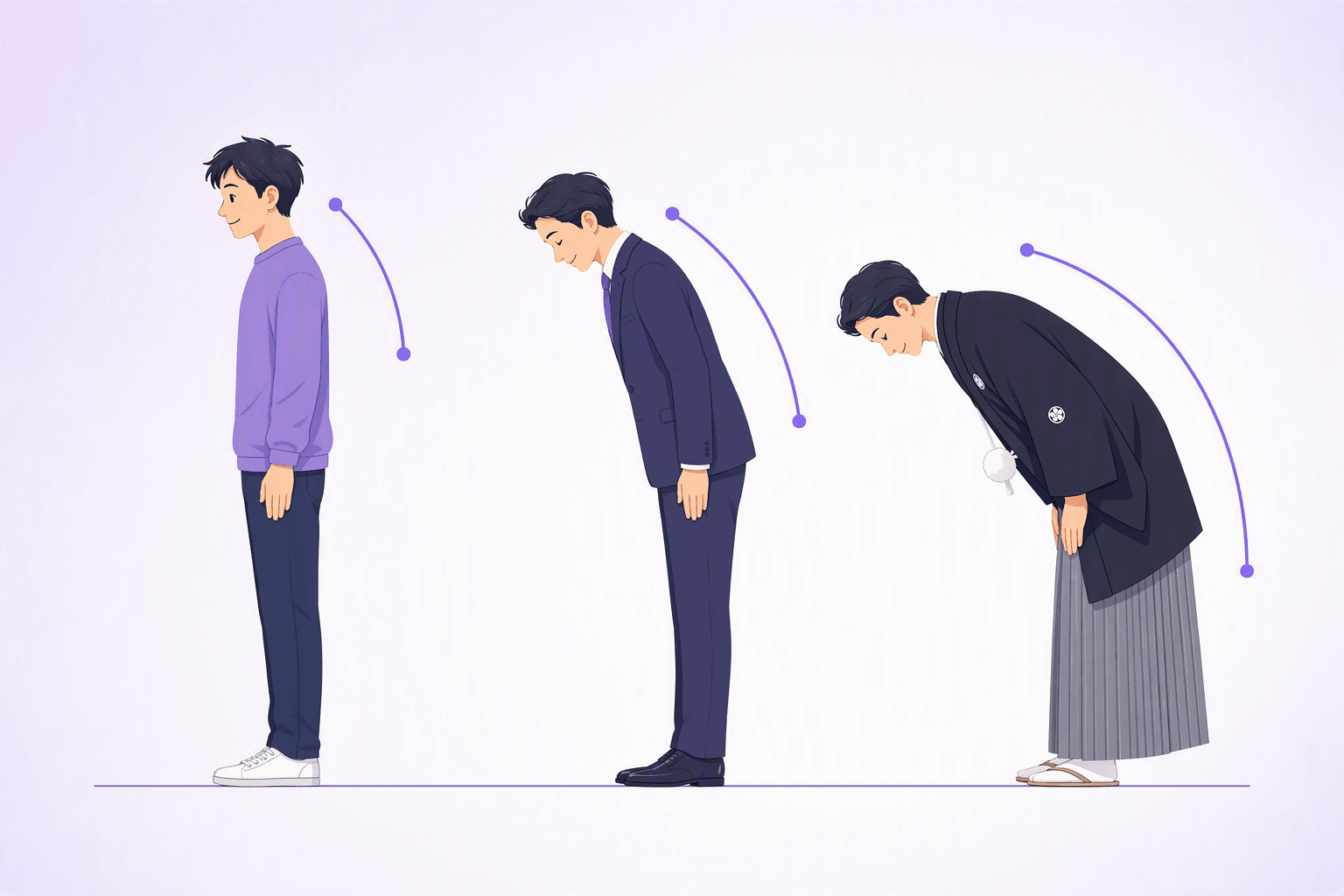
Bowing (ojigi) accompanies virtually all Japanese greetings. A casual nod of about 15 degrees is fine for friends. A 30-degree bow is standard for business greetings. A deep 45-degree bow shows deep respect or apology. The depth and duration of the bow communicates as much as the words you choose.
Practice With Real Japanese Content
Reading about greetings builds your knowledge, but hearing them spoken naturally with proper intonation is what makes them stick. Japanese films and anime are excellent for this. The strict social hierarchy in Japanese culture means characters constantly shift between casual and formal greetings, giving you natural context for each one.
Wordy lets you watch Japanese movies and shows with interactive subtitles. Tap on any greeting to see its meaning, romaji pronunciation, formality level, and cultural context in real time. Instead of memorizing phrases from a list, you absorb them from authentic conversations with native speakers.
For more Japanese content, explore our blog for language guides including the best movies to learn Japanese. You can also visit our Japanese learning page to start practicing with real content today.
Frequently Asked Questions
What is the most common way to say hello in Japanese?
What is the difference between 'Ohayou' and 'Ohayou gozaimasu'?
When should I use 'keigo' (polite language) in Japanese greetings?
Why do Japanese people say 'Moshi moshi' on the phone?
What does 'Irasshaimase' mean and should I respond to it?
Is it rude to just say 'Konnichiwa' in Japan?
Sources & References
- The Japan Foundation, Survey Report on Japanese-Language Education Abroad (2021)
- NHK World-Japan, Japanese Language Lessons: Greetings and Everyday Expressions
- Ethnologue: Languages of the World, Japanese language entry (2024)
- Makino, S. & Tsutsui, M. (1986). 'A Dictionary of Basic Japanese Grammar.' The Japan Times.
- Agency for Cultural Affairs, Japan, National Language Survey (2023)
Start learning with Wordy
Watch real movie clips and build your vocabulary as you go. Free to download.


