Quick Answer
The most common way to say happy birthday in Japanese is 'お誕生日おめでとうございます' (Otanjoubi omedetou gozaimasu, oh-tahn-joh-bee oh-meh-deh-toh goh-zah-ee-mahs), the polite form meaning 'congratulations on your birthday.' Among friends, the casual '誕生日おめでとう' (Tanjoubi omedetou) is standard. Japanese birthday culture blends traditional customs with Western influences like birthday cakes and the familiar birthday melody.
The Short Answer
The most common way to say happy birthday in Japanese is お誕生日おめでとうございます (Otanjoubi omedetou gozaimasu, oh-tahn-joh-bee oh-meh-deh-toh goh-zah-ee-mahs). This is the polite form appropriate for most situations. Among close friends, the casual 誕生日おめでとう (Tanjoubi omedetou) is equally natural. Both center on おめでとう (omedetou), which means "congratulations" and is the key word in all Japanese birthday expressions.
Japanese is spoken by approximately 125 million people, the vast majority in Japan, according to Ethnologue's 2024 data. Japanese birthday culture has evolved dramatically over the past century. Traditional Japan focused on collective age celebrations (where everyone turned a year older on New Year's Day), but modern Japan has fully embraced individual birthday celebrations with Western-style cakes, candles, and the familiar Happy Birthday melody, often sung in English.
"Japanese celebrations blend ancient customs with imported traditions in a way that is uniquely harmonious. The birthday party, a relatively recent addition to Japanese social life, has been thoroughly domesticated, complete with its own etiquette and expected phrases."
(Seiichi Makino, A Dictionary of Basic Japanese Grammar, The Japan Times, 1986)
This guide covers 16 essential Japanese birthday expressions organized by category: standard wishes, casual and polite forms, the birthday song, formal and written phrases, milestone celebrations, and gift-giving language. Each includes Japanese script, romaji, pronunciation, and cultural context.
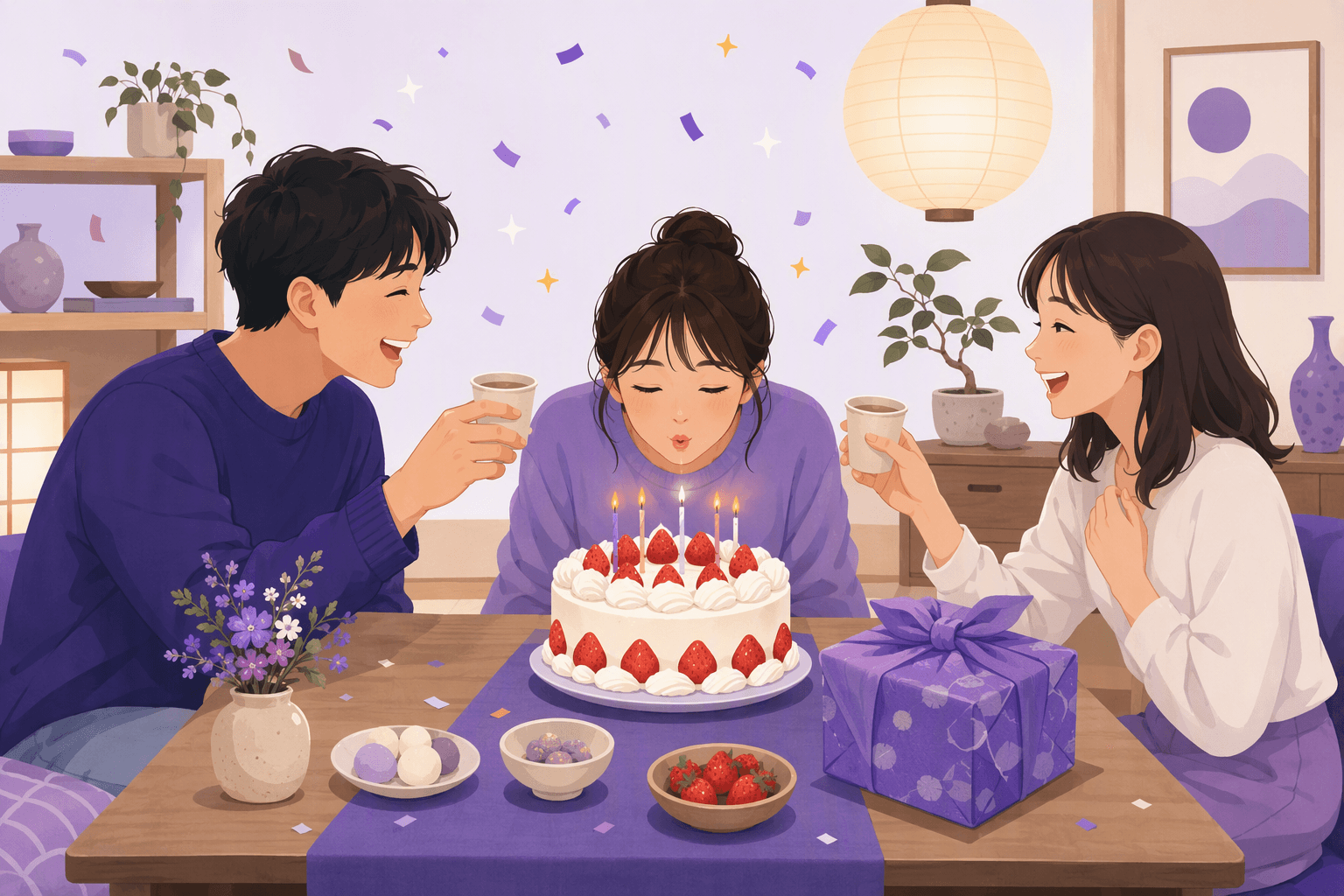
Quick Reference: Japanese Birthday Phrases at a Glance
| English | Japanese | Pronunciation | Formality |
|---|---|---|---|
| Happy birthday (polite) | お誕生日おめでとうございます (Otanjoubi omedetou gozaimasu) | oh-tahn-joh-bee oh-meh-deh-toh goh-zah-ee-mahs | polite |
| Happy birthday (casual) | 誕生日おめでとう (Tanjoubi omedetou) | tahn-joh-bee oh-meh-deh-toh | casual |
| Happy birthday (English loanword) | ハッピーバースデー (Happii baasudee) | hah-pee bah-soo-deh | casual |
| Congratulations (polite) | おめでとうございます (Omedetou gozaimasu) | oh-meh-deh-toh goh-zah-ee-mahs | polite |
| Congratulations (casual) | おめでとう (Omedetou) | oh-meh-deh-toh | casual |
| Happy birthday (very polite) | お誕生日おめでとうございます。心よりお祝い申し上げます (... Kokoro yori oiwai moushiagemasu) | koh-koh-roh yoh-ree oh-ee-wah-ee moh-shee-ah-geh-mahs | very formal |
| May this be a wonderful year | 素敵な一年になりますように (Suteki na ichinen ni narimasu you ni) | soo-teh-kee nah ee-chee-nehn nee nah-ree-mahs yoh nee | polite |
| Happy [age] birthday | [年齢]歳のお誕生日おめでとう ([Nenrei]-sai no otanjoubi omedetou) | [nehn-reh-ee]-sah-ee noh oh-tahn-joh-bee oh-meh-deh-toh | casual |
| This is for you (giving a gift) | これ、プレゼント (Kore, purezento) | koh-reh poo-reh-zehn-toh | casual |
| It's nothing much, but... (giving a gift) | つまらないものですが (Tsumaranai mono desu ga) | tsoo-mah-rah-nah-ee moh-noh dehs gah | formal |
| Happy belated birthday | 遅くなりましたが、お誕生日おめでとうございます (Osoku narimashita ga, otanjoubi omedetou gozaimasu) | oh-soh-koo nah-ree-mah-shtah gah | polite |
| Many happy returns | これからも元気でいてね (Kore kara mo genki de ite ne) | koh-reh kah-rah moh gehn-kee deh ee-teh neh | casual |
| Let's celebrate! | お祝いしよう! (Oiwai shiyou!) | oh-ee-wah-ee shee-yoh | casual |
| Congratulations on your 60th | 還暦おめでとうございます (Kanreki omedetou gozaimasu) | kahn-reh-kee oh-meh-deh-toh goh-zah-ee-mahs | polite |
| Cheers! | 乾杯! (Kanpai!) | kahn-pah-ee | casual |
| I hope your wishes come true | 願いが叶いますように (Negai ga kanaimasu you ni) | neh-gah-ee gah kah-nah-ee-mahs yoh nee | polite |
Standard Birthday Wishes
These are the core birthday expressions used across Japan. The choice between polite and casual forms follows the same keigo (politeness level) system that governs all Japanese communication.
お誕生日おめでとうございます (Otanjoubi omedetou gozaimasu)
/oh-tahn-joh-bee oh-meh-deh-toh goh-zah-ee-mahs/
Literal meaning: Congratulations on your honorable birth day
“お誕生日おめでとうございます、田中さん!素敵な一年になりますように。”
Happy birthday, Tanaka-san! May it be a wonderful year for you.
The standard polite birthday greeting. The honorific 'o' prefix on 'tanjoubi' and the polite 'gozaimasu' ending make this appropriate for coworkers, acquaintances, seniors, and anyone you address with '-san.'
This is the safe, universal birthday greeting in Japanese. The word 誕生日 (tanjoubi) breaks down into 誕生 (tanjou = birth) and 日 (bi = day). The honorific お (o) prefix shows respect, and ございます (gozaimasu) is the polite form of the copula. According to NHK, this is the recommended form for all but the most intimate relationships.
誕生日おめでとう (Tanjoubi omedetou)
/tahn-joh-bee oh-meh-deh-toh/
Literal meaning: Congratulations on your birthday
“誕生日おめでとう!今夜、飲みに行こうよ!”
Happy birthday! Let's go drinking tonight!
The casual form used with close friends, siblings, and people your age or younger. Drops the honorific 'o' prefix and the polite 'gozaimasu' ending. Natural and warm among friends.
Dropping the お prefix and the ございます ending creates the casual form used between friends. This is the version you would text to a close friend or say at a casual birthday gathering. Among young Japanese friends, this feels natural and warm. Using the full polite form with a close friend might actually create distance.
💡 When in Doubt, Go Polite
If you are unsure which form to use, always choose the polite おめでとうございます. Being too polite in Japanese is never offensive; it simply signals respect. Being too casual with someone who expects polite speech, however, can cause real discomfort.
ハッピーバースデー (Happii baasudee)
/hah-pee bah-soo-deh/
Literal meaning: Happy birthday (English loanword)
“ハッピーバースデー!プレゼント持ってきたよ!”
Happy birthday! I brought a present!
The English phrase borrowed into Japanese and written in katakana. Extremely common among younger generations, on social media, on birthday cakes, and in commercial settings. Considered trendy and modern rather than foreign.
English loanwords are thoroughly integrated into modern Japanese, and ハッピーバースデー is one of the most commonly used. You will see it on birthday cakes, in LINE messages (Japan's dominant messaging app), on party decorations, and across social media. It carries a modern, fun connotation and is particularly popular among younger Japanese speakers.
The Japanese Birthday Song
おめでとう or ハッピーバースデートゥーユー (Birthday song)
/hah-pee bah-soo-deh too yoo/
Literal meaning: Happy birthday to you (English melody)
“ハッピーバースデートゥーユー、ハッピーバースデートゥーユー、ハッピーバースデーディア太郎、ハッピーバースデートゥーユー!”
Happy birthday to you, happy birthday to you, happy birthday dear Taro, happy birthday to you!
Most Japanese people sing the birthday song in English (or English-approximation katakana). This is by far the most common version at modern Japanese birthday celebrations, from children's parties to adult gatherings.
Unlike many countries that have translated the birthday song into their own language, Japan predominantly sings it in English, or rather, in the Japanese-accented English approximation. The lyrics follow the original melody:
ハッピーバースデートゥーユー ハッピーバースデートゥーユー ハッピーバースデーディア [name] ハッピーバースデートゥーユー
Some groups, particularly at children's parties or traditional family celebrations, may use the Japanese version with お誕生日おめでとう as the lyrics, but the English version dominates. According to NHK, this reflects Japan's broader pattern of adopting Western celebration customs while adding uniquely Japanese elements.
🌍 Birthday Cakes in Japan
Japanese birthday cakes are distinctive: they are almost always light sponge cakes (ショートケーキ, shootokeeki) topped with whipped cream and fresh strawberries. This style, called a Japanese Christmas cake or birthday cake, originated in the Taisho era (1912-1926) when Western confectionery was adapted to Japanese tastes. The cakes tend to be less sweet than Western cakes and are prized for their lightness.
Formal and Written Birthday Wishes
For business contexts, writing to seniors, and formal occasions. Japanese formal language (keigo) elevates birthday wishes to expressions of deep respect.
心よりお祝い申し上げます (Kokoro yori oiwai moushiagemasu)
/koh-koh-roh yoh-ree oh-ee-wah-ee moh-shee-ah-geh-mahs/
Literal meaning: From my heart, I humbly offer my celebration/congratulations
“お誕生日おめでとうございます。心よりお祝い申し上げます。”
Happy birthday. I offer my heartfelt congratulations.
The most formal birthday expression in Japanese. Uses humble speech (謙譲語 kenjougo) with '申し上げます' (moushiagemasu). Reserved for business superiors, clients, and formal written communications.
申し上げます (moushiagemasu) is the humble form of "to say/offer," placing the speaker below the recipient. This level of formality is appropriate for birthday messages to company executives, respected clients, or other figures deserving deep respect. You would typically find this in a formal birthday card or email, not in spoken conversation.
素敵な一年になりますように (Suteki na ichinen ni narimasu you ni)
/soo-teh-kee nah ee-chee-nehn nee nah-ree-mahs yoh nee/
Literal meaning: May it become a wonderful year
“誕生日おめでとう!素敵な一年になりますように。”
Happy birthday! May this be a wonderful year for you.
A warm, forward-looking birthday wish. The 'ように' (you ni) ending expresses a wish or hope. Common in birthday cards, LINE messages, and social media posts. Works in both polite and casual registers.
The ように (you ni) construction is essential for Japanese wish-making. It expresses a hope or desire and appears in many celebratory contexts, from birthday wishes to New Year prayers at shrines. This particular phrase is one of the most popular additions to birthday messages on LINE and Instagram in Japan.
願いが叶いますように (Negai ga kanaimasu you ni)
/neh-gah-ee gah kah-nah-ee-mahs yoh nee/
Literal meaning: May your wishes come true
“ろうそくを吹き消して!願いが叶いますように!”
Blow out the candles! May your wishes come true!
Said when the birthday person blows out candles on the cake. The candle-blowing tradition was adopted from Western culture and is now standard at Japanese birthday celebrations.
Like the candle-blowing tradition it accompanies, this phrase reflects the Western birthday customs that Japan adopted during the postwar period. The tradition of making a silent wish before blowing out candles is now thoroughly Japanese, and this phrase serves as the verbal encouragement from onlookers. You can explore more Japanese expressions through our Japanese learning page.
Casual Birthday Expressions
Among friends and in informal settings, Japanese birthday language gets creative and affectionate.
おめでとう (Omedetou)
/oh-meh-deh-toh/
Literal meaning: Congratulations
“おめでとう!何歳になったの?”
Congrats! How old did you turn?
The shortest, most casual birthday congratulation. Works when the birthday context is obvious. Also used for other celebrations: graduations, promotions, New Year. Derived from the adjective 'medetai' (auspicious, worthy of celebration).
おめでとう is the core congratulatory word in Japanese. Its root is めでたい (medetai), an adjective meaning "auspicious" or "worthy of celebration." This single word is the foundation of virtually all Japanese congratulatory expressions. At a birthday party where context is clear, just saying おめでとう! is perfectly natural among friends.
これからも元気でいてね (Kore kara mo genki de ite ne)
/koh-reh kah-rah moh gehn-kee deh ee-teh neh/
Literal meaning: From now on too, please stay healthy/well
“誕生日おめでとう、おばあちゃん!これからも元気でいてね。”
Happy birthday, grandma! Please stay healthy for a long time.
A heartfelt wish for continued health and vitality. Especially meaningful when said to parents, grandparents, or elderly friends. The Japanese cultural emphasis on health makes this one of the most touching birthday wishes.
Health is deeply valued in Japanese culture, and wishing someone continued 元気 (genki = energy, health, vitality) is one of the most heartfelt things you can say. This phrase is particularly meaningful for elderly relatives. The ね (ne) particle at the end adds a soft, affectionate touch.
お祝いしよう! (Oiwai shiyou!)
/oh-ee-wah-ee shee-yoh/
Literal meaning: Let's celebrate!
“今日は誕生日でしょ?お祝いしよう!焼肉行こう!”
It's your birthday today, right? Let's celebrate! Let's go for yakiniku!
An enthusiastic invitation to celebrate. The volitional form 'しよう' (shiyou = let's do) creates an inviting, energetic tone. Often paired with a suggestion for how to celebrate: dinner, drinks, karaoke.
Japanese birthday celebrations among friends often involve 飲み会 (nomikai = drinking party), 焼肉 (yakiniku = grilled meat), or カラオケ (karaoke). This phrase kicks off the celebration planning with enthusiasm.
Milestone Birthday Celebrations
Japanese culture recognizes specific birthday milestones with dedicated names and celebrations, especially in later life.
還暦おめでとうございます (Kanreki omedetou gozaimasu)
/kahn-reh-kee oh-meh-deh-toh goh-zah-ee-mahs/
Literal meaning: Congratulations on your return-calendar (60th birthday)
“お父さん、還暦おめでとうございます!赤いちゃんちゃんこを用意しましたよ。”
Father, congratulations on your 60th birthday! We prepared a red vest for you.
The 60th birthday is called '還暦' (Kanreki) because it marks the completion of one full cycle of the Chinese zodiac calendar (12 animals × 5 elements = 60 years). The birthday person traditionally wears a red vest (赤いちゃんちゃんこ) symbolizing a return to infancy and rebirth.
The 還暦 celebration is one of Japan's most culturally significant birthday milestones. According to the Agency for Cultural Affairs, the tradition dates back centuries and is rooted in the Chinese zodiac calendar system. After the 60th birthday, Japanese culture recognizes 古希 (Koki, 70th), 喜寿 (Kiju, 77th), 傘寿 (Sanju, 80th), 米寿 (Beiju, 88th, especially auspicious because the kanji for 88 resembles the character for rice, 米), and 白寿 (Hakuju, 99th).
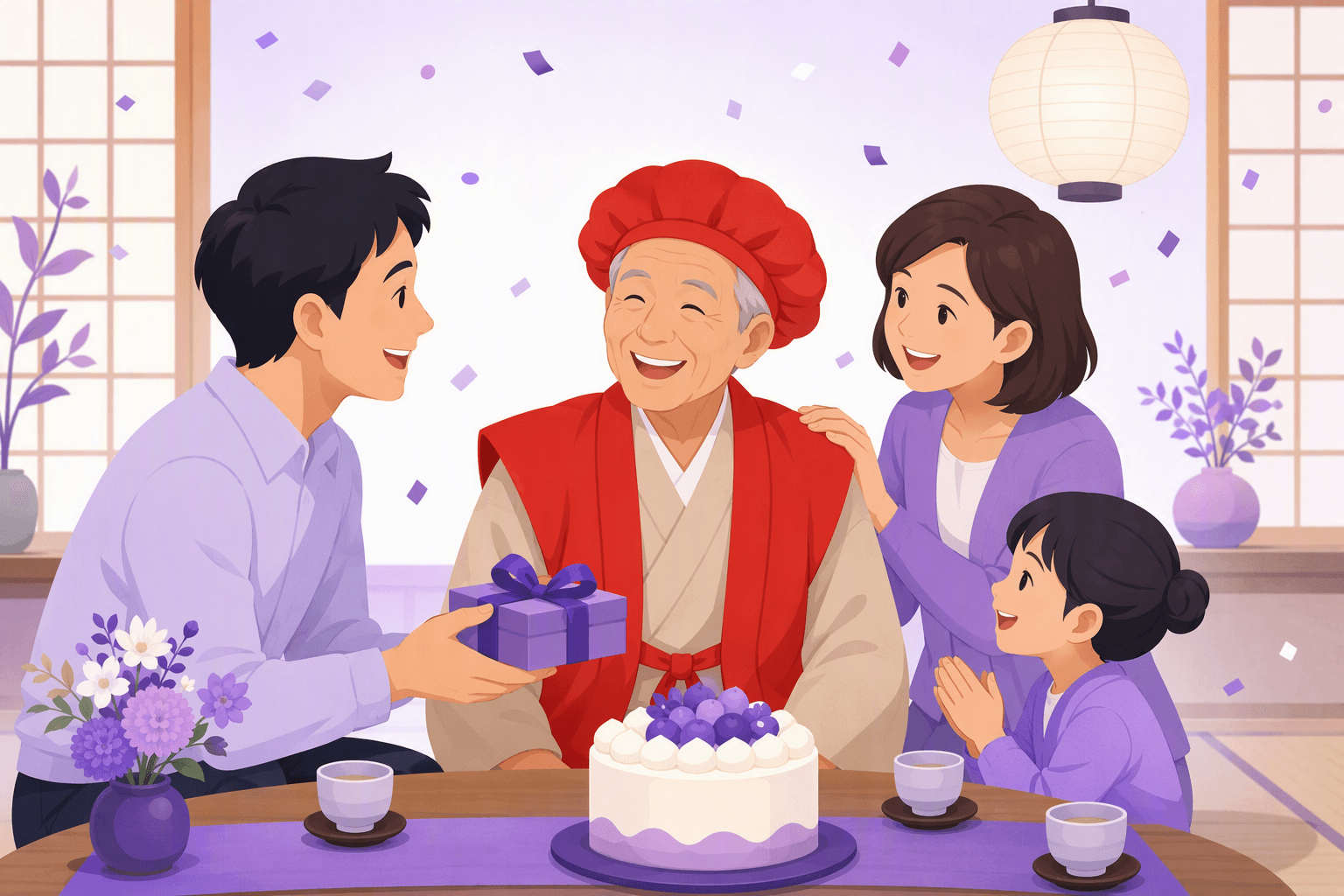
🌍 The Red Vest Tradition
At a 還暦 celebration, the 60-year-old traditionally wears a red vest called a ちゃんちゃんこ (chanchanko). Red symbolizes protection from evil and a return to the vitality of youth (babies in Japan traditionally wore red). While some modern Japanese find this tradition embarrassing, it remains widely practiced, especially in more traditional families.
Gift-Giving Language
Birthday gift exchange in Japan follows specific etiquette. These phrases help you handle the ritual gracefully.
つまらないものですが (Tsumaranai mono desu ga)
/tsoo-mah-rah-nah-ee moh-noh dehs gah/
Literal meaning: It's a boring/trivial thing, but...
“つまらないものですが、お誕生日のお祝いです。どうぞ。”
It's nothing much, but this is a birthday gift for you. Please accept it.
The classic Japanese humble phrase used when giving a gift. Despite saying it's 'boring,' the gift is often carefully chosen and beautifully wrapped. This self-deprecation is a core part of Japanese etiquette, elevating the recipient by lowering yourself.
This phrase exemplifies 謙遜 (kenson = humility), a foundational value in Japanese social interaction. Even if you are giving an expensive, thoughtfully chosen gift, presenting it as "nothing much" shows proper humility. The Japan Foundation notes that this phrase, while increasingly considered old-fashioned by younger generations, remains standard in formal and semi-formal gift-giving.
乾杯! (Kanpai!)
/kahn-pah-ee/
Literal meaning: Dry cup (drink it all)
“誕生日おめでとう!乾杯!”
Happy birthday! Cheers!
The universal Japanese toast. At birthday dinners with drinks, someone will raise their glass and shout '乾杯!' before everyone drinks. It is customary to hold your glass lower than that of a senior or older person as a sign of respect.
乾杯 literally means "dry cup," the idea being that you drain your glass completely. At birthday 飲み会, the toast is an essential ritual. An important etiquette note: when toasting with someone senior to you, hold your glass slightly lower than theirs. This subtle gesture shows respect and is noticed by Japanese people.
How to Respond to Japanese Birthday Wishes
| They Say | You Say | Translation |
|---|---|---|
| お誕生日おめでとうございます | ありがとうございます (Arigatou gozaimasu) | Thank you very much |
| 誕生日おめでとう | ありがとう! (Arigatou!) | Thanks! |
| ハッピーバースデー | ありがとう!嬉しい! (Arigatou! Ureshii!) | Thanks! I'm happy! |
| 素敵な一年に | そうなるといいな (Sou naru to ii na) | I hope so |
| 乾杯! | 乾杯! (Kanpai!) | Cheers! |
💡 Receiving Gifts in Japan
When receiving a birthday gift in Japan, accept it with both hands and thank the giver. It is traditional not to open the gift in front of the giver to avoid any potential embarrassment. However, if the giver says 開けてください (Akete kudasai, meaning "please open it"), then open it and express appreciation. Modern younger Japanese are increasingly adopting the Western custom of opening gifts immediately.
Practice With Real Japanese Content
Reading about birthday phrases builds your vocabulary, but hearing native speakers use them in natural conversation is what creates real fluency. Japanese anime, dramas, and films are filled with birthday scenes, from the elaborate surprise parties in slice-of-life anime to the heartfelt family celebrations in Japanese cinema.
Wordy lets you watch Japanese movies and shows with interactive subtitles. Tap any phrase to see its meaning, pronunciation, and cultural context in real time. Instead of memorizing phrases from a list, you absorb them from authentic conversations with natural intonation and emotion.
For more Japanese content, explore our blog for language guides including the best movies to learn Japanese. You can also visit our Japanese learning page to start practicing with real content today.
Frequently Asked Questions
What is the most common way to say happy birthday in Japanese?
What is the difference between おめでとう and おめでとうございます?
Do Japanese people sing 'Happy Birthday' in English?
Is it rude to wish someone happy birthday late in Japan?
What birthday milestones are important in Japan?
What gifts are appropriate for Japanese birthdays?
Sources & References
- The Japan Foundation, Survey Report on Japanese-Language Education Abroad (2021)
- NHK World-Japan, Japanese Language Lessons: Celebrations and Customs
- Ethnologue: Languages of the World, Japanese language entry (2024)
- Makino, S. & Tsutsui, M. (1986). 'A Dictionary of Basic Japanese Grammar.' The Japan Times.
- Agency for Cultural Affairs, Japan, National Language Survey (2023)
Start learning with Wordy
Watch real movie clips and build your vocabulary as you go. Free to download.


