Japanese Etiquette and Customs: A Practical Guide to Politeness, Bowing, and Daily Rules
Quick Answer
Japanese etiquette is built around showing consideration for others, reading the situation, and using polite language and body cues like bowing. If you follow a few high-impact rules, remove shoes when appropriate, keep your voice low in public, and use simple polite phrases like すみません and ありがとうございます, you will avoid most common mistakes.
Japanese etiquette and customs are best understood as a system for minimizing friction in shared life: show consideration, avoid imposing, and match your language and body behavior to the situation. If you master a few visible habits, bow lightly, remove shoes when required, keep your voice low on trains, and use core polite phrases like すみません (soo-mee-mah-SEN) and ありがとうございます (ah-ree-GAH-toh goh-zah-ee-MAHSS), you will handle most everyday interactions smoothly.
Japan is also a place where people often communicate indirectly, so “doing the right thing” is frequently about reading cues rather than reciting rules. Sociolinguist Haru Yamada, in Different Games, Different Rules, describes how Japanese interaction can prioritize harmony and context over direct verbal clarity, which is exactly what visitors feel on day one.
If you want a phrase-first refresher before the cultural details, start with how to say hello in Japanese and how to say goodbye in Japanese. You will hear those forms constantly in real life and in TV dialogue.
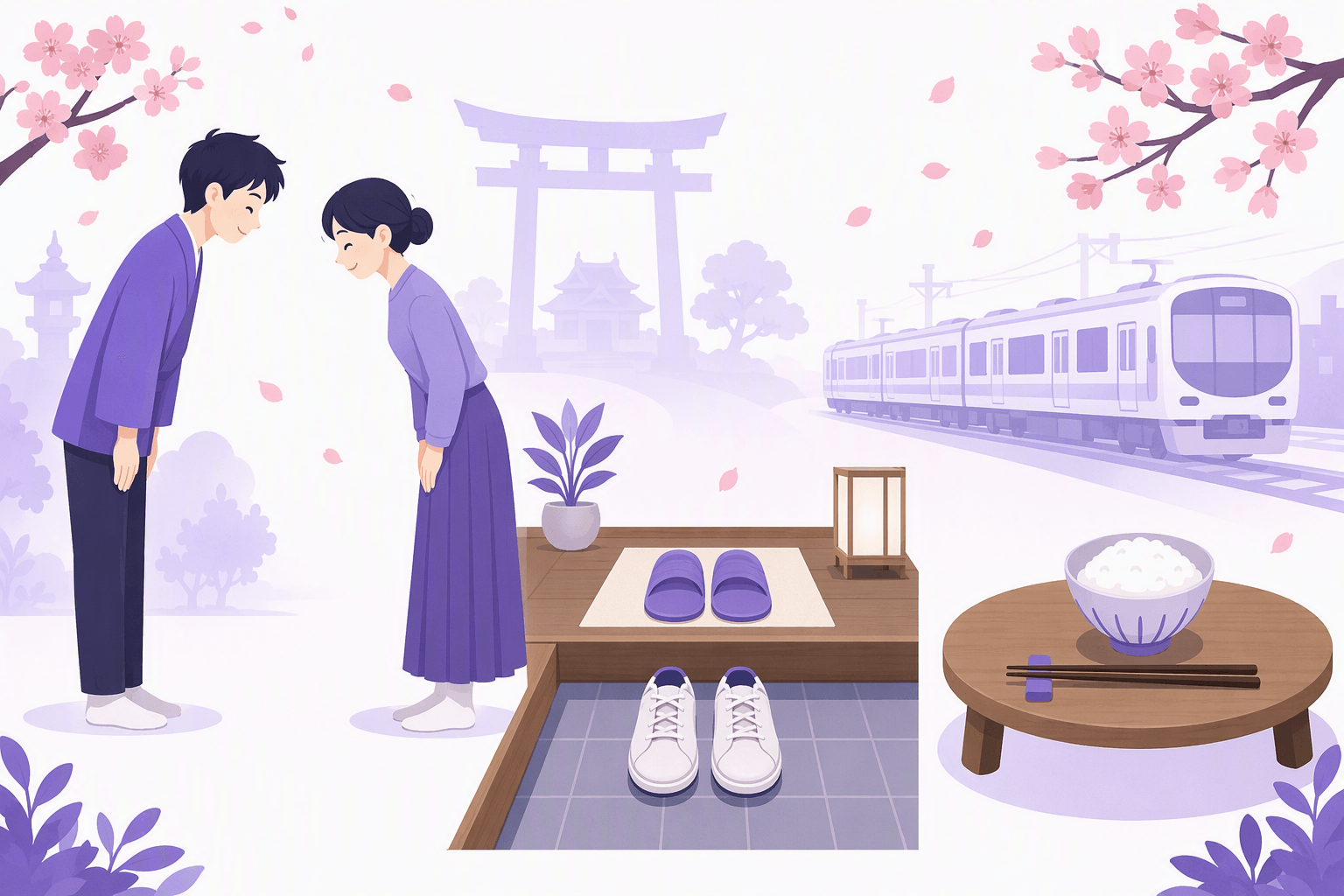
Why Japanese etiquette feels strict (and why it works)
A useful mental model is “shared space first.” In dense cities, small behaviors scale fast: one loud phone call becomes ten, one suitcase in the aisle becomes a traffic jam.
Japan has about 125 million people, and the Tokyo metro area alone is one of the largest urban agglomerations in the world. In that context, norms around quietness, orderly lines, and clean shared spaces function like social infrastructure.
Japanese is also spoken by roughly 123 million people worldwide (Ethnologue, 27th edition, 2024). That means most interactions you will have in Japan are with native speakers who share the same unspoken expectations, so visitors stand out quickly, for good or bad.
The cultural logic: harmony, roles, and “reading the air”
You will hear the idea of 空気を読む, “reading the air,” meaning noticing what the situation expects without being told. It is not mystical. It is pattern recognition: who speaks first, where you stand, how loudly you talk, when you apologize.
Anthropologist Ruth Benedict’s The Chrysanthemum and the Sword is often cited in English-language discussions of Japanese social norms. Even when you disagree with parts of her framing, her work is useful for understanding why outsiders tend to interpret Japan as “rule-heavy”: many rules are social rather than legal, and they are enforced by subtle feedback, not confrontation.
💡 A visitor-friendly rule
When unsure, copy the calmest person nearby. Match their volume, pace, and distance. In Japan, mirroring polite behavior is usually safer than trying to be “extra friendly.”
Greetings and bowing: what to do with your body
Bowing is not about perfection. It is about signaling respect and non-aggression, and it pairs naturally with polite set phrases.
Basic bow types (practical, not ceremonial)
- Small bow or nod: quick greetings, passing thanks, casual service interactions.
- Medium bow: meeting someone, thanking for help, apologizing for inconvenience.
- Deeper bow: formal apologies, formal thanks, business settings with hierarchy.
As a visitor, a small bow is enough most of the time. If you bow too deeply for a small interaction, it can feel awkward, like over-tipping.
Handshakes, eye contact, and personal space
Handshakes are common in international business, but many Japanese people still prefer a bow. If someone offers a handshake, take it, and you can add a slight bow at the start.
Eye contact is typically softer than in many Western contexts. Staring can feel intense. Looking at the face but not locking eyes continuously reads as polite.
Shoes, slippers, and the genkan: the rule you cannot ignore
If there is one etiquette rule that produces instant discomfort when broken, it is wearing outdoor shoes indoors.
How to spot a shoes-off space
Look for:
- A genkan entry area, often lower than the interior floor.
- A visible step up.
- A row of shoes near the entrance.
- Slippers provided.
Common places:
- Homes.
- Ryokan and many minshuku.
- Some traditional restaurants.
- Some temples and historic buildings.
- Some clinics, schools, and fitting rooms.
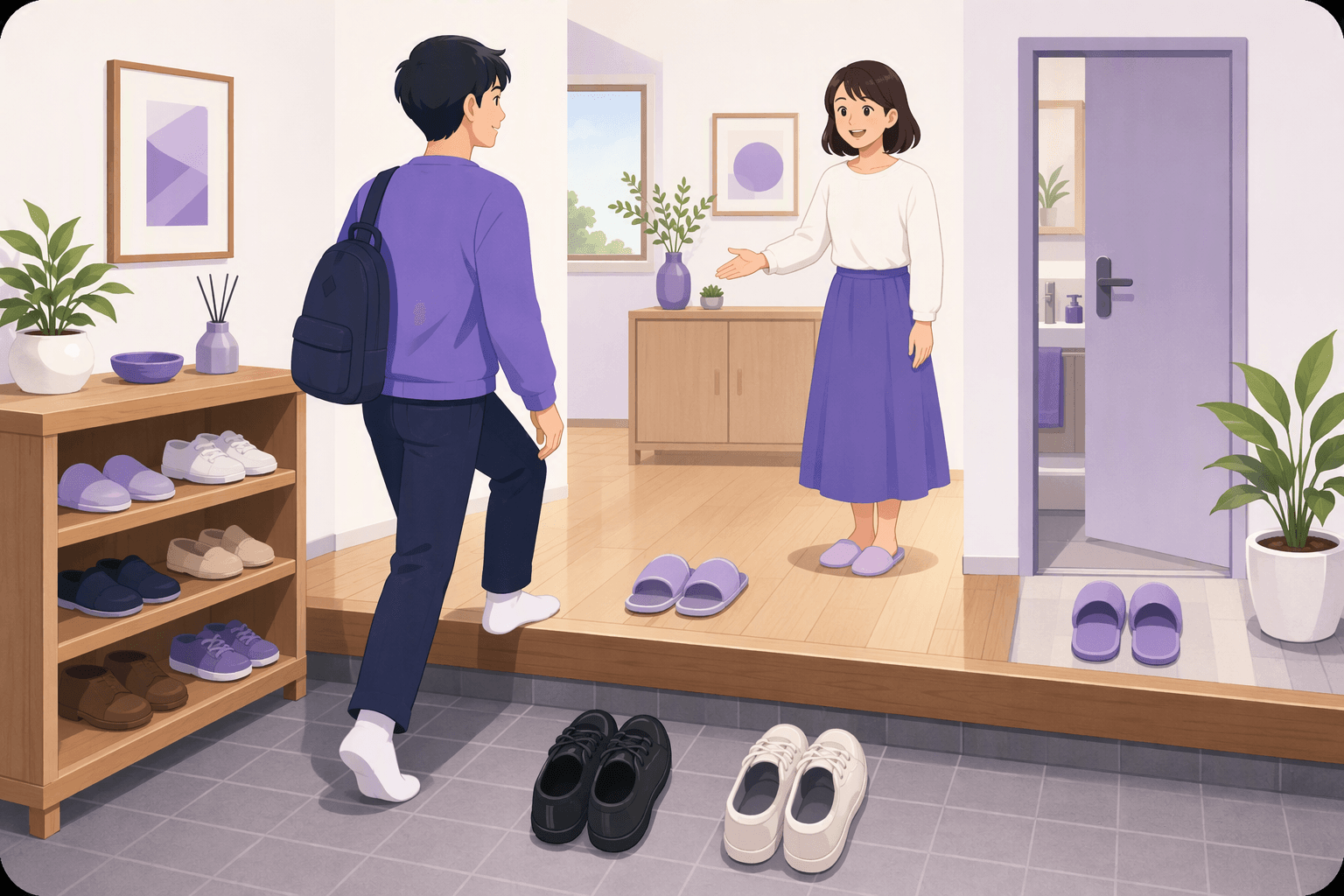
Toilet slippers: the classic mistake
Many homes and traditional accommodations have separate bathroom slippers. Switch into them only inside the toilet room, then switch back immediately.
Forgetting and walking around the house in toilet slippers is memorable for everyone, and not in a good way.
🌍 Why shoes matter so much
Shoes carry dirt from outside, but the deeper issue is boundary-marking. The inside space is “clean” and socially intimate, and the entrance is a buffer zone. The genkan is a physical reminder to switch modes: outside to inside, public to private.
Public behavior: trains, streets, and shared quiet
Japan is not silent. It is controlled. People can be lively in izakaya and festivals, but public transit and queues are treated as shared quiet zones.
Trains and buses
Common expectations:
- Keep phone calls off trains.
- Use headphones at low volume.
- Do not eat messy food on local commuter trains.
- Keep backpacks in front or down by your feet when crowded.
- Let people off before boarding.
If you need to speak, do it quietly. On many lines, you will see signs asking passengers to set phones to silent mode.
Queues and escalators
Lines are a social contract. Cutting is rare and noticed immediately.
Escalator standing sides vary by region. In Tokyo, people often stand on the left. In Osaka, people often stand on the right. If you cannot remember, stand where most people stand and keep your suitcase tight to your body.
Trash and cleanliness
Public trash cans can be scarce, especially after security changes in past decades. People often carry trash until they find a bin at a convenience store or station.
The norm is not “someone will clean it,” it is “I will not create work for others.” That mindset shows up everywhere.
Dining etiquette: chopsticks, ordering, and paying
Food culture is where etiquette feels most visible, because the actions are small and repeated.
Chopsticks: the two taboo actions
Avoid:
- Sticking chopsticks upright in rice.
- Passing food from chopsticks to chopsticks.
Both resemble funeral rites. Even if nobody scolds you, it can create a sudden awkward pause.
Other common manners:
- Use the provided chopstick rest if available.
- Do not rub disposable chopsticks together, it can imply the restaurant is cheap.
- If sharing dishes, use serving chopsticks when provided.
Saying “itadakimasu” and “gochisousama”
You will often hear:
- いただきます (ee-tah-dah-kee-MAHSS) before eating.
- ごちそうさまでした (goh-chee-SOH-sah-mah deh-SHEE-tah) after eating.
These are not prayers. They are social acknowledgments: gratitude for the food and the people involved.
Ordering and paying
In many casual places, you pay at the register, not at the table. In some restaurants, you buy a ticket from a vending machine first.
Tipping is not customary in Japan. Trying to tip can confuse staff and sometimes triggers a polite refusal routine.
⚠️ Do not force tips
If you want to show appreciation, use words and behavior: a clear ありがとうございます and a small bow. If you insist on tipping, it can create discomfort because it changes the role relationship between customer and staff.
Gift-giving and omiyage: why small gifts matter
Gift-giving in Japan is structured and frequent. Visitors notice it most through omiyage, small regional souvenirs brought back for coworkers, friends, or family.
Omiyage in daily life
If you travel, it is common to bring back individually wrapped snacks for the office. The point is not the value. The point is signaling: “I was away, and I remembered you.”
This fits what sociologist Takie Sugiyama Lebra explores in Japanese Patterns of Behavior: social life is strongly role-based, and small rituals help maintain smooth relationships without heavy emotional talk.
How to give a gift politely
- Present it with two hands.
- Say a simple phrase like つまらないものですが, often translated as “it is nothing,” which is a humility formula, not literal self-insult.
- Do not expect the gift to be opened immediately, especially in formal contexts.
Language etiquette: politeness levels without the textbook headache
You do not need to master keigo to be polite, but you do need to avoid sounding too blunt.
The safe default: desu/masu style
For beginners, the safest register is です/ます style. It signals respect without sounding stiff.
Core phrases that carry you far:
- すみません (soo-mee-mah-SEN): excuse me, sorry, and also a soft way to get attention.
- お願いします (oh-neh-GAH-ee-shee-mahss): please, and also “I am asking for your help.”
- ありがとうございます (ah-ree-GAH-toh goh-zah-ee-MAHSS): thank you very much.
If you want more greeting options, see how to say hello in Japanese. For endings, see how to say goodbye in Japanese.
Why “no” is often indirect
In many situations, direct refusal can feel face-threatening. You may hear:
- ちょっと, meaning “a bit,” used as a soft no.
- 難しい, “difficult,” meaning “probably not.”
- 検討します, “I will consider it,” meaning “no, but politely.”
This is where context matters. If the person avoids committing, offers alternatives, or changes the topic, treat it as a no and move on gracefully.
Honorifics: -san is your friend
Use -さん for most people unless they tell you otherwise. If you are curious about name etiquette and suffixes, Japanese honorifics explained goes deeper.
Visiting shrines and temples: respectful basics
Japan has both Shinto shrines and Buddhist temples, and etiquette differs slightly, but visitors can follow a few safe behaviors.
At a shrine
Common steps at many shrines:
- Bow lightly at the entrance gate area.
- Purify hands and mouth at the water pavilion if present, watch others first.
- Approach calmly, do not block the main path if it is busy.
- At the offering box, toss a coin, bow, clap twice, pray silently, bow again, depending on the shrine practice.
If you are unsure, stand back and observe. Quiet respect beats confident mistakes.
At a temple
Temples often emphasize quietness and photography rules. Incense may be present. Follow posted signs.
If you see areas marked off, do not cross them for a better photo. In Japan, boundaries are taken seriously even when they are just a rope.
Onsen and bathing culture: rules that surprise first-timers
Bathing etiquette is one of the biggest culture shocks, because it is both social and rule-bound.
The core rule: wash before you soak
In an onsen or sento:
- Undress in the changing area, no swimsuits in most traditional baths.
- Wash thoroughly at the shower stations before entering the bath.
- The bath is for soaking, not cleaning.
Keep your towel out of the water. Many people place it on their head or on the side.
Tattoos
Some facilities restrict tattoos due to historical associations with organized crime. Policies vary widely now, especially in tourist areas, but you should check ahead.
Work and school norms: punctuality and group coordination
Even if you are not working in Japan, these norms shape everyday life.
Punctuality is respect, not just scheduling
Arriving on time signals reliability and consideration. Being late creates work for others, because plans are coordinated tightly.
The group often outranks the individual preference
You will notice more consensus-building and fewer public disagreements. In meetings, decisions may be shaped before the meeting through informal alignment.
This is one reason foreigners sometimes feel meetings are “slow.” The speed is in the preparation, not the room.
What not to say: swearing, bluntness, and “cute” Japanese
Many learners pick up casual phrases from anime or social media and use them in real life. That can backfire.
Swearing is rarer than you think
Japanese has rude language, but it is often more about pronouns, imperatives, and tone than a single swear word. If you are curious, read our guide to Japanese swear words, but treat it as recognition practice, not a speaking checklist.
Romantic phrases: context matters
Learners love 愛してる (AH-ee-shee-teh-roo), but it is stronger and less casually used than “I love you” in English. For real-world options and when people actually say them, see how to say I love you in Japanese.
💡 A safer way to sound friendly
Instead of trying to be “casual,” aim for “warm and polite.” A soft voice, a smile, and ありがとうございます will land better than slang you are not fully sure about.
How to learn etiquette fast using movies and TV (without copying the wrong characters)
Movies and dramas are excellent for etiquette, because you can see posture, distance, and timing. The risk is copying characters who are intentionally rude, comedic, or exaggerated.
What to watch for in dialogue scenes
- How often people say すみません, and what it accomplishes.
- How service staff use set phrases and how customers respond.
- How people avoid direct refusals and offer alternatives.
- How bow depth changes with the situation.
A practical technique is to pick one scene and focus on one behavior, like how someone enters a room, rather than trying to memorize everything at once. If you want a structured way to do that with short clips and repeatable listening, explore learning Japanese.
A quick “do this, avoid that” checklist
Do:
- Bow lightly when greeting, thanking, and apologizing.
- Keep your voice low on public transit.
- Remove shoes when required, and use slippers correctly.
- Queue neatly and let people exit first.
- Use すみません and ありがとうございます generously.
Avoid:
- Phone calls on trains.
- Eating messy food while walking in crowded areas.
- Chopstick funeral taboos.
- Forcing tips or gifts on staff.
- Overusing casual anime-style speech with strangers.
Closing: the goal is comfort, not perfection
Japanese etiquette is not a test you pass. It is a set of habits that makes other people feel comfortable. If you stay observant, keep your behavior compact, and use polite basics with clear pronunciation, you will be treated kindly even when you make small mistakes.
When you want to build that instinct through real dialogue, use short scenes where you can replay the same interaction and notice the nonverbal details. That is where etiquette becomes automatic, not stressful.
Frequently Asked Questions
What is the most important rule of Japanese etiquette?
Do I always need to bow in Japan?
When should you take off your shoes in Japan?
Is it rude to eat or drink while walking in Japan?
What are common chopstick mistakes to avoid in Japan?
How polite should my Japanese be as a beginner?
Sources & References
- Agency for Cultural Affairs (Japan), Japanese Language Education and Policy materials, accessed 2026
- Japan Foundation, Japanese language and culture resources, accessed 2026
- NHK World-Japan, Culture and manners guidance, accessed 2026
- Ethnologue, 27th edition, 2024
- Sugimoto, *An Introduction to Japanese Society*, Cambridge University Press
Start learning with Wordy
Watch real movie clips and build your vocabulary as you go. Free to download.


