Japanese New Year (Oshōgatsu): Traditions, Food, and Phrases You’ll Actually Hear
Quick Answer
Japanese New Year, Oshōgatsu (oh-SHOH-gah-tsuh), is Japan’s biggest annual holiday, centered on family visits, shrine or temple prayers (hatsumōde), special foods like osechi and ozōni, and set phrases such as 'Akemashite omedetō gozaimasu.' This guide explains what happens from late December through early January, plus what to say and what to avoid.
Japanese New Year is called Oshōgatsu (oh-SHOH-gah-tsuh), and it is Japan’s most important holiday season, marked by year-end cleaning, special foods like osechi and ozōni, the first shrine or temple visit (hatsumōde), and set greetings such as Akemashite omedetō gozaimasu (ah-keh-MAH-shee-teh oh-meh-deh-TOH goh-zah-ee-MAHSS). If you want to participate respectfully, the key is timing: different phrases belong to “before midnight” vs “after midnight,” and many customs are about starting the year “clean” in both the home and relationships.
Japan is also one of the world’s major language communities: Ethnologue estimates about 123 million native speakers of Japanese (Ethnologue, 27th ed., 2024). That scale matters because Oshōgatsu is not a niche tradition, it shapes national schedules, media, travel, and the language you hear in real conversations.
If you want a fast warm-up on greetings in general, start with our hello in Japanese guide and come back here for the New Year-specific rules.
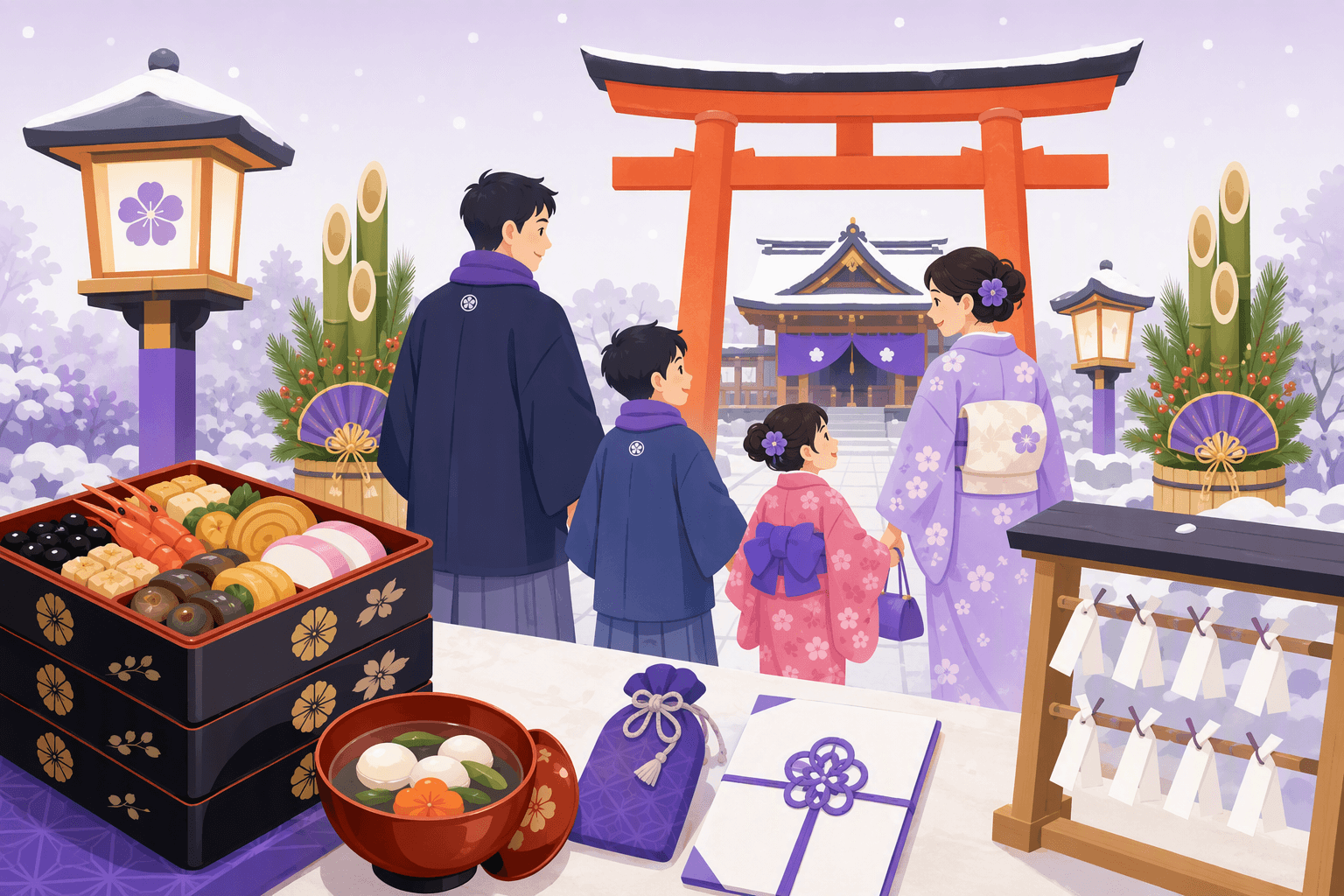
What “Oshōgatsu” actually covers (and why it feels longer than one day)
Oshōgatsu can mean New Year’s Day itself, but in everyday talk it often refers to the whole New Year period. Many people treat it as a season that begins with year-end routines in late December and runs through the first few days of January.
The “before and after midnight” split
A lot of confusion comes from one simple cultural fact: Japanese has different “closing the year” phrases and “opening the year” phrases. If you say the wrong one at the wrong time, you will not offend anyone, but you will sound like you are reading a phrasebook.
A practical rule: use year-end phrases until December 31, then switch to New Year greetings from January 1 onward.
Why the holiday is family-centered
Modern Japan celebrates New Year on January 1, aligning with the Gregorian calendar. Historically, Japan used a lunisolar calendar, and the shift to the modern calendar changed the date but not the social function: a major reset point for households and communities.
The anthropologist Joy Hendry, in her work on Japanese society and ritual, treats seasonal events as “social glue” that organizes relationships and obligations. Oshōgatsu is exactly that: it is a time for family visits, formal greetings, and “resetting” ties with colleagues and neighbors.
The year-end lead-up: what happens in late December
Oshōgatsu starts to feel real in Japan before January arrives. The language you hear in stores, offices, and train stations changes, and so do people’s priorities.
大掃除
Ōsōji (oh-SOH-jee) means “big cleaning,” the deep clean many households do at the end of the year. It is not just tidying, it is a symbolic reset: you start the year without last year’s dust.
You will also hear people talk about getting rid of clutter, finishing tasks, and “closing” projects. In workplaces, this can include cleaning desks and shared spaces.
年末 and 忘年会
Nenmatsu (NEHN-maht-soo) means “year-end.” It shows up everywhere: signs, TV, and casual talk about schedules.
Bōnenkai (BOH-nehng-kai) are “forget the year” parties, often workplace dinners. They are social, sometimes loud, and not necessarily “traditional” in a shrine sense, but they are part of the season’s rhythm.
🌍 Why New Year feels 'formal' in Japanese
Japanese has strong routines for set phrases, especially around seasonal events. Linguist Haruo Shirane, writing on Japanese cultural history and seasonal aesthetics, highlights how calendars and seasonal markers shape language and literature. Oshōgatsu is one of the biggest “set phrase” seasons, so formulaic greetings sound natural, not stiff.
The main rituals of Japanese New Year (the things people actually do)
Tourist summaries often list customs like a checklist. In real life, families mix and match based on region, religion, and schedule, but a few practices are extremely common.
初詣
Hatsumōde (hah-tsoo-MOH-deh) is the first shrine or temple visit of the year. People pray for good health, safety, exams, business success, and relationships.
Crowds can be intense at famous sites. JNTO regularly warns travelers to expect long lines and to plan around peak times (JNTO, accessed 2026).
お守り and おみくじ
Omamori (oh-MAH-moh-ree) are protective amulets you buy at shrines or temples. They are often tied to a specific goal, like traffic safety or academic success.
Omikuji (oh-mee-KOO-jee) are paper fortunes. If you get a bad one, you may tie it at the site, depending on local practice.
年賀状
Nengajō (NEHN-gah-joh) are New Year cards. The tradition has been pressured by digital messaging, but it still matters in many families and workplaces because it is a structured way to maintain relationships.
If you receive one, it is polite to respond, even if you do it digitally. The point is acknowledging the relationship at the year boundary.
お年玉
Otoshidama (oh-TOH-shee-dah-mah) is New Year money given to children, usually in small decorative envelopes. It is one of the most universally recognized New Year practices in Japan.
If you are visiting a Japanese household with children, you are not expected to give otoshidama as a foreign guest, but you should be aware of it because it will come up.
New Year food: what’s on the table and what it signals
Food is one of the most visible parts of Oshōgatsu, and it is also where regional differences show up fast.
おせち料理
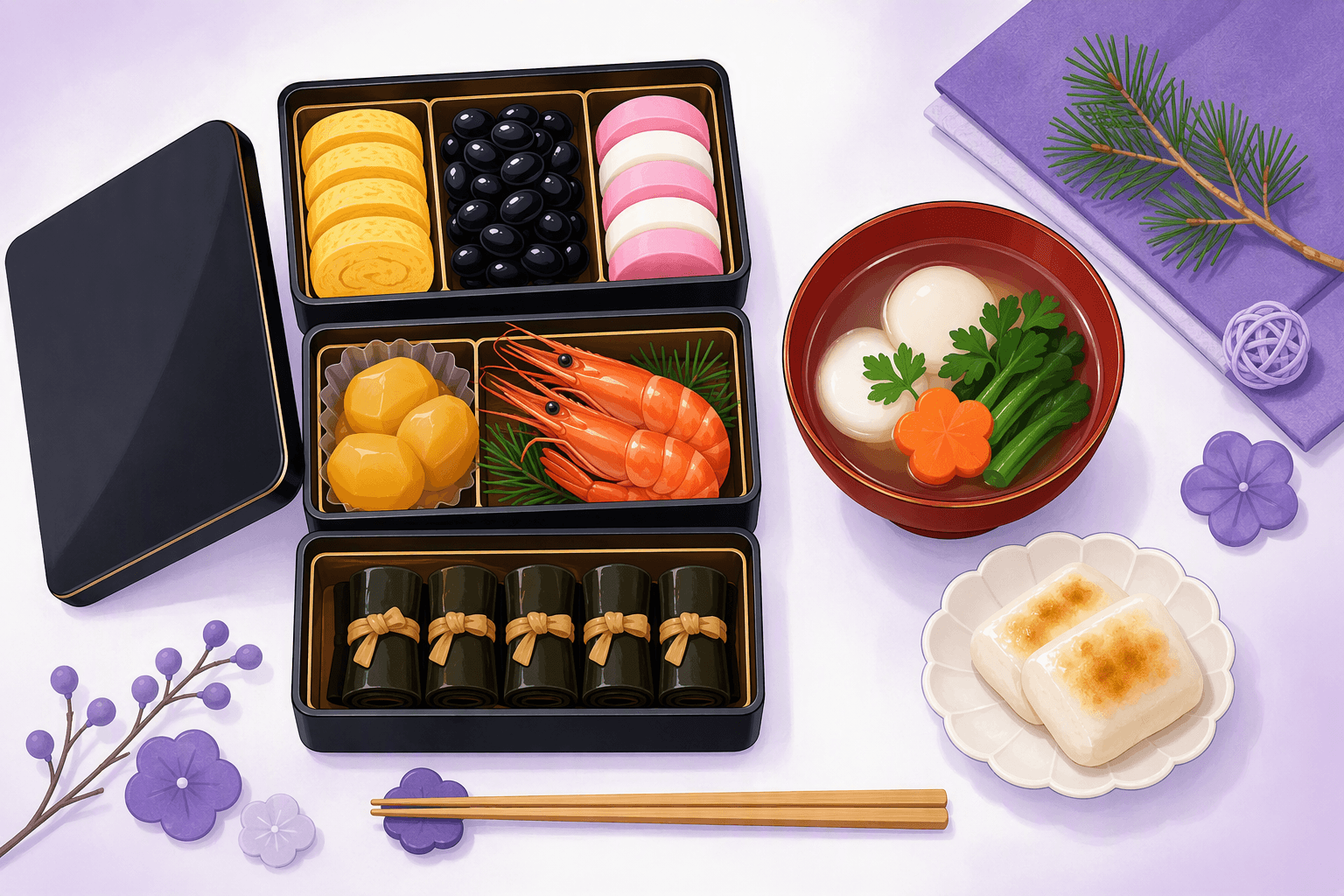
Osechi-ryōri (oh-SEH-chee ryoh-REE) is a set of dishes prepared for the New Year and often served in stacked boxes. The idea is partly practical: you prepare in advance so you do not cook constantly during the holiday.
Many items carry symbolic meanings, like longevity, prosperity, or fertility. Even if you do not memorize the symbolism, you will hear people mention it casually.
お雑煮
Ozōni (oh-ZOH-nee) is a soup with mochi, and it varies a lot by region and family. Some versions use miso, others use clear broth, and the shape of mochi can differ too.
If someone asks what kind your family eats, they are often inviting a friendly “regional identity” conversation, not testing you.
Mochi and the “don’t rush it” rule
Mochi is delicious and also genuinely risky if eaten carelessly, especially for older adults. Japanese media regularly reminds people to chew well and take small bites during the season.
⚠️ Mochi safety is not a joke
If you are offered mochi, take small bites and chew slowly. In Japan, choking incidents are a known seasonal issue, and warnings appear every year. Declining politely is fine if you are unsure.
What to say: the New Year phrases that matter most
These are the phrases you will actually hear in real life, on TV, in shops, and in messages. Pronunciations below are mora-aware, so you can keep the rhythm.
| English | Japanese | Pronunciation | Formality |
|---|---|---|---|
| Happy New Year (polite) | あけましておめでとうございます | ah-keh-MAH-shee-teh oh-meh-deh-TOH goh-zah-ee-MAHSS | formal |
| Happy New Year (casual) | あけましておめでとう | ah-keh-MAH-shee-teh oh-meh-deh-TOH | casual |
| Have a good New Year (said before Jan 1) | よいお年を | yoh-ee oh-TOH-shee oh | polite |
| Thank you for this year (business-like) | 今年もお世話になりました | koh-TOH-shee moh oh-SEH-wah nee nah-REE-mah-shee-tah | formal |
| Please treat me well this year | 今年もよろしくお願いします | koh-TOH-shee moh yoh-roh-SHEE-koo oh-neh-GAH-ee-shee-mahss | formal |
| First shrine visit of the year | 初詣 | hah-tsoo-MOH-deh | polite |
あけましておめでとうございます
Akemashite omedetō gozaimasu (ah-keh-MAH-shee-teh oh-meh-deh-TOH goh-zah-ee-MAHSS) is the safest, most standard “Happy New Year” greeting. Use it with coworkers, neighbors, shop staff you recognize, and anyone you would normally address politely.
It is also common to pair it with a second line: Kotoshi mo yoroshiku onegaishimasu (koh-TOH-shee moh yoh-roh-SHEE-koo oh-neh-GAH-ee-shee-mahss). That second phrase is less about “please” and more about maintaining a good relationship this year.
/ah-keh-MAH-shee-teh oh-meh-deh-TOH goh-zah-ee-MAHSS/
Literal meaning: A set New Year greeting, literally closer to 'Congratulations on the opening of the year.'
“あけましておめでとうございます。今年もよろしくお願いします。”
Happy New Year. Please treat me well this year.
This is the default greeting from January 1 onward. In workplaces, the two-sentence combo is extremely common in emails and in-person greetings.
あけましておめでとう
Akemashite omedetō (ah-keh-MAH-shee-teh oh-meh-deh-TOH) is the casual version. Use it with friends, siblings, and people you are on first-name terms with.
If you are unsure, do not “split the difference” by half-politeness. In Japanese, being cleanly polite is usually safer than sounding awkwardly casual.
よいお年を
Yoi otoshi o (yoh-ee oh-TOH-shee oh) is the phrase you say before the New Year arrives. Think of it as “Have a good New Year,” said while you are still in the old year.
This is the classic timing trap for learners. If you say it on January 2, people will understand, but it will sound off.
/yoh-ee oh-TOH-shee oh/
Literal meaning: Literally 'a good year,' with an implied 'I wish you.'
“では、よいお年を。”
Well then, have a good New Year.
Used in late December when parting ways. You can say it to coworkers as you leave the office for the last time that year.
今年もお世話になりました
Kotoshi mo osewa ni narimashita (koh-TOH-shee moh oh-SEH-wah nee nah-REE-mah-shee-tah) is a year-end phrase that signals gratitude for support. You will hear it in business contexts and polite relationships.
This is a good example of what linguist Sachiko Ide calls discernment politeness: you choose a phrase because the relationship and situation call for it, not because you are expressing personal emotion.
今年もよろしくお願いします
Kotoshi mo yoroshiku onegaishimasu (koh-TOH-shee moh yoh-roh-SHEE-koo oh-neh-GAH-ee-shee-mahss) is a relationship-maintenance phrase. It appears in New Year greetings, introductions, and emails.
If you want to sound natural, keep it as a set chunk. Do not overthink translating each word.
Shrine vs temple etiquette: how to avoid the obvious mistakes
Japan’s religious landscape is layered, and many people participate culturally without strong affiliation. Still, sites have etiquette, and following it shows respect.
At Shinto shrines
At many shrines, you will see a purification fountain. People rinse hands and sometimes the mouth, following posted instructions.
When praying, a common pattern is bow, clap twice, pray, bow. Not every shrine does it identically, so watch what locals do.
At Buddhist temples
Temples often have incense and different prayer gestures. Clapping is not typical in the same way as at shrines.
If you are unsure, the best strategy is simple: move calmly, copy the person in front of you, and do not block pathways for photos.
🌍 Why set etiquette matters
Seasonal rituals are “high-traffic culture”: lots of people participate at once, including people who do not go often. Clear etiquette reduces friction in crowds. That’s why you see signage and repeated patterns during hatsumōde.
What’s open, what’s closed, and why travel gets intense
Oshōgatsu affects logistics. Many businesses close or run limited hours around January 1 to 3, while transport hubs can be packed.
If you are visiting Japan, treat the period like a national “peak season.” JNTO’s New Year guidance is a good reality check for closures and crowd expectations (JNTO, accessed 2026).
New Year language in media: what you’ll hear on TV and in stores
Even if you are not attending family events, you will hear Oshōgatsu language everywhere.
Store announcements and signage
You will see phrases like “New Year sale” and seasonal greetings. Staff may greet you with Akemashite omedetō gozaimasu in early January, especially if you are a regular.
Emails and workplace messages
In offices, New Year greetings can be surprisingly formulaic. That is normal.
If you want a broader base for polite greetings beyond New Year, our goodbye in Japanese guide helps because leaving language overlaps with year-end partings.
“What not to say”: common learner mistakes (and how to recover)
Mistakes during Oshōgatsu are usually forgiven instantly. Still, a few patterns are worth avoiding.
Mixing up the timing phrases
If you accidentally say Yoi otoshi o after January 1, just smile and switch to Akemashite omedetō gozaimasu. No apology speech needed.
Overusing casual speech with older people
If you are meeting someone’s parents or grandparents, default to the polite forms. Japanese politeness is not about distance, it is about choosing the socially appropriate register.
If you want to understand how strong language fits into “appropriateness” too, see our Japanese swear words guide. It gives useful context on why certain words feel harsher than learners expect.
Trying to translate “I love you” into a New Year message
New Year greetings are not romantic by default. If you want romantic Japanese, it is better to use phrases that match the relationship and context. Our I love you in Japanese guide explains why direct “I love you” translations can feel heavy in Japanese.
How to learn Oshōgatsu Japanese from real clips (without memorizing lists)
Seasonal language is perfect for learning from media because the same phrases repeat across dramas, variety shows, and street interviews. You can build strong listening recognition quickly.
Focus on chunks, not single words
Phrases like Akemashite omedetō gozaimasu and Kotoshi mo yoroshiku onegaishimasu are best learned as fixed units. This matches how native speakers process them in fast speech.
Train your ear for mora timing
Japanese rhythm is mora-timed, so “clean beats” matter. If you compress sounds, you can still be understood, but you will struggle to hear the phrase when it is spoken quickly.
A practical drill: clap the beats while listening, then repeat at the same pace. Keep long vowels long and do not collapse “oh-meh-deh-TOH.”
💡 A simple New Year listening plan
In late December and early January, search for hatsumōde street interviews and New Year greeting segments. You will hear the same greetings dozens of times. Repetition in a tight seasonal window is one of the fastest ways to lock in pronunciation and listening.
A realistic “do this, say this” checklist for visitors
If you want to participate without stress, this is enough.
- In late December, say Yoi otoshi o when parting ways.
- From January 1, say Akemashite omedetō gozaimasu, and add Kotoshi mo yoroshiku onegaishimasu in polite contexts.
- At shrines and temples, move slowly, follow posted etiquette, and do not block lines for photos.
- Try osechi or ozōni if offered, and eat mochi carefully.
For more everyday greeting range beyond the holiday season, browse the Wordy blog and compare how phrases change by situation.
Closing: the point of Oshōgatsu (and how to sound natural)
Oshōgatsu is not just “New Year’s Day in Japan.” It’s a socially shared reset: clean the house, close the year with gratitude, open the year with set greetings, and reconnect with family and community through visits, food, and ritual.
If you learn only two lines, make them these: Yoi otoshi o (before January 1) and Akemashite omedetō gozaimasu (from January 1). Then listen for them in real scenes, because the fastest way to make them feel natural is to hear how often native speakers actually use them.
Frequently Asked Questions
What is Oshōgatsu in Japan?
When do you say 'Akemashite omedetō gozaimasu'?
What is hatsumōde and why is it important?
What is the difference between osechi and ozōni?
Is Japanese New Year more important than Christmas in Japan?
Sources & References
- Agency for Cultural Affairs (Japan), Cultural Heritage and Annual Events pages, accessed 2026
- Japan National Tourism Organization (JNTO), New Year in Japan travel guidance, accessed 2026
- Encyclopaedia Britannica, 'New Year festival' and Japan-related entries, accessed 2026
- Ethnologue, 27th edition, 2024
- NHK Broadcasting Culture Research Institute, language and culture resources, accessed 2026
Start learning with Wordy
Watch real movie clips and build your vocabulary as you go. Free to download.


