Quick Answer
Japanese ramen vocabulary helps you read a ramen-shop ticket machine, choose your broth and noodle texture, request toppings, and eat politely. Learn the words you will see on menus, from ramen and chashu to kaedama and gochisōsama.
Japanese ramen vocabulary starts with ラーメン /ɾa.meɴ/, but ordering confidently also means recognizing broth names, noodle options, toppings, and the short phrases used in a busy shop. Learn words such as 豚骨 /toɴ.ko.t͡sɯ/ for pork-bone broth, 味玉 /a.d͡ʑi.ta.ma/ for a seasoned egg, and 替え玉 /ka.e.da.ma/ for extra noodles, then you can handle most ramen menus in Japan.
Ramen is one of Japan's most recognizable everyday foods, yet it is far from one fixed dish. Japan has 47 prefectures, and many regions have a distinct ramen identity, from the rich pork broth of Fukuoka to Sapporo's miso-based bowls and Kitakata's broad, curly noodles.
Japanese is spoken by roughly 123 million first-language speakers, mainly in Japan, so food vocabulary is useful far beyond a single tourist interaction. If you are also preparing for restaurants generally, see our guide to ordering food at a restaurant in Japanese.
| English | Japanese | Pronunciation | Note |
|---|---|---|---|
| Ramen | ラーメン | /ɾa.meɴ/, rah-MEHN | Wheat noodles in a seasoned soup, usually served with toppings. |
| Broth or soup | スープ | /sɯː.pɯ/, SOO-poo | The liquid base of the bowl. |
| Noodles | 麺 | /meɴ/, mehn | Also written めん or メン on casual menus. |
| Topping or ingredient | 具 | /ɡɯ/, goo | A menu may list toppings as 具材. |
| Meal ticket | 食券 | /ɕo.kɯ.keɴ/, shoh-koo-kehn | A ticket purchased at a vending machine before ordering. |
| Ticket vending machine | 券売機 | /keɴ.ba.i.ki/, kehn-bah-ee-kee | Common at quick-service ramen shops. |
| Extra noodles | 替え玉 | /ka.e.da.ma/, kah-eh-dah-mah | A refill of noodles, especially common with Hakata ramen. |
| Large serving | 大盛り | /oː.mo.ɾi/, OH-moh-ree | A larger portion, often of noodles. |
Why ramen vocabulary matters
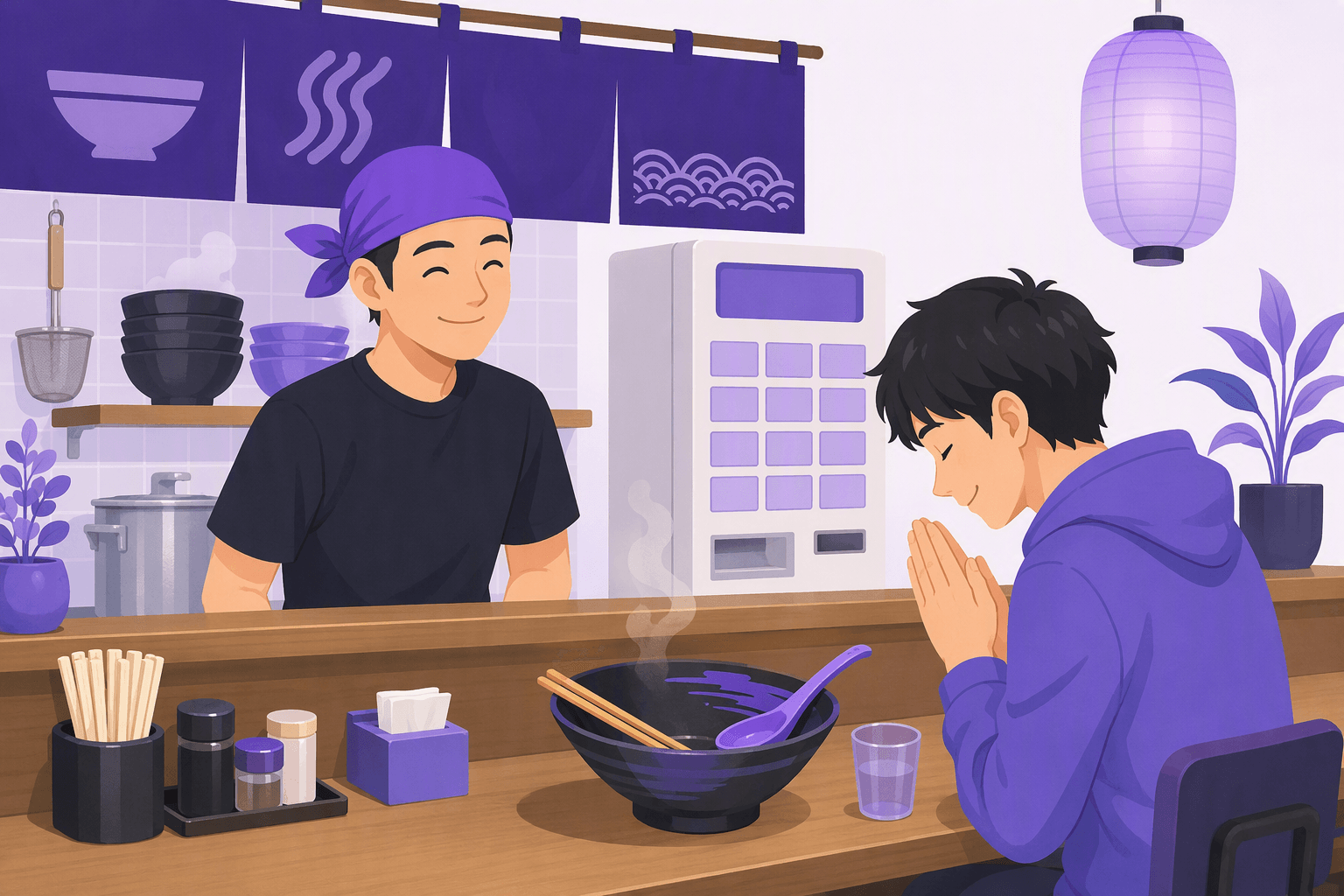
Many ramen shops operate quickly. You may line up outside, select a bowl at a 券売機 /keɴ.ba.i.ki/, sit at a counter, and receive questions in rapid Japanese about noodle firmness or extra garlic.
The good news is that the interaction is predictable. You do not need advanced grammar to order well, but recognizing a dozen menu words prevents expensive or disappointing guesses.
Food historian Barak Kushner traces ramen's development through Chinese culinary influence, postwar food systems, urban life, and regional competition in Slurp! A Social and Culinary History of Ramen. That history explains why ramen can feel both deeply Japanese and endlessly variable.
Ramen is also connected to a broader food culture that values seasonality, local ingredients, and shared eating practices. UNESCO inscribed 和食 /wa.ɕo.kɯ/, traditional Japanese dietary culture, on its Intangible Cultural Heritage list in 2013, although ramen itself has a different historical path from formal 和食 /wa.ɕo.kɯ/ cuisine.
The essential ramen menu words
ラーメン
ラーメン /ɾa.meɴ/ is the standard name for a bowl of wheat noodles in broth. It is usually written in katakana because the dish developed from Chinese noodle traditions.
Menus may add a broth, flavor, region, or topping before ラーメン /ɾa.meɴ/. For example, 味噌ラーメン /mi.so ɾa.meɴ/ is miso ramen, while チャーシューメン /t͡ɕaː.ɕɯː.meɴ/ is ramen with extra roast pork.
スープ
スープ /sɯː.pɯ/ means soup or broth. In ramen, the broth is often the center of the dish, made from bones, chicken, seafood, vegetables, or a combination of these.
A ramen bowl commonly has two flavor layers. The スープ /sɯː.pɯ/ provides body, while the たれ /ta.ɾe/ provides concentrated seasoning, often soy sauce, salt, or miso.
たれ
たれ /ta.ɾe/ is a seasoned sauce or concentrated flavor base. In ramen, it is placed in the bowl before the stock is added.
You may not always see たれ /ta.ɾe/ listed on a menu, but understanding it helps explain why two bowls with similar stock can taste very different. A chicken broth with soy-based たれ /ta.ɾe/ tastes unlike the same stock with salt-based seasoning.
麺
麺 /meɴ/ means noodles. Shops often make a point of their noodle style, including thickness, shape, wheat blend, water content, and firmness.
You may see 細麺 /ho.so.meɴ/, thin noodles, or 太麺 /fɯ.to.meɴ/, thick noodles. Curly noodles are 縮れ麺 /t͡ɕi.d͡ʑi.ɾe.meɴ/, while straight noodles are ストレート麺 /sɯ.to.ɾeː.to.meɴ/.
具
具 /ɡɯ/ means an ingredient or filling. In ramen, it refers to toppings, such as pork, egg, green onion, bamboo shoots, and seaweed.
The longer form 具材 /ɡɯ.za.i/ means ingredients. You might hear staff use it in a description, but menus often list the individual topping names instead.
The four major ramen flavor styles
The most useful category word is 味 /a.d͡ʑi/, meaning flavor or taste. A ramen menu may organize bowls by seasoning style rather than by the stock underneath.
| English | Japanese | Pronunciation | Note |
|---|---|---|---|
| Soy sauce ramen | 醤油ラーメン | /ɕoː.jɯ ɾa.meɴ/, SHOH-yoo rah-MEHN | Usually savory, aromatic, and brown or clear in appearance. |
| Salt ramen | 塩ラーメン | /ɕi.o ɾa.meɴ/, shee-oh rah-MEHN | Often a lighter-colored broth with a clean, salty profile. |
| Miso ramen | 味噌ラーメン | /mi.so ɾa.meɴ/, mee-soh rah-MEHN | Made with fermented soybean paste, often rich and hearty. |
| Pork-bone ramen | 豚骨ラーメン | /toɴ.ko.t͡sɯ ɾa.meɴ/, tohn-koh-tsoo rah-MEHN | Rich broth made by simmering pork bones for a long time. |
| Chicken broth | 鶏白湯 | /to.ɾi pa.i.taɴ/, toh-ree pah-ee-tahn | Creamy chicken-based broth, often written with the Chinese reading 白湯. |
| Fish and pork double soup | 魚介豚骨 | /ɡjo.ka.i toɴ.ko.t͡sɯ/, gyoh-kah-ee tohn-koh-tsoo | A rich style combining seafood and pork-bone flavors. |
| Dipping noodles | つけ麺 | /t͡sɯ.ke.meɴ/, tsoo-keh-mehn | Cold or warm noodles served separately from a concentrated dipping broth. |
| Spicy ramen | 辛いラーメン | /ka.ɾa.i ɾa.meɴ/, kah-rah-ee rah-MEHN | Also look for the character 辛, meaning spicy. |
醤油ラーメン
醤油ラーメン /ɕoː.jɯ ɾa.meɴ/ uses soy sauce as its central seasoning. It is one of the classic Tokyo-associated styles and often has a clear brown broth with chicken, pork, seafood, or vegetable stock underneath.
The long vowel in 醤油 /ɕoː.jɯ/ matters. Say the first part as two beats, しょ /ɕo/ plus う /ɯ/, rather than compressing it into one short sound.
塩ラーメン
塩ラーメン /ɕi.o ɾa.meɴ/ is salt-seasoned ramen. The word 塩 /ɕi.o/ has two morae, so say shi-o, not one merged syllable.
This style can be delicate, but it is not necessarily bland. Because salt seasoning does not darken the broth much, it often lets chicken, seafood, and aromatic oils stand out.
味噌ラーメン
味噌ラーメン /mi.so ɾa.meɴ/ is ramen seasoned with fermented soybean paste. It is strongly associated with Sapporo in Hokkaido, where rich miso broth pairs well with cold weather, corn, butter, bean sprouts, and hearty noodles.
Culinary historian Katarzyna J. Cwiertka examines how modern Japanese cuisine developed through industrialization, nationalism, and changing urban diets. Ramen is an excellent example: a bowl can be intensely local while also reflecting national food trends and global ingredients.
豚骨ラーメン
豚骨ラーメン /toɴ.ko.t͡sɯ ɾa.meɴ/ is pork-bone ramen, not pork cutlet ramen. The word 豚骨 /toɴ.ko.t͡sɯ/ literally refers to pork bones cooked long enough to create a pale, opaque, rich broth.
It is closely associated with Hakata, now part of Fukuoka City. Thin noodles are common, which is why 替え玉 /ka.e.da.ma/, an extra noodle refill, became such a recognizable ramen-shop practice.
つけ麺
つけ麺 /t͡sɯ.ke.meɴ/ means dipping noodles. The noodles and soup arrive separately, and the dipping broth is usually more concentrated than ordinary ramen soup.
Dip a small bundle of noodles into the broth rather than pouring everything together immediately. Some shops offer スープ割り /sɯː.pɯ.wa.ɾi/, hot stock added to the leftover dipping broth so you can drink it at the end.
Ramen toppings you will see everywhere
Toppings can change a bowl dramatically. Learn these words before you press a vending-machine button, especially because a photo may be small or absent.
| English | Japanese | Pronunciation | Note |
|---|---|---|---|
| Roast pork | チャーシュー | /t͡ɕaː.ɕɯː/, CHAH-shoo | Braised or roasted pork slices, often written 焼豚. |
| Seasoned soft-boiled egg | 味玉 | /a.d͡ʑi.ta.ma/, ah-jee-tah-mah | Short for 味付け玉子, an egg marinated in seasoning. |
| Green onion | ねぎ | /ne.ɡi/, neh-gee | Also written ネギ or 葱. |
| Bamboo shoots | メンマ | /meɴ.ma/, mehm-mah | Fermented bamboo shoots, often crunchy and savory. |
| Dried seaweed | 海苔 | /no.ɾi/, noh-ree | Thin sheets of nori, common in many styles. |
| Bean sprouts | もやし | /mo.ja.ɕi/, moh-yah-shee | A frequent topping in miso and rich ramen styles. |
| Garlic | にんにく | /niɴ.ni.kɯ/, neen-nee-koo | Often offered crushed, minced, or grated. |
| Wood ear mushroom | きくらげ | /ki.kɯ.ɾa.ɡe/, kee-koo-rah-geh | A crunchy mushroom common in tonkotsu ramen. |
チャーシュー
チャーシュー /t͡ɕaː.ɕɯː/ is roast pork, though its preparation varies by shop. Some slices are soft and braised, while others are pink, smoky, or seared just before serving.
A bowl labeled チャーシューメン /t͡ɕaː.ɕɯː.meɴ/ contains extra pork. It is usually more expensive than a standard bowl, but useful when pork is the main reason you chose the shop.
味玉
味玉 /a.d͡ʑi.ta.ma/ is a marinated soft-boiled egg. It is an abbreviation of 味付け玉子 /a.d͡ʑi.t͡sɯ.ke ta.ma.ɡo/, literally seasoned egg.
If you see 煮卵 /ni.ta.ma.ɡo/, it usually refers to a similar soy-seasoned ramen egg. Both are common upgrades, and the yolk may range from jammy to nearly set.
メンマ
メンマ /meɴ.ma/ is seasoned bamboo shoot. The doubled consonant in the middle creates a slight pause, so it has three morae: メン /meɴ/, マ /ma/ with the nasal ending counted separately in rhythm.
Its crisp texture contrasts with soft noodles and fatty broth. It is a familiar topping, even though many learners first mistake it for a kind of mushroom.
💡 A useful ordering sentence
Point to the menu item and say これをお願いします /ko.ɾe.o o.ne.ɡa.i.ɕi.ma.sɯ/, meaning "this one, please." For an added topping, say 味玉をお願いします /a.d͡ʑi.ta.ma.o o.ne.ɡa.i.ɕi.ma.sɯ/.
How to customize your bowl
Some shops ask no questions. Others specialize in customization and may ask you to choose noodle firmness, broth richness, oil, or garlic.
麺のかたさ
麺のかたさ /meɴ.no ka.ta.sa/ means noodle firmness. At a tonkotsu shop, staff may ask 麺のかたさは? /meɴ.no ka.ta.sa wa/, meaning “How firm would you like your noodles?”
Useful answers include ふつう /fɯ.t͡sɯː/, regular; かため /ka.ta.me/, firm; and やわらかめ /ja.wa.ɾa.ka.me/, softer. The ending め /me/ means somewhat or on the more side.
こってり
こってり /ko.t.te.ɾi/ describes a rich, heavy, fatty flavor. It is often used for a thick broth with abundant oil or pork richness.
The contrasting word あっさり /a.s.sa.ɾi/ means light or clean-tasting. It does not mean flavorless, only less rich and oily.
少なめ and 多め
少なめ /sɯ.kɯ.na.me/ means less, while 多め /oː.me/ means extra or more. These words are useful for items such as garlic, green onion, oil, or noodles.
For example, にんにく少なめ /niɴ.ni.kɯ sɯ.kɯ.na.me/ means less garlic. ねぎ多め /ne.ɡi oː.me/ means extra green onion.
🌍 The ticket machine changes the conversation
A 券売機 /keɴ.ba.i.ki/ reduces spoken ordering, which is practical in compact shops with a fast turnover. Look for a button labeled おすすめ /o.sɯ.sɯ.me/, meaning recommended, if the menu feels overwhelming. The largest or brightest button is often the shop's signature bowl, but not always.
Ramen shop etiquette that actually matters
Ramen shops are usually casual, not ceremonial. You do not need perfect chopstick technique or flawless Japanese. Still, a few habits make the experience smoother.
First, check whether the shop uses a ticket machine. Buy your 食券 /ɕo.kɯ.keɴ/ before joining the line if other customers are doing so. In many shops, staff will direct you to a seat and collect the ticket.
Second, eat at a reasonable pace. Ramen is served hot, and noodles soften as they sit in broth. This is practical rather than judgmental etiquette: the bowl is at its best soon after it arrives.
Third, slurping is accepted. It can cool hot noodles and carry broth with them. You do not have to perform a loud slurp, but trying to eat every noodle silently is unnecessary.
Fourth, do not assume you must finish every drop of broth. Rich soups can be high in sodium and fat, and leaving soup is normal. Finishing the noodles is more expected than emptying the bowl.
Finally, say ごちそうさまでした /ɡo.tɕi.soː.sa.ma.de.ɕi.ta/ when leaving. It means thanks for the meal and recognizes the people who prepared it. For more basics before your trip, practice Japanese greetings and Japanese travel phrases.
Regional ramen words worth knowing
Regional labels matter because they often signal more than location. They tell you what style of broth, noodle, and topping combination to expect.
札幌ラーメン /sa.p.po.ɾo ɾa.meɴ/ is Sapporo ramen, often associated with miso broth. 博多ラーメン /ha.ka.ta ɾa.meɴ/ is Hakata ramen, usually a thin-noodle tonkotsu style from Fukuoka.
喜多方ラーメン /ki.ta.ka.ta ɾa.meɴ/ is Kitakata ramen, known for broad, wavy noodles and soy-based soup. 横浜家系ラーメン /jo.ko.ha.ma i.e.ke.i ɾa.meɴ/ is Yokohama Iekei ramen, a rich style blending pork-bone and soy flavors, often served with spinach and seaweed.
The global popularity of ramen has a parallel in instant noodles. The World Instant Noodles Association reports that global demand reached about 120.2 billion servings in 2023. Instant ramen and restaurant ramen are not the same food experience, but that scale shows how far Japanese noodle culture has travelled.
Food scholar Eric C. Rath, in Japan's Cuisines, presents Japanese food history as a collection of changing regional practices rather than a single unchanging national menu. That perspective is useful at a ramen shop: a regional label is an invitation to expect a particular local style, not a rigid rule.
Practice your ramen order
Use this short sequence as a realistic model:
-
醤油ラーメンをお願いします。 /ɕoː.jɯ ɾa.meɴ.o o.ne.ɡa.i.ɕi.ma.sɯ/
Soy sauce ramen, please. -
味玉もお願いします。 /a.d͡ʑi.ta.ma mo o.ne.ɡa.i.ɕi.ma.sɯ/
A seasoned egg too, please. -
麺はかためでお願いします。 /meɴ wa ka.ta.me de o.ne.ɡa.i.ɕi.ma.sɯ/
Firm noodles, please. -
替え玉をください。 /ka.e.da.ma.o kɯ.da.sa.i/
Extra noodles, please. -
ごちそうさまでした。 /ɡo.tɕi.soː.sa.ma.de.ɕi.ta/
Thank you for the meal.
Hearing these words in context is the fastest way to remember them. Watch Japanese food scenes, pause when a character orders, and listen for おいしい /o.i.ɕiː/, delicious, 熱い /a.t͡sɯ.i/, hot, and いただきます /i.ta.da.ki.ma.sɯ/, said before eating. For more food and dining language, explore Japanese food culture and Japanese food vocabulary.
Frequently Asked Questions
What is the Japanese word for ramen?
How do I order ramen in Japanese?
What does kaedama mean at a ramen shop?
Is it rude to slurp ramen in Japan?
What should I say after eating ramen in Japanese?
Sources & References
- UNESCO, Washoku, Traditional Dietary Cultures of the Japanese, notably for the celebration of New Year, accessed 2026
- Ministry of Agriculture, Forestry and Fisheries of Japan, Japanese Food Culture, accessed 2026
- World Instant Noodles Association, Global Demand for Instant Noodles, accessed 2026
- Barak Kushner, Slurp! A Social and Culinary History of Ramen, Global Oriental
- Katarzyna J. Cwiertka, Modern Japanese Cuisine: Food, Power and National Identity, Reaktion Books
Start learning with Wordy
Watch real movie clips and build your vocabulary as you go. Free to download.


