At the Restaurant in Japanese: 25+ Phrases for Ordering, Paying, and Polite Talk
Quick Answer
To handle a restaurant in Japanese, you mainly need polite set phrases: 'Sumimasen' (soo-mee-mah-SEN) to get attention, 'Kore o kudasai' (KOH-reh oh koo-dah-SAH-ee) to order, and 'Okaikei onegaishimasu' (oh-KAI-kay oh-neh-GAH-ee-shee-mahss) to pay. This guide gives you 25+ natural lines, when to use them, and the cultural rules that make them sound right.
| English | Japanese | Pronunciation | Formality |
|---|---|---|---|
| Excuse me (to get attention) | すみません | soo-mee-mah-SEN | polite |
| Please (request) | お願いします | oh-neh-GAH-ee-shee-mahss | polite |
| This, please | これをください | KOH-reh oh koo-dah-SAH-ee | polite |
| Two of these, please | これを二つください | KOH-reh oh foo-TAH-tsoo koo-dah-SAH-ee | polite |
| Do you have an English menu? | 英語のメニューはありますか? | AY-goh noh MEH-nyoo wah ah-ree-MAHSS-kah | polite |
| What do you recommend? | おすすめは何ですか? | oh-SOO-soo-meh wah NAHN dehss-kah | polite |
| I'll have this | これにします | KOH-reh nee shee-MAHSS | polite |
| No wasabi, please | わさび抜きでお願いします | wah-SAH-bee noo-KEE deh oh-neh-GAH-ee-shee-mahss | polite |
| Just water, please | お水をお願いします | oh-MEE-zoo oh oh-neh-GAH-ee-shee-mahss | polite |
| Cheers! | 乾杯! | kahn-PAH-ee | casual |
| It was delicious | おいしかったです | oh-ee-SHEE-kaht-tah dehss | polite |
| The bill, please | お会計お願いします | oh-KAI-kay oh-neh-GAH-ee-shee-mahss | polite |
| Can I pay by card? | カードで払えますか? | KAH-doh deh hah-rah-EH-mahss-kah | polite |
| Thank you for the meal (when leaving) | ごちそうさまでした | goh-chee-SOH-sah-mah DEH-shee-tah | polite |
To get through a restaurant in Japanese, you do not need perfect grammar, you need a small set of polite, repeatable phrases: すみません (soo-mee-mah-SEN) to call staff, これをください (KOH-reh oh koo-dah-SAH-ee) to order, and お会計お願いします (oh-KAI-kay oh-neh-GAH-ee-shee-mahss) to pay. This guide gives you the lines people actually use, mora-accurate pronunciation, and the cultural rules that make them land well.
Japanese is spoken by about 123 million people worldwide, according to Ethnologue (2024). Even if you are only visiting Japan, restaurant language is one of the fastest ways to feel functional, because the interaction follows predictable scripts.
If you want a broader base for everyday greetings, pair this with our hello guide. For end-of-meal exits and parting lines, our goodbye guide helps too.
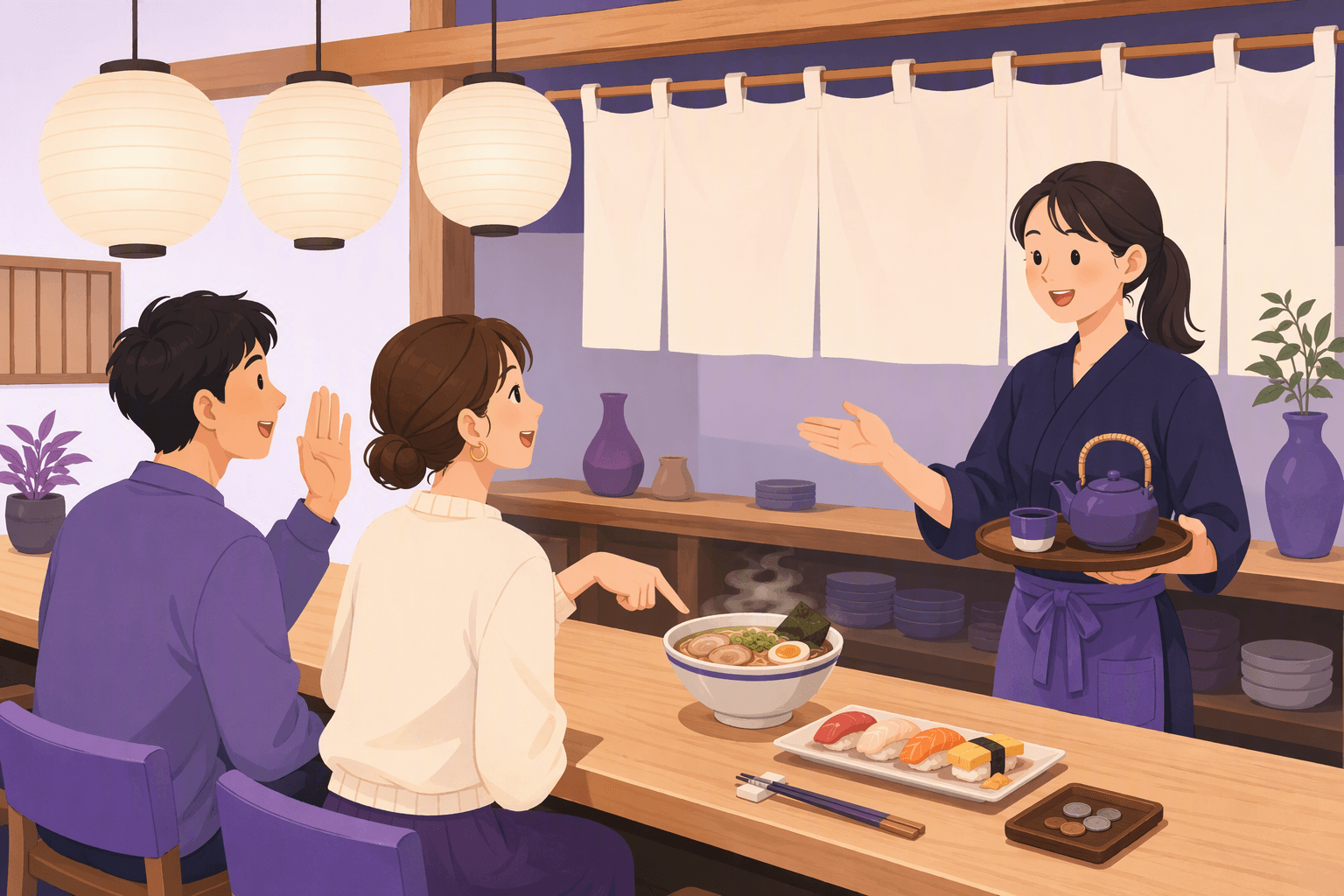
How restaurant politeness works in Japanese (so your phrases sound right)
Japanese restaurant talk is less about inventing sentences and more about choosing the right level of politeness and timing. The most common “restaurant Japanese” is polite but not stiff, usually です/ます style.
Linguist Haruo Shirane, in his work on Japanese language and culture, highlights how set expressions carry social meaning beyond literal translation. In restaurants, those set expressions do a lot of work for you.
The two magic softeners: すみません and お願いします
In English, “excuse me” and “please” are optional. In Japanese restaurants, すみません and お願いします are the grease that keeps the interaction smooth.
- すみません (soo-mee-mah-SEN) is “excuse me,” “sorry,” and “hey, could you help me?” in one.
- お願いします (oh-neh-GAH-ee-shee-mahss) is a polite request marker that makes short phrases feel complete.
💡 A safe default
If you can only remember one pattern, use: "Sumimasen" + request + "onegaishimasu." It is polite, normal, and works from ramen shops to hotel restaurants.
Why “thank you” looks different at restaurants
You will still say ありがとうございます (ah-ree-GAH-toh goh-zah-ee-MAHSS), but restaurants also use ritual thanks:
- いただきます (ee-tah-dah-kee-MAHSS) before eating
- ごちそうさまでした (goh-chee-SOH-sah-mah DEH-shee-tah) after eating
These reflect a broader cultural pattern of formulaic gratitude. Anthropologist Merry White, writing on Japanese food culture, connects dining language to social harmony and respect for the work behind a meal.
The core restaurant phrases (with pronunciation you can trust)
Below are the phrases you will use most often. After that, you will see when to use each one, plus common variations you will hear in movies and TV.
すみません
Pronunciation: soo-mee-mah-SEN
This is the standard way to get attention without sounding demanding. Use it when you want to order, ask a question, or request the check.
/soo-mee-mah-SEN/
Literal meaning: A set phrase that covers 'excuse me' and a light apology.
“すみません、注文いいですか?”
Excuse me, can I order?
In Japan, calling staff with 'Sumimasen' is normal and polite. It is often preferred over trying to wave silently.
お願いします
Pronunciation: oh-neh-GAH-ee-shee-mahss
Use this after a noun or short request to make it polite. It is also common when handing something over, like a card or a coupon.
/oh-neh-GAH-ee-shee-mahss/
Literal meaning: A polite request marker, closer to 'I ask for your favor.'
“お水をお願いします。”
Water, please.
You will hear 'onegaishimasu' constantly in service interactions. It is a safe choice when you are unsure how formal to be.
これをください
Pronunciation: KOH-reh oh koo-dah-SAH-ee
This is the cleanest ordering phrase when you are pointing at a menu item or a display. It avoids needing the dish name.
/KOH-reh oh koo-dah-SAH-ee/
Literal meaning: Give me this, please.
“これをください。”
This one, please.
Pointing is normal. Many Japanese menus are designed for pointing, with photos, numbers, or set labels.
おすすめは何ですか?
Pronunciation: oh-SOO-soo-meh wah NAHN dehss-kah
A natural way to ask for a recommendation. You can also ask about a specific category, like fish or dessert.
/oh-SOO-soo-meh wah NAHN dehss-kah/
Literal meaning: As for recommendations, what is it?
“おすすめは何ですか?辛くないのがいいです。”
What do you recommend? I'd like something not spicy.
Staff may recommend a seasonal special or the most popular set. It is a normal question, not pushy.
お会計お願いします
Pronunciation: oh-KAI-kay oh-neh-GAH-ee-shee-mahss
This is the standard “check, please.” In many places you will pay at the register, not at the table.
/oh-KAI-kay oh-neh-GAH-ee-shee-mahss/
Literal meaning: Payment, please.
“すみません、お会計お願いします。”
Excuse me, the bill please.
Many restaurants bring a small tray with the receipt. You usually take it to the cashier near the exit.
Step-by-step: what to say at each moment
Restaurant interactions are predictable. If you map phrases to moments, you stop translating in your head.
When you enter: greetings and party size
Many places greet you first. You can respond simply, or you can add a polite greeting.
Useful lines:
- こんにちは (kohn-NEE-chee-wah) if it is daytime
- 二人です (foo-TAH-ree dehss) for “two people”
- 予約しています (yoh-YAH-koo shee-teh ee-MAHSS) for “I have a reservation”
If you want to refresh greetings and when to use them, see how to say hello in Japanese.
🌍 Why staff ask your party size early
Seating is often optimized for table shape and flow. Saying your number quickly helps staff choose a counter seat, a two-top, or a tatami room without extra back-and-forth.
Getting attention: the polite way to call staff
Use すみません (soo-mee-mah-SEN). In casual places, you may also hear a staff call button, or staff may check in automatically.
Avoid shouting “hey” equivalents. If you have ever heard rough Japanese in anime, that tone does not belong in restaurants.
If you are curious about what not to say, our Japanese curse words guide explains why direct insults and aggressive imperatives land much harder in Japanese than many learners expect.
Ordering: three patterns that cover almost everything
Pattern 1: Pointing
- これをください (KOH-reh oh koo-dah-SAH-ee)
Pattern 2: Dish name + request
- ラーメンをお願いします (RAH-men oh oh-neh-GAH-ee-shee-mahss)
Pattern 3: Decision marker
- これにします (KOH-reh nee shee-MAHSS) meaning “I will go with this.”
A small but powerful add-on is quantity:
- 二つ (foo-TAH-tsoo) for “two (items)”
- 一つ (hee-TOH-tsoo) for “one (item)”
Customizations: what is realistic to ask for
Japanese restaurants vary. Some are flexible, some are not. The safest customization requests are simple omissions:
- 抜きでお願いします (noo-KEE deh oh-neh-GAH-ee-shee-mahss) meaning “without it, please”
- Example: わさび抜きでお願いします (wah-SAH-bee noo-KEE deh oh-neh-GAH-ee-shee-mahss)
You can also ask about ingredients:
- これ、何が入っていますか? (KOH-reh, NAH-nee gah hah-ee-TEH ee-MAHSS-kah) meaning “What is in this?”
⚠️ Allergies and dietary restrictions
If you have a serious allergy, do not rely on vague phrasing. Ask directly about the ingredient and cross-contact. In Japan, some broths and sauces contain fish, shellfish, or pork even when the dish looks vegetable-based.
Drinks and toasts: 乾杯 and the unspoken rules
乾杯! (kahn-PAH-ee) is “cheers.” It is casual and widely used.
In group settings, people often wait until everyone has a drink before starting. You do not need a speech, just match the timing.
During the meal: small talk that fits restaurants
Japanese restaurant talk is often minimal, especially with staff. If you want to be friendly, keep it simple:
- おいしいです (oh-ee-SHEE dehss) “It’s delicious.”
- おすすめ、当たりでした (oh-SOO-soo-meh, ah-TAH-ree deh-shee-tah) “Your recommendation was a hit.”
If you are dining with someone you are close to, you might use warmer language, but keep in mind that romantic phrases are context-sensitive. If you want those, see how to say I love you in Japanese, but do not force them into a staff interaction.
Paying: where and how it happens
In many restaurants, you do not ask for the check and then wait for the card machine at the table. Instead:
- Ask: お会計お願いします (oh-KAI-kay oh-neh-GAH-ee-shee-mahss)
- Receive a receipt or slip
- Take it to the register near the exit
- Pay there
Card acceptance varies by place and region. Ask:
- カードで払えますか? (KAH-doh deh hah-rah-EH-mahss-kah) “Can I pay by card?”
Leaving: the phrase that matters most
Say:
- ごちそうさまでした (goh-chee-SOH-sah-mah DEH-shee-tah)
Then add:
- ありがとうございました (ah-ree-GAH-toh goh-zah-ee-MAH-shee-tah) if you want
For more parting phrases beyond restaurants, use how to say goodbye in Japanese.
🌍 Why 'gochisousama deshita' feels so native
It is not a review of taste, it is a social closing that acknowledges effort and hospitality. Even if the meal was simple, saying it signals you understand the script of Japanese dining.
Common restaurant words you will hear (and how to respond)
You do not need to say these perfectly, but recognizing them reduces stress.
いらっしゃいませ
Pronunciation: ee-RAH-shah-ee-mah-SEH
Staff say this when you enter. You do not have to respond. A small nod or こんにちは (kohn-NEE-chee-wah) is fine.
お決まりですか?
Pronunciation: oh-kee-MAH-ree dehss-kah
Meaning “Have you decided?” If you need time:
- まだです (MAH-dah dehss) “Not yet.”
- もう少しください (moh-SOO-koh-shee koo-dah-SAH-ee) “A little more time, please.”
以上でよろしいですか?
Pronunciation: ee-JOH deh yoh-ROH-shee dehss-kah
Meaning “Is that all?” or “Is that correct?” You can answer:
- はい (HAH-ee) yes
- 大丈夫です (dai-JOH-boo dehss) meaning “That’s fine.”
How to practice restaurant Japanese with movie and TV clips
Restaurant scenes repeat the same language: greetings at the door, ordering, reacting to food, paying, leaving. That repetition is why video practice works well here.
A practical method is:
- Watch the clip once with subtitles for meaning.
- Rewatch and shadow only the set phrases: すみません, お願いします, これをください, お会計お願いします.
- Repeat with the same rhythm, because Japanese is mora-timed.
If you want a broader immersion routine, see how to learn a language with movies. For a structured set of tools, browse the blog index or start on our Japanese learning page.
The biggest mistakes learners make (and the easy fixes)
Mistake 1: Using casual speech with staff
Even if you know casual forms, restaurants are a “polite default” space. Stick to です/ます and set phrases.
Fix: use お願いします and ください instead of casual commands.
Mistake 2: Translating word-for-word from English
Japanese service language is formulaic. Trying to build a custom sentence often makes you hesitate.
Fix: memorize three chunks: すみません, これをください, お会計お願いします.
Mistake 3: Collapsing morae in pronunciation
Japanese timing matters. If you compress sounds, you become harder to understand even with correct words.
Fix: clap the beats for tricky words. Example: かん-ぱ-い (kahn-PAH-ee) is three beats.
💡 A 5-minute drill that works
Practice a loop: "Sumimasen." "Kore o kudasai." "O-mizu o onegaishimasu." "Okaikei onegaishimasu." Keep each beat clear, especially long vowels and the final 'n' sound in 'sumimasen.'
A simple restaurant script you can reuse
Use this as a mental template.
- Get attention: すみません (soo-mee-mah-SEN)
- Order: これをください (KOH-reh oh koo-dah-SAH-ee)
- Drink: お水をお願いします (oh-MEE-zoo oh oh-neh-GAH-ee-shee-mahss)
- Compliment: おいしかったです (oh-ee-SHEE-kaht-tah dehss)
- Pay: お会計お願いします (oh-KAI-kay oh-neh-GAH-ee-shee-mahss)
- Leave: ごちそうさまでした (goh-chee-SOH-sah-mah DEH-shee-tah)
If you can do that, you can eat almost anywhere in Japan without stress.
Keep learning with real scenes
Restaurant Japanese is one of the fastest wins because the same phrases show up again and again. When you learn them through real clips, you also learn timing, intonation, and when people actually say them.
If you want more everyday building blocks, continue with how to say hello in Japanese and how to say goodbye in Japanese, then expand into listening-heavy practice on /learn/japanese.
Frequently Asked Questions
What is the most useful Japanese phrase in a restaurant?
How do you ask for the bill in Japanese?
Is it rude to say 'kudasai' to staff?
Do Japanese restaurants expect tips?
What do you say before and after eating in Japanese?
How can I order if I cannot read kanji on the menu?
Sources & References
- Japan Foundation, Japanese language learning resources (accessed 2026)
- Agency for Cultural Affairs (Japan), Japanese language and culture materials (accessed 2026)
- NHK WORLD-JAPAN, Easy Japanese lessons and phrase resources (accessed 2026)
- Ethnologue: Languages of the World, Japanese language entry (2024)
- Kenkyusha, Japanese-English dictionary resources (accessed 2026)
Start learning with Wordy
Watch real movie clips and build your vocabulary as you go. Free to download.


