Quick Answer
Japanese food culture is built around respect: for ingredients, the cook, and the people you eat with. In practice that means set meal structure, shared dishes, clear etiquette (especially with chopsticks), and ritual phrases like itadakimasu and gochisousama. This guide explains what to do, what to say, and why it matters in real Japanese meals.
Japanese food culture is a set of everyday rules and phrases that show respect for the meal, the cook, and the people you are eating with, from saying itadakimasu before you start to how you handle chopsticks and share dishes. If you follow a few core habits, watch for the flow of the group, and use the right set phrases, you will come across as thoughtful even if your Japanese is basic.
Japan has about 125 million people, and Japanese is one of the world’s major languages, with roughly 123 million L1 speakers (Ethnologue, 27th edition, 2024). That scale matters because dining norms are not niche, they are shared expectations you will meet in homes, school lunches, izakaya, and convenience stores.
If you are also building everyday greetings for social situations, pair this guide with how to say hello in Japanese and how to say goodbye in Japanese. Food and greetings often come as a package in real life.
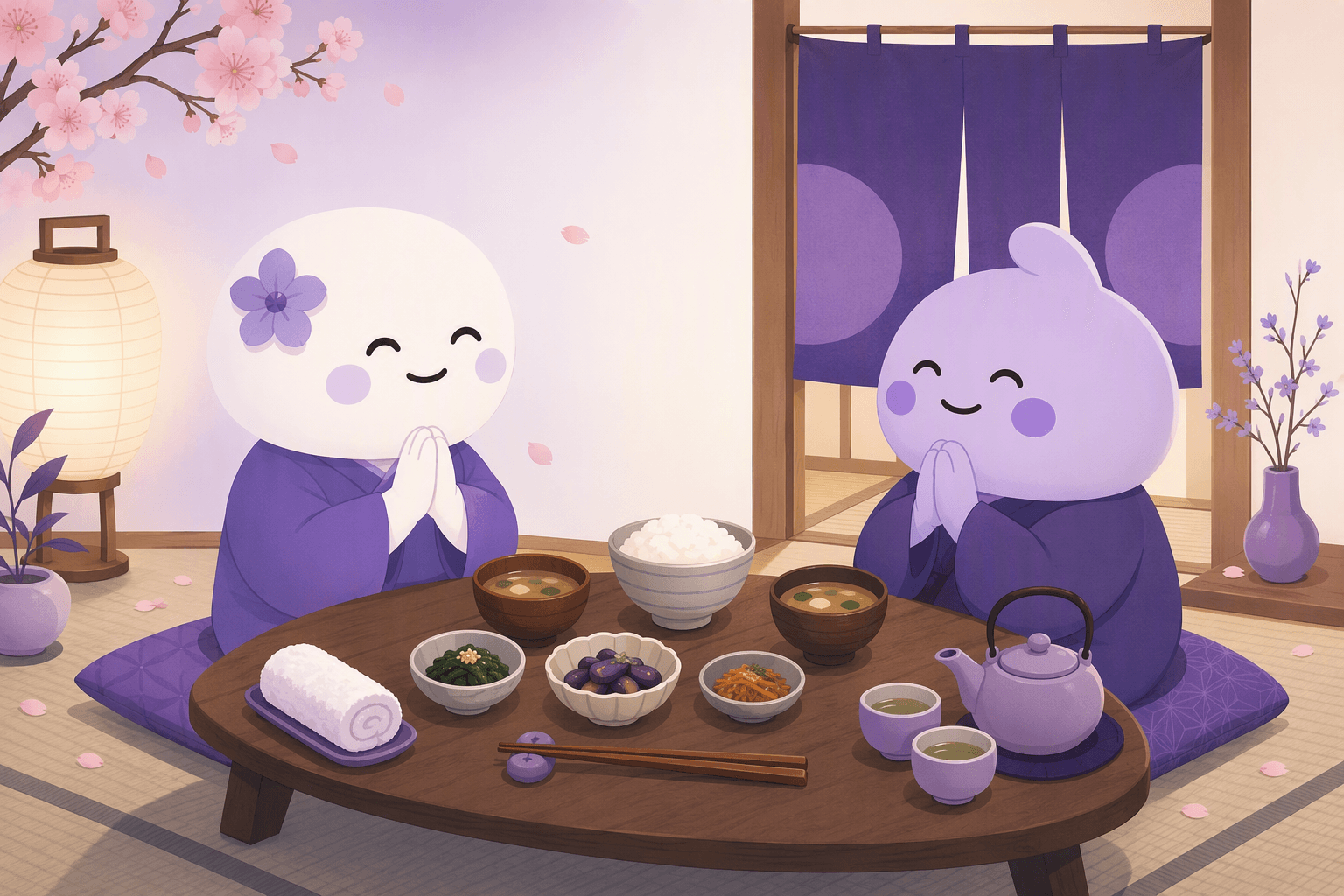
| English | Japanese | Pronunciation | Formality |
|---|---|---|---|
| Thanks for the food (before eating) | いただきます | ee-tah-dah-kee-MAHSS | polite |
| Thanks for the meal (after eating) | ごちそうさまでした | goh-chee-SOH-sah-mah deh-SHEE-tah | polite |
| Excuse me (to get attention, enter, or pass) | すみません | soo-mee-mah-SEN | polite |
| Please (requesting) | お願いします | oh-neh-GAH-ee-shee-mahss | polite |
| Cheers (toast) | 乾杯 | kahn-PAH-ee | casual |
| This is delicious | おいしいです | oh-EE-shee des | polite |
| I'm full | お腹いっぱいです | oh-NAH-kah ee-PAH-ee des | polite |
| May I have the bill? | お会計お願いします | oh-KAI-kay oh-neh-GAH-ee-shee-mahss | polite |
The big idea: respect, not perfection
Japanese dining etiquette is less about rigid rules and more about showing you are considerate. You wait when others wait, you do not create discomfort, and you acknowledge effort.
This aligns with what linguist Haruko Minegishi Cook describes in her work on Japanese interaction: routine phrases and small acts help maintain social harmony in ordinary settings. Food is one of the most routine settings of all.
💡 A simple rule that works almost everywhere
Match the group. If everyone is sharing, share. If everyone is quiet and eating fast, do not turn it into a long speech. If the host is guiding the pace, follow their lead.
Before you eat: seating, towels, and the start signal
Oshibori and where to put your hands
In many restaurants you get an oshibori, a wet towel. Use it to clean your hands, then fold it neatly and set it aside.
Do not wipe your face or neck with it in more formal places. In casual izakaya, people sometimes do, but it is safer to keep it to hands.
Waiting to start
In group meals, you usually wait until everyone has their food. If you start early, it can read as impatient, even if nobody says anything.
If you are in a hurry, a small sumimasen plus a quick explanation is better than silently starting. You will hear sumimasen constantly in Japan because it covers apology, attention, and softening.
いただきます
Say itadakimasu (ee-tah-dah-kee-MAHSS) right before you begin. It is not a prayer, and it is not only for home.
It is a ritualized thanks that frames eating as receiving, which fits Japanese humility patterns described in reference grammars like Makino and Tsutsui’s work on Japanese usage. You are not thanking a specific person only, you are acknowledging the whole chain behind the meal.
/ee-tah-dah-kee-MAHSS/
Literal meaning: Literally tied to 'humbly receive', used as a pre-meal thanks.
“いただきます。”
Thanks for the food. (said before eating)
Said before eating at home, in school lunches, and in restaurants. In groups, wait until everyone is ready, then say it together or quietly as you start.
The structure of a Japanese meal (and why it feels different)
Ichijuu-sansai as a mental model
A classic pattern is ichijuu-sansai: one soup plus three side dishes, with rice and pickles often present. You still see this logic in teishoku set meals, even when the dishes change.
The point is balance, not abundance. Different cooking methods, colors, and textures make the meal feel complete.
🌍 Washoku is not just 'Japanese food'
UNESCO lists washoku as Intangible Cultural Heritage, focusing on traditional dietary culture, seasonality, and social practices around eating. That framing helps explain why etiquette and presentation matter as much as the ingredients.
Shared dishes vs individual sets
At izakaya, yakiniku, and many family meals, sharing is normal. In ramen shops and teishoku restaurants, individual sets are normal.
If you are unsure, watch whether plates arrive in the middle or directly in front of each person. If it is in the middle, assume it is for sharing unless someone tells you otherwise.
Chopstick etiquette that actually matters
You do not need perfect chopstick technique to be polite. You do need to avoid a few actions that carry strong cultural associations.
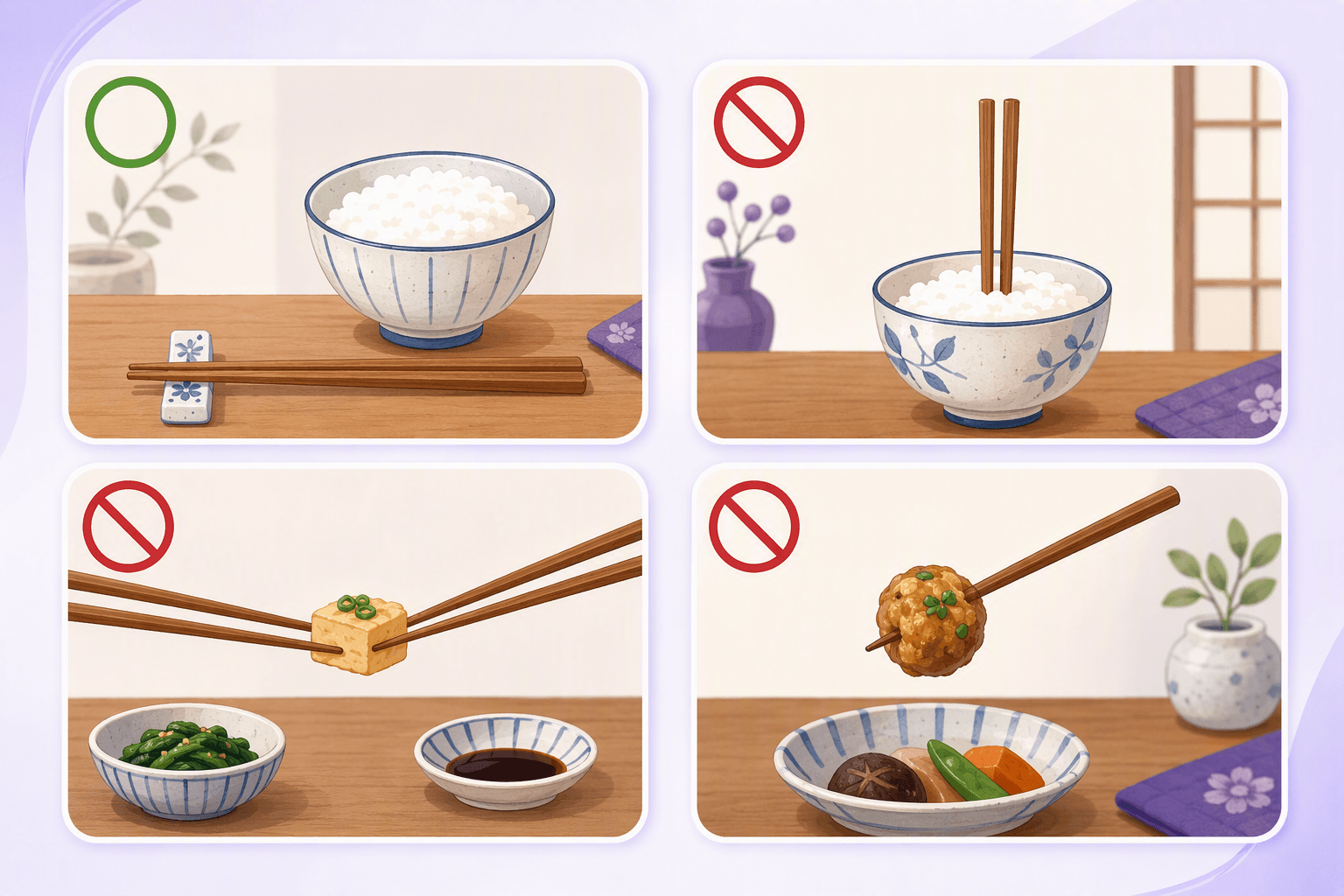
The three biggest "do not do this" rules
-
Do not stick chopsticks upright in rice. It resembles offerings in funerary contexts.
-
Do not pass food from chopsticks to chopsticks. That also echoes funeral bone-passing rituals.
-
Do not spear food with chopsticks. If something is hard to pick up, ask for a spoon or adjust your grip.
⚠️ Disposable chopsticks
Avoid rubbing waribashi together to remove splinters. It can imply the restaurant provides low-quality chopsticks. If there is a splinter, remove it quietly or ask for another pair.
Where to put chopsticks between bites
Use a hashioki (chopstick rest) if provided. If not, rest them across the edge of your plate or on the paper sleeve for disposable chopsticks.
Do not leave chopsticks crossed in the bowl. It looks messy and can signal you are done when you are not.
Serving others: the polite workaround
If you are taking food from a shared plate, use serving chopsticks if they exist. If not, flip your chopsticks and use the clean ends, especially in more formal company.
In close friend groups, people may not bother. In mixed groups, the clean-end habit is a safe default.
Slurping, sipping, and sound: what is normal
Noodles
Slurping ramen, soba, and udon is widely accepted. It is not required, but it is not rude in casual contexts.
If you cannot slurp comfortably, just eat normally. Nobody expects foreigners to perform it.
Soup
Miso soup is often sipped directly from the bowl, with chopsticks used to pick up solids. That can feel unusual if you come from spoon-centered soup cultures.
If a spoon is provided, you can use it. In many places it will not be.
Ordering and paying: the flow in real restaurants
Getting attention
Sumimasen (soo-mee-mah-SEN) is your friend. It is the standard way to call staff without sounding demanding.
In some casual places, staff may call out irasshaimase when you enter. You do not need to answer, a nod is enough.
お願いします
Onegaishimasu (oh-neh-GAH-ee-shee-mahss) is a polite request marker. You can attach it to almost anything you want to order.
If you are learning more everyday phrases, how to say hello in Japanese helps because greetings and requests often come together at the start of an interaction.
Paying at the register
In many restaurants you pay at the register near the exit, not at the table. You may receive a small tray with the bill, then take it to the cashier.
When paying cash, place money on the tray rather than handing it directly. Cards are increasingly accepted, but not universal.
/oh-KAI-kay oh-neh-GAH-ee-shee-mahss/
Literal meaning: A polite request for the check.
“すみません。お会計お願いします。”
Excuse me. May I have the bill, please?
Common in restaurants where staff bring a bill slip to your table. In many places you then pay at the register near the exit.
Drinking culture: izakaya basics, toasts, and pouring
乾杯
Kanpai (kahn-PAH-ee) is the standard toast. In groups, wait until everyone has a drink before you toast.
In work settings, the first kanpai can be more formal, and people may wait for a senior person to initiate. If you are unsure, pause and follow.
Pouring for others
In many social settings, especially with beer, people pour for each other. You do not have to force this, but noticing empty glasses and offering is seen as attentive.
If someone pours for you, lift your glass slightly as a polite acknowledgment. Small gestures matter.
🌍 Why pouring feels social
Anthropologist Emiko Ohnuki-Tierney’s work on Japanese symbolism highlights how everyday practices can carry social meaning. Pouring is not about the liquid, it is about monitoring the group and showing you are engaged.
Compliments, gratitude, and finishing the meal
おいしいです
Oishii desu (oh-EE-shee des) is a simple, safe compliment. You can also say oishii, more casual.
If you want to sound more specific, you can praise a dish directly, but even a basic oishii desu is appreciated.
ごちそうさまでした
Gochisousama deshita (goh-chee-SOH-sah-mah deh-SHEE-tah) is said after eating. In restaurants, you can say it to staff as you leave.
It also works at home. If someone cooked for you, saying it clearly is a strong politeness signal.
/goh-chee-SOH-sah-mah deh-SHEE-tah/
Literal meaning: A set phrase meaning 'It was a feast', used as thanks after eating.
“ごちそうさまでした。とてもおいしかったです。”
Thanks for the meal. It was very delicious.
Said after meals at home and when leaving restaurants. In casual settings, people may shorten it to 'gochisousama'.
Home meals: what guests should do
Bringing something
If you are invited to someone’s home, bringing a small omiyage gift is common. It is often food, nicely packaged.
You do not need something expensive. The point is thoughtfulness and presentation.
Helping and cleanup
Many hosts will refuse help at first out of politeness. Offering once is good, offering twice can be fine, pushing beyond that can become awkward.
If you do help, simple tasks like carrying plates or pouring tea are low-risk.
Convenience store and bento culture: modern daily eating
Japanese food culture is not only kaiseki and sushi. A lot of daily eating happens through konbini, depachika food halls, and bento.
This matters for learners because you will hear the same politeness patterns in everyday transactions. The language of food is also the language of routine service encounters.
If you want more context for how Japanese sounds in real speech, learning through short clips can help you catch fast set phrases like sumimasen and onegaishimasu. Wordy’s approach is built around that kind of repeated, real context listening, but any consistent exposure to native audio helps.
What not to do: a short, practical list
Do not police your own mistakes out loud
Foreigners sometimes apologize repeatedly for not using chopsticks well. One quick sumimasen is enough.
Over-apologizing can create more discomfort than the original mistake.
Do not use aggressive language when drinking
Japanese has plenty of strong language, but it lands differently across contexts. If you are curious, keep it separate from dining situations and learn it responsibly, for example in our guide to Japanese swear words.
Food spaces are where you build trust. Strong slang can break that trust fast.
Learn Japanese food culture through movies and TV: what to listen for
Food scenes are great for language learning because the phrases repeat. You will hear them in ramen shops, family kitchens, school lunches, and date scenes.
Listen for:
- The timing of itadakimasu and gochisousama
- How sumimasen is used to soften everything
- How people avoid direct no by offering alternatives
If you are building a fuller social toolkit, add a few relationship phrases too, but keep them context-appropriate. How to say I love you in Japanese is useful, but it is not something you drop casually at dinner.
A quick mini-script you can reuse
Use this as a polite, natural sequence in many casual restaurants:
- Enter, nod, follow seating.
- Order with onegaishimasu.
- Before eating: itadakimasu.
- Compliment: oishii desu.
- Finish: gochisousama deshita.
- Leave with a small bow and arigatou gozaimasu if you know it.
If you want more everyday openers and closers, revisit how to say hello in Japanese and how to say goodbye in Japanese. Those phrases are the social frame around the meal.
💡 The fastest way to sound polite
Use set phrases at the right moment. Perfect grammar matters less than timing: itadakimasu before the first bite, gochisousama as you finish, sumimasen when you need attention.
The takeaway
Japanese food culture is best understood as a system of small signals: you wait, you share smoothly, you avoid a few chopstick taboos, and you use ritual phrases that show gratitude. Learn those signals and you can relax, enjoy the meal, and focus on the conversation.
If you want to practice these phrases in real context, watch for food scenes and repeat the lines out loud with the same rhythm and mora timing. That is one of the most reliable ways to make polite Japanese feel automatic.
Frequently Asked Questions
What does itadakimasu actually mean?
Do you have to say gochisousama after every meal in Japan?
Is it rude to slurp noodles in Japan?
What are the biggest chopstick mistakes foreigners make in Japan?
Why do Japanese meals have so many small dishes?
Sources & References
- Agency for Cultural Affairs (Japan), Washoku: Traditional Dietary Cultures of the Japanese, accessed 2026
- UNESCO, Washoku, traditional dietary cultures of the Japanese (Intangible Cultural Heritage), accessed 2026
- Ministry of Agriculture, Forestry and Fisheries (Japan), Washoku resources and food culture materials, accessed 2026
- Ethnologue, 27th edition, 2024
- NHK Broadcasting Culture Research Institute, language and culture resources, accessed 2026
Start learning with Wordy
Watch real movie clips and build your vocabulary as you go. Free to download.


