Japanese Food Vocabulary: 30 Essential Words for Washoku, Sushi, Ramen, and Restaurant Phrases
Quick Answer
The most essential Japanese food words to learn first are 'ご飯 / ごはん' (gohan, rice/meal), '寿司 / すし' (sushi), 'ラーメン' (raamen, ramen), and the untranslatable meal phrases 'いただきます' (itadakimasu, said before eating) and 'ごちそうさまでした' (gochisousama deshita, said after eating). Japanese food culture, known as 和食 (washoku), was designated a UNESCO Intangible Cultural Heritage in 2013.
Japanese food vocabulary is one of the most practical word sets you can learn. Whether you are navigating a Tokyo ramen shop, decoding a sushi menu, or understanding cooking scenes in anime, food words appear constantly in everyday Japanese life.
With approximately 123 million native speakers according to Ethnologue's 2024 data, Japanese is the language behind one of the world's most influential culinary traditions. In 2013, UNESCO inscribed 和食 (washoku, Japanese cuisine) on its Intangible Cultural Heritage list, not as a single dish, but as an entire social practice built on respect for nature, seasonal ingredients, and aesthetic presentation. Learning food vocabulary means learning Japanese culture at its most fundamental level.
"Washoku is not merely a set of recipes or ingredients. It is a comprehensive social practice rooted in the Japanese spirit of respect for nature, closely connected to the sustainable use of natural resources."
(UNESCO, Intangible Cultural Heritage nomination document for Washoku, 2013)
This guide covers 30+ essential food words organized by category, with kanji, hiragana, pronunciation, and the cultural context that makes Japanese food vocabulary unique. For interactive practice with authentic Japanese content, visit our Japanese learning page.

Quick Reference: 30 Essential Food Words
| English | Japanese | Pronunciation | Note |
|---|---|---|---|
| Rice / Meal | ご飯 / ごはん | gohan | Means both 'rice' and 'meal' |
| Raw rice | 米 / こめ | kome | Uncooked rice grain |
| Noodles | 麺 / めん | men | General term for noodles |
| Sushi | 寿司 / すし | sushi | Vinegared rice + topping |
| Sashimi | 刺身 / さしみ | sashimi | Raw sliced fish, no rice |
| Tuna | まぐろ | maguro | Most popular sushi topping |
| Salmon | 鮭 / さけ | sake | Also read 'shake' |
| Ramen | ラーメン | raamen | Katakana: Chinese origin |
| Udon | うどん | udon | Thick wheat noodles |
| Soba | そば | soba | Buckwheat noodles |
| Tempura | 天ぷら / てんぷら | tempura | Battered fried food |
| Curry | カレー | karee | Katakana: via English |
| Miso soup | 味噌汁 / みそしる | misoshiru | Staple side dish |
| Tofu | 豆腐 / とうふ | toufu | Lit. 'bean curd' |
| Egg | 卵 / たまご | tamago | Also written 玉子 |
| Meat | 肉 / にく | niku | 牛肉, 豚肉, 鶏肉 for types |
| Fish | 魚 / さかな | sakana | General term |
| Vegetable | 野菜 / やさい | yasai | Lit. 'field greens' |
| Fruit | 果物 / くだもの | kudamono | Lit. 'tree things' |
| Bread | パン | pan | Katakana: Portuguese origin |
| Water | 水 / みず | mizu | Free at restaurants |
| Tea | お茶 / おちゃ | ocha | Green tea by default |
| Beer | ビール | biiru | Katakana: Dutch/English origin |
| Sake (rice wine) | 日本酒 / にほんしゅ | nihonshu | 酒 alone = any alcohol |
| Sweet / Dessert | 甘い / あまい | amai | Adjective: sweet |
| Spicy / Hot | 辛い / からい | karai | Also means 'salty' regionally |
| Delicious | 美味しい / おいしい | oishii | Most common food praise |
| Let's eat (before) | いただきます | itadakimasu | Said before every meal |
| Thank you (after) | ごちそうさまでした | gochisousama deshita | Said after every meal |
| Check, please | お会計 / おかいけい | okaikei | お会計をお願いします |
Rice and Staples: The Foundation of Every Meal
Rice is not just food in Japan; it is the foundation of the entire meal structure. The word ご飯 (gohan) means both "cooked rice" and "meal," revealing how deeply rice is embedded in Japanese food culture. According to NHK's 2023 survey on dining customs, over 80% of Japanese households still eat rice-based meals daily.
ご飯 (ごはん)
The most important food word in Japanese. ご飯 (gohan) has a double meaning: it refers to cooked white rice specifically, and also to "a meal" in general. 朝ご飯 (asagohan) means "breakfast" (morning rice), 昼ご飯 (hirugohan) means "lunch" (midday rice), and 晩ご飯 (bangohan) means "dinner" (evening rice). The prefix ご is an honorific, reflecting the reverence Japanese culture places on rice.
米 (こめ)
Kome refers to raw, uncooked rice grains. Japan's relationship with rice runs so deep that the kanji 米 appears in the word for "America" (米国, beikoku), since historically, America was associated with rice trade. The Agency for Cultural Affairs notes that rice-related vocabulary contains over 30 distinct terms in Japanese, from 新米 (shinmai, new rice harvest, also meaning "beginner") to 古米 (komai, old rice).
麺 (めん)
The general term for noodles. Japanese cuisine features three major noodle types: ラーメン (raamen), うどん (udon), and そば (soba). Each has distinct characteristics, regional variations, and eating etiquette. Slurping noodles loudly in Japan is not rude; it is considered a sign of enjoyment and actually helps cool the noodles.
🌍 ご飯 = Rice = Meal
The fact that gohan means both "rice" and "meal" tells you everything about rice's cultural status in Japan. Asking 「ご飯食べた?」(gohan tabeta?, "Have you eaten rice?") is the Japanese equivalent of asking "Have you eaten?", a fundamental greeting that shows care. A meal without rice is not considered a proper meal in traditional Japanese thinking.
Sushi and Sashimi Vocabulary
Sushi is perhaps the most internationally recognized Japanese food, yet many learners confuse key terms. 寿司 (sushi) specifically refers to vinegared rice topped or filled with ingredients, while 刺身 (sashimi) is sliced raw fish served without rice.
寿司 (すし)
The word sushi actually refers to the seasoned rice, not the fish. The kanji 寿司 is an ateji (phonetic kanji) where the characters were chosen for their auspicious meanings: 寿 (longevity) and 司 (to manage). Common types include 握り寿司 (nigirizushi, hand-pressed), 巻き寿司 (makizushi, rolled), and ちらし寿司 (chirashizushi, scattered).
刺身 (さしみ)
Sashimi means "pierced body": 刺 (sashi, pierce) and 身 (mi, body/flesh). It is raw fish sliced and served without rice, typically with soy sauce and wasabi. Learning to distinguish sushi from sashimi on a menu immediately marks you as a more knowledgeable diner.
まぐろ
Tuna, the single most popular sushi topping in Japan. Maguro comes in grades: 赤身 (akami, lean red meat), 中トロ (chuutoro, medium fatty), and 大トロ (ootoro, fatty belly, the most expensive). At conveyor belt sushi restaurants, まぐろ plates are typically among the first to sell out.
💡 回転寿司 (Kaiten-zushi) Vocabulary
At conveyor belt sushi (回転寿司, kaiten-zushi), useful words include: 皿 (sara, plate), 一皿 (hitosara, one plate), タッチパネル (tacchi paneru, touch panel for ordering), ガリ (gari, pickled ginger), and わさび抜き (wasabi-nuki, no wasabi). You can order directly from the chef by saying the item name followed by お願いします (onegai shimasu).
Cooked Dishes: Ramen, Udon, and Beyond
Japanese comfort food spans an enormous range of cooked dishes. Many of the most beloved items have interesting linguistic origins that reveal Japan's history of cultural exchange.
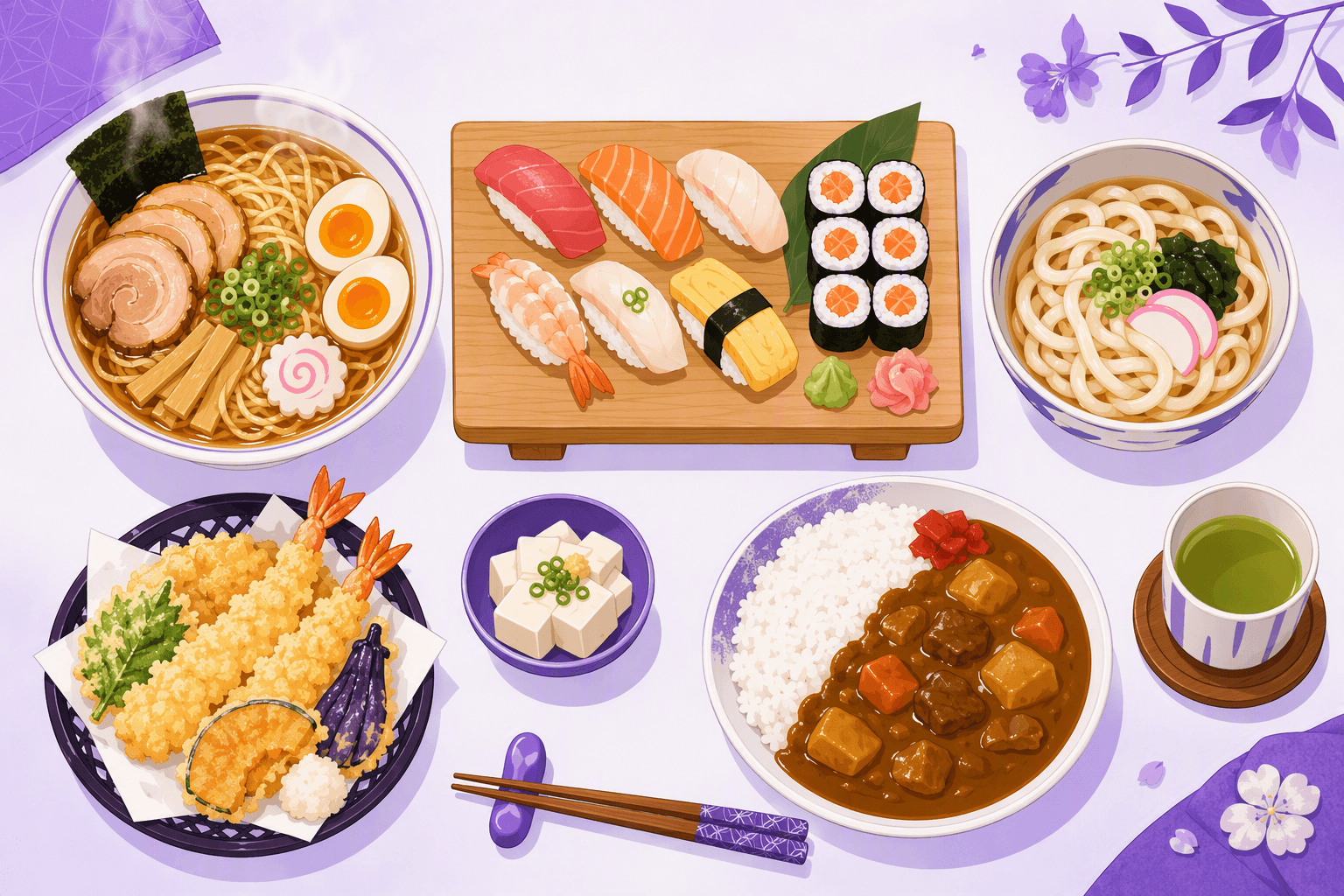
ラーメン
Written in katakana because it was borrowed from Chinese (拉麺, pulled noodles). Despite its foreign origin, ramen has become one of Japan's most iconic foods. Each region has a signature style: 豚骨 (tonkotsu, pork bone broth) in Fukuoka, 味噌 (miso) in Sapporo, 醤油 (shouyu, soy sauce) in Tokyo. The word ラーメン appears in katakana on virtually every street in Japanese cities.
うどん
Thick wheat flour noodles served hot or cold. Udon is written in hiragana because it is a native Japanese word with uncertain kanji origins. Regional varieties include 讃岐うどん (Sanuki udon) from Kagawa Prefecture, known for its firm, chewy texture. Kagawa is sometimes called "Udon Prefecture" because residents consume more udon per capita than anywhere else in Japan.
そば
Buckwheat noodles with a distinctive nutty flavor. Soba holds special cultural significance: 年越しそば (toshikoshi soba, year-crossing soba) is eaten on New Year's Eve throughout Japan. The long noodles symbolize longevity, and the tradition dates back to the Edo period. Soba is also used in the word 側 (soba, "near/beside"), though the kanji is different.
天ぷら (てんぷら)
Battered and deep-fried seafood or vegetables. The word likely comes from the Portuguese tempero (seasoning) or tempora (Lenten period), reflecting Japan's contact with Portuguese traders in the 16th century. 天ぷら is a perfect example of how Japanese cuisine absorbed foreign techniques and made them entirely its own.
カレー
Japanese curry, written in katakana because it entered Japanese via English (which borrowed it from Tamil). Japanese curry rice (カレーライス, karee raisu) is thicker and sweeter than Indian or Thai curries. According to NHK surveys, it consistently ranks as one of the top three favorite home-cooked meals in Japan, alongside ramen and gyoza.
"Japanese curry, originally introduced through the British Navy in the Meiji era, has been so thoroughly domesticated that it now represents one of the most consumed home meals in Japan, a dish that is simultaneously foreign in origin and quintessentially Japanese in practice."
(Katarzyna Cwiertka, Modern Japanese Cuisine, Reaktion Books, 2006)
Vegetables, Fruits, and Ingredients
Japanese cooking emphasizes 旬 (shun, seasonality), using ingredients at their peak. This principle is so important that restaurant menus change quarterly to reflect what is freshest.
| English | Japanese | Pronunciation | Note |
|---|---|---|---|
| Vegetable | 野菜 / やさい | yasai | General term |
| Radish | 大根 / だいこん | daikon | Lit. 'big root' |
| Mushroom | きのこ | kinoko | 椎茸 (shiitake) is one type |
| Onion | 玉ねぎ / たまねぎ | tamanegi | Lit. 'ball onion' |
| Seaweed | 海苔 / のり | nori | Used in sushi rolls |
| Soy sauce | 醤油 / しょうゆ | shouyu | Japan's essential condiment |
| Apple | りんご | ringo | Aomori is famous for apples |
| Strawberry | いちご | ichigo | Premium fruit in Japan |
🌍 旬 (Shun): The Art of Seasonality
The concept of 旬 (shun) is central to Japanese food philosophy. It means "in season" or "at its peak" and dictates what appears on menus throughout the year. Spring brings 竹の子 (takenoko, bamboo shoots), summer means 枝豆 (edamame) and 西瓜 (suika, watermelon), autumn features 松茸 (matsutake mushrooms) and 柿 (kaki, persimmons), and winter highlights 鍋 (nabe, hot pot) and みかん (mikan, mandarin oranges). Eating seasonally is not a trend in Japan; it is a centuries-old practice.
Katakana Foods: Borrowed Words on Every Menu
A distinctive feature of Japanese food vocabulary is the split between native words (kanji/hiragana) and borrowed words (katakana). Recognizing this pattern instantly tells you a food's origin story.
Portuguese-origin words entered Japanese during the 16th century trade period:
- パン (pan, bread): from Portuguese pão
- 天ぷら (tempura): likely from Portuguese tempero
Chinese-origin words include some of Japan's most beloved dishes:
- ラーメン (raamen): from Chinese 拉麺
- 餃子 (gyouza): from Chinese 餃子 (jiǎozi)
English-origin words reflect modern Western influence:
- カレー (karee, curry)
- ビール (biiru, beer)
- ケーキ (keeki, cake)
- コーヒー (koohii, coffee)
When you see katakana on a menu, you can often guess the word by reading it aloud slowly. ハンバーガー is "hanbaagaa" (hamburger), アイスクリーム is "aisu kuriimu" (ice cream), and サラダ is "sarada" (salad). This katakana decoding skill is one of the fastest ways to expand your restaurant vocabulary.
Restaurant Phrases: From Entering to Paying
Knowing what to say at a Japanese restaurant is just as important as knowing food names. Japanese dining has specific phrases for every stage of the meal.
いただきます
The phrase said before every meal in Japan. It literally means "I humbly receive" (from the humble verb いただく, itadaku). It expresses gratitude to the cook, to the farmers, to the animals and plants that gave their lives, and to nature itself. There is no single English translation. NHK's research on dining customs found that over 90% of Japanese people say いただきます before meals, making it one of the most universally practiced cultural phrases in the language.
ごちそうさまでした
Said after finishing a meal. ご馳走 (gochisou) literally means "running around," referring to the effort of a host running around to prepare a feast. さまでした adds formal gratitude. Together, the phrase acknowledges all the effort that went into the meal. When leaving a restaurant, saying ごちそうさまでした to the staff is standard and expected.
お会計 (おかいけい)
The word for "bill" or "check." To ask for the check, say お会計をお願いします (okaikei wo onegai shimasu). In many Japanese restaurants, you take a slip from your table to a register near the exit rather than paying at the table. Some restaurants use the phrase お勘定 (okanjou), which means the same thing.
| English | Japanese | Pronunciation | Note |
|---|---|---|---|
| Let's eat (before meal) | いただきます | itadakimasu | Said with hands together |
| Thank you (after meal) | ごちそうさまでした | gochisousama deshita | Said to staff when leaving |
| Check, please | お会計をお願いします | okaikei wo onegai shimasu | Or gesture an X with fingers |
| One person | 一人です | hitori desu | When being seated |
| Two people | 二人です | futari desu | When being seated |
| Excuse me (waiter) | すみません | sumimasen | To call a server |
| This, please | これをお願いします | kore wo onegai shimasu | Point at menu item |
| No wasabi | わさび抜き | wasabi-nuki | Common sushi request |
| It's delicious | 美味しいです | oishii desu | Compliment to the chef |
💡 Counting Food: Japanese Counters
Japanese uses different counting words depending on the shape of the food. Round items like eggs and oranges use 個 (ko): 卵三個 (tamago sanko, three eggs). Long items like carrots and bananas use 本 (hon): バナナ二本 (banana nihon, two bananas). Flat items like slices of sashimi use 枚 (mai): 刺身三枚 (sashimi sanmai, three slices). Bowls of rice or noodles use 杯 (hai): ラーメン一杯 (raamen ippai, one bowl of ramen). When uncertain, the general counter つ (tsu) always works: ひとつ, ふたつ, みっつ (one, two, three).
The Five Principles of Washoku
What makes 和食 (washoku) a UNESCO-recognized cultural heritage is not any single dish but a complete philosophy built on five principles. Understanding these concepts gives you vocabulary that goes far beyond food.
五色 (ごしき, goshiki), Five Colors: Every meal should include white, black, red, yellow, and green. This ensures both visual beauty and nutritional balance. A typical Japanese set meal (定食, teishoku) achieves this through white rice, dark seaweed, red pickled ginger, yellow egg, and green vegetables.
五味 (ごみ, gomi), Five Tastes: Sweet (甘い, amai), salty (塩辛い, shiokarai), sour (酸っぱい, suppai), bitter (苦い, nigai), and umami (うま味). Japan is where the fifth taste, umami, was scientifically identified by chemist Kikunae Ikeda in 1908. The word itself (うま味) comes from うまい (umai, delicious).
五法 (ごほう, gohou), Five Methods: Raw (生, nama), simmer (煮る, niru), grill (焼く, yaku), steam (蒸す, musu), and fry (揚げる, ageru). A full kaiseki meal incorporates all five methods across its courses.
旬 (しゅん, shun), Seasonality: Using ingredients at their natural peak, as discussed earlier.
盛り付け (もりつけ, moritsuke), Presentation: The art of arranging food beautifully. Japanese presentation considers 色 (iro, color), 形 (katachi, shape), and 器 (utsuwa, the vessel/dish). The plate is considered part of the dish itself.
🌍 Umami: Japan's Gift to Global Food Science
The word うま味 (umami) is one of the few Japanese food terms that has entered virtually every language on earth. Kikunae Ikeda isolated glutamic acid from kelp broth (昆布だし, kombu dashi) in 1908 and named this fifth taste "umami," a word combining うまい (delicious) and 味 (mi, taste). Today, umami is a foundational concept in global gastronomy, and its Japanese origin reflects the depth of Japan's food culture.
Practice Food Vocabulary With Real Japanese Content
Food scenes appear in virtually every Japanese movie, drama, and anime, from the intricate kitchen sequences in Studio Ghibli films to the ramen shop conversations in everyday dramas. These scenes are rich with the vocabulary covered in this guide: ordering phrases, ingredient names, and the ritual expressions that frame every meal.
Check out our guide to the best movies for learning Japanese for recommendations. Films like Tampopo and Spirited Away are particularly dense with food vocabulary and dining culture.
Wordy lets you practice food words in real context by watching Japanese content with interactive subtitles. When ご飯, ラーメン, or いただきます appears in dialogue, you can tap to see the kanji, readings, and meaning instantly. Explore our blog for more Japanese guides, or visit our Japanese learning page to start building your vocabulary today.
Frequently Asked Questions
What does 'itadakimasu' mean before a meal?
What is washoku and why is it special?
Why are some Japanese food words written in katakana?
How do you order food at a Japanese restaurant?
What counting words are used for food in Japanese?
Sources & References
- UNESCO, Representative List of the Intangible Cultural Heritage: Washoku (2013)
- Agency for Cultural Affairs, Japan (文化庁), National Language Survey (2024)
- NHK Broadcasting Culture Research Institute, Survey on Dining Customs and Language (2023)
- Ethnologue: Languages of the World, Japanese language entry (2024)
- Cwiertka, K.J. (2006). Modern Japanese Cuisine: Food, Power, and National Identity. Reaktion Books.
Start learning with Wordy
Watch real movie clips and build your vocabulary as you go. Free to download.


