Quick Answer
The most common way to say yes in Japanese is 'Hai' (はい, hah-ee), and the most common way to say no is 'Iie' (いいえ, ee-eh). But here is the catch: Japanese speakers rarely say no directly. Instead, they rely on indirect expressions like 'Chotto...' (ちょっと, that's a bit...) or 'Muzukashii desu' (難しいです, that would be difficult) to decline without causing discomfort. Understanding these indirect refusals is essential to real-world Japanese communication.
The Short Answer
The most common way to say yes in Japanese is Hai (はい, hah-ee), and the most common way to say no is Iie (いいえ, ee-eh). But Japanese communication is far more nuanced than these two words suggest. In real-world conversation, Japanese speakers have multiple ways to express agreement, and they almost never say "no" directly.
Japanese is spoken by approximately 125 million people, primarily in Japan, according to Ethnologue's 2024 data. Unlike English, where "yes" and "no" are straightforward and used constantly, Japanese culture has developed an elaborate system of indirect communication built around maintaining social harmony. The Agency for Cultural Affairs' 2023 National Language Survey found that over 70% of Japanese adults prefer indirect expressions when declining requests, especially in professional settings.
"The Japanese language does not simply communicate information; it communicates the relationship between speaker and listener. Saying 'no' directly can rupture that relationship in ways that Westerners often fail to appreciate."
(Takeo Doi, The Anatomy of Dependence, Kodansha International, 1971)
This guide covers 12 essential expressions: 6 ways to say yes and 6 ways to say no (including the indirect refusals that Japanese speakers actually use daily). Each includes the Japanese script, romaji pronunciation, and cultural context so you understand not just the words but when and why to use them.
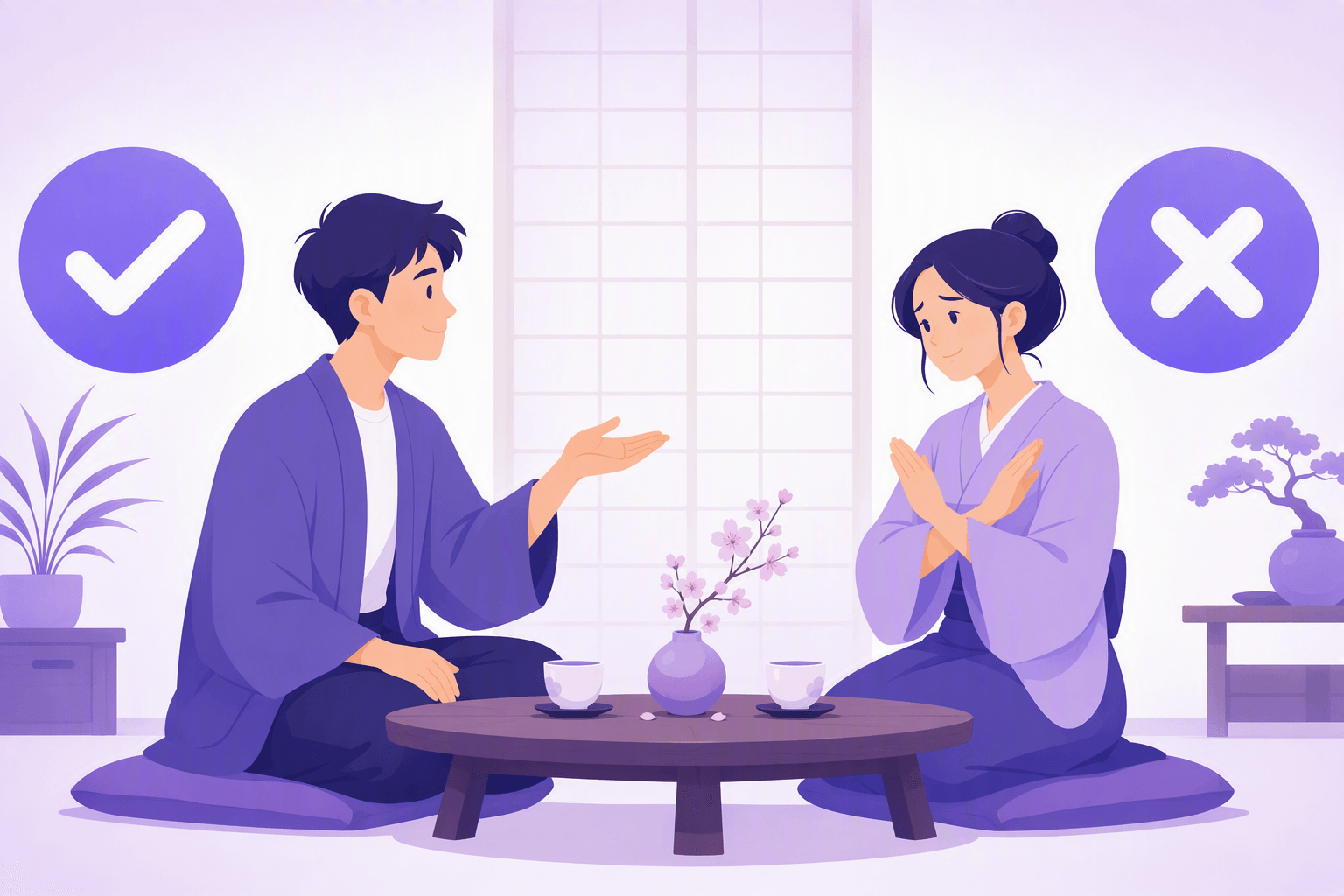
Quick Reference: Yes and No in Japanese
| English | Japanese | Pronunciation | Formality |
|---|---|---|---|
| Yes (standard) | はい (Hai) | hah-ee | polite |
| Yeah (casual) | うん (Un) | oon | casual |
| Yes (soft agreement) | ええ (Ee) | eh | polite |
| That's right | そうです (Sou desu) | soh dehs | polite |
| Of course | もちろん (Mochiron) | moh-chee-rohn | polite |
| Understood / Roger | 了解 (Ryoukai) | ryoh-kah-ee | casual |
| No (standard) | いいえ (Iie) | ee-eh | polite |
| Nah (casual) | いや (Iya) | ee-yah | casual |
| Well... (indirect no) | ちょっと (Chotto) | choht-toh | polite |
| That's difficult (indirect no) | 難しい (Muzukashii) | moo-zoo-kah-shee | polite |
| No way / Not allowed | だめ (Dame) | dah-meh | casual |
| No thank you (polite decline) | 結構です (Kekkou desu) | keh-koh dehs | formal |
Why Japanese Speakers Rarely Say "No" Directly
Before diving into the specific phrases, it is essential to understand a cultural concept that shapes how yes and no work in Japanese. This is not a minor cultural footnote; it is the foundation of Japanese communication.
Japanese culture places enormous value on wa (和), social harmony. Directly rejecting someone, even in small matters, can disrupt wa by causing the other person to lose face. To avoid this, Japanese speakers have developed a sophisticated system of indirect refusals that communicate "no" without ever saying the word.
空気を読む (Kuuki wo yomu): Reading the Air
The concept of kuuki wo yomu (空気を読む, reading the air) means picking up on unspoken social cues. When a Japanese speaker says chotto... (that's a bit...) and trails off, they are not being vague. They are giving a clear "no" that any Japanese listener would immediately understand. Someone who cannot read these signals is called KY (kuuki yomenai, "can't read the air"), which is a genuine social criticism in Japan.
本音と建前 (Honne to Tatemae): True Feelings vs. Public Face
According to Takeo Doi's landmark work The Anatomy of Dependence, Japanese communication operates on two layers: honne (本音, true feelings) and tatemae (建前, the public-facing position). When someone says kangaete okimasu (I'll think about it), their tatemae is open-mindedness, but their honne is almost always "no." Understanding this duality is critical for anyone communicating in Japanese.
🌍 Business Meetings: No Never Means Maybe
In Japanese business culture, a direct "no" is exceptionally rare. Phrases like muzukashii desu ne (that would be difficult) or kentou sasete itadakimasu (allow us to consider it) are standard ways to decline proposals. Foreign businesspeople who interpret these as "maybe" and follow up aggressively often damage relationships. If a Japanese colleague says something is "difficult," the answer is no.
Ways to Say Yes in Japanese
These six expressions cover the full range of agreement, from formal business acknowledgment to enthusiastic casual agreement.
はい (Hai)
/hah-ee/
Literal meaning: Yes
“はい、分かりました。すぐに対応します。”
Yes, I understand. I'll handle it right away.
The standard, all-purpose 'yes' in Japanese. Works in every formality level. In business, it is often repeated ('Hai, hai') while listening to show active engagement. Be careful, as too many rapid 'hai's can sound dismissive.
Hai is the foundation of affirmative communication in Japanese. It covers far more than simple agreement. It also functions as "here" during roll call, "understood" when receiving instructions, and as a listening signal during phone calls. According to Makino and Tsutsui's A Dictionary of Basic Japanese Grammar, hai is one of the most frequently used words in the entire language.
One important nuance: hai does not always mean the speaker agrees with you. In conversation, Japanese listeners say hai repeatedly to indicate they are following along, not that they approve. This catches many foreign speakers off guard.
うん (Un)
/oon/
Literal meaning: Yeah / Uh-huh
“うん、いいよ。明日の3時で大丈夫。”
Yeah, sure. 3 o'clock tomorrow works fine.
The casual equivalent of 'Hai.' Used freely among friends, family, and close colleagues. Never use this with superiors, customers, or in formal settings; it would be considered disrespectful.
Un is what you will hear in everyday casual conversation among friends. It functions exactly like the English "yeah" or "uh-huh." You will hear it constantly in Japanese films and anime. Check out our guide to the best movies for learning Japanese to hear it in natural context.
ええ (Ee)
/eh/
Literal meaning: Yes (soft)
“ええ、その通りだと思います。”
Yes, I think that's exactly right.
A softer, slightly more conversational form of 'Hai.' Common among women and in polite but not overly formal conversation. It conveys gentle agreement without the crispness of 'Hai.'
Ee sits between hai and un on the formality spectrum. It is polite enough for most social situations but carries a warmer, less rigid tone than hai. NHK language materials note that ee is particularly common in Kansai (Osaka/Kyoto region) dialect, where it appears even more frequently than in standard Tokyo Japanese.
そうです (Sou desu)
/soh dehs/
Literal meaning: That is so / That's right
“A: 東京に住んでいるんですか? B: はい、そうです。”
A: Do you live in Tokyo? B: Yes, that's right.
Used to confirm factual statements rather than agree with opinions. The casual form 'Sou da yo' is used among friends. 'Sou desu ne' (with 'ne') shifts to mean 'That's true, isn't it,' a thinking-aloud expression rather than confirmation.
Sou desu is specifically for confirming that something is correct. If someone asks "Is this the train to Shibuya?" the natural response is hai, sou desu (yes, that's right). The casual form sou da yo drops the politeness, while sou desu ne adds the particle ne and shifts the meaning toward "yes, I suppose so," more of a thinking-aloud expression.
もちろん (Mochiron)
/moh-chee-rohn/
Literal meaning: Of course / Naturally
“もちろん、喜んでお手伝いします。”
Of course, I'd be happy to help.
Expresses enthusiastic or emphatic agreement. Works across formality levels but carries energy and certainty. Use it when you want to convey that the answer is obviously yes.
Mochiron adds emphasis and enthusiasm to your agreement. It signals that the answer is not just yes but obviously yes. In business contexts, mochiron desu (adding the polite copula) is common when accepting a request or confirming availability. It carries a warmth that plain hai lacks.
了解 (Ryoukai)
/ryoh-kah-ee/
Literal meaning: Understood / Acknowledged
“了解!じゃあ、駅前で待ち合わせね。”
Got it! So we'll meet in front of the station.
Originally military/business jargon meaning 'acknowledged,' now widely used in casual texting and chat. The more formal version is 'Ryoukai shimashita' (了解しました). Very common in LINE messages and workplace chat apps.
Ryoukai has migrated from formal military and business acknowledgment into everyday casual use, especially in digital communication. On LINE (Japan's dominant messaging app) and workplace chat tools, ryoukai or the abbreviated ryokai is one of the most common responses. The polite form ryoukai shimashita (understood, formal) is appropriate in business emails and meetings.
Ways to Say No in Japanese
This is where Japanese diverges from English. While the direct forms exist, the indirect forms are what Japanese speakers actually use in daily life.
いいえ (Iie)
/ee-eh/
Literal meaning: No
“いいえ、違います。会議は明日ではなく金曜日です。”
No, that's incorrect. The meeting is Friday, not tomorrow.
The textbook word for 'no,' but rarely used as a flat refusal. Its most natural uses are: correcting factual errors, deflecting compliments ('Iie, iie,' meaning 'No, no, not at all'), and answering negative questions. Using it to refuse a request can feel blunt.
Iie is the word every Japanese textbook teaches first, but real-world usage is far more limited than learners expect. You will hear it most often as a humble deflection of compliments (iie, iie, meaning "oh no, not at all") or to correct factual mistakes. As a direct refusal to a request or invitation, iie can feel jarringly blunt in Japanese social contexts.
いや (Iya)
/ee-yah/
Literal meaning: Nah / No way
“いや、それはちょっと違うと思うよ。”
Nah, I think that's a bit off.
The casual form of 'no.' Used among friends to disagree, express surprise, or dismiss something. Can also function as a filler word similar to 'well...' at the start of a sentence.
Iya is the casual counterpart to iie. Among friends, it functions much like the English "nah" or "no way." It also doubles as a conversation filler: starting a sentence with iya... can mean "well..." or "actually..." without necessarily expressing disagreement. Context and tone make the difference.
ちょっと (Chotto)
/choht-toh/
Literal meaning: A little / A bit...
“A: 今夜飲みに行かない? B: 今日はちょっと...”
A: Want to go drinking tonight? B: Today is a bit...
The quintessential Japanese indirect refusal. By saying 'that's a bit...' and trailing off, the speaker communicates 'no' without ever saying the word. Any Japanese listener understands this immediately. This is one of the most important expressions to recognize.
Chotto is arguably the most important "no" expression for learners to understand. Literally meaning "a little," it becomes a polite refusal when used with a trailing tone and unfinished sentence. The speaker implies that something is a bit difficult or a bit inconvenient without spelling it out. This is tatemae in action: the surface words say "a little" while the true meaning is a clear decline.
⚠️ Do Not Miss This Signal
If a Japanese person responds to your request or invitation with chotto... followed by a pause or a sucking-in of breath through the teeth, the answer is no. Pushing further or asking "a little what?" would be a significant social misstep. Accept the implied refusal gracefully.
難しい (Muzukashii)
/moo-zoo-kah-shee dehs neh/
Literal meaning: That's difficult, isn't it...
“その日程は少し難しいですね...別の日はいかがですか?”
That schedule is a bit difficult... How about a different day?
Another classic indirect refusal, especially common in business. By calling something 'difficult' rather than 'impossible' or 'no,' the speaker preserves both parties' dignity. Very frequently used in meetings and negotiations.
In Japanese business culture, muzukashii (difficult) is one of the most common ways to say no. When a client proposes an unrealistic deadline and the Japanese side responds sore wa chotto muzukashii desu ne (that's a bit difficult), they are not inviting negotiation. They are declining. According to NHK's business Japanese materials, this is among the top expressions that foreign professionals misinterpret in Japanese workplaces.
だめ (Dame)
/dah-meh/
Literal meaning: No good / Not allowed
“ここで写真を撮るのはだめですよ。”
You can't take photos here.
A blunt, direct 'no' that carries real force. Used for prohibitions, rules, and firm refusals. Parents say it to children, signs display it as warnings, and friends use it casually. In formal settings, 'Dame desu' adds some politeness.
Dame is one of the few direct, unambiguous ways to say "no" in Japanese. It means something is not allowed, not acceptable, or no good. Parents use it with children (dame!, meaning "stop that!"), it appears on prohibition signs, and friends use it casually to shoot down bad ideas. Unlike chotto or muzukashii, there is no ambiguity. Dame means no.
結構です (Kekkou desu)
/keh-koh dehs/
Literal meaning: That is sufficient / I'm fine
“お茶のおかわりはいかがですか? ー 結構です、ありがとうございます。”
Would you like a refill of tea?, No thank you, I'm fine.
The polite, formal way to decline an offer. Frequently used with shopkeepers, waitstaff, and in business. Equivalent to 'No, thank you' in English. Be aware: 'Kekkou' can also mean 'quite good' in other contexts, so tone matters.
Kekkou desu is the go-to expression for politely declining offers. When a shop clerk asks if you want a bag, a waiter offers more water, or a colleague offers to help, kekkou desu is the smooth, socially correct refusal. One quirk noted by Makino and Tsutsui: kekkou has two opposite meanings depending on context: it can mean "quite good" (positive) or "I'm fine without it" (declining). Tone and context make the difference clear to native speakers.
Yes and No in Context: Business vs. Casual
The gap between business and casual communication in Japanese is enormous. Here is how agreement and disagreement shift across settings.
| Situation | Casual | Business / Formal |
|---|---|---|
| Saying yes | うん (Un) | はい (Hai) / 承知しました (Shouchi shimashita) |
| Strong agreement | そうそう (Sou sou) | おっしゃる通りです (Ossharu toori desu) |
| Saying no | いや (Iya) / だめ (Dame) | ちょっと難しいですね (Chotto muzukashii desu ne) |
| Declining an offer | いらない (Iranai) | 結構です (Kekkou desu) |
| Acknowledging | 了解 (Ryoukai) | 承知いたしました (Shouchi itashimashita) |
💡 When in Doubt, Be Indirect
If you are unsure whether to be direct or indirect in Japanese, always choose indirect. Japanese speakers will appreciate your awareness of social nuance far more than they will appreciate blunt clarity. Err on the side of softness. You can always clarify if needed, but you cannot unsay something blunt.
Practice With Real Japanese Content
Reading about yes and no builds your knowledge, but hearing these expressions in real conversations (with the pauses, the trailing tones, the sharp dame! from a frustrated character) is what makes them stick. Japanese films and dramas are especially useful here because they naturally demonstrate the gap between direct and indirect communication.
Wordy lets you watch Japanese movies and shows with interactive subtitles. Tap on any expression to see its meaning, romaji pronunciation, formality level, and cultural context in real time. You will quickly learn to recognize the difference between a genuine hai and a polite chotto... that really means no.
For more Japanese language content, explore our blog for guides including the best movies to learn Japanese. You can also visit our Japanese learning page to start practicing with authentic content today.
Frequently Asked Questions
How do you say yes in Japanese?
How do you say no in Japanese?
Why do Japanese people avoid saying no directly?
What does 'Chotto' mean when Japanese people say it?
Is it rude to say 'Iie' in Japanese?
How do you politely decline an offer in Japanese?
Sources & References
- Makino, S. & Tsutsui, M. (1986). 'A Dictionary of Basic Japanese Grammar.' The Japan Times.
- NHK World-Japan, Japanese Language Lessons: Expressions of Agreement and Disagreement
- Agency for Cultural Affairs, Japan, National Language Survey (2023)
- Doi, Takeo (1971). 'The Anatomy of Dependence (Amae no Kozo).' Kodansha International.
- Ethnologue: Languages of the World, Japanese language entry (2024)
Start learning with Wordy
Watch real movie clips and build your vocabulary as you go. Free to download.


