Quick Answer
Japanese terms of endearment work very differently from Western pet names. Direct nicknames like 'honey' or 'baby' are rare in Japanese relationships. Instead, Japanese couples express affection through honorific suffixes like '-chan,' indirect expressions like 'Anata' (you/dear), name-shortening, and tone of voice. The borrowed English words 'Daarin' (darling) and 'Hanii' (honey) exist but are used far less often than Western media suggests.
The Short Answer
Japanese terms of endearment are fundamentally different from Western pet names. While English speakers freely call partners "honey," "baby," or "sweetheart," Japanese couples rarely use equivalent direct nicknames. Instead, affection is expressed through honorific suffixes like -chan (ちゃん), name-shortening, tone of voice, and the careful choice of which pronoun for "you" to use. The borrowed English words Daarin (ダーリン, darling) and Hanii (ハニー, honey) exist in Japanese but are used far less than anime and manga might lead you to believe.
Japanese is spoken by approximately 125 million people. According to the Agency for Cultural Affairs' 2023 National Language Survey, Japanese communication culture places enormous value on indirectness, what linguists call "high-context communication." The concept of kuuki wo yomu (空気を読む, reading the air) means that the most powerful emotional messages are often conveyed through context, actions, and subtle verbal cues rather than explicit declarations.
"In Japanese intimate relationships, affection is not so much spoken as woven into the fabric of daily interaction. The choice of a pronoun, the shortening of a name, the tone of a sentence: these are Japan's true terms of endearment."
(Adapted from Doi Takeo, The Anatomy of Dependence, Kodansha International, 1971)
This guide covers 16 Japanese terms of endearment and affectionate expressions, including why most Western-style pet names do not work in Japanese and what Japanese people actually say instead.
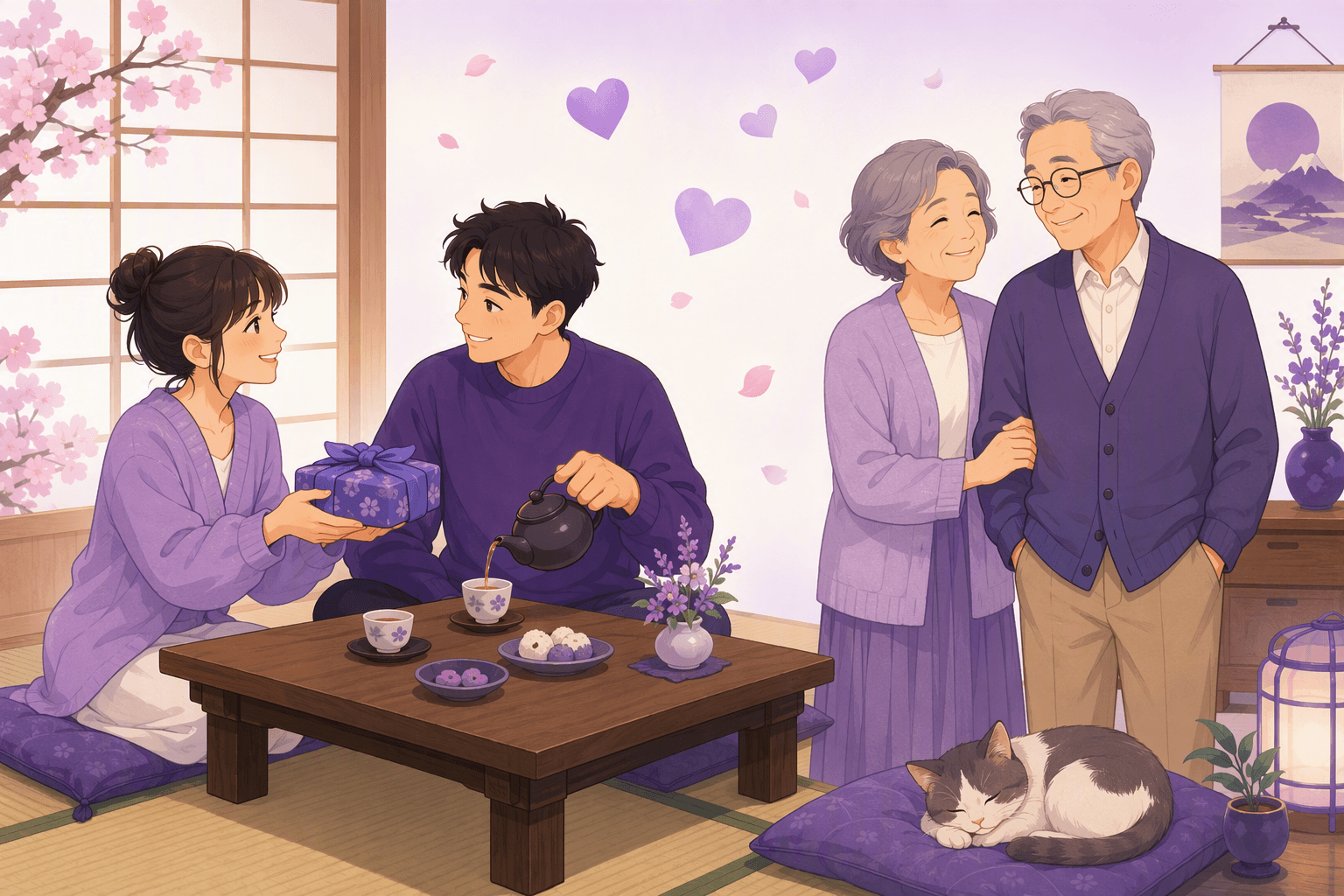
Quick Reference: Japanese Terms of Endearment at a Glance
| English | Japanese | Pronunciation | Formality |
|---|---|---|---|
| You / Dear (wife to husband) | あなた (Anata) | ah-NAH-tah | casual |
| Person I like / Love | 好きな人 (Sukina hito) | SKEE-nah hee-toh | casual |
| Darling (borrowed English) | ダーリン (Daarin) | DAH-reen | casual |
| Honey (borrowed English) | ハニー (Hanii) | HAH-nee | casual |
| Affectionate suffix | ちゃん (-chan) | -chan | casual |
| Beloved / Dear | 愛しい (Itoshii) | ee-TOH-shee | casual |
| Mama (to wife) | ママ (Mama) | MAH-mah | casual |
| Papa (to husband) | パパ (Papa) | PAH-pah | casual |
| You (rough/intimate) | おまえ (Omae) | oh-MAH-eh | casual |
| My (possessive endearment) | うちの (Uchi no) | OO-chee noh | casual |
| Cute / Adorable | かわいい (Kawaii) | kah-WAH-ee | casual |
| Familiar suffix (male) | くん (-kun) | -koon | casual |
| You / Sweetheart (literary) | きみ (Kimi) | KEE-mee | casual |
| Nickname suffix | っち (-cchi) | -chee | slang |
| Precious / Important | 大切な人 (Taisetsu na hito) | tah-ee-SEH-tsoo nah hee-toh | polite |
| My angel (playful) | 天使 (Tenshi) | TEHN-shee | casual |
Why Japanese Pet Names Work Differently
Before exploring individual terms, understanding this cultural context is essential. In Western cultures, pet names are a direct expression of affection: the more you love someone, the more creative your nicknames become. In Japan, the relationship between words and feelings operates almost in reverse.
The concept of amae (甘え), explored in Doi Takeo's landmark 1971 book The Anatomy of Dependence, describes the Japanese model of intimacy as comfortable mutual reliance. Love is demonstrated through actions (cooking a meal, remembering a preference, silently anticipating a need) rather than through verbal labels. According to the NINJAL Corpus of Everyday Japanese Conversation, explicit pet names appear far less frequently in Japanese couple dialogue than in equivalent English data.
This does not mean Japanese relationships are cold, far from it. It means the warmth is encoded differently: in a suffix, a shortened name, a particular pronoun, or simply the tone of voice. Understanding these subtle signals is the key to understanding Japanese endearment.
🌍 The Embarrassment Factor (恥ずかしい)
Many Japanese people describe using Western-style pet names as hazukashii (恥ずかしい), meaning embarrassing. A 2019 survey by a major Japanese marriage agency found that over 60% of married Japanese couples primarily address each other by name or family role, not by pet names. The word hazukashii does not carry negative judgment; it simply means that direct verbal affection feels uncomfortably exposed for many Japanese people, who prefer to show love through subtler channels.
Name-Based Endearment: Japan's Primary System
The most common way Japanese people express affection through language is by modifying their partner's name. This system is Japan's true equivalent of Western pet names.
ちゃん (-chan)
/-chan/
Literal meaning: Affectionate/cute diminutive suffix
“ゆみちゃん、今日も可愛いね。”
Yumi-chan, you look cute today too.
Japan's most important verbal endearment. Adding '-chan' to a partner's name transforms it into a term of affection. Originally for children and women, now used by couples of all genders. Using '-chan' without permission is presumptuous. It signals closeness, affection, and familiarity.
The suffix -chan is the closest thing Japanese has to a universal pet name system. It attaches to a person's name (usually their first name or a shortened version) and adds warmth, familiarity, and cuteness. Yumiko becomes Yumi-chan. Takeshi becomes Take-chan. The act of adding -chan to someone's name says "I feel close to you and I find you endearing."
According to Makino and Tsutsui's A Dictionary of Basic Japanese Grammar, -chan originated as a childish mispronunciation of -san (the standard polite suffix). Over time, it became the standard marker of affection and intimacy in Japanese. Between romantic partners, the shift from -san to -chan often marks a pivotal moment in the relationship.
くん (-kun)
/-koon/
Literal meaning: Familiar/affectionate suffix (typically masculine)
“たけくん、ご飯できたよ。”
Take-kun, dinner is ready.
Traditionally used for boys and younger men, but in romantic contexts a woman may use '-kun' with her boyfriend or husband. It implies familiarity and gentle affection without the overt cuteness of '-chan.' Some couples mix: she uses '-kun' for him, he uses '-chan' for her.
While -chan carries explicit cuteness, -kun offers a more understated warmth. It is the suffix women commonly use for boyfriends and husbands, sitting between the formality of -san and the sweetness of -chan. In many Japanese couples, the dynamic is -chan for her and -kun for him, creating a balanced system of mutual affection through suffixes alone.
っち (-cchi)
/-chee/
Literal meaning: Casual nickname suffix
“まーちゃんっち、遊ぼうよ!”
Ma-chan-cchi, let's hang out!
A playful, youthful suffix that creates cute nicknames. 'Yumi' becomes 'Yumicchi.' Popular among younger Japanese people, especially in the Kanto region. Between couples, it adds an extra layer of playful intimacy beyond '-chan.'
The -cchi suffix is a newer addition to Japan's nickname toolkit, popular among younger generations. It creates ultra-casual, playful nicknames that feel youthful and intimate. While -chan is universal, -cchi signals that you are part of a specific close circle. Between couples, it can be even more intimate than -chan because it is more personal and creative.
💡 Name-Shortening as Endearment
In Japanese, shortening someone's name is itself a form of endearment. Takeshi becomes Take, Yumiko becomes Yumi, Masahiro becomes Masa. Combined with a suffix, this creates layered affection: Masa-kun from a girlfriend, Yumi-chan from a boyfriend. The shorter the name, the closer the relationship. Going from Tanaka-san to Yumiko-san to Yumi-chan to just Yumi traces the entire arc of growing intimacy.
Pronoun-Based Endearment
Japanese has multiple words for "you," and the one you choose communicates volumes about the relationship. Some of these function as de facto terms of endearment.
あなた (Anata)
/ah-NAH-tah/
Literal meaning: You (standard)
“あなた、今日は早く帰れる?”
Dear, can you come home early today?
When a wife says 'Anata' to her husband, it functions as 'dear' or 'darling.' This is one of Japan's oldest and most established terms of endearment for married couples. In any other context, 'Anata' is simply the standard word for 'you.' The endearment meaning is specific to wife-to-husband address.
Anata is a masterclass in how Japanese embeds endearment into everyday grammar. As a standard pronoun, it simply means "you." But when a wife addresses her husband as Anata, it transforms into "dear" or "darling," one of the most traditional Japanese terms of endearment. This dual meaning exists because Japanese pronouns are so rarely used (subjects are usually dropped) that when a wife deliberately says Anata, the act of naming "you" itself becomes intimate.
According to the Agency for Cultural Affairs' National Language Survey, Anata as a spousal address remains common among Japanese women over 40, though younger wives may prefer first names with -chan or -kun.
おまえ (Omae)
/oh-MAH-eh/
Literal meaning: You (rough/direct)
“おまえがいないと寂しいよ。”
I'm lonely without you.
A rough, masculine pronoun for 'you' that paradoxically functions as an intimate term between couples. When a husband says 'Omae' to his wife in a soft tone, it carries gruff affection, like a tough exterior hiding tenderness. Can be rude in other contexts. The intimacy comes from the informality.
Omae is one of Japanese's most fascinating linguistic paradoxes. In general usage, it is a rough, potentially rude way to say "you." Between strangers, it can start a fight. But between a husband and wife, Omae spoken in a soft tone communicates a particular brand of Japanese masculine affection: gruff on the surface, tender underneath. NHK World-Japan's language materials note that Omae in intimate contexts is comparable to how some English speakers use "you" with an affectionate growl.
きみ (Kimi)
/KEE-mee/
Literal meaning: You (intimate/literary)
“きみのことがずっと好きだった。”
I've always liked you.
An intimate pronoun meaning 'you,' primarily used by men to women. It carries a romantic, slightly literary quality. Common in love songs, confessions, and poetry. The famous Japanese novel 'Kimi no Na wa' (Your Name) uses this pronoun. Less common in daily speech than in media.
Kimi occupies a special place in Japanese romantic vocabulary. It is an intimate "you" with a poetic, literary quality: the pronoun of love songs, confession scenes, and romantic novels. The global anime hit Kimi no Na wa (Your Name) uses this pronoun in its title precisely because of its romantic connotation. In real life, Kimi is used less frequently than media suggests, but when it appears, it carries genuine emotional weight.
Borrowed and Modern Terms
Globalization has brought Western-style pet names into Japanese, though they occupy a different cultural space than their originals.
ダーリン (Daarin)
/DAH-reen/
Literal meaning: Darling (from English)
“ダーリン、大好き!”
Darling, I love you!
The English word 'darling' adapted into Japanese katakana. Made famous by the manga/anime 'Urusei Yatsura' where Lum constantly calls Ataru 'Daarin.' In real Japanese couples, it is used playfully or ironically rather than seriously. Can sound theatrical or anime-influenced.
Daarin entered mainstream Japanese vocabulary through manga and anime, most famously through Urusei Yatsura (1978-1987), where the alien character Lum endlessly calls the protagonist Daarin. In real Japanese relationships, using Daarin seriously would feel performative or deliberately anime-influenced. Some couples use it playfully, with a wink to its pop culture origins, but it is far from standard. According to NINJAL corpus data, borrowed English endearments remain statistically rare in natural Japanese conversation.
ハニー (Hanii)
/HAH-nee/
Literal meaning: Honey (from English)
“ハニー、行こうよ!”
Honey, let's go!
The English word 'honey' adapted into Japanese. Even less common than 'Daarin' in real-life usage. Can sound comical or deliberately Western-influenced. Occasionally used by Japanese couples who have lived abroad or who enjoy incorporating English into their communication.
Hanii is the Japanese pronunciation of "honey" and, like Daarin, it exists more in the cultural imagination than in actual daily use. Japanese couples who use it tend to be internationally oriented, deliberately playful, or channeling a Western romantic style. For most Japanese people, calling their partner Hanii would feel like wearing a Halloween costume on a regular Tuesday: fun, maybe, but not natural.
好きな人 (Sukina hito)
/SKEE-nah hee-toh/
Literal meaning: Person I like / The one I love
“あなたは私の好きな人。ずっとそばにいてね。”
You are the one I love. Stay by my side always.
A way of expressing 'my beloved' or 'the person I love' without using a direct pet name. Japanese often expresses endearment through description rather than direct address. You would say this about your partner to others, or directly to them in an intimate moment.
Rather than using a pet name, Japanese speakers often express endearment by describing the person's role in their life. Sukina hito (the person I like/love) is both a way of referring to your partner when talking to others and, in tender moments, a way of affirming your feelings directly. This descriptive approach is deeply Japanese: instead of labeling someone with a cute name, you describe what they mean to you.
Expressive and Emotional Terms
These words are used to describe or address a loved one with emotional depth, even if they are not "pet names" in the Western sense.
愛しい (Itoshii)
/ee-TOH-shee/
Literal meaning: Beloved / Endearing / Precious
“愛しい人よ、おやすみ。”
My beloved, good night.
An adjective meaning 'beloved' or 'dear' that can function as a term of endearment. 'Itoshii hito' (beloved person) is a poetic way to refer to your partner. Carries literary, almost old-fashioned warmth. More common in writing, songs, and emotional moments than in daily speech.
Itoshii is one of the most beautiful words in the Japanese romantic vocabulary. It means "beloved," "precious," or "endearing" and derives from the kanji 愛 (love). Unlike Western pet names that are used habitually, itoshii appears in moments of genuine emotional depth: a whispered itoshii hito (my beloved) during an intimate moment, a line in a love letter, or a lyric in a ballad. Its rarity in daily speech is what gives it power.
大切な人 (Taisetsu na hito)
/tah-ee-SEH-tsoo nah hee-toh/
Literal meaning: Important/precious person
“あなたは私にとって大切な人です。”
You are a precious person to me.
A quintessentially Japanese way of expressing love through understatement. Rather than 'I love you,' you say 'you are important to me.' This indirect approach carries enormous emotional weight in Japanese culture, where restraint amplifies sincerity.
Taisetsu na hito (precious/important person) exemplifies how Japanese communicates love through what linguists call "indirectness strategies." Telling someone they are taisetsu does not sound understated to Japanese ears. It sounds deeply sincere, because it avoids the inflation that can come with overused direct declarations. The NINJAL corpus shows that taisetsu appears frequently in Japanese couple communication, often carrying more emotional weight than suki (like) or even ai (love).
かわいい (Kawaii)
/kah-WAH-ee/
Literal meaning: Cute / Adorable
“今日もかわいいね。”
You're cute today too.
Japan's most famous adjective. When directed at a partner, it functions as a compliment-endearment. Telling your partner 'Kawaii!' is a daily affirmation of affection in many Japanese relationships. It works for appearance, behavior, and personality: essentially anything adorable.
Kawaii may be the most internationally recognized Japanese word after sushi and samurai. In romantic contexts, telling your partner kawaii (cute/adorable) functions as both compliment and endearment. A boyfriend saying kyou mo kawaii ne (you're cute today too) to his girlfriend is a standard daily exchange in Japanese couples. The word's range is enormous: it covers physical appearance, behavior, voice, gestures, and personality.
天使 (Tenshi)
/TEHN-shee/
Literal meaning: Angel / Heavenly messenger
“うちの子は天使だよ。”
My child is an angel.
Literally 'angel.' Used primarily for babies and small children. Between romantic partners, it is playful and slightly theatrical, more common in text messages and social media than in spoken Japanese. Carries a pop-culture flavor influenced by anime and manga.
Tenshi (angel) is one of the few Japanese terms that functions similarly to a Western pet name. It is most commonly used for babies and children, and a new parent calling their infant tenshi is completely natural. Between romantic partners, it leans playful and is more common in written communication (text messages, social media) than in face-to-face conversation. Its usage has been amplified by anime and manga, where angelic imagery is a common romantic trope.
Role-Based Address: Mama and Papa
One of the most distinctive features of Japanese couple communication is the shift to parental role-based address after having children.
ママ / パパ (Mama / Papa)
/MAH-mah / PAH-pah/
Literal meaning: Mom / Dad
“パパ、子供たちもう寝たよ。”
Papa, the kids are asleep now.
Japanese couples with children commonly shift from first names to 'Mama' and 'Papa' (or the more traditional 'Okaasan' and 'Otousan'). This is not considered distancing; it reflects how Japanese identity incorporates family roles. Partners literally become each other's 'Mama' and 'Papa.'
According to NINJAL research, the shift to Mama/Papa address is the dominant pattern for Japanese couples with children. Western observers sometimes interpret this as the death of romance, but in Japanese culture, it reflects something different: the integration of the parental role into personal identity. When a wife calls her husband Papa, she is not reducing him to a function; she is acknowledging the family unit they have built together. The more traditional forms Okaasan (お母さん, mother) and Otousan (お父さん, father) carry even more weight.
うちの (Uchi no)
/OO-chee noh/
Literal meaning: My household's / Our
“うちの人、料理が上手なんですよ。”
My partner is a great cook.
'Uchi no hito' (うちの人, 'the person of my household') is a common way to refer to a spouse. 'Uchi no' expresses belonging through household membership rather than possession. It is indirect, modest, and characteristically Japanese, defining a partner by shared domestic life rather than romantic attachment.
Uchi no hito (the person of my household) is how many Japanese people refer to their spouse when talking to others. It is the ultimate example of Japanese indirect endearment, defining your partner not by romance but by shared domestic life. The word uchi (うち) means "inside" or "household," emphasizing the private, intimate world the couple has built together. For more on how these expressions sound in natural context, visit our Japanese learning page.
Japanese Endearment: Actions Over Words
Understanding Japanese terms of endearment requires accepting that the most powerful expressions of love in Japan often are not words at all.
| Action | What It Communicates | Western Equivalent |
|---|---|---|
| Making a bento lunch box | I thought of you; I care about your well-being | "I love you" |
| Saying 気をつけて (Be careful) | I worry about your safety; come back to me | "I'll miss you" |
| Pouring tea before they ask | I notice you; I anticipate your needs | "You're important to me" |
| Walking on the street-side of the sidewalk | I want to protect you | "I care about you" |
| Remembering small preferences | You matter enough that I pay attention | "You're special to me" |
"In Japan, love is a verb long before it is a noun. The vocabulary of endearment is written in actions that speak louder than any pet name could."
(Adapted from NHK World-Japan, Japanese Language Lessons)
🌍 Amae: The Japanese Model of Love
The psychologist Doi Takeo described amae (甘え) as the Japanese capacity for comfortable dependence on another person. In an amae relationship, you can be fully yourself without performance or pretense. This is why Japanese couples often do not need pet names; the relationship itself, with its rituals and silent understandings, is the endearment. When a Japanese person says their partner "understands them without words," they are describing the highest form of Japanese intimacy.
Practice With Real Japanese Content
Reading about Japanese endearment builds your understanding, but hearing these subtle expressions in context (the tone shift when someone says -chan, the softness of Anata from a wife to her husband, the warmth behind kawaii ne) is what makes them real. Japanese romantic films and dramas are the best classroom for these nuances.
Wordy lets you watch Japanese movies and shows with interactive subtitles. Tap any expression to see its meaning, romaji pronunciation, formality level, and cultural context in real time. Instead of reading about how -chan works, you can hear it spoken naturally across dozens of scenes.
For more Japanese content, explore our blog for guides including the best movies to learn Japanese. You can also visit our Japanese learning page to start practicing with real content today.
Frequently Asked Questions
Do Japanese couples use pet names like 'honey' or 'baby'?
What is the most common way Japanese couples address each other?
What does adding '-chan' to someone's name mean in Japanese?
Why is Japanese endearment so different from Western cultures?
What does 'Anata' mean when a Japanese wife says it to her husband?
Is it true that Japanese people call their partners 'Mama' and 'Papa'?
Sources & References
- Makino, S. & Tsutsui, M. (1986). 'A Dictionary of Basic Japanese Grammar.' The Japan Times.
- National Institute for Japanese Language and Linguistics (NINJAL), Corpus of Everyday Japanese Conversation
- Agency for Cultural Affairs, Japan, National Language Survey (2023)
- Doi, Takeo (1971). 'The Anatomy of Dependence (Amae no Kozo).' Kodansha International.
- NHK World-Japan, Japanese Language Lessons: Everyday Communication
Start learning with Wordy
Watch real movie clips and build your vocabulary as you go. Free to download.


