Quick Answer
The standard way to say good morning in Japanese is 'Ohayou gozaimasu' (おはようございます, oh-hah-yoh goh-zah-ee-mahs). This is the polite form used with colleagues, strangers, and superiors. Among friends and family, the casual 'Ohayou' (おはよう) is more natural. But Japanese mornings involve far more than a single greeting, from the departure ritual of 'Ittekimasu' to workplace 'asa-chou' morning meetings, the language wraps an entire culture around the start of each day.
The Short Answer
The most common way to say good morning in Japanese is Ohayou gozaimasu (おはようございます, oh-hah-yoh goh-zah-ee-mahs). This polite form works with colleagues, strangers, elders, and anyone you want to show respect to. With friends and family, the shorter Ohayou (おはよう) is the standard casual version.
Japanese is spoken by approximately 125 million people, and according to the Agency for Cultural Affairs' 2023 National Language Survey, morning greetings are among the most culturally significant daily rituals in Japan. Unlike English, where "good morning" is a standalone phrase, Japanese mornings are built around an interconnected web of greetings, departure rituals, and group activities that define the rhythm of the day.
"The Japanese morning greeting is not simply a statement about the time of day. It is a declaration of readiness, an acknowledgment of shared effort, and a reaffirmation of one's place within the social group."
(Seiichi Makino, A Dictionary of Basic Japanese Grammar, The Japan Times, 1986)
This guide covers 16 essential Japanese morning greetings and expressions, from formal keigo to casual slang, plus the cultural rituals surrounding them. Each includes Japanese script, romaji pronunciation, and the cultural context you need to use it naturally.
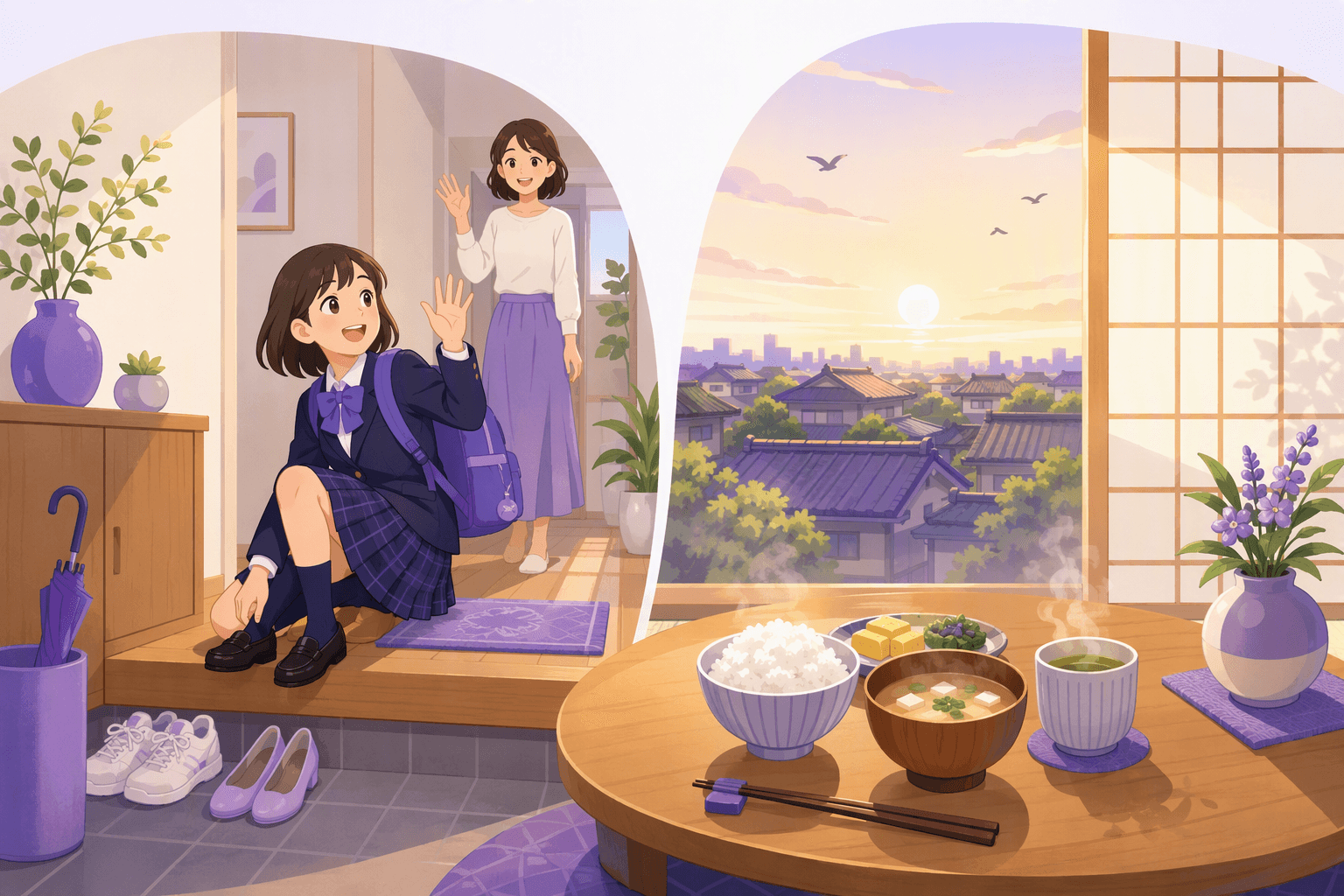
Quick Reference: Japanese Morning Greetings at a Glance
| English | Japanese | Pronunciation | Formality |
|---|---|---|---|
| Good morning (polite) | おはようございます (Ohayou gozaimasu) | oh-hah-yoh goh-zah-ee-mahs | polite |
| Good morning (casual) | おはよう (Ohayou) | oh-hah-yoh | casual |
| Mornin' (slang) | おはよっす (Ohayossu) | oh-hah-yohss | slang |
| Did you sleep well? | よく眠れた? (Yoku nemureta?) | yoh-koo neh-moo-reh-tah | casual |
| Nice weather today | 今日もいい天気ですね (Kyou mo ii tenki desu ne) | kyoh moh ee tehn-kee dehs neh | polite |
| I'm heading out | いってきます (Ittekimasu) | eet-teh-kee-mahs | polite |
| Have a safe trip | いってらっしゃい (Itterasshai) | eet-teh-rahs-shah-ee | polite |
| Have you eaten breakfast? | 朝ごはん食べた? (Asagohan tabeta?) | ah-sah-goh-hahn tah-beh-tah | casual |
| Good morning (very polite) | おはようございます、お疲れ様です (Ohayou gozaimasu, otsukaresama desu) | oh-hah-yoh goh-zah-ee-mahs, oh-tsoo-kah-reh-sah-mah dehs | formal |
| Good morning, excuse me | おはようございます、失礼します (Ohayou gozaimasu, shitsurei shimasu) | oh-hah-yoh goh-zah-ee-mahs, shee-tsoo-reh shee-mahs | formal |
| Morning! (feminine casual) | おはよ〜 (Ohayo~) | oh-hah-yoh | casual |
| Good morning (humble) | おはようございます、お先に失礼します (Ohayou gozaimasu, osaki ni shitsurei shimasu) | oh-hah-yoh goh-zah-ee-mahs, oh-sah-kee nee shee-tsoo-reh shee-mahs | very formal |
| It's cold this morning | 今朝は寒いですね (Kesa wa samui desu ne) | keh-sah wah sah-moo-ee dehs neh | polite |
| Wake up! | 起きて! (Okite!) | oh-kee-teh | casual |
| Good morning everyone | 皆さん、おはようございます (Minasan, ohayou gozaimasu) | mee-nah-sahn, oh-hah-yoh goh-zah-ee-mahs | polite |
| I overslept! | 寝坊した! (Nebou shita!) | neh-boh shee-tah | casual |
The Core Morning Greetings
These are the essential good morning greetings you need to know. The choice between them depends entirely on your relationship with the listener and the social context, a concept central to Japanese communication.
おはようございます (Ohayou gozaimasu)
/oh-hah-yoh goh-zah-ee-mahs/
Literal meaning: It is early (polite form)
“おはようございます、部長。今日の会議は何時からですか?”
Good morning, department head. What time does today's meeting start?
The standard polite morning greeting in Japanese. Used with colleagues, customers, strangers, superiors, and elders. In workplaces, it is the mandatory first greeting of the day; skipping it would be considered rude.
Ohayou gozaimasu is built from hayai (early), transformed into its polite form with the gozaimasu suffix. According to the Agency for Cultural Affairs' 2023 survey, this greeting ranks among the top three most-used daily expressions in Japan. In offices, schools, and shops across the country, it is the sound that starts every morning.
The greeting is typically used from waking hours until around 10-11 AM, though the exact cutoff is flexible. What matters more than the clock is the context: if you are seeing someone for the first time that day, ohayou gozaimasu is always appropriate as a first greeting.
🌍 The Entertainment Industry Exception
In Japanese television, film, and theater, ohayou gozaimasu is used as a greeting at ANY time of day, even at midnight. Walking onto a film set at 11 PM? You still say ohayou gozaimasu. This tradition treats the greeting as "hello, I'm starting work" rather than a comment on the time. It has spread to advertising agencies, game studios, and other creative industries.
おはよう (Ohayou)
/oh-hah-yoh/
Literal meaning: It is early (casual)
“おはよう!昨日よく寝れた?”
Morning! Did you sleep well last night?
The casual version of 'Ohayou gozaimasu,' with the polite suffix dropped. Use with friends, siblings, roommates, and people your own age in casual settings. The shift between Ohayou and Ohayou gozaimasu is one of the clearest demonstrations of Japanese politeness levels.
Simply dropping gozaimasu transforms the greeting from polite to casual. This is what you say to your roommate shuffling into the kitchen, your friend at school, or your sibling at the breakfast table. The difference between ohayou and ohayou gozaimasu is one of the first lessons in understanding Japanese keigo (politeness levels), and it applies to far more than just mornings.
If you have watched any anime or Japanese drama, you have heard ohayou countless times. It is usually the very first word spoken in morning scenes, often paired with a yawn or a stretch. Our guide to the best movies for learning Japanese features films rich with these authentic daily exchanges.
おはよっす (Ohayossu)
/oh-hah-yohss/
Literal meaning: Mornin' (compressed slang from Ohayou gozaimasu)
“おはよっす!今日の練習、何時から?”
Mornin'! What time's practice today?
A slangy, compressed greeting popular among young men, sports teams, and martial arts dojos. It merges 'Ohayou' with the clipped energy of 'Ossu.' Think of it as the Japanese equivalent of a quick 'Mornin' with a head nod.
Ohayossu is a mashup of ohayou and ossu (the martial-arts-derived greeting). It carries a sporty, masculine energy and is common in school clubs, gym locker rooms, and among young male friends. While traditionally male, younger generations are loosening these gender associations.
You will hear ohayossu frequently in sports anime like Haikyuu!! and Slam Dunk, where teammates greet each other with this punchy morning slang before practice.
おはよ〜 (Ohayo~)
/oh-hah-yoh/
Literal meaning: Morniiing (drawn-out casual)
“おはよ〜。まだ眠い〜。”
Morniiing. I'm still sleepy.
A soft, drawn-out version of 'Ohayou' common among young women and in text messages. The elongated vowel (marked with 〜) gives it a gentle, friendly tone. Very common in LINE messages and social media.
The elongated ohayo~ with its trailing wave mark adds a softer, friendlier feel. It is especially common in text messages on LINE (Japan's dominant messaging app) and among female friends greeting each other. In written form, you might also see it as おはよー or おはよぅ, each with a slightly different nuance of cuteness or sleepiness.
Morning Conversation Starters
Once the initial greeting is exchanged, these expressions keep the morning conversation flowing. They are the phrases that fill the space between "good morning" and the start of the day's activities.
よく眠れた? (Yoku nemureta?)
/yoh-koo neh-moo-reh-tah/
Literal meaning: Were you able to sleep well?
“おはよう。よく眠れた?顔色がちょっと悪いよ。”
Morning. Did you sleep well? You look a little pale.
A common morning question between family members, partners, and close friends. The polite form is 'Yoku nemuremashita ka?' (よく眠れましたか?). Asking about sleep shows care for the other person's well-being.
Sleep is a common topic in Japanese morning conversations, partly because Japan has one of the shortest average sleep durations among developed nations. Asking yoku nemureta? is a genuine expression of concern, not just small talk. The polite equivalent, yoku nemuremashita ka? (よく眠れましたか?), works in more formal settings such as a ryokan (traditional inn).
朝ごはん食べた? (Asagohan tabeta?)
/ah-sah-goh-hahn tah-beh-tah/
Literal meaning: Did you eat morning rice?
“おはよう、朝ごはん食べた?まだなら一緒に食べよう。”
Morning, have you eaten breakfast? If not, let's eat together.
A caring morning question, especially from parents to children or between close friends. Note that 'gohan' literally means 'rice' but is used as the generic word for 'meal,' reflecting rice's central role in Japanese food culture.
The word asagohan literally translates to "morning rice," revealing how deeply rice is embedded in Japanese culture. Even if breakfast is toast and coffee, the word remains asagohan. This question is a staple of family mornings and frequently appears in anime when a parent calls a character down to the breakfast table.
今日もいい天気ですね (Kyou mo ii tenki desu ne)
/kyoh moh ee tehn-kee dehs neh/
Literal meaning: Today also is nice weather, isn't it
“おはようございます。今日もいい天気ですね。お出かけですか?”
Good morning. Nice weather again today, isn't it? Are you heading out?
A classic polite morning conversation starter with neighbors and acquaintances. The particle 'ne' invites agreement and creates a sense of shared experience. Weather talk serves the same social bonding function in Japanese as it does in English.
Weather comments are universal ice-breakers, and Japan is no exception. Kyou mo ii tenki desu ne is the standard follow-up to ohayou gozaimasu with neighbors, shopkeepers, and acquaintances. The particle ne at the end softens the statement into a shared observation, inviting a nod or agreement in return.
今朝は寒いですね (Kesa wa samui desu ne)
/keh-sah wah sah-moo-ee dehs neh/
Literal meaning: This morning is cold, isn't it
“おはようございます。今朝は寒いですね。風邪に気をつけてくださいね。”
Good morning. It's cold this morning, isn't it? Please be careful not to catch a cold.
A seasonal morning greeting common in autumn and winter. Japanese conversation places high value on seasonal awareness (kisetsukan). Commenting on the cold shows attentiveness and care for the other person.
Japanese culture places extraordinary value on seasonal awareness, known as kisetsukan (季節感). Mentioning the morning cold is not just small talk; it demonstrates your attunement to the natural world, a quality deeply respected in Japanese aesthetics. You might also hear kesa wa atsui desu ne (It's hot this morning, isn't it?) during Japan's famously humid summers.
The Ittekimasu / Itterasshai Morning Ritual
No guide to Japanese mornings is complete without this paired expression. It is one of the most culturally distinctive features of Japanese daily life.
いってきます (Ittekimasu)
/eet-teh-kee-mahs/
Literal meaning: I will go and come back
“じゃあ、いってきます!今日は遅くなるかも。”
Well then, I'm off! I might be late today.
Said when leaving home for school or work. It is one half of a ritual pair: the person staying behind responds with 'Itterasshai.' This exchange is so deeply embedded that skipping it feels wrong to most Japanese people, like leaving without saying goodbye.
Ittekimasu combines itte (going) with kimasu (will come), creating a single phrase that means "I will go and I will return." It is said at the doorway every morning as you put on your shoes in the genkan (entryway). The phrase carries an implicit promise: I am leaving, but I will come back to this home.
According to NHK World-Japan's language materials, the ittekimasu/itterasshai exchange is practiced in over 95% of Japanese households with multiple members. It is one of the first phrases children learn and one of the last rituals people maintain into old age.
いってらっしゃい (Itterasshai)
/eet-teh-rahs-shah-ee/
Literal meaning: Please go and come back (honorific)
“いってらっしゃい!傘持った?午後から雨だよ。”
Have a good day! Did you take your umbrella? It's going to rain this afternoon.
The response to 'Ittekimasu.' Said by the person staying at home: a parent, spouse, or roommate. It uses the honorific form of 'come,' elevating the departing person. Together, the pair forms one of Japan's most beloved daily rituals.
Itterasshai is the response that completes the ritual. It uses irassharu, the honorific verb for "to go/come/be," making it inherently respectful. A parent saying itterasshai to a child heading to school is wishing them safe passage and a safe return.
If you watch anime, you have seen this exchange hundreds of times. The scene is iconic: a character shouts ittekimasu! while rushing out the door with toast in their mouth, and a voice from inside calls back itterasshai! It is one of the most recognizable tropes in Japanese animation, and it reflects genuine daily practice.
🌍 The Genkan Ritual
The genkan (玄関) is the entryway of a Japanese home where shoes are removed. The ittekimasu/itterasshai exchange always happens here, at the boundary between home and the outside world. This threshold carries deep cultural meaning, connecting to the Japanese concept of uchi (inside/home) versus soto (outside). Stepping out of the genkan is a daily transition from the safety of home to the demands of the world.
Workplace Morning Expressions
Japanese offices have their own morning vocabulary. The concepts of asa-chou (morning assembly) and collective rituals set the tone for the entire workday.
皆さん、おはようございます (Minasan, ohayou gozaimasu)
/mee-nah-sahn, oh-hah-yoh goh-zah-ee-mahs/
Literal meaning: Everyone, it is early (polite)
“皆さん、おはようございます。本日の朝礼を始めます。”
Good morning, everyone. Let's begin today's morning assembly.
The opening line of the 'asa-chou' (朝礼) morning assembly held in many Japanese workplaces. A manager or designated speaker addresses the team to start the day. Over 60% of Japanese companies practice some form of morning meeting.
The asa-chou or chourei (朝礼, morning assembly) is a defining feature of Japanese corporate culture. It typically begins with minasan, ohayou gozaimasu from a team leader, followed by the group echoing the greeting back in unison. The assembly might include announcements, a safety reminder, a motivational quote, or a brief speech by a rotating team member. Many companies also incorporate radio taisou exercises.
おはようございます、お疲れ様です (Ohayou gozaimasu, otsukaresama desu)
/oh-hah-yoh goh-zah-ee-mahs, oh-tsoo-kah-reh-sah-mah dehs/
Literal meaning: It is early; you are honorably tired
“おはようございます、お疲れ様です。昨日の資料、確認できましたか?”
Good morning. Thanks for your hard work. Were you able to review yesterday's documents?
A combined greeting common when arriving at the office and seeing colleagues who are already working. The 'otsukaresama desu' acknowledges that they have been working before you arrived. It shows respect for their effort.
In Japanese offices, combining ohayou gozaimasu with otsukaresama desu is a natural way to greet colleagues who arrived before you. It simultaneously says "good morning" and "I see you've been working hard," a small but meaningful acknowledgment of shared effort that defines Japanese workplace culture.
おはようございます、失礼します (Ohayou gozaimasu, shitsurei shimasu)
/oh-hah-yoh goh-zah-ee-mahs, shee-tsoo-reh shee-mahs/
Literal meaning: It is early; I am being rude (excuse me for intruding)
“おはようございます、失礼します。会議室の予約を確認したいのですが。”
Good morning, excuse me. I'd like to confirm the meeting room reservation.
Used when entering someone's office or a meeting room in the morning. 'Shitsurei shimasu' adds a layer of politeness by acknowledging that you are interrupting or entering their space. Standard in formal business environments.
Shitsurei shimasu literally means "I am committing a rudeness," a humble way of excusing yourself for entering someone's space. Paired with the morning greeting, it is the standard way to enter a supervisor's office or a meeting room at the start of the day. The self-deprecating phrasing is characteristic of Japanese keigo.
Waking Up and Getting Started
These expressions capture the moments between opening your eyes and heading out the door.
起きて! (Okite!)
/oh-kee-teh/
Literal meaning: Get up! / Wake up!
“もう七時だよ、起きて!学校遅刻するよ!”
It's already seven o'clock, wake up! You'll be late for school!
The command form of 'okiru' (to wake up/get up). Every Japanese household with children has heard this shouted up the stairs. It is a morning-scene staple in anime, often followed by the sleepy character's reluctant 'Mou go-fun...' (Five more minutes...).
Okite! is the te-form of okiru (to get up), functioning as a direct command. It is a fixture of anime morning scenes: a parent or sibling shouts okite! while the protagonist buries themselves deeper under the covers. The comedy of the reluctant waker is a universal experience that transcends language.
寝坊した! (Nebou shita!)
/neh-boh shee-tah/
Literal meaning: I overslept!
“やばい、寝坊した!もう八時じゃん!”
Oh no, I overslept! It's already eight o'clock!
The panicked exclamation of someone who slept through their alarm. 'Nebou' combines 'ne' (sleep) and 'bou' (excessive). This is the trigger for one of anime's most iconic scenes: the frantic morning dash with toast in mouth.
Nebou shita is responsible for one of anime's most enduring visual tropes: the late-for-school dash. The character wakes up, screams nebou shita!, throws on their uniform, grabs toast, and sprints out the door. While exaggerated in animation, the underlying panic is something every Japanese student and worker has experienced. Japan's culture of punctuality makes oversleeping a genuinely stressful event.
How to Respond to Japanese Morning Greetings
Japanese morning etiquette relies heavily on echoing, repeating the same or a similar greeting back. Here are the standard response patterns.
Responses to Morning Greetings
| They Say | You Say | Notes |
|---|---|---|
| おはようございます (Ohayou gozaimasu) | おはようございます (Ohayou gozaimasu) | Echo the polite form back |
| おはよう (Ohayou) | おはよう (Ohayou) | Echo the casual form back |
| おはよっす (Ohayossu) | おはよっす (Ohayossu) / おう (Ou) | Casual echo or quick acknowledgment |
| いってきます (Ittekimasu) | いってらっしゃい (Itterasshai) | Always respond with the paired phrase |
Responses to Morning Questions
| They Say | You Say |
|---|---|
| よく眠れた? (Yoku nemureta?) | うん、ぐっすり (Un, gussuri): "Yeah, like a log" |
| 朝ごはん食べた? (Asagohan tabeta?) | まだ (Mada): "Not yet" / もう食べた (Mou tabeta): "Already ate" |
| 今日もいい天気ですね (Kyou mo ii tenki desu ne) | そうですね (Sou desu ne): "It really is, isn't it" |
💡 The Power of Echoing
Unlike in English, where responding "Good morning" to "Good morning" can feel robotic, in Japanese it is the expected and natural response. Echoing the same greeting back, at the same formality level, shows that you understand the social dynamic and are participating correctly.
Radio Taisou: Japan's Morning Exercise Ritual
No discussion of Japanese mornings is complete without rajio taisou (ラジオ体操, radio calisthenics). First broadcast on NHK Radio in 1928, this structured exercise routine has been a cornerstone of Japanese morning culture for nearly a century.
According to Japan Post Insurance (Kanpo), which sponsors the program, an estimated 27 million Japanese people participate in radio taisou regularly. During summer vacation, children gather at local parks at 6:30 AM for group exercises. Many companies begin the workday with radio taisou, performed together in the office or factory floor.
The exercises themselves are simple (stretching, bending, jumping) and designed to be accessible to all ages. But their cultural significance runs deeper. Radio taisou embodies the Japanese values of collective harmony (wa), self-discipline, and starting the day with shared purpose. If you visit Japan and see a group of people exercising in unison in a park at dawn, you are witnessing one of the country's most enduring traditions.
🌍 Morning Routines in Anime
Japanese anime and manga are rich with authentic morning scenes. Watch for the ittekimasu/itterasshai exchange at the genkan, the frantic nebou shita! dash, and the gentle ohayou between family members at breakfast. Series like My Neighbor Totoro, Nichijou, and March Comes in Like a Lion depict Japanese morning routines with particular warmth and accuracy. These scenes are perfect for building listening comprehension of natural morning expressions.
Practice With Real Japanese Content
Reading about morning greetings builds your vocabulary, but hearing them spoken naturally, with correct intonation, speed, and emotional context, is what makes them stick. Japanese films and anime are perfect for this because morning scenes happen in nearly every episode, giving you repeated exposure to these phrases in authentic settings.
Wordy lets you watch Japanese movies and shows with interactive subtitles. Tap on any morning greeting to see its meaning, romaji pronunciation, formality level, and cultural context in real time. Instead of memorizing from a list, you absorb these expressions from the natural rhythm of daily Japanese life.
For more Japanese content, explore our blog for language guides including the best movies to learn Japanese. You can also visit our Japanese learning page to start practicing with real content today.
Frequently Asked Questions
What is the difference between 'Ohayou' and 'Ohayou gozaimasu'?
Why do people in the Japanese entertainment industry say 'Ohayou gozaimasu' at night?
What is 'Ittekimasu' and when do I say it?
What is 'radio taisou' and why is it connected to Japanese mornings?
How do I say 'Did you sleep well?' in Japanese?
What is 'asa-chou' in a Japanese workplace?
Sources & References
- The Japan Foundation, Survey Report on Japanese-Language Education Abroad (2021)
- NHK World-Japan, Japanese Language Lessons: Greetings and Everyday Expressions
- Makino, S. & Tsutsui, M. (1986). 'A Dictionary of Basic Japanese Grammar.' The Japan Times.
- Agency for Cultural Affairs, Japan, National Language Survey (2023)
- Japan Post Insurance (Kanpo), History of Radio Taisou (ラジオ体操の歴史)
Start learning with Wordy
Watch real movie clips and build your vocabulary as you go. Free to download.


