Quick Answer
Japanese has two number systems: Sino-Japanese (ichi, ni, san) used for most counting and math, and native Japanese (hitotsu, futatsu, mittsu) used for counting objects without specific counters. The Sino-Japanese system is what you need for numbers 1-100. The key pattern: 11 is 'juu ichi' (ten-one), 20 is 'ni juu' (two-ten), and 25 is 'ni juu go' (two-ten-five).
Japanese numbers present a unique challenge: the language has not one but two complete counting systems. The Sino-Japanese system (borrowed from Chinese over a thousand years ago) handles most modern counting, while the native Japanese system persists for counting general objects and in cultural traditions.
Japanese is spoken by approximately 125 million people, primarily in Japan, according to Ethnologue's 2024 data. The Japan Foundation reports that over 3.8 million people worldwide are studying Japanese as a foreign language. Whether you are shopping in Tokyo, reading a menu in Osaka, or understanding an anime character rattling off numbers, mastering the Sino-Japanese counting system is essential.
"The coexistence of native Japanese and Sino-Japanese number systems creates a richness of expression unmatched in European languages. The choice between readings often carries subtle nuances of formality, tradition, and even superstition."
(Masayoshi Shibatani, The Languages of Japan, Cambridge University Press, 1990)
This guide covers the Sino-Japanese numbers 1-100, explains the native counting system, introduces the critical concept of counters, and explores the deep cultural significance of numbers in Japanese society.

| Japanese | English | Pronunciation |
|---|---|---|
| 一 (いち) | 1 | ichi |
| 二 (に) | 2 | ni |
| 三 (さん) | 3 | san |
| 四 (し/よん) | 4 | shi / yon |
| 五 (ご) | 5 | go |
| 六 (ろく) | 6 | roku |
| 七 (しち/なな) | 7 | shichi / nana |
| 八 (はち) | 8 | hachi |
| 十 (じゅう) | 10 | juu |
| 百 (ひゃく) | 100 | hyaku |
Numbers 1-10: The Core System
The Sino-Japanese numbers 1-10 are the foundation for all larger numbers. Pay attention to 4, 7, and 9, which each have two valid readings.
| English | Japanese | Pronunciation | Note |
|---|---|---|---|
| 1 | 一 (いち) | ichi | |
| 2 | 二 (に) | ni | |
| 3 | 三 (さん) | san | |
| 4 | 四 (し/よん) | shi / yon | Yon preferred (shi = death) |
| 5 | 五 (ご) | go | |
| 6 | 六 (ろく) | roku | |
| 7 | 七 (しち/なな) | shichi / nana | Nana more common |
| 8 | 八 (はち) | hachi | |
| 9 | 九 (きゅう/く) | kyuu / ku | Kyuu preferred (ku = suffering) |
| 10 | 十 (じゅう) | juu |
⚠️ Avoiding Shi and Ku
The number 4 (shi) sounds identical to 死 (death), and 9 (ku) sounds like 苦 (suffering). Japanese speakers actively avoid these readings in most contexts. Hotels and hospitals frequently skip rooms numbered 4, 9, 42 (shi-ni = "to death"), and 49 (shi-ku = "death and suffering"). Always default to yon for 4 and kyuu for 9 unless you know a specific context requires the alternative.
Numbers 11-20: The Multiplicative Pattern
Starting at 11, Japanese numbers become beautifully logical. The pattern is juu (ten) + unit. No new vocabulary needed; just combine what you already know.
| English | Japanese | Pronunciation | Note |
|---|---|---|---|
| 11 | 十一 (じゅういち) | juu ichi | 10 + 1 |
| 12 | 十二 (じゅうに) | juu ni | 10 + 2 |
| 13 | 十三 (じゅうさん) | juu san | 10 + 3 |
| 14 | 十四 (じゅうよん) | juu yon | 10 + 4 (yon preferred) |
| 15 | 十五 (じゅうご) | juu go | 10 + 5 |
| 16 | 十六 (じゅうろく) | juu roku | 10 + 6 |
| 17 | 十七 (じゅうなな) | juu nana | 10 + 7 (nana preferred) |
| 18 | 十八 (じゅうはち) | juu hachi | 10 + 8 |
| 19 | 十九 (じゅうきゅう) | juu kyuu | 10 + 9 (kyuu preferred) |
| 20 | 二十 (にじゅう) | ni juu | 2 x 10 |
Notice the shift at 20: ni juu literally means "two tens." This multiplicative logic is the key to the entire system. Where English has unique words for "eleven" and "twelve," Japanese simply says "ten-one" and "ten-two."
The Tens: 20 to 100
Each multiple of ten follows the pattern: unit + juu (ten). The only new word you need is hyaku (百) for 100.
| English | Japanese | Pronunciation | Note |
|---|---|---|---|
| 20 | 二十 (にじゅう) | ni juu | 2 x 10 |
| 30 | 三十 (さんじゅう) | san juu | 3 x 10 |
| 40 | 四十 (よんじゅう) | yon juu | 4 x 10 |
| 50 | 五十 (ごじゅう) | go juu | 5 x 10 |
| 60 | 六十 (ろくじゅう) | roku juu | 6 x 10 |
| 70 | 七十 (ななじゅう) | nana juu | 7 x 10 |
| 80 | 八十 (はちじゅう) | hachi juu | 8 x 10 |
| 90 | 九十 (きゅうじゅう) | kyuu juu | 9 x 10 |
| 100 | 百 (ひゃく) | hyaku |
The system is completely transparent: if you know the digits 1-9 and the word juu (ten), you can construct any tens number. This mathematical elegance extends to all compound numbers.
Compound Numbers (21-99): Building Blocks
Compound numbers combine the tens and units with no connecting word; just place them side by side. The pattern is unit + juu + unit.
| English | Japanese | Pronunciation | Note |
|---|---|---|---|
| 21 | 二十一 (にじゅういち) | ni juu ichi | |
| 25 | 二十五 (にじゅうご) | ni juu go | |
| 33 | 三十三 (さんじゅうさん) | san juu san | |
| 44 | 四十四 (よんじゅうよん) | yon juu yon | Avoids shi readings |
| 56 | 五十六 (ごじゅうろく) | go juu roku | |
| 68 | 六十八 (ろくじゅうはち) | roku juu hachi | |
| 77 | 七十七 (ななじゅうなな) | nana juu nana | |
| 89 | 八十九 (はちじゅうきゅう) | hachi juu kyuu | |
| 99 | 九十九 (きゅうじゅうきゅう) | kyuu juu kyuu |
There is no Japanese equivalent of "and" between the tens and units. Ni juu go (25) is simply "two-ten-five." This directness makes Japanese compound numbers shorter and faster to say than their Western counterparts.
💡 Sound Changes in Compounds
When counting with certain counters, some numbers undergo sound changes (rendaku). For example, ichi + hyaku becomes hyaku (not ichi-hyaku), san + hyaku becomes san-byaku (not san-hyaku), and roku + hyaku becomes roppyaku. These changes only apply with specific counters and in the hundreds. The basic 1-99 system has no such complications.
Beyond 100: Hundreds and Thousands
Larger numbers follow the same multiplicative logic, with a few important sound changes.
| English | Japanese | Pronunciation | Note |
|---|---|---|---|
| 100 | 百 (ひゃく) | hyaku | |
| 200 | 二百 (にひゃく) | ni hyaku | |
| 300 | 三百 (さんびゃく) | san byaku | Sound change: h → b |
| 600 | 六百 (ろっぴゃく) | roppyaku | Sound change: h → pp |
| 800 | 八百 (はっぴゃく) | happyaku | Sound change: h → pp |
| 1,000 | 千 (せん) | sen | |
| 3,000 | 三千 (さんぜん) | san zen | Sound change: s → z |
| 10,000 | 一万 (いちまん) | ichi man | Man = 10,000 unit |
A critical difference from Western languages: Japanese groups large numbers by ten-thousands (man, 万), not thousands. So one million is not "one thousand thousands" but hyaku man (hundred ten-thousands). This grouping difference causes frequent confusion when translating large numbers between Japanese and English.
The Native Japanese Counting System
Alongside the Sino-Japanese system, Japanese retains a native counting system used for counting generic objects (without specific counters) and in various traditional contexts. It only goes up to 10.
| English | Japanese | Pronunciation |
|---|---|---|
| 1 thing | 一つ (ひとつ) | hitotsu |
| 2 things | 二つ (ふたつ) | futatsu |
| 3 things | 三つ (みっつ) | mittsu |
| 4 things | 四つ (よっつ) | yottsu |
| 5 things | 五つ (いつつ) | itsutsu |
| 6 things | 六つ (むっつ) | muttsu |
| 7 things | 七つ (ななつ) | nanatsu |
| 8 things | 八つ (やっつ) | yattsu |
| 9 things | 九つ (ここのつ) | kokonotsu |
| 10 things | 十 (とお) | too |
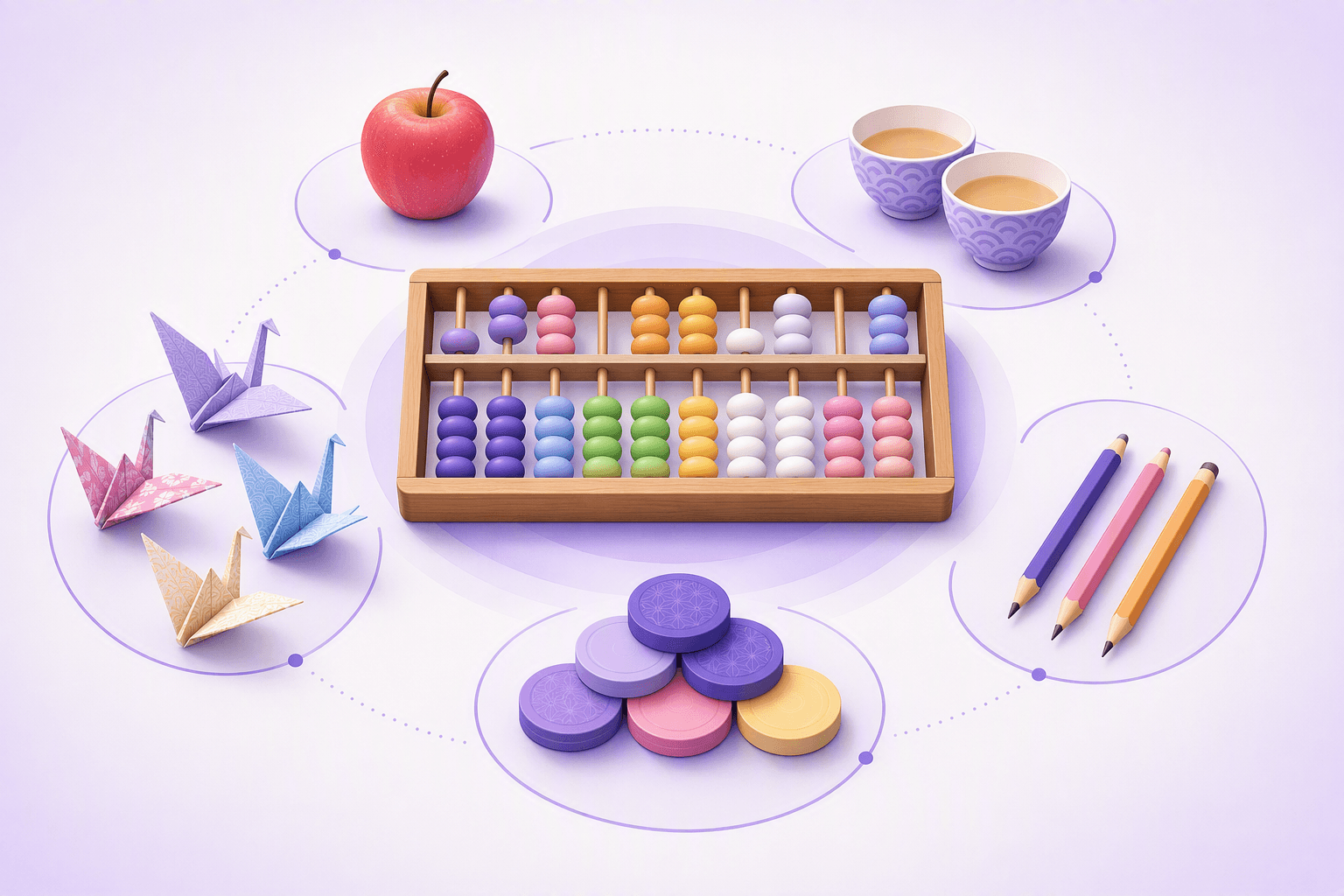
You will hear these constantly in daily life. Ordering at a restaurant: mittsu kudasai (three, please). Counting apples at a store: futatsu. When you do not know the correct specific counter for an object, the native system is always a safe fallback for quantities up to 10.
Introduction to Counters (Josuushi)
Japanese requires special counter words when counting specific categories of objects. This concept does not exist in English and is one of the most challenging aspects of the number system.
| English | Japanese | Pronunciation | Note |
|---|---|---|---|
| People (2+) | -人 (-にん) | -nin | hitori (1), futari (2), san-nin (3+) |
| Long objects | -本 (-ほん) | -hon | Pencils, bottles, rivers |
| Flat objects | -枚 (-まい) | -mai | Paper, tickets, plates |
| Small animals | -匹 (-ひき) | -hiki | Cats, dogs, fish |
| Machines/vehicles | -台 (-だい) | -dai | Cars, computers, TVs |
| Books | -冊 (-さつ) | -satsu | Books, notebooks, magazines |
| Cups/glasses | -杯 (-はい) | -hai | Cups of coffee, glasses of water |
The Agency for Cultural Affairs reports that there are over 500 counter words in Japanese, though only about 30-40 are commonly used in daily life. The system is learned gradually through exposure rather than memorization.
💡 Counter Survival Strategy
When you do not know the correct counter for something, use the native Japanese system (hitotsu, futatsu, mittsu...) for quantities up to 10. It works for almost any generic object and is always understood, even if it is not the most precise choice. Japanese speakers will appreciate the effort and understand you perfectly.
Ordinal Numbers in Japanese
Japanese ordinals are formed by adding the prefix dai- (第) before the number, or the suffix -banme (番目) after it. Both are widely used.
| English | Japanese | Pronunciation |
|---|---|---|
| 1st | 第一 / 一番目 | dai ichi / ichi banme |
| 2nd | 第二 / 二番目 | dai ni / ni banme |
| 3rd | 第三 / 三番目 | dai san / san banme |
| 4th | 第四 / 四番目 | dai yon / yon banme |
| 5th | 第五 / 五番目 | dai go / go banme |
| 10th | 第十 / 十番目 | dai juu / juu banme |
Dai- is more formal and literary (第一章 = Chapter 1), while -banme is more conversational (一番目の人 = the first person). In everyday speech, Japanese often skips ordinals entirely, using context or specific counters to indicate order.
Cultural Significance of Numbers in Japan
Numbers in Japanese culture carry profound symbolic meaning that affects everything from hospital room assignments to wedding gift amounts.
Unlucky 4 (shi/死): The most important number taboo in Japan. The reading shi for 4 is a homophone of 死 (death). Hospitals routinely lack a 4th floor and room 4. Gift sets never contain 4 items. According to the Agency for Cultural Affairs' 2023 survey, this avoidance remains deeply ingrained across all age groups.
Unlucky 9 (ku/苦): The reading ku for 9 sounds like 苦 (suffering or agony). Combined with 4, the number 49 (shi-ku) is especially feared as it can be heard as "unto death suffering." Hospital wards and hotels avoid these number combinations.
Lucky 7 (nana/shichi): Seven is considered lucky in Japan, influenced by both Buddhist traditions (the Seven Lucky Gods, 七福神) and Western cultural exchange. The festival of Tanabata (七夕, the seventh evening) falls on July 7th and is one of Japan's most beloved celebrations.
Lucky 8 (hachi): The number 8 is extremely auspicious in Japan. The kanji 八 widens at the bottom, symbolizing expanding prosperity (suehirogari, 末広がり). License plates with 8888 command premium prices. The 2008 Beijing Olympics opening ceremony famously began at 8:08 PM on 08/08/08, reflecting the shared East Asian reverence for this number.
Wedding gift amounts: Money gifts at Japanese weddings must always be in odd numbers (30,000 yen, 50,000 yen) because even numbers can be divided, symbolizing separation. The number 20,000 is avoided. The amount 40,000 is taboo for combining an even number with the death-associated 4.
🌍 Number Wordplay (Goroawase)
Japanese extensively uses number-wordplay called goroawase (語呂合わせ). Because each digit has multiple readings, numbers can spell words: 4649 can be read as yo-ro-shi-ku (nice to meet you), 39 as san-kyuu (thank you), and 1564 as hi-go-ro-shi (killing time). This system is used for phone numbers, passwords, and even dates.
Practice with Real Japanese Content
Japanese numbers appear in unique contexts, from the distinctive way prices are announced in convenience stores to the counting songs in anime to the number-heavy world of Japanese baseball commentary. Real-world exposure is essential for internalizing the counter system and sound changes.
Japanese films and anime offer excellent number practice. Shopping scenes, school settings, and sports broadcasts are especially useful. Visit our guide to the best movies for learning Japanese for top recommendations across genres.
Wordy helps you practice Japanese numbers in authentic contexts with interactive subtitles on Japanese movies and shows. When a number or counter appears, tap it to see the kanji, hiragana reading, and meaning. Check our blog for more Japanese learning resources, or head to our Japanese learning page to start practicing today.
Frequently Asked Questions
What are the numbers 1-10 in Japanese?
Why does Japanese have two number systems?
Why is 4 considered unlucky in Japanese?
What are counters and why are they needed?
How do you form compound numbers in Japanese?
What is the difference between 'nana' and 'shichi' for 7?
Sources & References
- Agency for Cultural Affairs, Japan, Survey on the Japanese Language, 2023
- Shibatani, M. (1990). The Languages of Japan. Cambridge University Press.
- Japan Foundation, Japanese-Language Education Survey, 2021
- Ethnologue: Languages of the World, Japanese language entry (2024)
Start learning with Wordy
Watch real movie clips and build your vocabulary as you go. Free to download.


