Quick Answer
The single most useful Japanese travel phrase is 'Sumimasen' (すみません, soo-mee-mah-sehn). It works as 'excuse me,' 'sorry,' and even a casual 'thank you,' covering dozens of daily travel situations in one word. Beyond that, knowing around 50 key phrases for transport, hotels, food, shopping, and emergencies will transform your Japan trip from stressful to smooth.
Why These Phrases Matter
The single most useful Japanese travel phrase is Sumimasen (すみません, soo-mee-mah-sehn). It covers "excuse me," "sorry," and even a light "thank you," all in one word. Master it, and you have already solved half your travel communication needs.
Japan welcomed over 31 million international visitors in 2024, according to the Japan National Tourism Organization (JNTO). Yet despite this tourism boom, English proficiency outside major tourist hubs remains limited. The Japan Foundation's 2021 survey found that while 3.8 million people worldwide study Japanese, most tourists arrive knowing zero phrases and struggle accordingly. Whether you're looking up "japanese travel phrases" for travel, study, or conversation, this guide covers everything you need.
The cultural dimension matters even more than the linguistic one. Japan operates on a system of politeness and social consideration that permeates every interaction, from buying a train ticket to entering a restaurant. Knowing the right phrase signals respect, and the Japanese response to a tourist making an effort is overwhelmingly warm.
"In Japanese society, the attempt to communicate in the local language is itself a form of politeness. Even imperfect Japanese signals cultural awareness and respect, qualities that Japanese speakers value far more than grammatical accuracy."
(Anna Wierzbicka, Cross-Cultural Pragmatics, Mouton de Gruyter)
This guide covers 50+ essential phrases organized by travel situation: getting around, hotels, food, shopping, and emergencies. Each includes Japanese script, romaji, English pronunciation, and cultural context so you know exactly when and how to use it.
Quick Reference: Top 10 Travel Phrases
| English | Japanese | Pronunciation | Formality |
|---|---|---|---|
| Excuse me / Sorry / Thank you | すみません (Sumimasen) | soo-mee-mah-sehn | polite |
| Please (when requesting) | お願いします (Onegaishimasu) | oh-neh-gah-ee-shee-mahs | polite |
| Thank you | ありがとうございます (Arigatou gozaimasu) | ah-ree-gah-toh goh-zah-ee-mahs | polite |
| How much is this? | いくらですか? (Ikura desu ka?) | ee-koo-rah dehs kah | polite |
| Where is...? | ...はどこですか? (...wa doko desu ka?) | ...wah doh-koh dehs kah | polite |
| The check, please | お会計お願いします (Okaikei onegaishimasu) | oh-kah-ee-keh oh-neh-gah-ee-shee-mahs | polite |
| I don't understand | わかりません (Wakarimasen) | wah-kah-ree-mah-sehn | polite |
| Do you speak English? | 英語は話せますか? (Eigo wa hanasemasu ka?) | eh-goh wah hah-nah-seh-mahs kah | polite |
| Help! | 助けて! (Tasukete!) | tah-soo-keh-teh | casual |
| Yes / No | はい / いいえ (Hai / Iie) | hah-ee / ee-eh | polite |
Getting Around
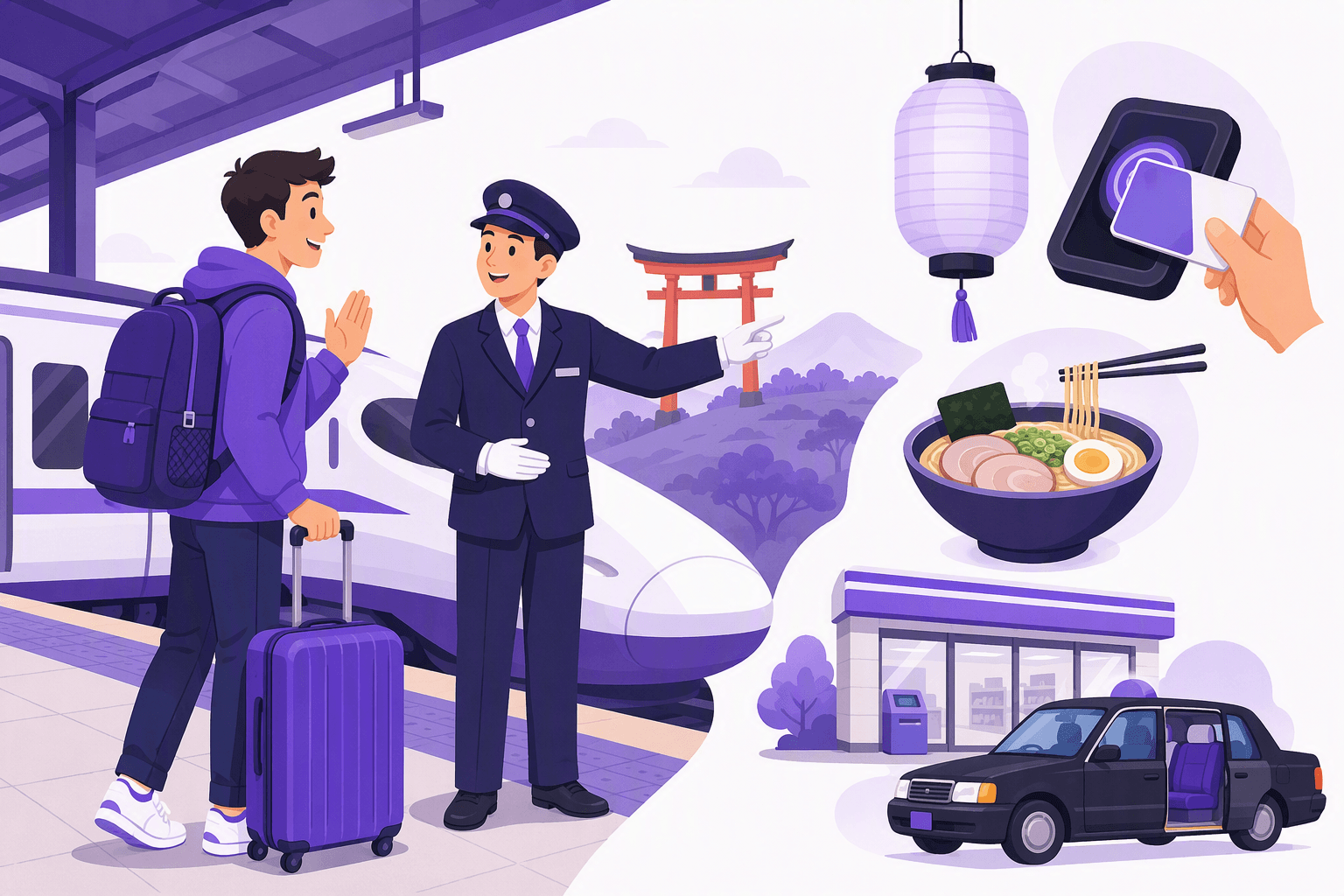
Japan's public transport system is famously efficient, but navigating it requires a few key phrases. Train stations in major cities have English signage, but bus routes, taxi conversations, and asking for directions almost always require Japanese. An IC card (Suica or Pasmo) eliminates the need to buy individual tickets. Just tap and go at station gates, convenience stores, and vending machines.
すみません (Sumimasen)
/soo-mee-mah-sehn/
Literal meaning: There is no end (to my imposition on you)
“すみません、駅はどこですか?”
Excuse me, where is the station?
The Swiss Army knife of Japanese travel. Use it to get someone's attention, apologize for bumping into them on a crowded train, or express gratitude when someone helps you. You will say this word more than any other.
Sumimasen derives from the verb sumu (to end/settle), and its literal meaning ("there is no end to my imposition") reveals a core Japanese cultural value: awareness of the burden you place on others. For travelers, it is the word you say before asking a question, after someone moves aside for you, and when you accidentally block a doorway. According to NHK's pronunciation standards, the stress falls evenly across all syllables.
ここはどこですか? (Koko wa doko desu ka?)
/koh-koh wah doh-koh dehs kah/
Literal meaning: As for here, where is it?
“すみません、ここはどこですか?地図を見ても分かりません。”
Excuse me, where is this place? I can't figure it out even looking at the map.
Essential when you're lost. Japanese people will often walk you to your destination rather than just pointing. This is considered normal hospitality, not an imposition.
When asking for a specific place, swap koko (here) for the location name: Tōkyō Eki wa doko desu ka? (Where is Tokyo Station?). Japanese people are remarkably willing to help lost tourists. Do not be surprised if someone walks you to your destination personally.
切符はいくらですか? (Kippu wa ikura desu ka?)
/kee-poo wah ee-koo-rah dehs kah/
Literal meaning: As for the ticket, how much is it?
“新宿までの切符はいくらですか?”
How much is a ticket to Shinjuku?
Useful at bus stops and smaller stations without English ticket machines. For trains, IC cards (Suica/Pasmo) are easier: just tap and the correct fare is deducted automatically.
💡 IC Cards: Your Best Friend in Japan
Get a Suica or Pasmo IC card (now available on iPhone via Apple Wallet). It works on virtually all trains, buses, and subways nationwide. You can also use it to pay at convenience stores (コンビニ, konbini), vending machines, and many shops. Load it with yen at any station machine and tap to pay. No Japanese needed.
...までお願いします (...made onegaishimasu)
/...mah-deh oh-neh-gah-ee-shee-mahs/
Literal meaning: To..., please
“東京駅までお願いします。”
To Tokyo Station, please.
The essential taxi phrase. Just say your destination followed by 'made onegaishimasu.' Taxi doors open and close automatically, so do not touch them. Tipping is not expected or desired.
Japanese taxis are impeccably clean and the drivers wear white gloves. The rear left door opens automatically, so do not try to open or close it yourself. Show the driver your destination on your phone screen if pronunciation feels difficult. And remember: no tipping. Ever.
乗り換えはどこですか? (Norikae wa doko desu ka?)
/noh-ree-kah-eh wah doh-koh dehs kah/
Literal meaning: As for the transfer, where is it?
“山手線への乗り換えはどこですか?”
Where is the transfer to the Yamanote Line?
Train stations in Tokyo can have over 30 platforms. Station staff at the ticket gates are always willing to help. Approach the manned gate rather than the automatic ones.
At the Hotel
Japanese hotels and ryokan (traditional inns) operate with exceptional precision. Check-in is typically at 3:00 PM and check-out at 10:00 or 11:00 AM, with little flexibility. The front desk (フロント, furonto) is your go-to for any request.
予約があります (Yoyaku ga arimasu)
/yoh-yah-koo gah ah-ree-mahs/
Literal meaning: A reservation exists
“すみません、予約があります。田中です。”
Excuse me, I have a reservation. The name is Tanaka.
Used at check-in. Having your booking confirmation on your phone is helpful. At ryokan (traditional inns), you may be asked to remove your shoes at the entrance. Look for the genkan (玄関), a recessed entryway with a shoe shelf.
At traditional ryokan, check-in involves more ceremony. You may be served tea and sweets while the staff explains the inn's facilities. Meals are often included and served in your room at set times. The Lonely Planet Japanese Phrasebook recommends having your confirmation number ready, as staff may need to match your foreign name to their booking system.
部屋はありますか? (Heya wa arimasu ka?)
/heh-yah wah ah-ree-mahs kah/
Literal meaning: As for a room, does one exist?
“今夜、部屋はありますか?一人です。”
Do you have a room for tonight? It's just me.
For walk-in stays. Japan has many affordable business hotels (ビジネスホテル) near train stations that often have availability. Capsule hotels (カプセルホテル) are another uniquely Japanese option for solo travelers.
鍵をお願いします (Kagi wo onegaishimasu)
/kah-gee oh oh-neh-gah-ee-shee-mahs/
Literal meaning: The key, please
“すみません、鍵をお願いします。部屋は305号室です。”
Excuse me, the key please. My room is 305.
Many Japanese hotels use physical keys or card keys that must be left at the front desk when you go out. This phrase also works when you return and need your key back.
Wi-Fiはありますか? (Wai-Fai wa arimasu ka?)
/wah-ee fah-ee wah ah-ree-mahs kah/
Literal meaning: As for Wi-Fi, does it exist?
“Wi-Fiはありますか?パスワードは何ですか?”
Do you have Wi-Fi? What is the password?
Most hotels offer free Wi-Fi. For on-the-go connectivity, renting a pocket Wi-Fi device at the airport is popular among tourists, available at counters in Narita and Haneda airports.
Ordering Food
Japanese food culture is a UNESCO Intangible Cultural Heritage, and eating is one of the highlights of any trip. Restaurants range from Michelin-starred establishments to standing noodle bars in train stations, and each has its own etiquette. Many restaurants display plastic food replicas (食品サンプル, shokuhin sanpuru) in their windows, and you can point at these to order if language fails you.
お会計お願いします (Okaikei onegaishimasu)
/oh-kah-ee-keh oh-neh-gah-ee-shee-mahs/
Literal meaning: The check, please
“すみません、お会計お願いします。”
Excuse me, the check please.
In Japan, you typically pay at the register near the exit, not at your table. Hand the bill to the cashier. Do not leave money on the table. Staff may assume you forgot it and chase you outside to return it.
⚠️ No Tipping in Japan
Tipping is not practiced in Japan and can cause genuine confusion or embarrassment. Staff may refuse the money, chase you down the street to return it, or feel uncomfortable about what to do. Excellent service is the baseline expectation, not something that requires extra payment. The price on the menu is the final price (tax may be included or added separately, but no tip is ever expected).
おすすめは何ですか? (Osusume wa nan desu ka?)
/oh-soo-soo-meh wah nahn dehs kah/
Literal meaning: As for a recommendation, what is it?
“初めてなんですが、おすすめは何ですか?”
It's my first time here. What do you recommend?
Japanese restaurant staff take pride in their recommendations. This phrase flatters the chef and usually gets you the best dish on the menu. At sushi counters, the chef's recommendation (おまかせ, omakase) is often the finest option.
アレルギーがあります (Arerugi ga arimasu)
/ah-reh-roo-gee gah ah-ree-mahs/
Literal meaning: An allergy exists
“すみません、えびのアレルギーがあります。”
Excuse me, I have a shrimp allergy.
Critical for food safety. Common allergens: えび (ebi, shrimp), たまご (tamago, egg), 小麦 (komugi, wheat), そば (soba, buckwheat), ピーナッツ (piinattsu, peanuts). Carry an allergy card in Japanese for restaurant staff.
いただきます (Itadakimasu)
/ee-tah-dah-kee-mahs/
Literal meaning: I humbly receive
“いただきます!わあ、美味しそう!”
Itadakimasu! Wow, this looks delicious!
Said before eating, with hands pressed together in a small prayer-like gesture. It expresses gratitude to everyone involved in the meal: the farmer, the cook, the server. Saying it marks you as culturally aware and is always appreciated.
ごちそうさまでした (Gochisousama deshita)
/goh-chee-soh-sah-mah deh-shtah/
Literal meaning: It was a feast
“ごちそうさまでした。とても美味しかったです。”
Thank you for the meal. It was very delicious.
Said after finishing a meal. It thanks the cook and staff for the food. Saying this as you leave a restaurant will earn you warm smiles and sometimes a 'thank you for coming' (ありがとうございました) in return.
Shopping
From the electronics towers of Akihabara to the traditional crafts of Kyoto, shopping is a major part of any Japan trip. Tax-free shopping (免税, menzei) is available for tourists spending over 5,000 yen at participating stores, so bring your passport.
いくらですか? (Ikura desu ka?)
/ee-koo-rah dehs kah/
Literal meaning: How much is it?
“すみません、これはいくらですか?”
Excuse me, how much is this?
Works anywhere: shops, markets, street stalls. Point at the item while asking. Japan is generally a fixed-price culture; haggling is not common except at flea markets (フリーマーケット) and some electronics shops in Akihabara.
もう少し安いのはありますか? (Mou sukoshi yasui no wa arimasu ka?)
/moh soo-koh-shee yah-soo-ee noh wah ah-ree-mahs kah/
Literal meaning: Is there something a little cheaper?
“素敵ですが、もう少し安いのはありますか?”
It's lovely, but is there something a little cheaper?
Rather than haggling on price (which is uncommon in Japan), this phrase politely asks if there's a more affordable alternative. Shop staff will appreciate your directness and usually offer options.
カードは使えますか? (Kaado wa tsukaemasu ka?)
/kah-doh wah tsoo-kah-eh-mahs kah/
Literal meaning: As for a card, can it be used?
“すみません、カードは使えますか?それとも現金だけですか?”
Excuse me, can I use a card? Or is it cash only?
Japan is still heavily cash-based. While major stores and chains accept cards, smaller shops and restaurants often do not. Always carry cash (現金, genkin). ATMs at 7-Eleven and Japan Post accept international cards.
免税できますか? (Menzei dekimasu ka?)
/mehn-zeh deh-kee-mahs kah/
Literal meaning: Can tax-free be done?
“免税できますか?パスポートはあります。”
Can I get tax-free? I have my passport.
Foreign tourists can get a 10% consumption tax exemption on purchases over 5,000 yen at stores displaying the 'Tax Free' symbol. Bring your passport; staff will attach the receipt to your passport page.
💡 Konbini Culture: The Traveler's Lifeline
Japanese convenience stores (コンビニ, konbini), including 7-Eleven, Lawson, and FamilyMart, are on a completely different level from their Western counterparts. They sell fresh onigiri (rice balls), bento boxes, hot meals, toiletries, phone chargers, postage stamps, concert tickets, and have international ATMs. Open 24/7 and found on virtually every city block, they are the single most useful resource for any traveler in Japan.
Emergencies
Emergencies are rare for tourists in Japan, as it is one of the safest countries in the world. But knowing these phrases can be critical when it matters. The emergency number is 110 for police and 119 for fire/ambulance (the reverse of many Western countries).
助けて! (Tasukete!)
/tah-soo-keh-teh/
Literal meaning: Save me! / Help me!
“助けて!財布を盗まれました!”
Help! My wallet was stolen!
The urgent cry for help. In a genuine emergency, this will get immediate attention. For less urgent help, use 'sumimasen' instead. Japan's crime rate is extremely low, but petty theft can happen in crowded tourist areas.
医者が必要です (Isha ga hitsuyou desu)
/ee-shah gah hee-tsoo-yoh dehs/
Literal meaning: A doctor is necessary
“すみません、医者が必要です。気分が悪いです。”
Excuse me, I need a doctor. I feel sick.
Hotels can arrange a doctor visit. For hospitals with English-speaking staff, search for 'international clinic' (国際クリニック) in your area. Bring your travel insurance documents and passport.
警察を呼んでください (Keisatsu wo yonde kudasai)
/keh-sah-tsoo oh yohn-deh koo-dah-sah-ee/
Literal meaning: Please call the police
“すみません、警察を呼んでください。パスポートをなくしました。”
Excuse me, please call the police. I've lost my passport.
Police boxes (交番, koban) are small stations found throughout Japanese cities and are staffed around the clock. Officers are approachable and can help with lost items, directions, and emergencies. Lost items are frequently turned in and returned in Japan.
...のアレルギーがあります (...no arerugi ga arimasu)
/...noh ah-reh-roo-gee gah ah-ree-mahs/
Literal meaning: I have an allergy to...
“ピーナッツのアレルギーがあります。救急車を呼んでください。”
I have a peanut allergy. Please call an ambulance.
For severe allergic reactions, call 119 (ambulance). Carry an allergy card in Japanese listing your allergies; pharmacies and hotels can help you create one. The word for ambulance is 救急車 (kyuukyuusha, kyoo-kyoo-shah).
Cultural Etiquette for Travelers
🌍 Four Rules Every Tourist Should Know
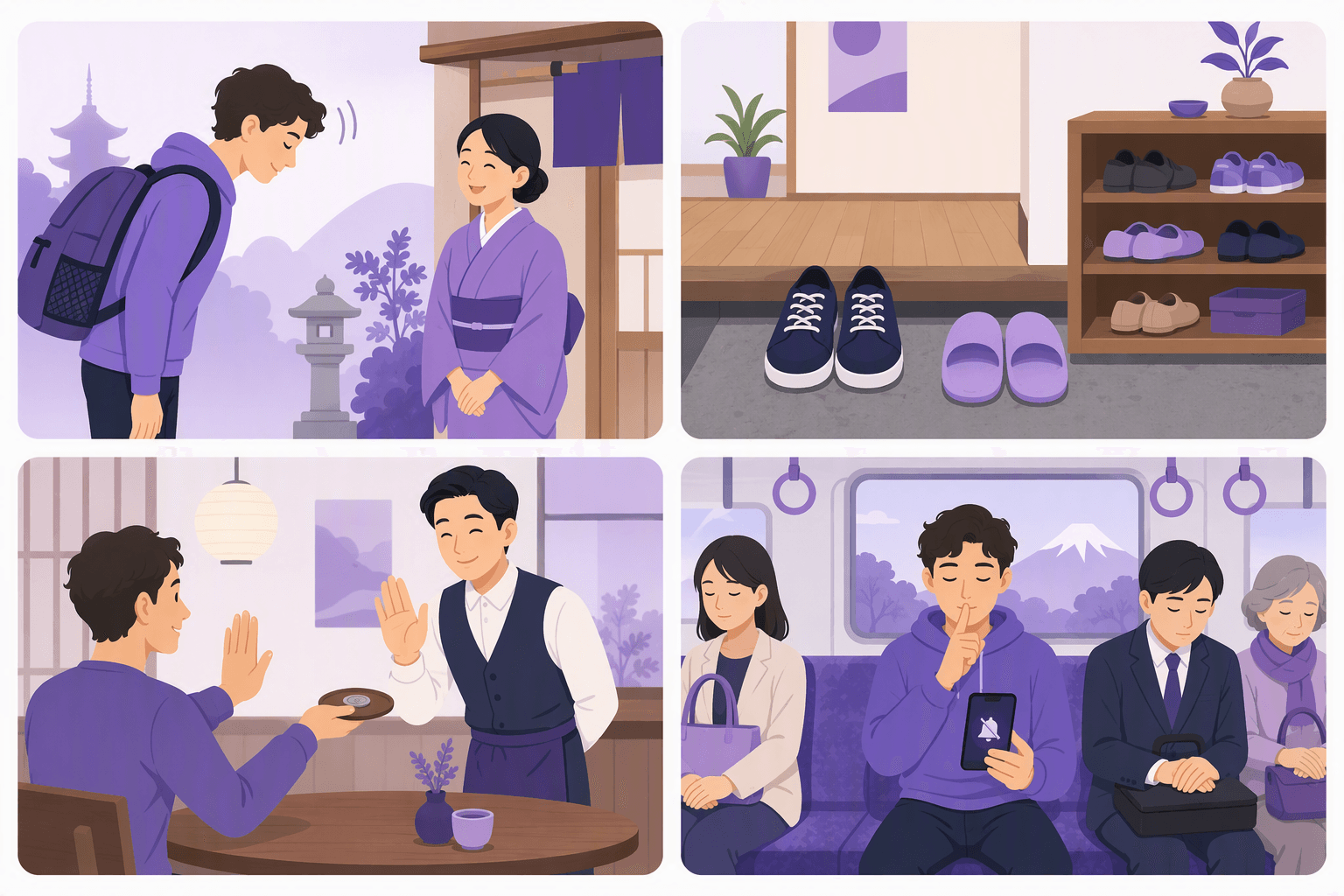
Bowing: A slight head nod (15 degrees) is sufficient for tourists. You do not need to do a deep 45-degree bow, as that is reserved for formal apologies and business meetings. A small nod when saying arigatou gozaimasu or sumimasen is perfect.
Removing shoes: Look for the genkan (玄関), a slightly lowered entryway with a shoe shelf or rows of slippers. You will encounter it at ryokan, temples, some restaurants, fitting rooms, and homes. Step up out of your shoes and into the slippers provided. Socks are fine; bare feet are not ideal.
No tipping: Worth repeating because it surprises so many Western travelers. Do not tip at restaurants, hotels, taxis, hair salons, or anywhere else. It is not customary and can cause genuine confusion.
Train etiquette: Set your phone to silent (マナーモード, manaa moodo, literally "manner mode"). Do not take phone calls on trains. Eating on local trains is frowned upon, but it is perfectly acceptable on long-distance trains like the shinkansen (bullet train), where bento boxes are practically a tradition.
Useful Counters for Travelers
Japanese uses counting words (counters) that change depending on the type of object. You do not need to learn all of them, but three are genuinely useful for tourists:
| Counter | Reading | Used For | Example |
|---|---|---|---|
| 〜枚 (mai) | mah-ee | Flat things: tickets, sheets, plates | 切符二枚 (kippu ni-mai) = 2 tickets |
| 〜人 (nin) | neen | People (except 1 and 2) | 三人です (san-nin desu) = 3 people |
| 〜つ (tsu) | tsoo | General objects | 一つください (hitotsu kudasai) = One, please |
For "how many people" at a restaurant, the host will ask nan-mei-sama desu ka? (何名様ですか?). Hold up fingers and say the number: futari (二人, two people) or san-nin (三人, three people).
Learn Japanese Through Movies and TV
Hearing these phrases spoken naturally by native speakers accelerates your learning dramatically. Japanese films and anime provide authentic pronunciation, intonation, and cultural context that phrasebooks cannot replicate. Check out our guide to the best movies to learn Japanese for curated recommendations organized by difficulty level.
For structured vocabulary building before your trip, Wordy's Japanese learning tools let you practice travel phrases with spaced repetition, so you retain what you learn. And for more Japanese phrase guides, visit our blog for articles covering greetings, thank you, sorry, and more.
Whether you are navigating Tokyo's labyrinthine subway system or ordering ramen in a tiny Osaka side-street shop, even a handful of these phrases will transform your travel experience. The Japanese word for effort is ganbaru (頑張る), and making the effort to speak even basic Japanese is the best way to connect with a culture that deeply values sincerity and respect.
Frequently Asked Questions
Do I need to speak Japanese to travel in Japan?
What is the most useful Japanese word for tourists?
Should I tip in Japan?
How do I pay for trains in Japan?
What should I know about Japanese etiquette as a tourist?
Can I use credit cards everywhere in Japan?
Sources & References
- Japan Foundation (国際交流基金), Survey Report on Japanese-Language Education Abroad (2021)
- Lonely Planet, Japanese Phrasebook & Dictionary, 9th edition (2023)
- Japan National Tourism Organization (JNTO), Visitor Arrival Statistics (2024)
- NHK Broadcasting Culture Research Institute, Pronunciation and Standard Japanese Usage
- Wierzbicka, A., Cross-Cultural Pragmatics: The Semantics of Human Interaction (Mouton de Gruyter)
Start learning with Wordy
Watch real movie clips and build your vocabulary as you go. Free to download.


