Quick Answer
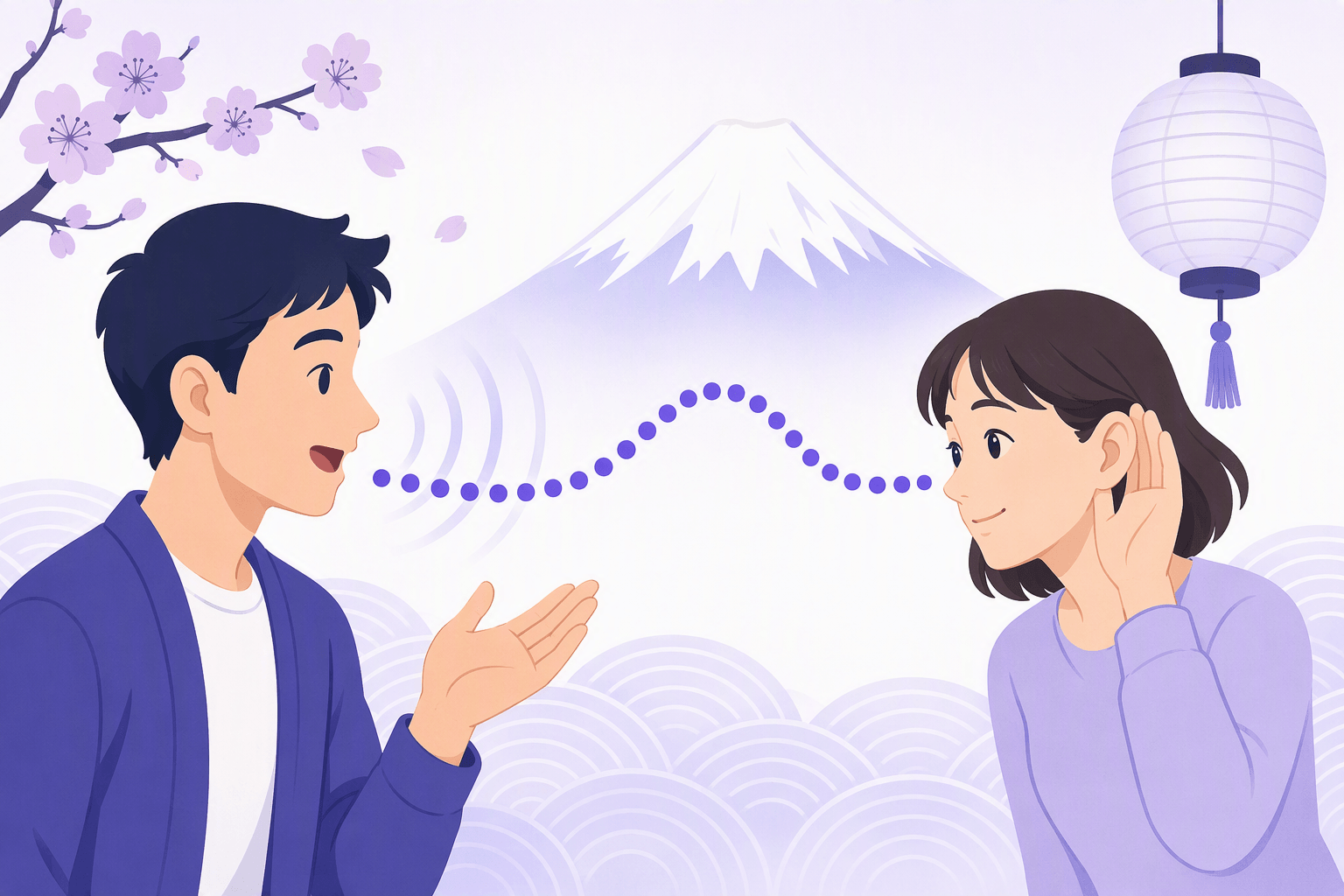
Japanese pronunciation is easiest when you focus on three things: clean vowel sounds, mora timing (rhythm), and pitch accent (high vs low). This guide explains each sound with English-friendly approximations, shows common learner mistakes, and gives practical drills you can practice with real TV and movie clips.
Japanese pronunciation is mainly about getting the rhythm and pitch right, not forcing an English-style accent. If you learn the five vowels, mora timing (beat-by-beat rhythm), and the basics of pitch accent, you can sound clear and natural quickly, even as a beginner.
| English | Japanese | Pronunciation | Formality |
|---|---|---|---|
| Hello (polite) | こんにちは | kohn-NEE-chee-wah | polite |
| Goodbye (casual) | じゃあね | jah-ah NEH | casual |
| Thank you (polite) | ありがとうございます | ah-ree-gah-TOH goh-zah-ee-MAHSS | formal |
| Excuse me / sorry | すみません | soo-mee-MAH-sen | polite |
| I love you | 愛してる | eye-shee-TEH-roo | casual |
| Nice to meet you | はじめまして | hah-jee-MEH-she-teh | polite |
Why Japanese pronunciation feels "different"
Japanese is spoken by about 123 million people, primarily in Japan, and it is among the world’s most spoken languages by native speakers (Ethnologue 2024). For learners, the challenge is rarely individual sounds, it is the system.
English uses stress, reduced vowels (like the "uh" in "about"), and consonant clusters. Japanese relies on steady vowel quality, mora timing, and pitch accent patterns documented in standard references like NHK’s accent dictionary and NINJAL resources.
"In Tokyo Japanese, what listeners perceive as 'accent' is fundamentally a pitch pattern, not stress. Learners who substitute English stress often sound less natural even when individual consonants are correct."
Haruo Kubozono, phonologist (work on Japanese prosody and accent)
💡 A fast win
If you fix mora timing and long vowels, your Japanese becomes easier to understand immediately. Pitch accent then becomes a refinement that makes you sound more native-like.
The three pillars: vowels, mora timing, pitch accent
Vowels (clean and stable)
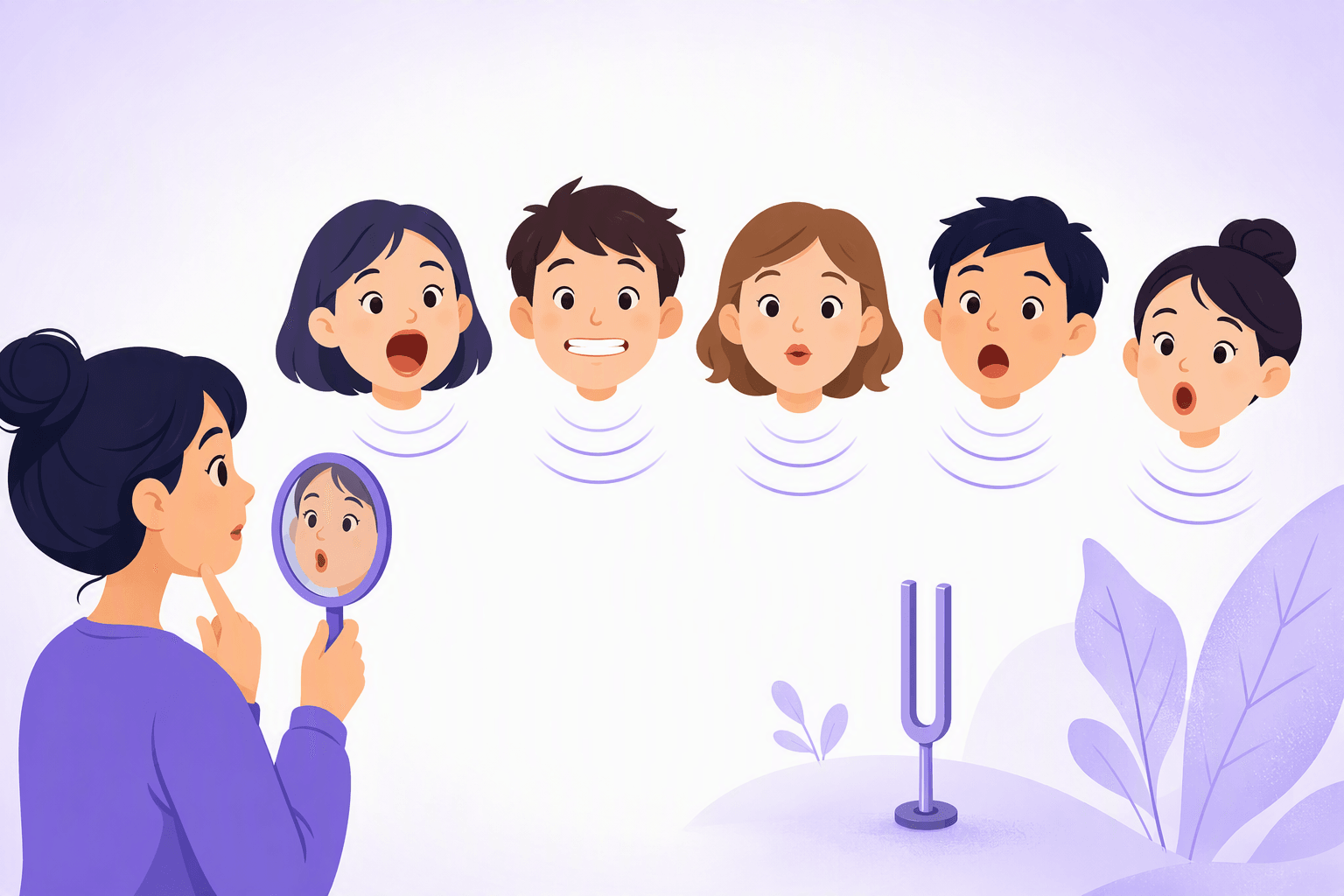
Japanese has five core vowels: あ a, い i, う u, え e, お o. They stay relatively pure, meaning you do not slide into another vowel the way English often does.
Think "Italian-style" vowels: short, clear, and consistent. This is one reason Japanese can sound crisp even at fast speed.
Mora timing (rhythm)
Japanese rhythm is counted in mora (beats), not syllables. Each kana usually equals one mora, including ん and small っ.
Example: がっこう (gakkou) has 4 mora: が / っ / こ / う. If you rush the small っ or the long vowel, the word can sound like a different word.
Pitch accent (high vs low)
Japanese does not have loud stress like English. Instead, words have a pitch pattern, often described as high (H) and low (L).
In Tokyo Japanese, many words are either heiban (flat after rising) or have a drop after a specific mora. Standard patterns are recorded in NHK and NINJAL accent dictionaries.
🌍 Why pitch matters in real life
In casual conversation, Japanese speakers often shorten words and drop particles. Pitch movement becomes one of the cues that keeps words distinct, especially in fast speech on TV and in movies.
Japanese vowels: how to pronounce あ い う え お
Below are practical approximations. Your goal is consistency, not a perfect match to a single speaker.
あ
Pronunciation: "ah" as in "father" (AH). Keep it open and short.
Common mistake: turning it into "uh" (reduced vowel). Japanese rarely reduces vowels the way English does.
い
Pronunciation: "ee" as in "see" (EE), but shorter and not tense.
Common mistake: adding a glide, like "y" at the start. Keep it clean.
う
Pronunciation: like "oo" in "food" (OO), but with less lip rounding. It can sound closer to "oo" than "uh," depending on the speaker.
Common mistake: pronouncing it as English "you." Avoid the "y" sound.
え
Pronunciation: "eh" as in "met" (EH), without turning into a diphthong like "ay."
Common mistake: saying "ay" (as in "day"). Keep it steady.
お
Pronunciation: "oh" (OH), but do not glide into "ow." Keep it pure.
Common mistake: English "oh" often ends with a "w" sound. Cut that off.
⚠️ Do not import English reduced vowels
If you say です (desu) like "deh-suh," you will sound unnatural. The final う is often devoiced or very light, but it is not a full "uh."
Consonants that matter most
Japanese consonants are generally straightforward, but a few deserve focused practice.
ら り る れ ろ
Pronunciation: a light tap between English "r" and "l." Approximation: "rah, ree, roo, reh, roh," with a quick tongue tap.
Common mistake: using a strong American "r" (as in "red") or a clear "l." Aim for a single tap, like the quick "tt" in American English "butter."
ふ
Pronunciation: "foo" but with a softer, breathy sound, closer to blowing air between lips. Approximation: "hoo" with lips closer together: "foo."
Common mistake: pronouncing it as English "fu" with a strong "f" against the teeth.
し and ち
し pronunciation: "shee" (SHEE), but lighter.
ち pronunciation: "chee" (CHEE).
Common mistake: overemphasizing them, especially in slow speech. Keep them short.
つ
Pronunciation: "tsoo" (TSOO). It is one sound, not "t" plus "soo" separated.
Practice: say "cats" and hold the "ts" at the end, then add "oo": "cats-oo" without a break.
が ぎ ぐ げ ご and ざ じ ず ぜ ぞ
These are voiced consonants. In some contexts, especially in casual speech, が can sound slightly nasalized in the middle of a word, but you do not need to force that as a learner.
Focus on voicing cleanly without adding extra vowels.
Small ゃ ゅ ょ: the "glide" sounds
きゃ きゅ きょ are single mora each: きゃ (kya), きゅ (kyu), きょ (kyo). Approximation: "kyah, kyoo, kyoh."
Common mistake: pronouncing きや (ki-ya) when it should be きゃ (kya). The small kana compress the sound into one beat.
Try clapping once for きゃ and twice for きや.
Long vowels: the meaning-changing detail
Long vowels are not optional. They can change meaning.
- おばさん (obasan, "aunt") vs おばあさん (obaasan, "grandmother")
- びる (biru, "building") vs びーる (biiru, "beer")
In hiragana, long お is often written おう or おお. In katakana, long vowels are often marked with ー.
Rule of thumb: if it is written long, hold it for two mora. Do not get louder, just longer.
Practice drill (10 seconds)
Say: とり (to-ri) then とおり (to-o-ri).
Tap: 2 beats vs 3 beats.
Small っ: the pause that carries meaning
Small っ (sokuon) marks a "geminate" consonant, basically a held consonant or a brief stop before the next consonant.
- さか (saka) vs さっか (sakka)
- きて (kite) vs きって (kitte)
Pronunciation tip: do not pronounce the っ as "tsu." Instead, make a tiny silence, then hit the next consonant strongly.
Practice drill
Say: いった (itta, "went") as "EE- (pause) -tah."
Keep the pause exactly one mora.
ん: the flexible nasal
ん changes depending on what comes next.
- Before b/p/m: sounds like "m" (しんぶん shinbun, approx "sheem-boon")
- Before k/g: back-of-mouth nasal (げんき genki)
- At end: nasal "n" or nasalized vowel (ほん hon)
The key mistake is adding a vowel: "hon-uh." Avoid that.
Devoicing: why some vowels seem to disappear
In standard speech, especially Tokyo-style, vowels like い and う can become devoiced between voiceless consonants (k, s, t, h, p). This is why です can sound like "dess" and すき can sound like "ski."
Do not force devoicing early. First learn clear vowels, then let devoicing happen naturally as your speed increases.
🌍 Anime vs everyday speech
Anime often exaggerates intonation and emotion, which can make vowels sound longer and pitch movement more dramatic. Live-action dramas and street interviews usually give you more realistic timing and devoicing patterns.
Pitch accent basics you can actually use
You do not need to memorize accent numbers to benefit from pitch accent. You need two practical skills: hearing the rise and hearing the drop.
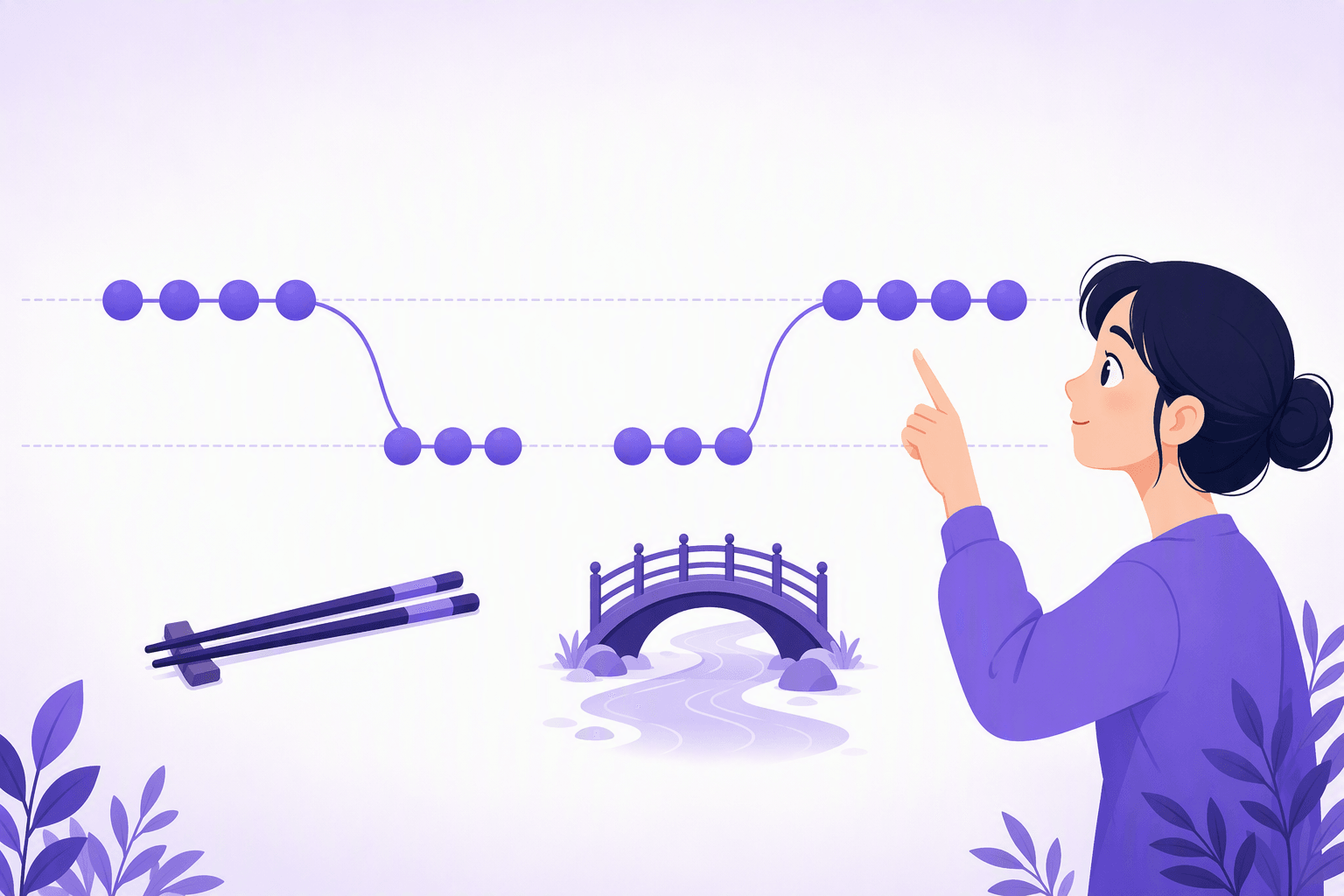
Heiban (flat after rising)
Many common words start low and then go high and stay high until the end, with the drop happening after the word if a particle follows.
Example idea: L-H-H pattern across the word, then drop on the particle.
Atamadaka (drop after the first mora)
Some words start high then drop immediately.
This is one reason English-style "stress the second syllable" can sound off. Japanese listeners expect pitch movement, not loudness.
Minimal pair to know: はし
はし (hashi) can mean different things depending on pitch pattern, commonly "chopsticks" vs "bridge." The exact pattern depends on dialect and dictionary standard, but the concept is real: pitch can disambiguate.
💡 How to practice pitch without a dictionary
Pick one actor or speaker and imitate their pitch for a specific phrase. Consistency within a phrase matters more than matching a theoretical pattern across all of Japanese.
Rhythm in real conversation: mora timing in action
Japanese timing shows up everywhere, especially in set phrases.
Try saying ありがとうございます (a-ri-ga-to-u go-za-i-ma-su). It is long, but it is regular. Each mora gets a beat, and the vowels stay clear.
This is why Japanese can be fast without becoming mushy. The rhythm is stable even when the speaker is emotional.
Pronunciation in common phrases (with real-life nuance)
If you want phrases to practice, start with greetings and short lines you will actually say. Wordy-style clip practice works best when the line is short enough to repeat 10 times.
For more phrase-focused guides, use these:
こんにちは
Pronunciation: "kohn-NEE-chee-wah"
Note: The は is written as "ha" but pronounced "wa" in this greeting. Do not generalize this rule, it is specific to certain particles and set phrases.
さようなら
Pronunciation: "sah-yoh-NAH-rah"
Cultural note: It can sound final, like a long goodbye. In daily life, people often prefer じゃあね (jah-ah NEH) or またね (mah-tah NEH) with friends.
すみません
Pronunciation: "soo-mee-MAH-sen"
It covers "excuse me," "sorry," and sometimes "thanks for the trouble." The pitch and softness matter more than volume.
A practical training plan (15 minutes a day)
This is the shortest path to noticeable improvement.
Step 1: Build a clean sound map (3 minutes)
Read a short kana line slowly. Keep vowels pure and avoid English diphthongs.
If you still mix up kana, pair this with how to learn hiragana and how to learn katakana.
Step 2: Mora tapping (4 minutes)
Pick one sentence. Tap each mora on your desk.
Your goal is equal spacing, including ん, small っ, and long vowels.
Step 3: Shadowing with constraints (6 minutes)
Shadow the line three times:
- rhythm only (monotone pitch)
- pitch movement only (same timing)
- full imitation
This isolates the two skills that matter most.
Step 4: Record and compare (2 minutes)
Record yourself once. Compare timing first, then pitch shape, then consonants.
Most learners do the reverse and get stuck.
Common mistakes English speakers make (and quick fixes)
Adding extra vowels after consonants
Mistake: "suh-toh-puh" for ストップ (sutoppu).
Fix: keep consonant clusters Japanese-style by using small っ and short vowels, not extra schwas.
Stressing words like English
Mistake: making one mora louder.
Fix: keep volume flat, use pitch movement.
Ignoring long vowels and small っ
Mistake: treating them as spelling details.
Fix: treat them as timing. If you can tap it, you can say it.
Over-rolling ら-row
Mistake: Spanish-style rolled r.
Fix: one tap only.
⚠️ A note on rude words
Pronunciation practice sometimes leads learners to repeat strong language from clips. If you are exploring that vocabulary, do it intentionally and understand context first. See our guide to Japanese swear words for severity and usage notes.
Dialects and "standard" pronunciation
Japan has major dialect regions, and pronunciation can shift with them. Kansai speech, for example, often has different pitch patterns than Tokyo speech.
Most learning materials teach a Tokyo-based standard because it is widely understood and used in national broadcasting. NHK’s pronunciation resources reflect this standardization approach.
If your goal is travel or media comprehension, standard pronunciation gives the best coverage. If your goal is fitting into a specific region, copy that region’s speakers.
Why movie and TV clips help pronunciation more than word lists
Pronunciation is not just sounds, it is timing plus emotion plus turn-taking. Clips give you all three.
Research and teaching frameworks like the Japan Foundation’s CEFR-aligned approach emphasize communicative ability, not isolated perfection. In practice, that means you should train pronunciation inside real lines, with real speed.
For broader learning strategy, start at the blog index or compare tools in best language learning apps.
A compact checklist you can use today
- Vowels: pure, no glide at the end
- Mora: tap every beat, including ん, small っ, and long vowels
- Pitch: copy the rise and the drop, not English stress
- Speed: increase only after timing stays stable
- Feedback: record, compare, repeat
If you do this for two weeks, you will hear the difference in your own recordings, and native speakers will too.
🌍 One last cultural detail: polite speech sounds 'smoother'
In polite speech, speakers often keep rhythm very even and avoid dramatic pitch swings. In casual speech, pitch can move more, contractions appear, and endings soften. Practicing both registers helps you sound appropriate, not just accurate.
Frequently Asked Questions
Is Japanese pronunciation hard for English speakers?
What is pitch accent in Japanese, and do I need it?
How do I pronounce ん (ん) correctly?
What is the difference between long vowels and double vowels?
How can I practice Japanese pronunciation with movies and anime?
Sources & References
- National Institute for Japanese Language and Linguistics (NINJAL), 'Japanese Accent Dictionary (日本語発音アクセント辞典)' (reference work), latest edition
- NHK Broadcasting Culture Research Institute, 'NHK日本語発音アクセント新辞典' (NHK Accent Dictionary), latest edition
- The Japan Foundation, 'JF Standard for Japanese-Language Education' (CEFR-based framework), latest version
- Ethnologue (SIL International), 'Japanese' language entry, 27th edition (2024)
- Agency for Cultural Affairs (文化庁), Japanese language policy and standard language resources, latest publications
Start learning with Wordy
Watch real movie clips and build your vocabulary as you go. Free to download.


