10 Best Language Learning Apps in 2026 (Honest Comparison)
Quick Answer
The best language learning apps in 2026 are Duolingo for gamified basics, Wordy for actually learning a language through real movie and TV show clips (with built-in vocabulary tracking, quizzes, and spaced repetition), Babbel for structured courses, and italki for live tutoring. A 2024 study in Language Learning & Technology found that learners who combined app-based study with authentic media input improved listening comprehension 47% faster than those using apps alone.
The best language learning app depends on how you learn. Gamified drills, real movie clips, structured courses, and live tutoring all work, but they work for different people. We tested 10 apps across method, content quality, pricing, and language coverage to help you pick the right one.
"The most effective language learners combine structured study with massive amounts of authentic input. No single tool does everything, but the right combination accelerates progress dramatically." - Dr. Robert Godwin-Jones, Language Learning & Technology (2024)
How We Evaluated
We assessed each app on five criteria:
- Learning method: Does the approach match what research says works?
- Content quality: Is the material accurate, engaging, and well-produced?
- Language coverage: How many languages, and how deep is the support?
- Value: What do you get for free vs. paid?
- Real-world readiness: Will you understand native speakers after using this?
Quick Comparison
| App | Best For | Method | Languages | Free Tier | Price | Skill Focus |
|---|---|---|---|---|---|---|
| Wordy | Movies & TV shows | Real media clips | 20+ | Daily limit | Subscription | Listening, Vocabulary |
| Duolingo | Gamified basics | Game-based drills | 40+ | Full (with ads) | $7/mo | Reading, Grammar |
| Babbel | Structured courses | Linguist-designed lessons | 14 | Trial only | $7-13/mo | Conversation, Grammar |
| Rosetta Stone | Total immersion | Image-based immersion | 25 | Trial only | $12-15/mo | Pronunciation, Intuition |
| Busuu | Community feedback | Courses + peer review | 13 | Basic lessons | $10-13/mo | Writing, CEFR Cert |
| Memrise | Vocabulary building | Spaced repetition + video | 20+ | Limited | $9/mo | Vocabulary |
| Pimsleur | Audio/speaking | Audio-only lessons | 51 | 1 free lesson | $15-20/mo | Speaking, Listening |
| Drops | Visual vocabulary | Swipe-based word games | 50+ | 5 min/day free | $9/mo | Vocabulary |
| italki | Live tutoring | 1-on-1 video lessons | 150+ | Browse free | $5-30/lesson | Speaking, All skills |
| HelloTalk | Language exchange | Chat with natives | 150+ | Free | $7/mo (VIP) | Speaking, Writing |
The 10 Best Language Learning Apps
Wordy
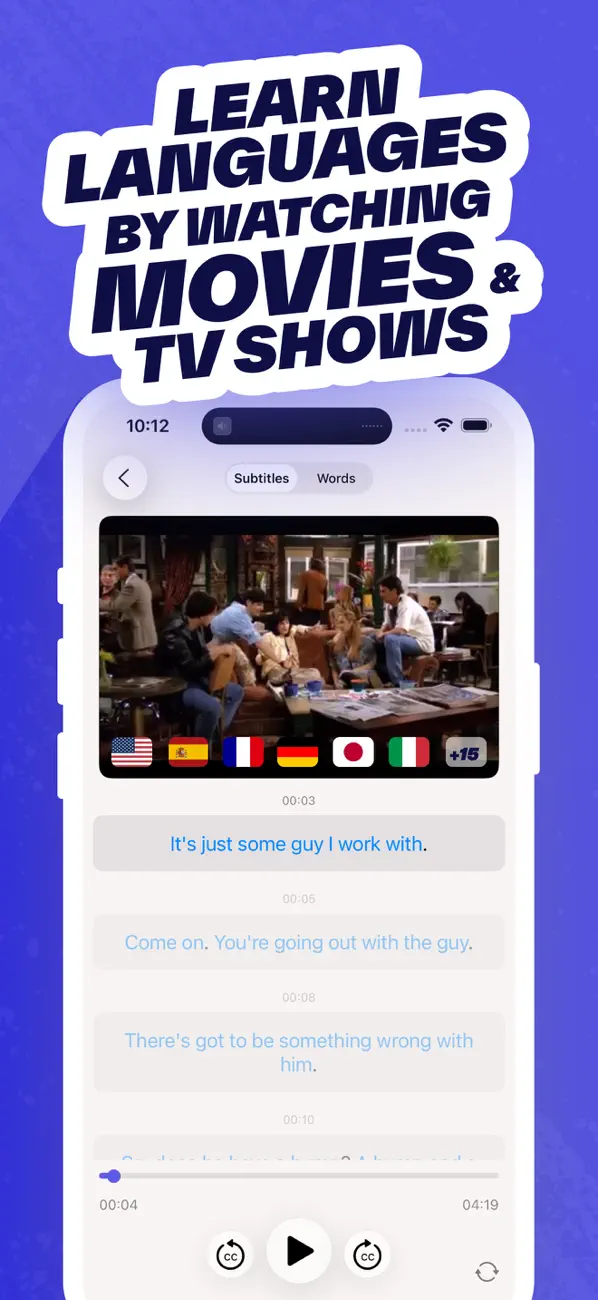
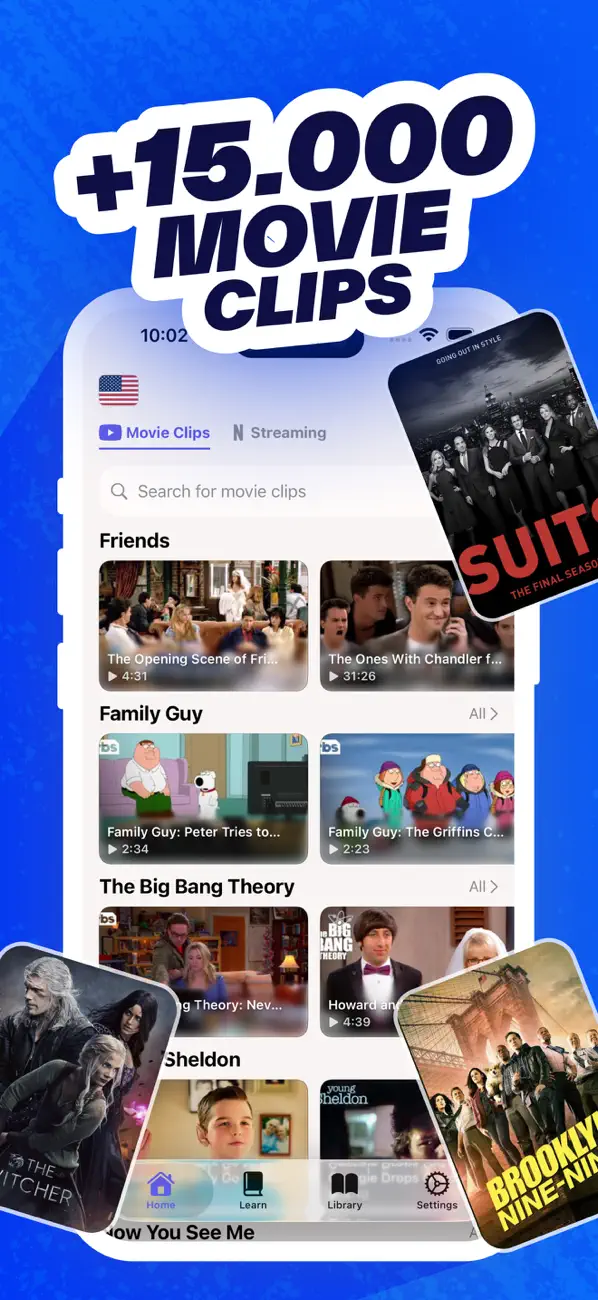
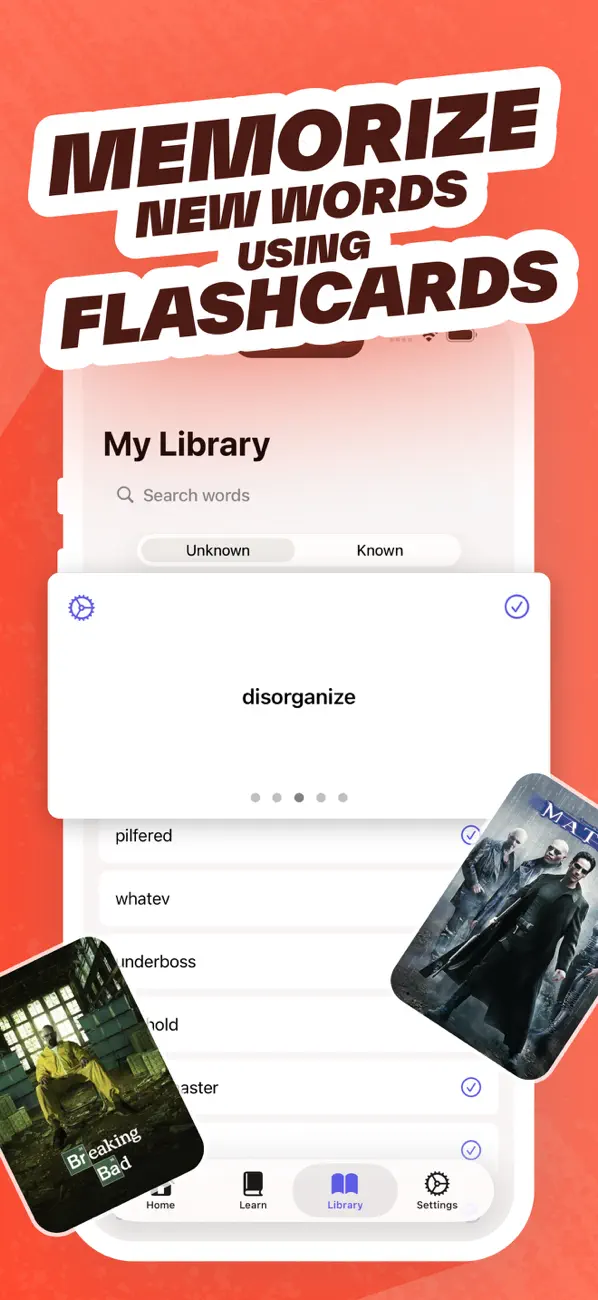
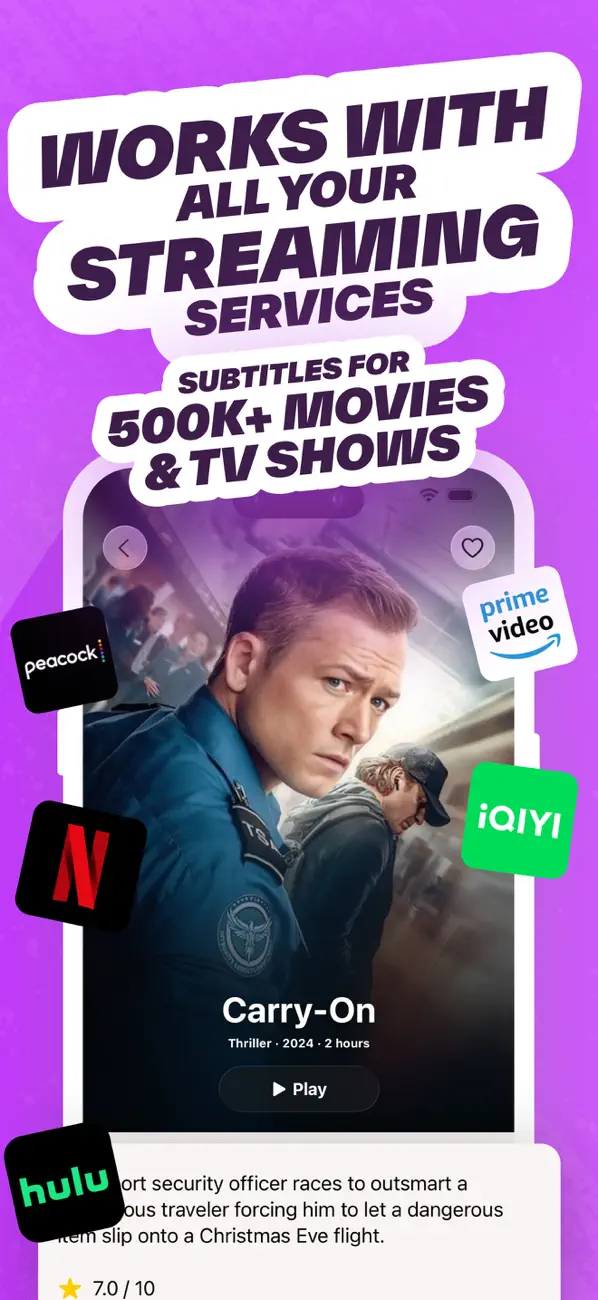
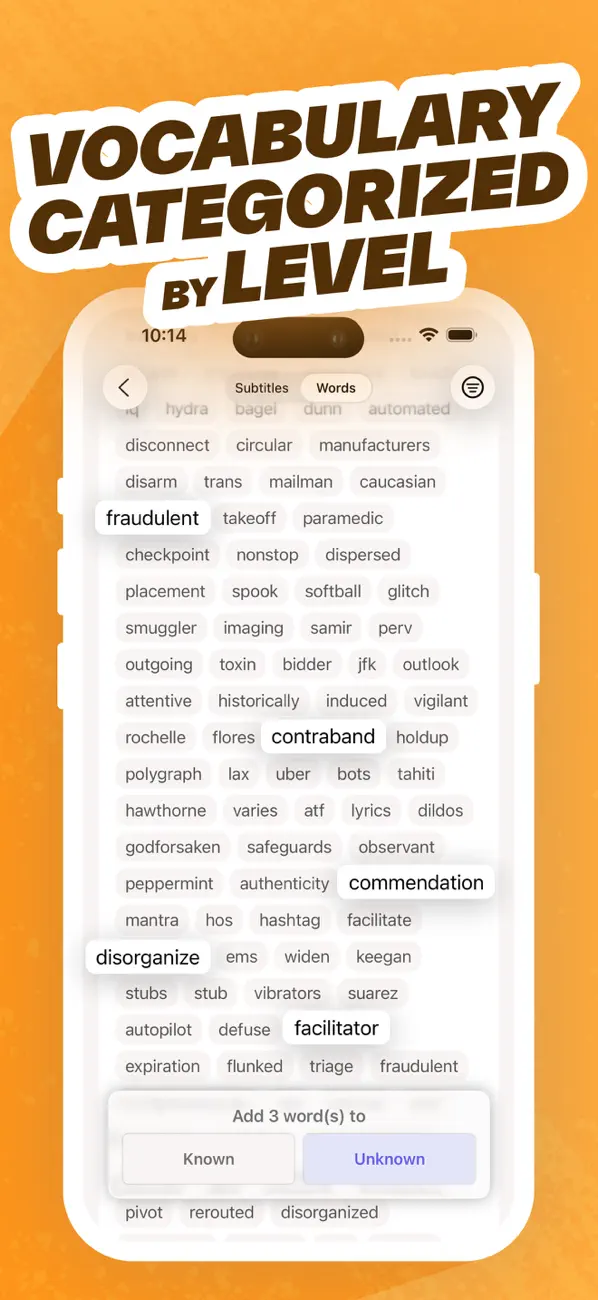
Wordy takes a different approach to language learning: instead of artificial exercises, you learn from real movies and TV shows. Open the app, pick a lesson, and watch a short clip from a real film or series. The app highlights the new words, shows you their meaning, and quizzes you on them right after. Everything is automatic: it selects clips at your level, tracks which words you know, and schedules reviews using spaced repetition. You never need to create flashcards, search for content, or decide what to study next.
The idea is backed by solid research. Webb & Rodgers (2009) found that popular TV series expose learners to 95% of the most frequent word families, and Krashen's Input Hypothesis established that comprehensible, authentic input is the primary driver of language acquisition. Wordy puts this into practice with 15,000+ clips across 20+ languages, each tagged by difficulty level from A1 beginner to C2 advanced.
The app organizes 9,000 words per language into a structured progression, so you are not just watching random scenes. You are building vocabulary systematically while hearing how native speakers actually talk. The Chrome extension lets you learn from any video on the web, turning Netflix or YouTube into a study session.
With 300,000+ users and a 4.8/5 App Store rating, Wordy fills the gap that traditional apps miss. Duolingo teaches you grammar through games, Babbel walks you through textbook dialogues, but neither exposes you to the speed, slang, and rhythm of real native speech. That is what Wordy does.
Bottom line: If you want to understand real native speakers (not just textbook sentences), Wordy is the strongest option. With 15,000+ clips, structured vocabulary, and spaced repetition quizzes, it covers listening, vocabulary, and review in one app.
Pros
- 15,000+ real movie and TV show clips
- Hear native speakers at natural speed from day one
- Quizzes built from scenes you just watched
- 9,000 words per language organized by level
Cons
- Not a full grammar course
- Clip library varies by language
- No live tutoring feature
Duolingo
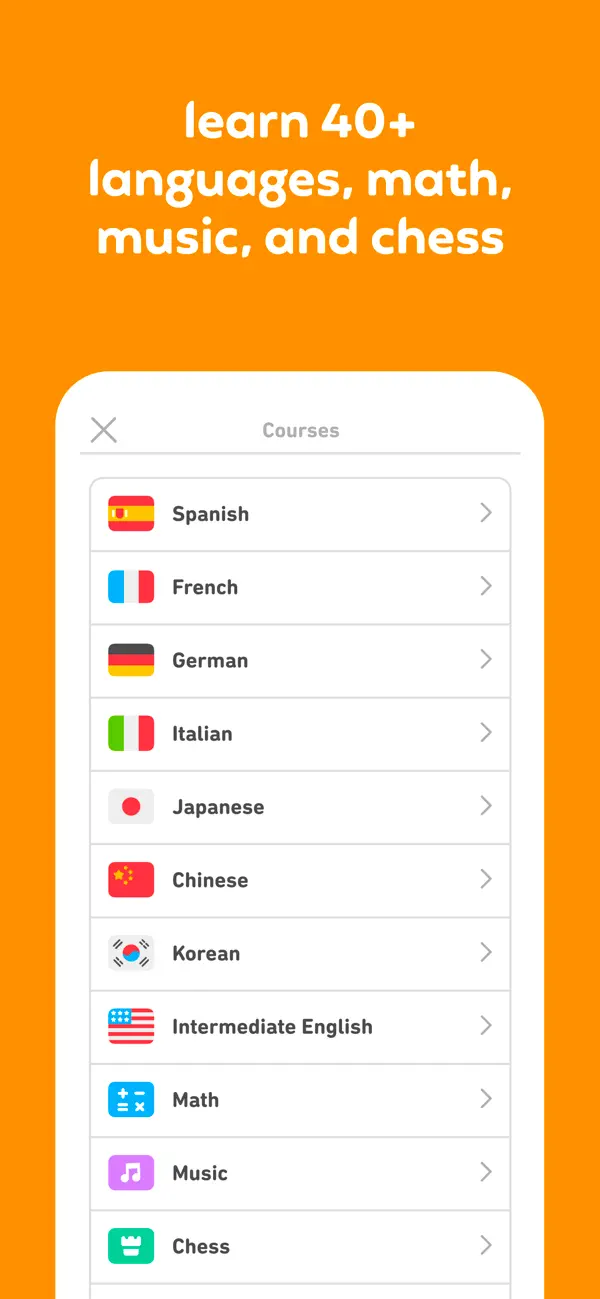
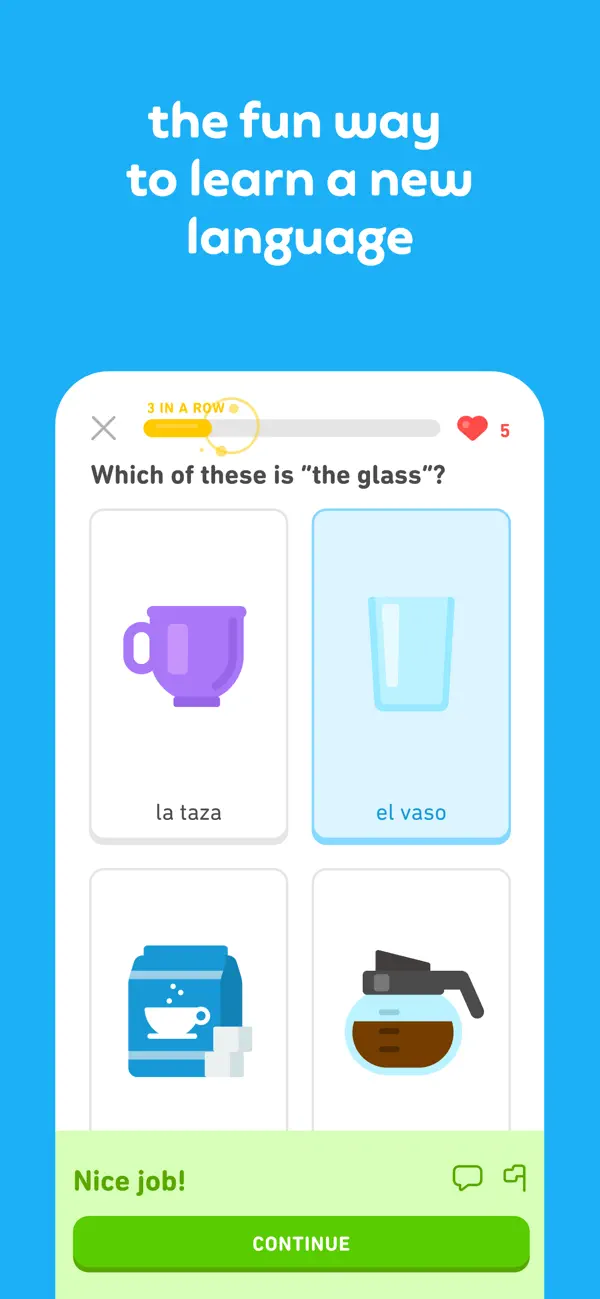
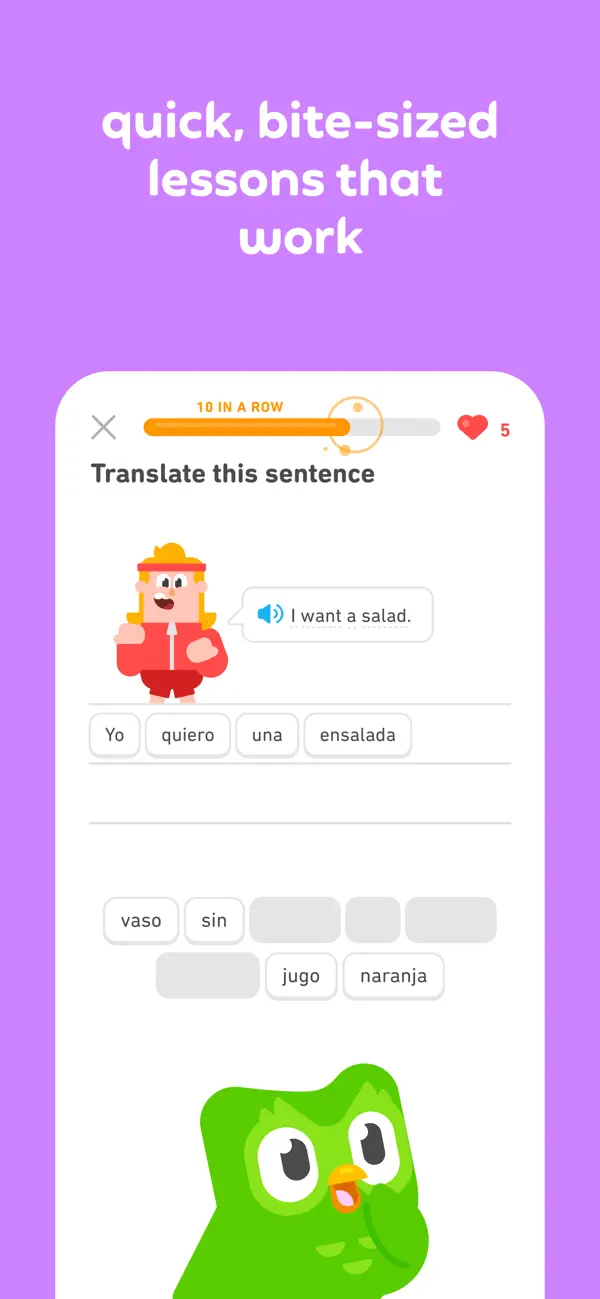
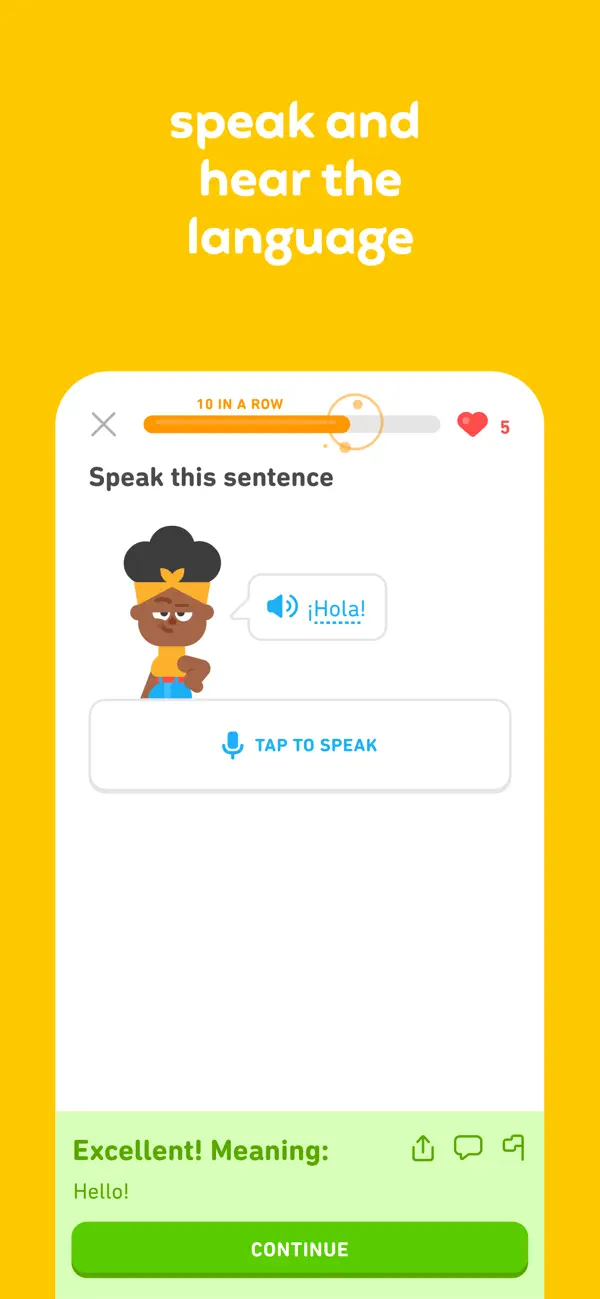
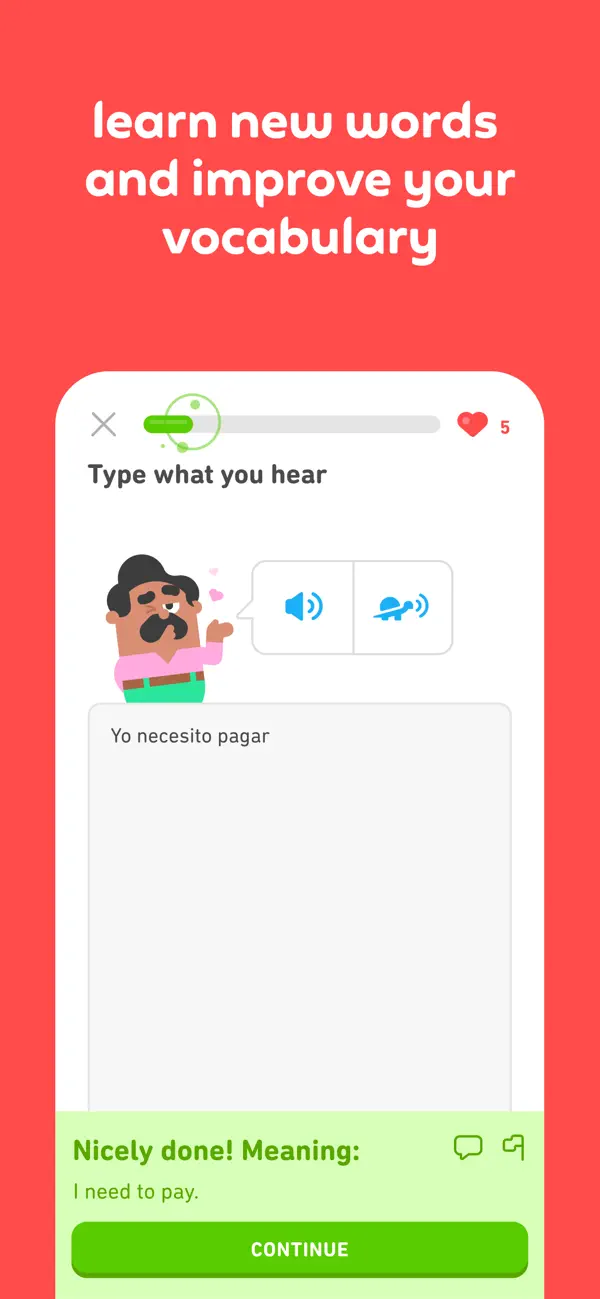
Duolingo is the most downloaded language app in the world, with over 500 million installs and a daily active user base that rivals some social media platforms. The secret is gamification done right. Every lesson feels like a mini-game: match words, fill blanks, listen and type. The streak system creates a powerful daily habit. Miss a day and your owl mascot guilt-trips you back. XP points and leaderboards add a competitive edge that keeps millions logging in.
A 2023 study by the City University of New York found that 34 hours of Duolingo equals roughly one university semester of language study for reading and listening skills. That is impressive for a completely free app. The course library spans 40+ languages, including less common ones like Hawaiian, Navajo, and High Valyrian.
Where Duolingo falls short is in preparing you for real conversations. The sentences you practice are often artificial ("The elephant drinks coffee"), and the app relies heavily on translation exercises rather than comprehension of natural speech. You rarely hear native speakers at natural speed, and the speaking exercises use basic speech recognition rather than evaluating fluency. Advanced learners often hit a ceiling around B1 level, where the gamified format cannot replicate the complexity of real-world language use.
Bottom line: Duolingo is the best free starting point for complete beginners. The gamification works well for building a daily habit. But if your goal is understanding native speakers or holding real conversations, you will need to supplement it with authentic input from movies, podcasts, or conversation partners.
Pros
- Completely free core experience
- 40+ languages available
- Addictive streak system keeps you coming back
- Bite-sized lessons fit any schedule
Cons
- Repetitive sentence drills
- Limited real-world listening practice
- Ads in free version can interrupt flow
- Advanced learners hit a ceiling quickly
Babbel
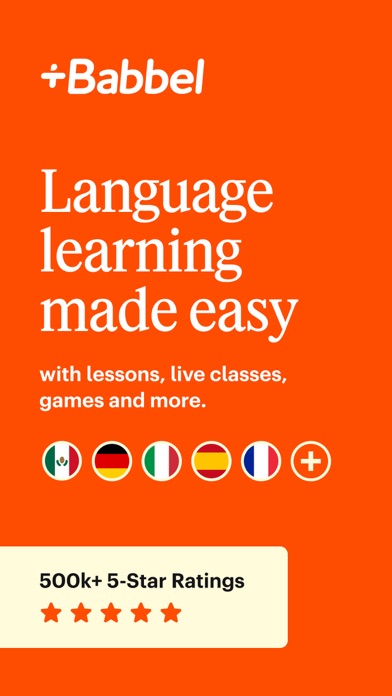
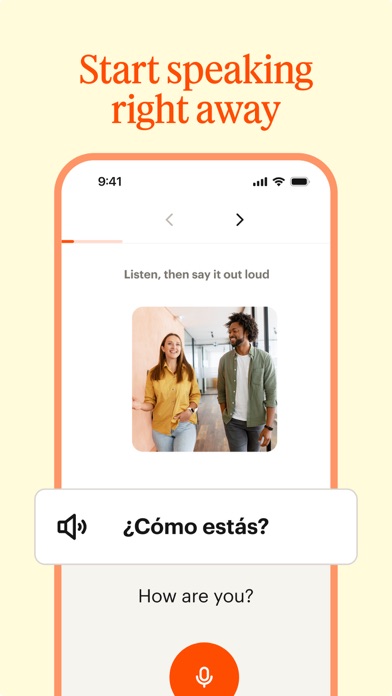
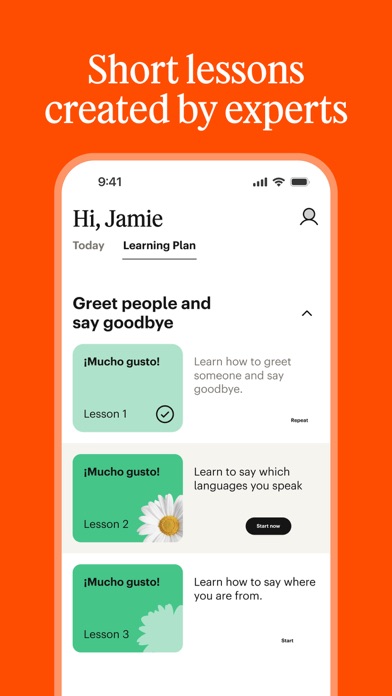
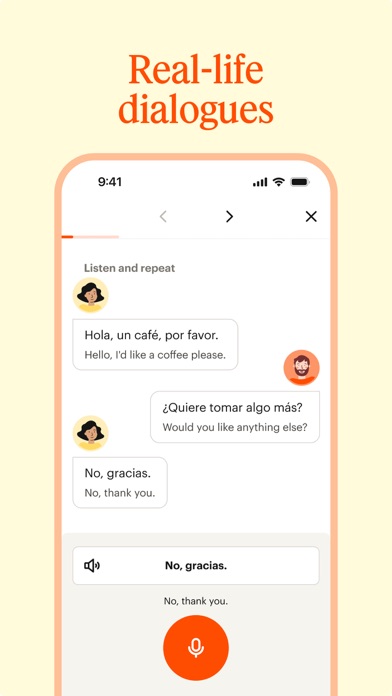
Babbel feels like having a private tutor who plans your lessons. Every course is designed by a team of over 150 linguists and organized around real-life conversation topics: ordering food, navigating airports, making small talk at work, handling emergencies abroad. From the first lesson, you are forming complete sentences rather than memorizing isolated words.
The speech recognition feature gives pronunciation feedback, letting you practice speaking before you ever talk to a real person. It is not as accurate as a human teacher, but it builds confidence. Babbel also offers review sessions that use spaced repetition to bring back material you are about to forget, and the podcast-style audio lessons are a nice addition for passive learning during commutes.
Where Babbel stands out is course quality. The lessons feel thoughtfully sequenced, building on each other in a logical progression. If Duolingo is a game, Babbel is a university course reimagined for your phone. The 20-day money-back guarantee also signals confidence in their product.
The trade-offs are real, though. Only 14 languages are available, which is a fraction of what Duolingo or Drops offer. There is no free tier after the trial period, so you are paying from day one. And while the content is well-structured, some users find it formulaic: lessons across different languages follow very similar patterns, which can feel repetitive if you are learning multiple languages.
Bottom line: Babbel is the best choice for learners who want a structured, curriculum-driven approach with clear progression. It excels at getting you from zero to basic conversation quickly, but you will need to supplement with real-world listening practice for fluency.
Pros
- Courses designed by linguists
- Conversation-focused from lesson one
- Speech recognition for pronunciation
- 20-day money-back guarantee
Cons
- Only 14 languages
- No free tier beyond trial
- Content can feel formulaic
- Less engaging than gamified apps

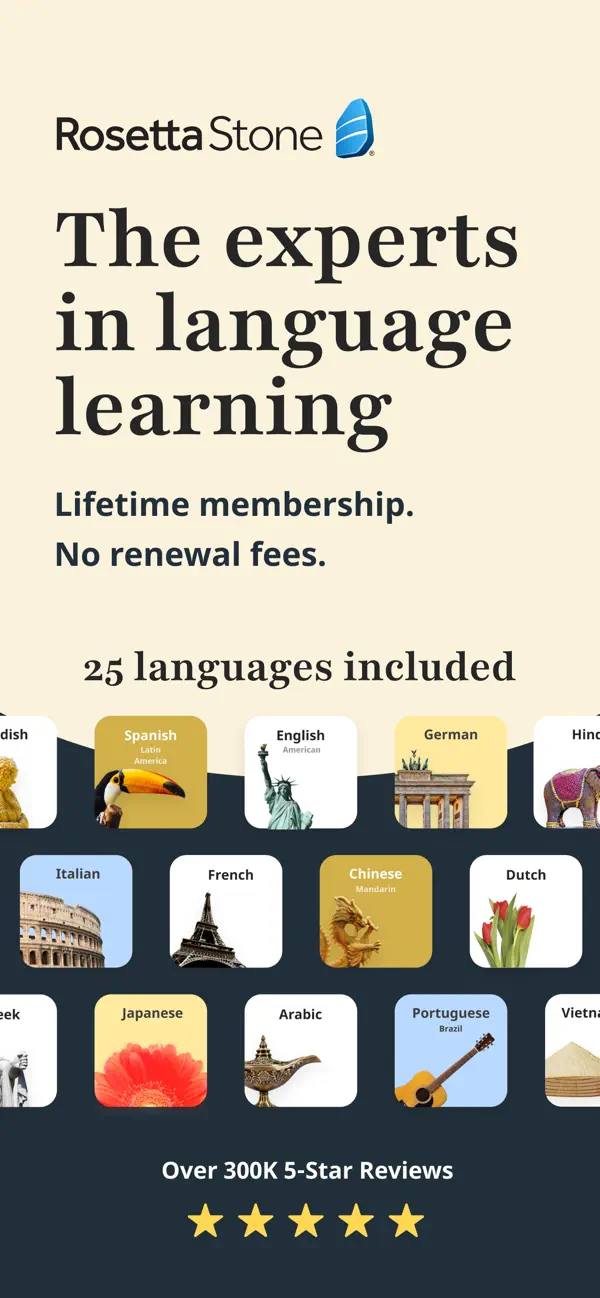
Rosetta Stone
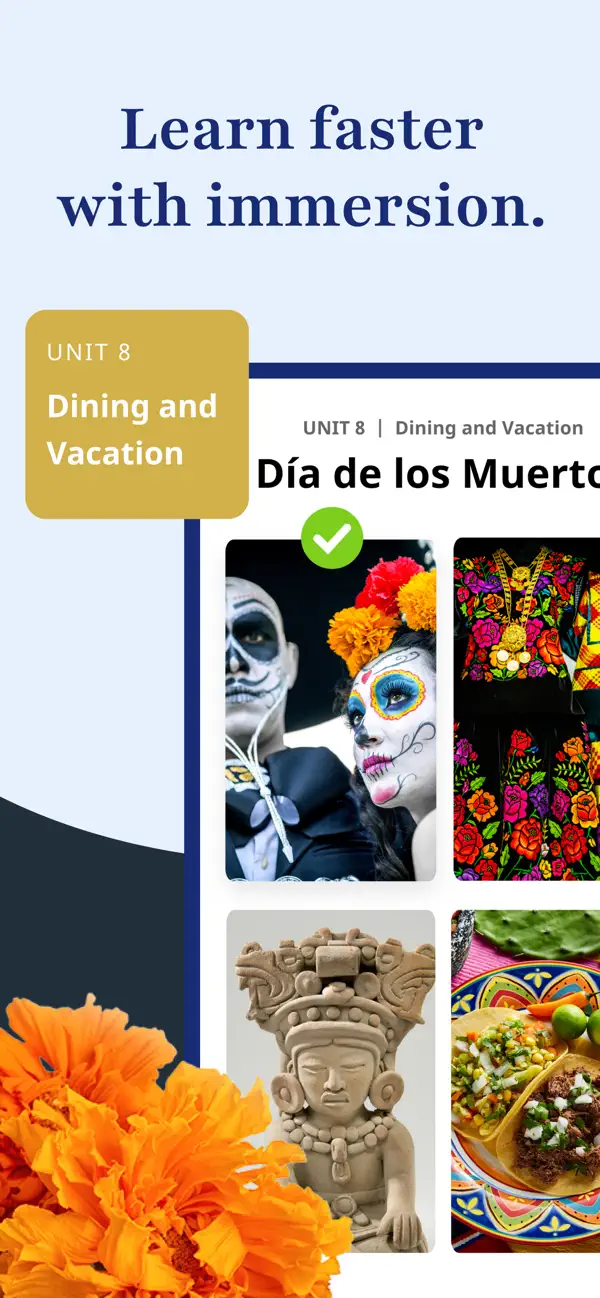
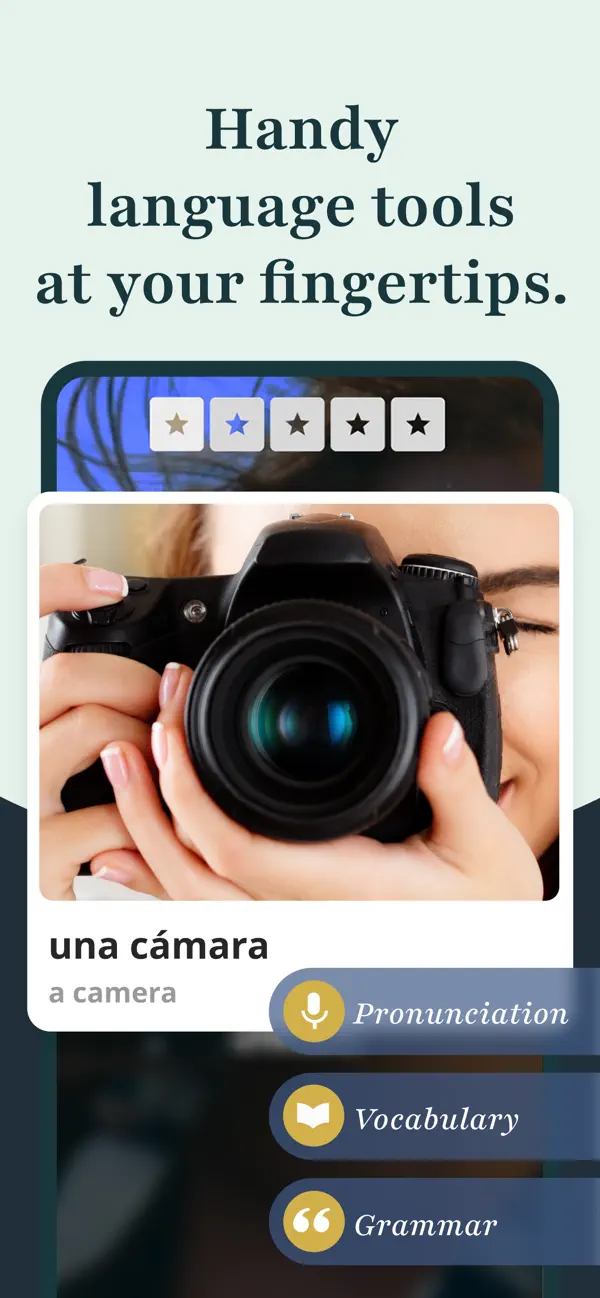
Rosetta Stone pioneered the "learn like a child" approach back in 1992, and the core philosophy has not changed: no translations, no grammar explanations, just images paired with target-language audio. You see a photo of a man running and hear "Der Mann läuft." Your brain learns to associate meaning directly with the foreign language, skipping the mental translation step.
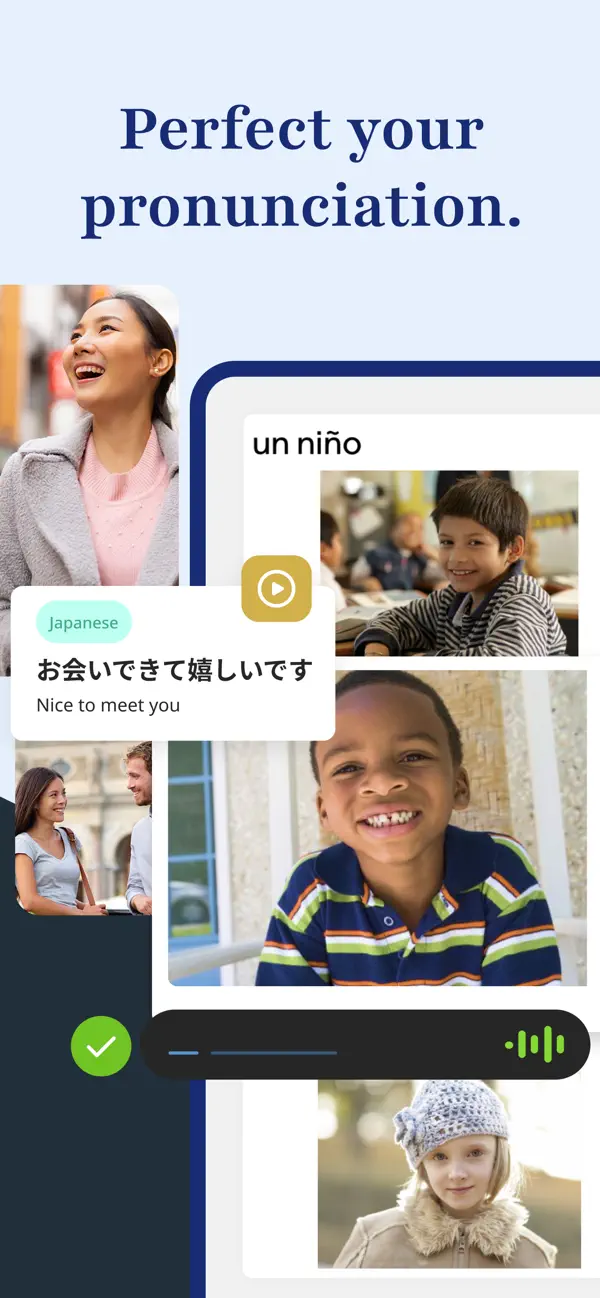
Their TruAccent pronunciation technology is one of the best in the industry. It analyzes your speech against native speaker recordings and gives real-time feedback on accuracy. For pronunciation-sensitive languages like Mandarin or French, this is a real advantage. The immersion method also builds strong intuitive comprehension: you start thinking in the language rather than translating from English.
The frustrations are equally real. Without any grammar explanations, you are left guessing at rules. Why is it "der Mann" but "die Frau"? Rosetta Stone will not tell you. For languages with complex grammar systems like German, Japanese, or Russian, this trial-and-error approach can feel painfully slow. The interface also feels dated compared to newer competitors, and the pricing ($12-15/month or a $179 lifetime purchase) is among the highest in the market.
The lifetime purchase option is worth mentioning: if you plan to study for years, paying once saves money compared to monthly subscriptions. But most learners will find that newer apps offer similar or better experiences at lower prices.
Bottom line: Rosetta Stone works best for visual learners studying languages with straightforward grammar. If you need explanations and structure, look at Babbel instead. If you want authentic immersion, movie-based apps provide more natural input.
Pros
- Full immersion method (no translations)
- TruAccent pronunciation technology
- Lifetime purchase option available
- Strong for visual learners
Cons
- Expensive compared to competitors
- Immersion method frustrates some learners
- Dated interface compared to newer apps
- Limited speaking practice with real people
Busuu
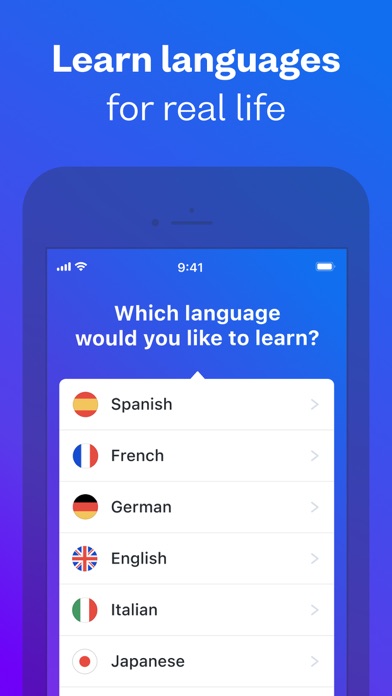
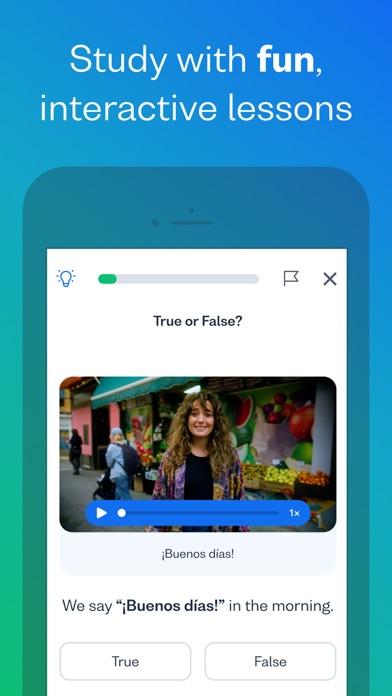
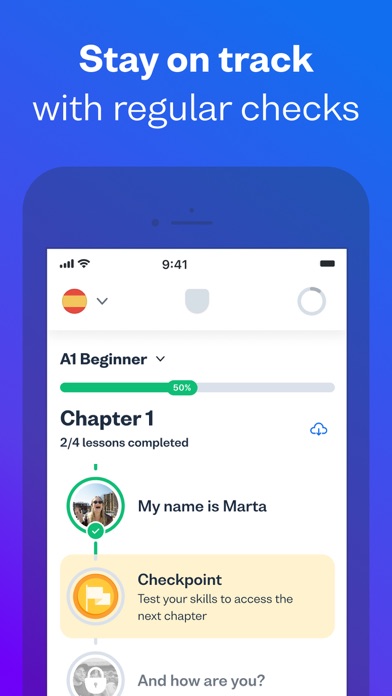
Busuu sits in an interesting middle ground: it combines structured courses like Babbel with a community feedback system that no other major app offers. The courses align to the CEFR framework (A1 through B2), which means your progress maps directly to internationally recognized proficiency levels. If you need a certificate for work or university, Busuu's official CEFR certification through McGraw-Hill is a genuine differentiator.
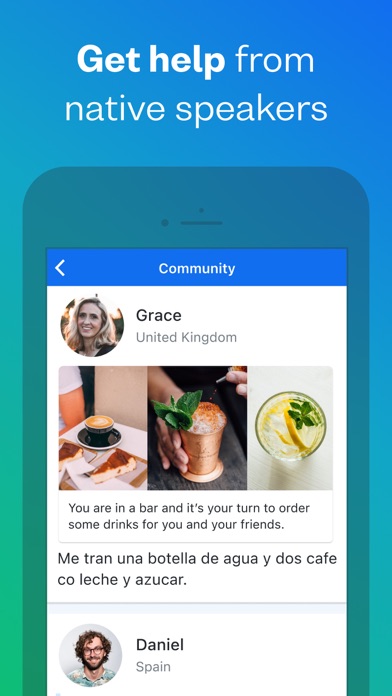
The standout feature is peer correction. After completing an exercise, you submit your writing or a voice recording, and native speakers in the community review it. You might write a short paragraph about your weekend in Spanish, and a native Spanish speaker in Buenos Aires corrects your grammar and suggests more natural phrasing. In return, you correct someone else's English. This feedback loop is effective for building confidence in writing and speaking.
The study plan feature deserves mention too. Tell Busuu your goal ("reach B1 in Spanish") and how many minutes per day you can study, and it builds a personalized schedule. The offline mode is a practical bonus for studying on flights or commutes without Wi-Fi.
The limitations: community feedback quality varies a lot. Some corrections are detailed and helpful, others are a thumbs-up with no explanation. Only 13 languages are available, and the free tier is so limited that it functions more as a demo than a usable product. The app also feels less polished than Duolingo or Babbel. The design is functional but not inspiring.
Bottom line: Busuu is the best app for learners who want structured courses with real human feedback. The CEFR certification adds practical value. But the community-dependent model means your experience is only as good as the people reviewing your work.
Pros
- CEFR-aligned course structure
- Native speaker corrections on exercises
- Offline mode for travel
- Study plan adapts to your schedule
Cons
- Community feedback quality varies
- Only 13 languages
- Free tier is very limited
- Less polished than Duolingo or Babbel
Want to understand native speakers, not just textbook sentences? Wordy teaches you vocabulary through 15,000+ real movie and TV show clips. The app picks scenes at your level and quizzes you automatically. Try it free on iOS, Android, or as a Chrome extension.

Memrise
Memrise built its reputation on one thing: making vocabulary stick. The spaced repetition algorithm is among the best available, tracking exactly which words you struggle with and resurfacing them at the optimal moment for long-term retention. If you have an exam in two weeks and need to cram 500 words, Memrise is your best bet.
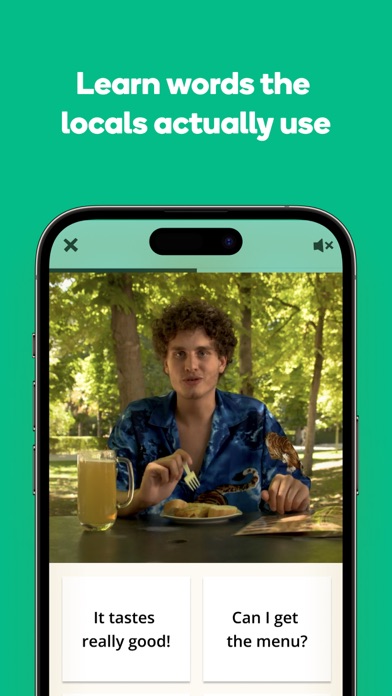
The native speaker video clips are a real differentiator. Instead of robotic text-to-speech, you see and hear actual people saying words and phrases in everyday contexts. A shopkeeper in Tokyo saying "いらっしゃいませ," a taxi driver in Mexico City asking "¿A dónde va?" These micro-encounters give you a feel for how the language sounds in the real world. It is not as immersive as full movie scenes, but it is far more authentic than synthesized audio.
The community-created course library is both a strength and a weakness. Users have built courses for everything from medical terminology to Tolkien's Elvish. The variety is unmatched, but quality control is nonexistent. Some community courses are excellent, others are full of errors. The official Memrise-produced courses are reliable but cover fewer topics.
Recent updates have added an AI chatbot for conversation practice, though it feels like an add-on rather than a core feature. The interface can feel cluttered, especially compared to Duolingo's clean design. And grammar instruction remains thin. Memrise teaches you words, not how to combine them into sentences.
Bottom line: Memrise is the strongest pure vocabulary tool available. Pair it with a grammar-focused app like Babbel or a comprehension app like Wordy, and you cover a lot of ground. On its own, it will give you a large vocabulary but limited ability to use it.
Pros
- Native speaker video clips
- Strong spaced repetition algorithm
- User-created content expands library
- Good for vocabulary cramming
Cons
- Grammar instruction is thin
- User content quality is inconsistent
- Interface can feel cluttered
- Full features require subscription
Pimsleur
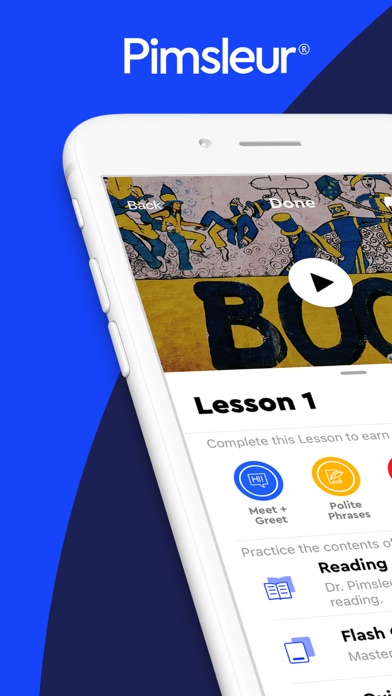
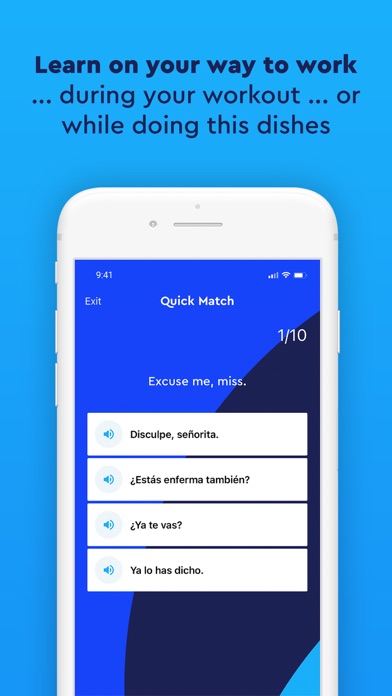
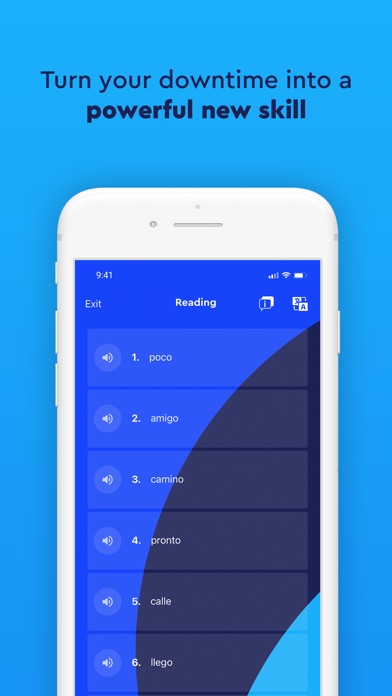
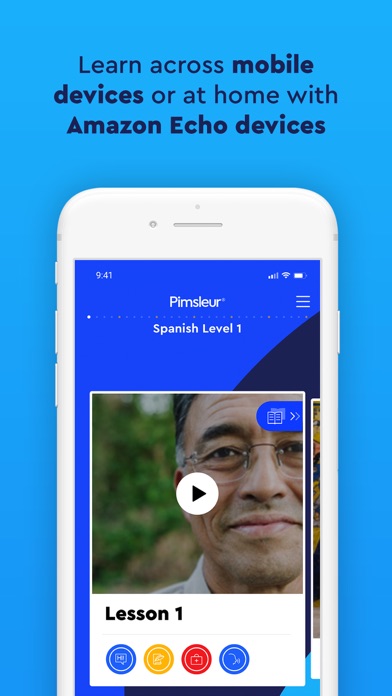
Pimsleur is built for your commute. Each lesson is exactly 30 minutes of pure audio: a native speaker says a phrase, you repeat it, the lesson moves on and circles back to test you later. This graduated interval recall method (prompting you to recall words at scientifically timed intervals) is one of the most research-backed techniques in language learning. Dr. Paul Pimsleur developed the method in the 1960s, and it has held up remarkably well.
The result is that after 30 lessons, most learners can hold a basic conversation. Not read a newspaper, not write an email, but actually speak and understand spoken responses. For a purely audio-based system, that is impressive. The method forces active recall rather than passive recognition, which is why Pimsleur graduates often report stronger speaking confidence than users of screen-based apps.
With 51 languages, Pimsleur has one of the widest selections available, including less-common options like Dari, Ojibwe, and Pashto. Each language typically offers 4-5 levels (150 lessons), taking you from complete beginner to upper-intermediate.
The downsides are significant, though. At $15-20/month, Pimsleur is one of the most expensive options. There is zero reading or writing practice. If you need to read signs, menus, or text messages in your target language, Pimsleur will not help. The lessons also feel rigid and scripted. You cannot skip ahead, revisit specific phrases, or customize the pace. And because the method was designed for audio cassettes in the 1960s, the app sometimes feels like a digital wrapper around an analog product.
Bottom line: Pimsleur is the best app for building speaking and listening skills through audio alone. It is ideal for commuters and people who hate staring at screens. But you will need a separate tool for reading, writing, and expanding vocabulary beyond conversational basics.
Pros
- Audio-based learning works anywhere
- Excellent for pronunciation and listening
- Research-backed graduated interval recall
- 51 languages available
Cons
- Expensive at $15-20/month
- No reading or writing practice
- Lessons feel rigid and scripted
- Slow progression for some learners

Drops
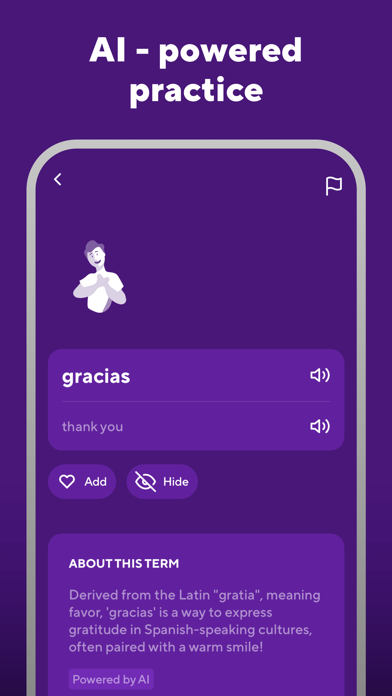
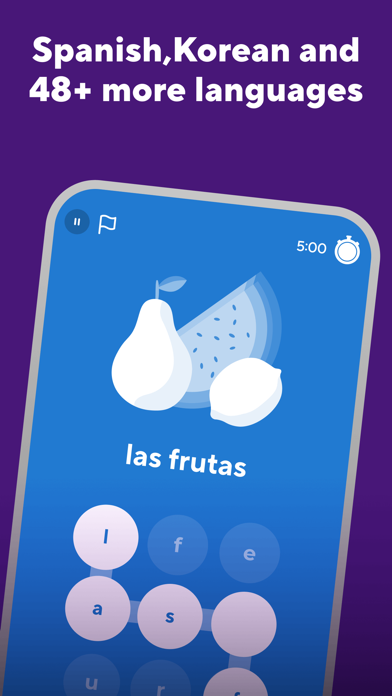
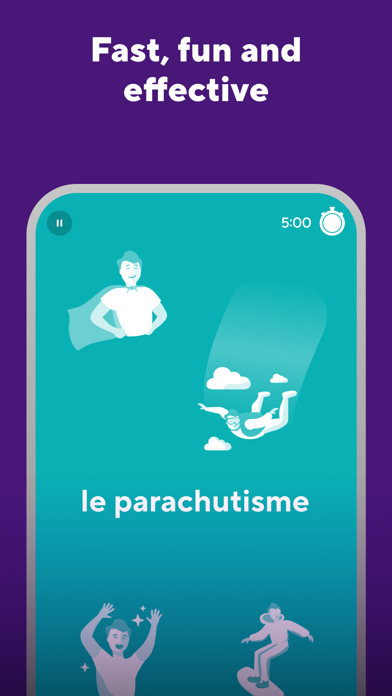
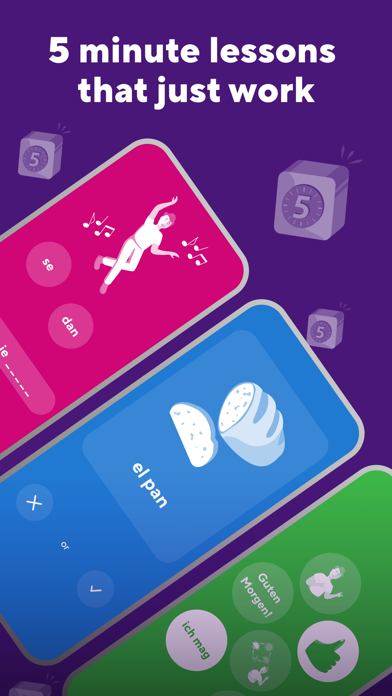
Drops strips language learning down to one thing: vocabulary. And it does that one thing beautifully. The app is arguably the best-designed language tool on the market: every interaction feels smooth, every illustration is hand-crafted, and the swipe-based word games are fun. Five-minute sessions are the default, which is both the hook and the philosophy. Short enough that you never skip a day, focused enough that you actually learn.
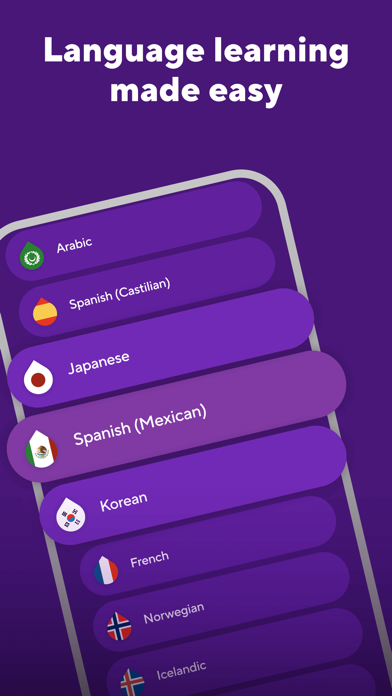
The language coverage is extraordinary. With 50+ languages, Drops includes options you will not find anywhere else: Maori, Ainu, Hawaiian, Samoan, Tagalog, and dozens more. If you are studying a less-common language, Drops might be one of your only app-based options.
The free tier limits you to one 5-minute session per day. It sounds restrictive, but it is actually a clever design choice that prevents burnout and forces consistency over intensity. Premium unlocks unlimited sessions and removes ads, but many users find the free tier sufficient for daily vocabulary building.
The constraint is also the core limitation. Drops teaches individual words, not sentences. There is no grammar, no conversation practice, no listening comprehension, no reading. You will learn that "Küche" means "kitchen" in German, but not how to say "The kitchen is on the left." Vocabulary without context is harder to retain and harder to use in real situations.
Bottom line: Drops is the most beautiful vocabulary app available and covers more languages than almost any competitor. Use it as a 5-minute daily supplement alongside a more complete app, never as your only learning tool.
Pros
- Beautiful visual design
- 5 minutes/day keeps it manageable
- 50+ languages including rare ones
- Purely vocabulary-focused (does one thing well)
Cons
- No grammar, conversation, or reading
- Free tier limited to 5 minutes per day
- Vocabulary without context is hard to retain
- Not sufficient as a primary learning tool
italki
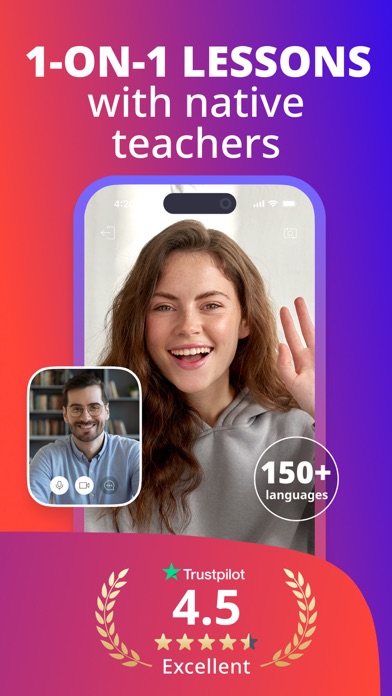
italki is not an app in the traditional sense. It is a marketplace connecting you with human tutors for 1-on-1 video lessons. And that distinction matters, because no app, no matter how advanced, can replicate the experience of a real conversation with a real person who adapts to your mistakes in real time.
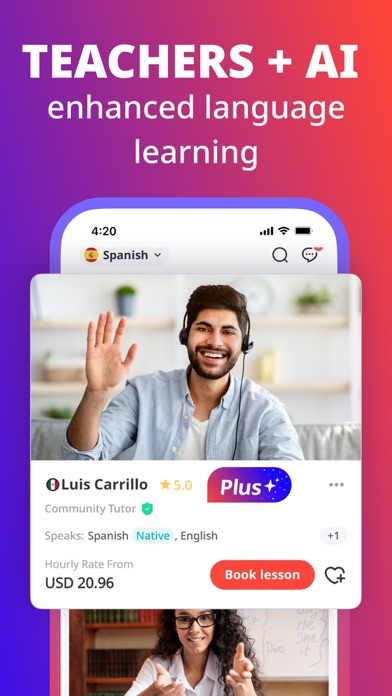
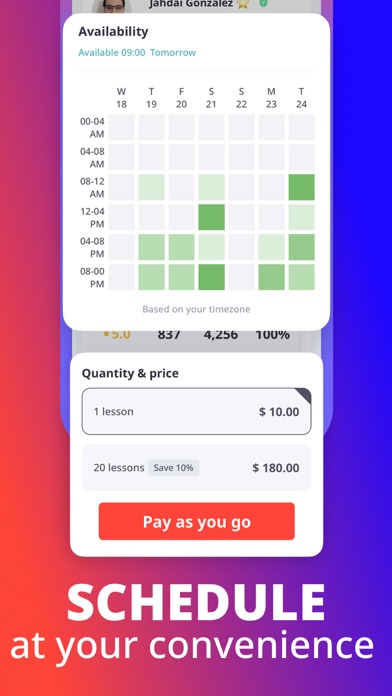
With 150+ languages and over 30,000 teachers worldwide, you can find a tutor for almost anything, from mainstream Spanish to endangered languages like Basque or Welsh. The pricing model is flexible: community tutors (native speakers without formal teaching credentials) charge $5-15/hour, while professional certified teachers charge $15-30+. You book individual lessons, so there is no subscription commitment.
The experience depends entirely on your teacher. A great tutor on italki will outperform any app by orders of magnitude. They can explain why you keep making the same mistake, adjust the difficulty in real time, and give you the kind of nuanced cultural context that no algorithm can provide. A mediocre tutor, on the other hand, will just chat aimlessly for an hour.
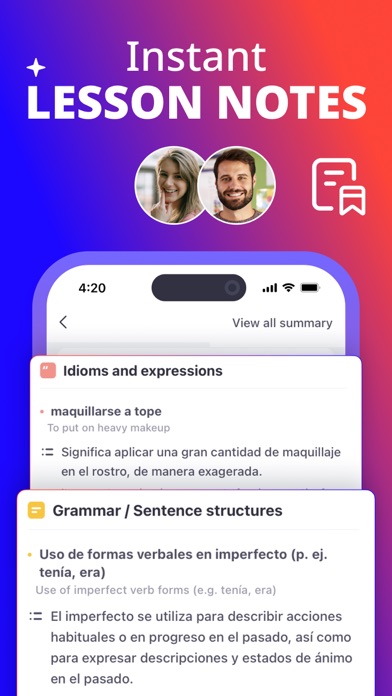
The platform includes a teacher rating system and student reviews to help you find the right fit. Most teachers offer a discounted trial lesson, so you can test several before committing. The built-in classroom has video chat, a shared notepad, and screen sharing.
The trade-off is friction. You need to schedule sessions, show up at a specific time, and pay per lesson. It requires more commitment than tapping through Duolingo on the couch. But for speaking fluency (the skill that apps struggle most to develop), nothing beats a human tutor.
Bottom line: italki is the best option for speaking practice and personalized instruction. Pair it with any self-study app (Duolingo for grammar, Wordy for listening, Memrise for vocabulary) and you have a complete learning system.
Pros
- Real human tutors for any language
- Flexible pay-per-lesson pricing
- Choose your own teacher and schedule
- Community tutors are affordable ($5-15/hr)
Cons
- No structured curriculum (depends on tutor)
- Quality varies between teachers
- Requires scheduling and commitment
- Not an app-based learning system

HelloTalk
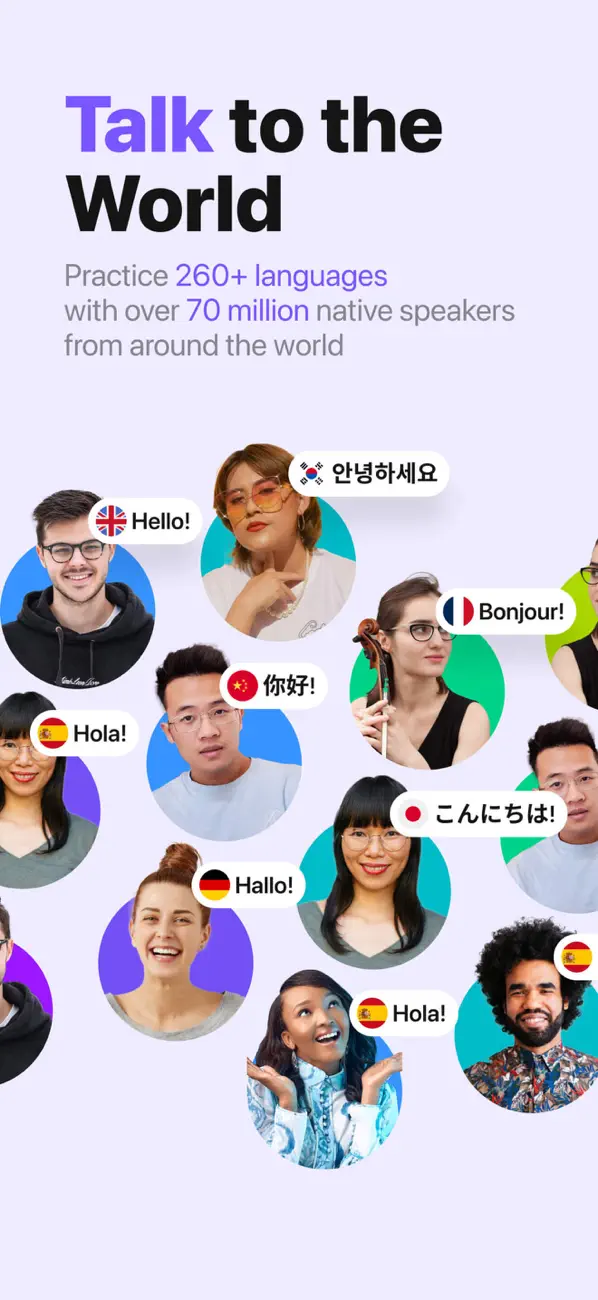
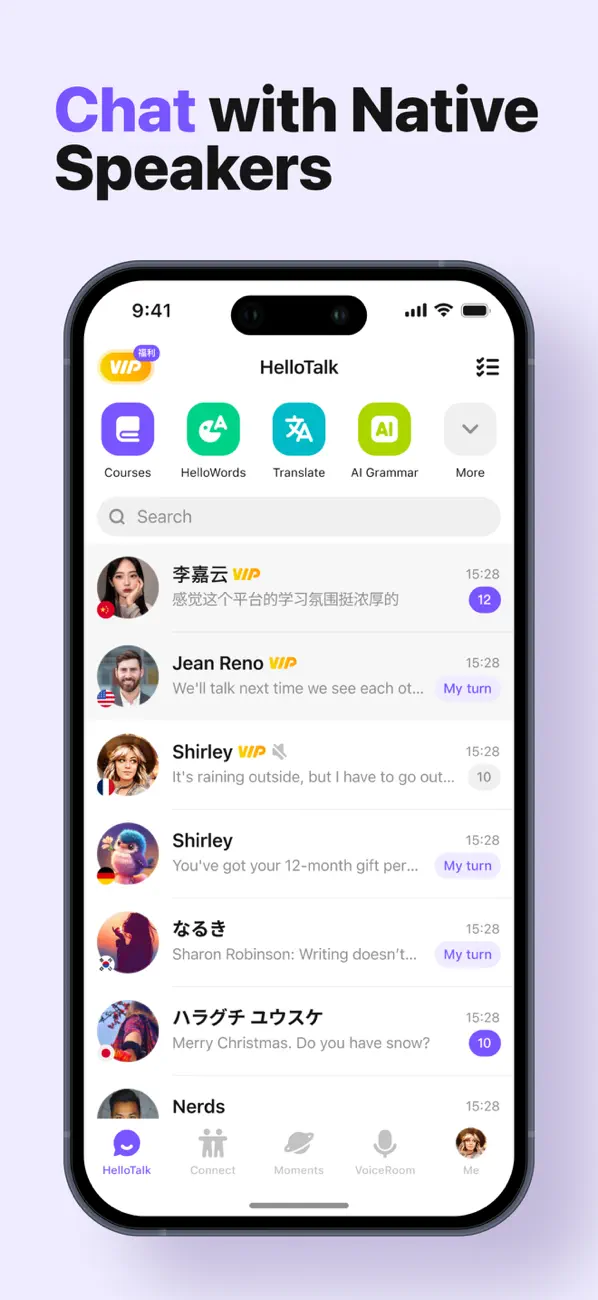
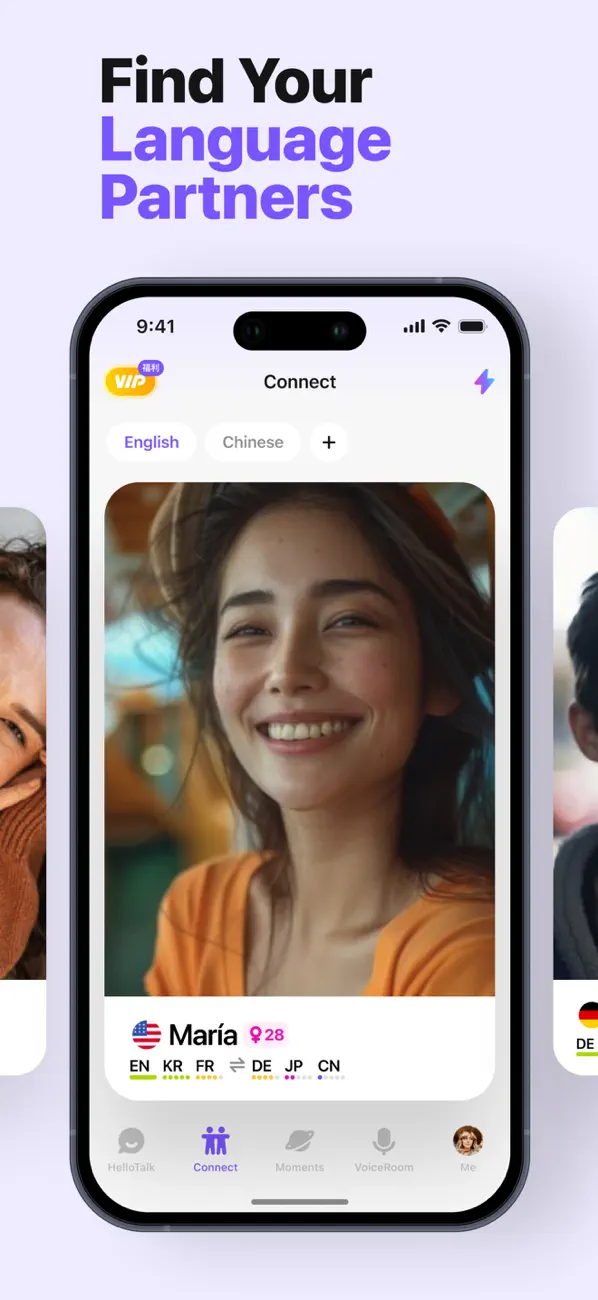
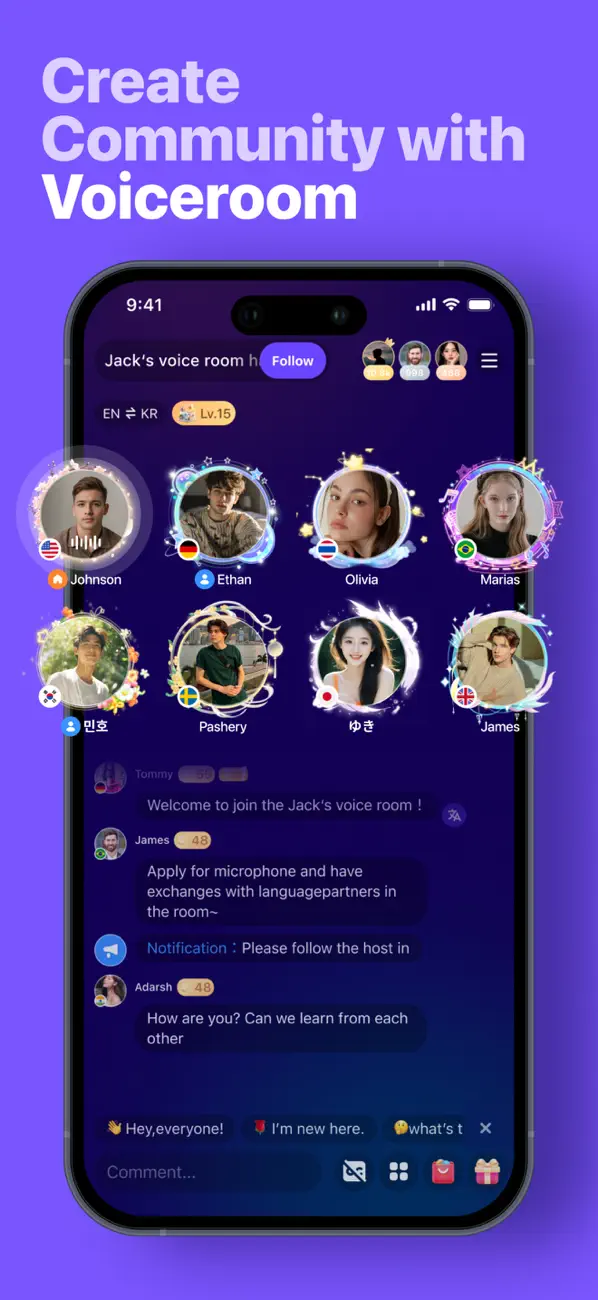
HelloTalk takes language learning out of the classroom and into real conversations. The concept is simple: you are paired with native speakers of your target language who want to learn your language. You teach each other. A Spanish speaker in Madrid practices English with you, while you practice Spanish with them. It is free, social, and (when it works) the most authentic practice you can get without traveling abroad.
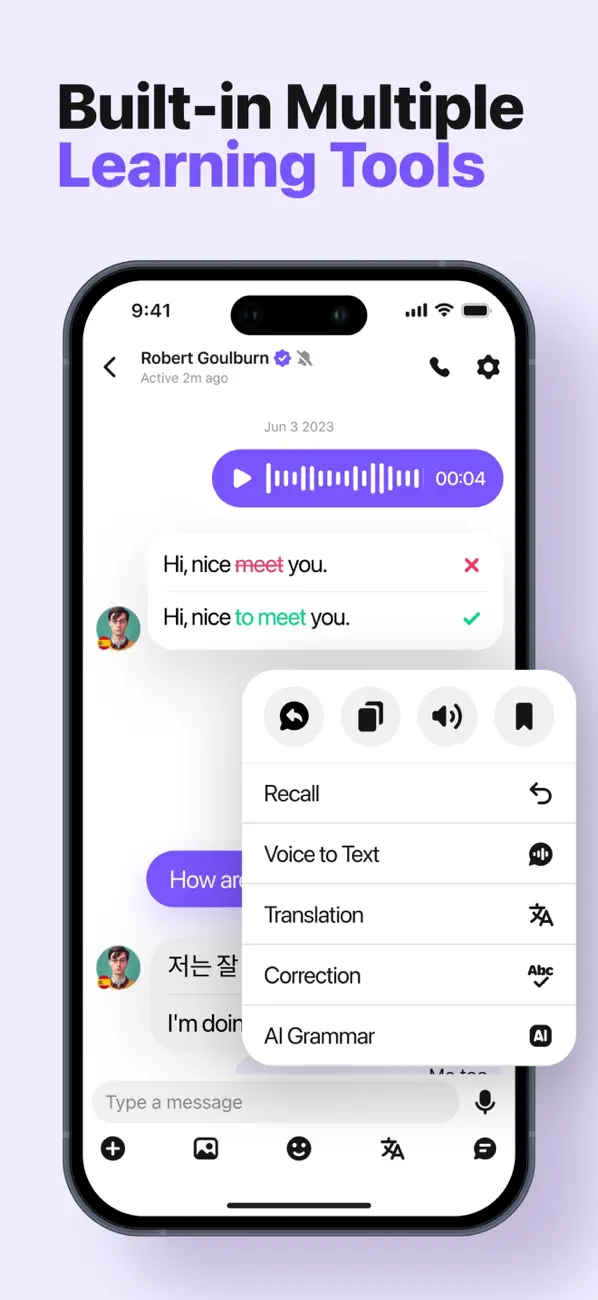
The app supports text, voice messages, voice calls, and video calls. Built-in correction tools let you tap on any message to fix grammar or suggest better phrasing, which turns every conversation into a mini-lesson. The "Moments" feature works like a language-learning social feed where you post in your target language and native speakers comment with corrections.
With 150+ languages and over 40 million users, finding a conversation partner is usually easy for popular languages. The AI-powered grammar correction and translation tools help bridge the gap when you get stuck mid-conversation.
The challenges are real, though. Finding committed exchange partners takes effort. Many conversations fizzle after a few messages. The platform has a well-known reputation for attracting users with non-language-learning motivations, which can be frustrating. And because there is no curriculum, your progress depends entirely on the quality and consistency of your partners. Some weeks you have great conversations; other weeks, silence.
The VIP subscription ($7/month) adds features like unlimited translations, advanced search filters, and the ability to see who visited your profile. The free tier is generous enough for most users, though.
Bottom line: HelloTalk provides the cheapest path to real conversation practice. It pairs perfectly with structured apps: use Duolingo or Babbel for grammar foundations, then practice what you have learned with real people on HelloTalk. Just be prepared to invest time in finding reliable partners.
Pros
- Free language exchange with native speakers
- Text, voice, and video chat options
- Built-in correction tools
- 150+ languages and massive user base
Cons
- Finding committed exchange partners takes effort
- Some users treat it as a dating app
- Learning depends on partner quality
- No structured lessons or curriculum
How to Choose the Right App
There is no single best app. The right choice depends on your learning style and goals:
- "I want to build a daily habit": Start with Duolingo. The gamification keeps you consistent.
- "I want to learn through entertainment, not boring drills": Use Wordy. You learn vocabulary from real movie and TV show clips, so it never feels like studying.
- "I want a structured course": Choose Babbel or Rosetta Stone for guided progression.
- "I want to speak with real people": Book tutors on italki or find exchange partners on HelloTalk.
- "I want to build vocabulary fast": Pair Memrise or Drops with one of the above.
The most effective learners combine two or three tools. A common pattern: use a structured app (Duolingo or Babbel) for grammar foundations, add authentic input through movies (Wordy) or podcasts, and practice speaking with a tutor (italki) or exchange partner (HelloTalk).

Do Language Learning Apps Actually Work?
Short answer: yes, with caveats.
A growing body of research supports app-based learning as effective for vocabulary acquisition and basic grammar. The 2023 CUNY study found Duolingo comparable to university instruction for reading and listening at beginner levels. Krashen's Input Hypothesis (1985) established that comprehensible input, the kind you get from watching movies or reading at your level, is the primary driver of language acquisition.
Where apps fall short is speaking fluency. No amount of tapping and swiping replaces the experience of holding a real conversation. The research consensus: apps are excellent for building the foundation (vocabulary, grammar patterns, listening comprehension), but speaking practice with humans remains irreplaceable for fluency.
The smartest approach is to think of apps as one part of a broader learning ecosystem, not the whole thing.
Start Learning Today
Ready to try learning languages through real movies and TV shows? Download Wordy and start watching clips in 20+ languages. You can also explore our language learning guides and pick a language to learn.
Frequently Asked Questions
What is the best free language learning app?
Can you become fluent using only an app?
What is the best app for learning with movies and TV shows?
Which language learning app is best for beginners?
How much do language learning apps cost?
Sources & References
- Godwin-Jones, R. (2024). Mobile-Assisted Language Learning and Authentic Input. Language Learning & Technology, 28(1), 1-18.
- Vesselinov, R. & Grego, J. (2023). The Effectiveness of Duolingo: A Research Report. City University of New York.
- Webb, S. & Rodgers, M.P.H. (2009). The Lexical Coverage of Movies. Applied Linguistics, 30(3), 407-427.
- Krashen, S. (1985). The Input Hypothesis: Issues and Implications. Longman.
Start learning with Wordy
Watch real movie clips and build your vocabulary as you go. Free to download.


