Learn Japanese With Anime: A Practical Guide to What Works (and What Doesn’t)
Quick Answer
You can learn real Japanese with anime, but only if you treat it as listening and vocabulary training, not as a script to imitate. The most effective approach is clip-based study: learn high-frequency phrases, shadow short lines, and track words with spaced repetition, while avoiding exaggerated character speech and overly casual register in real life.
You can learn Japanese with anime if you use it as structured listening and vocabulary practice, not as a script to copy blindly. The winning method is to study short clips repeatedly, learn the phrases that match real-life situations, and build a review system so words from episodes actually stick.
| English | Japanese | Pronunciation | Formality |
|---|---|---|---|
| Hello (casual) | やあ | YAH | casual |
| Hello (standard) | こんにちは | kohn-nee-CHEE-wah | polite |
| Thanks | ありがとう | ah-ree-GAH-toh | casual |
| Thanks (polite) | ありがとうございます | ah-ree-gah-TOH goh-zah-ee-MAHS | polite |
| Sorry / excuse me | すみません | soo-mee-MAH-sen | polite |
| See you | またね | MAH-tah-neh | casual |
| Goodbye (standard) | さようなら | sah-YOH-nah-rah | formal |
| I love you | 愛してる | eye-shee-TEH-roo | slang |
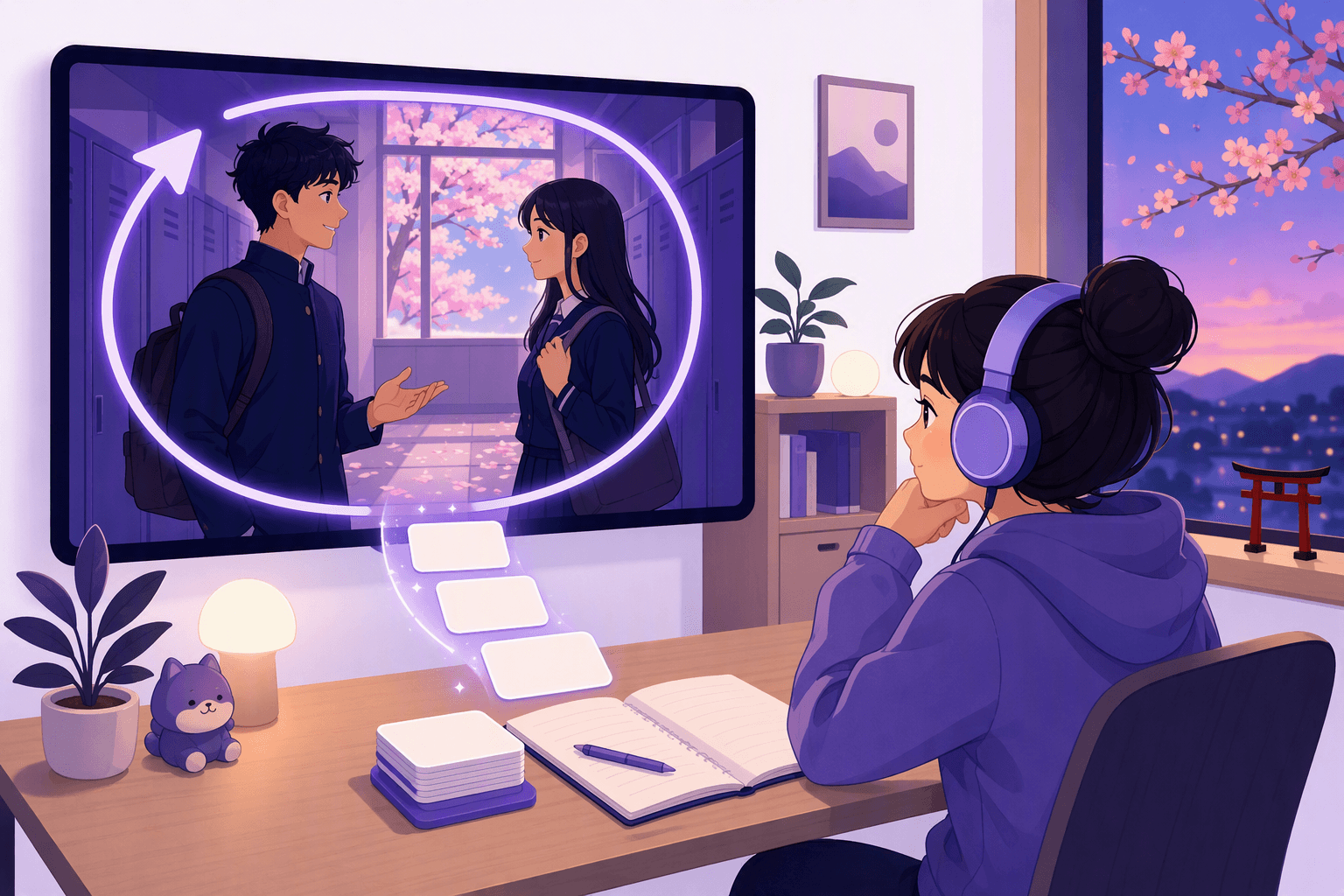
Why anime works for Japanese (and where it fails)
Anime is powerful because it gives you repeated, emotional, context-rich language. That combination makes phrases memorable, and memory is the bottleneck for most learners.
It fails when learners imitate the wrong register. Many iconic lines are intentionally dramatic, rude, archaic, or character-coded, and they can sound strange or even offensive in real life.
The real advantage: comprehensible input with context
Japanese is often hard to parse for beginners because words run together and particles are quiet. Anime provides visual context, and that context helps your brain segment sounds into words.
This aligns with a core idea in second-language acquisition: you improve fastest when you get understandable input that is just a bit above your current level.
"We acquire language in only one way: when we understand messages, when we obtain comprehensible input."
Stephen Krashen, linguist, in The Input Hypothesis (1985)
The hidden trap: character speech is not neutral speech
Anime characters use speech styles to signal personality instantly. That includes pronouns, sentence endings, and levels of politeness.
If you copy a tough-guy style, you can come off aggressive. If you copy a cutesy style, you can sound childish. Your goal is not to sound like a character, it is to sound like a person.
⚠️ A simple safety rule
If you are unsure whether a line is appropriate, do not use it with strangers. Default to desu and masu speech in real conversations, then loosen up only after you hear natives using casual speech with you.
The facts: Japanese reach, learners, and what that means for you
Japanese has about 123 million native speakers, concentrated primarily in Japan (Ethnologue 2024). That concentration matters because most learning resources target standard Japanese, often based on Tokyo usage.
Japanese learning is also huge globally. The Japan Foundation reported 3.79 million Japanese-language learners outside Japan in its 2021 survey, across 142 countries and regions. That means there is a large ecosystem of teachers, textbooks, and tests, and you can combine anime with more structured study without feeling like you are "doing it wrong."
Anime is part of why motivation stays high. Motivation is not fluff, it predicts consistency, and consistency predicts results.
For a broader context on language popularity and learning choices, see most spoken languages in the world.
What to copy from anime (high value Japanese)
You want lines that are:
- Common in real life
- Short enough to repeat
- Tied to a clear situation
- Not overly rude, archaic, or role-play-ish
Below are the categories that reliably transfer from anime to real conversations.
こんにちは
Pronunciation: kohn-nee-CHEE-wah.
This is a safe, daytime greeting. In anime it can sound formal or neutral depending on tone, but in real life it is a standard default.
If you want a full greeting breakdown with context and alternatives, use how to say hello in Japanese.
すみません
Pronunciation: soo-mee-MAH-sen.
This is one of the most useful words in Japanese because it covers "excuse me," "sorry," and even a soft "thanks for the trouble." Anime uses it constantly in shops, schools, and crowded scenes because it fits many micro-situations.
ありがとう / ありがとうございます
Pronunciation: ah-ree-GAH-toh, and ah-ree-gah-TOH goh-zah-ee-MAHS.
Anime gives you both casual and polite gratitude. The polite version is what you want with staff, teachers, and strangers.
ちょっと
Pronunciation: CHOHT-toh.
This literally means "a bit," but it is also a social tool. In real Japanese, ちょっと can soften refusals or signal hesitation without saying "no" directly.
Example vibe: ちょっと難しいです (CHOHT-toh moo-zoo-KAH-shee des) meaning "That’s a bit difficult," often implying "so, probably no."
お願いします
Pronunciation: oh-neh-GUY-shee-MAHS.
This is the backbone of polite requests, and anime uses it in clubs, teams, and everyday favors. It is also used when handing something over, like documents, money, or a form.
If you already know "please" forms, you can connect this with your broader politeness toolkit from how to say please in Japanese.
What not to copy (unless you know exactly why)
Some anime Japanese is real, but context-limited. Copying it blindly is how learners end up sounding rude.
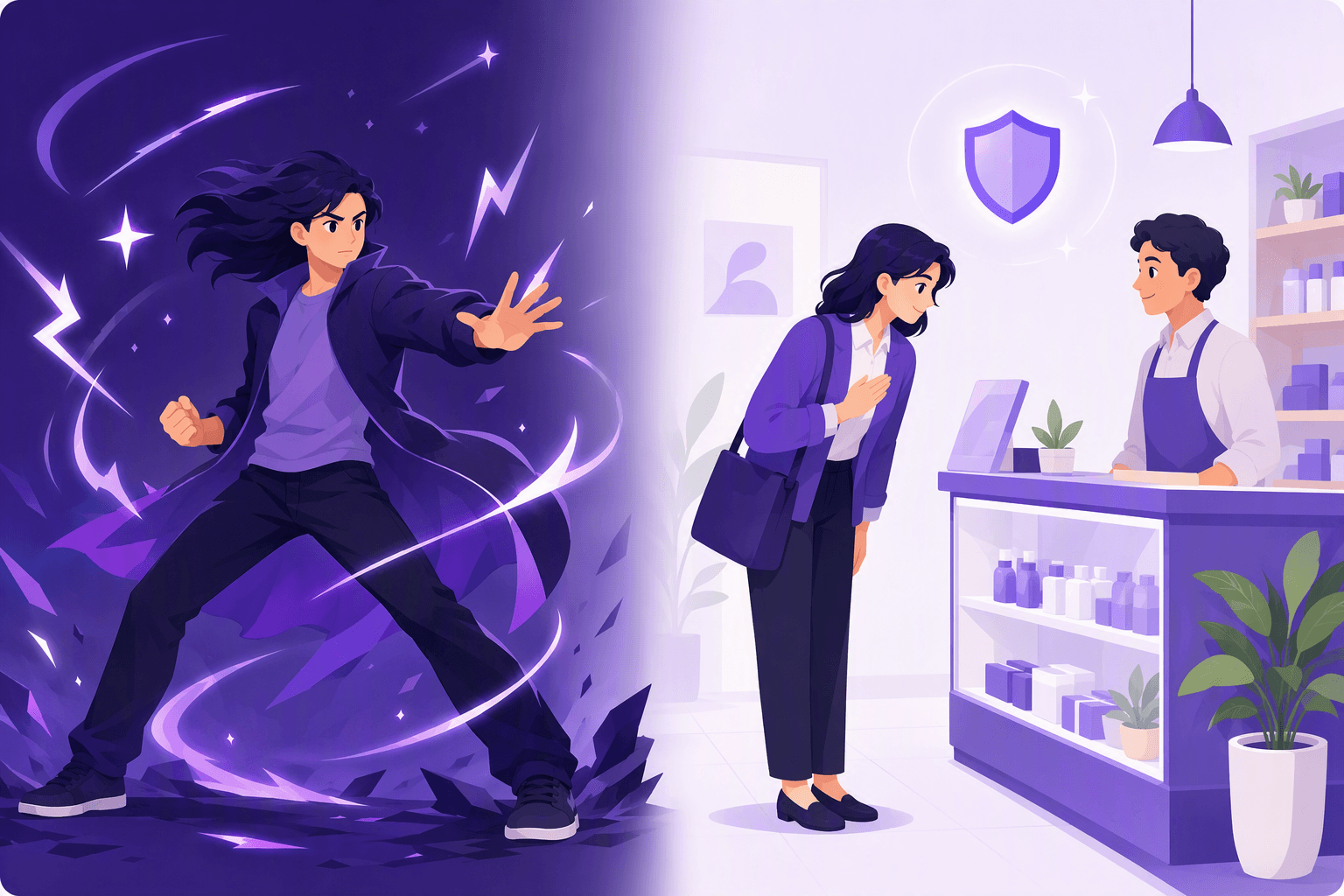
俺 / お前
Pronunciation: OR-eh, oh-MAE.
These are common in anime, especially shounen, but they are socially loaded. 俺 is a masculine "I" used among peers, and お前 is a very direct "you" that can sound confrontational.
In real life, many people avoid direct "you" entirely and use names or titles instead.
てめえ / 貴様
Pronunciation: teh-MEH, kee-SAH-mah.
These are aggressive "you" forms, often used in fights. They are not everyday language, and using them casually can escalate a situation fast.
だぜ / だぞ / なのだ
Pronunciation: dah-ZEH, dah-ZOH, nah-NOH-dah.
Sentence endings are character design. Some are used in real speech, but they can sound theatrical when overused, especially by non-natives.
Swearing and insults
Anime makes insults feel catchy, but real-life consequences are real. If you want to understand what you are hearing without accidentally repeating it, read Japanese swear words as a recognition guide, not a speaking checklist.
🌍 Why anime feels 'ruder' than daily Japanese
Japanese conversation often avoids direct confrontation, using softeners, vagueness, and context. Anime compresses emotion for storytelling, so it uses more direct language than you would hear in a workplace, a shop, or a first meeting.
A clip-based study method that actually works
Watching episodes end-to-end is fun, but it is not efficient. The method that produces measurable improvement is short, repeated, active practice.
Here is a simple system you can run with any show.
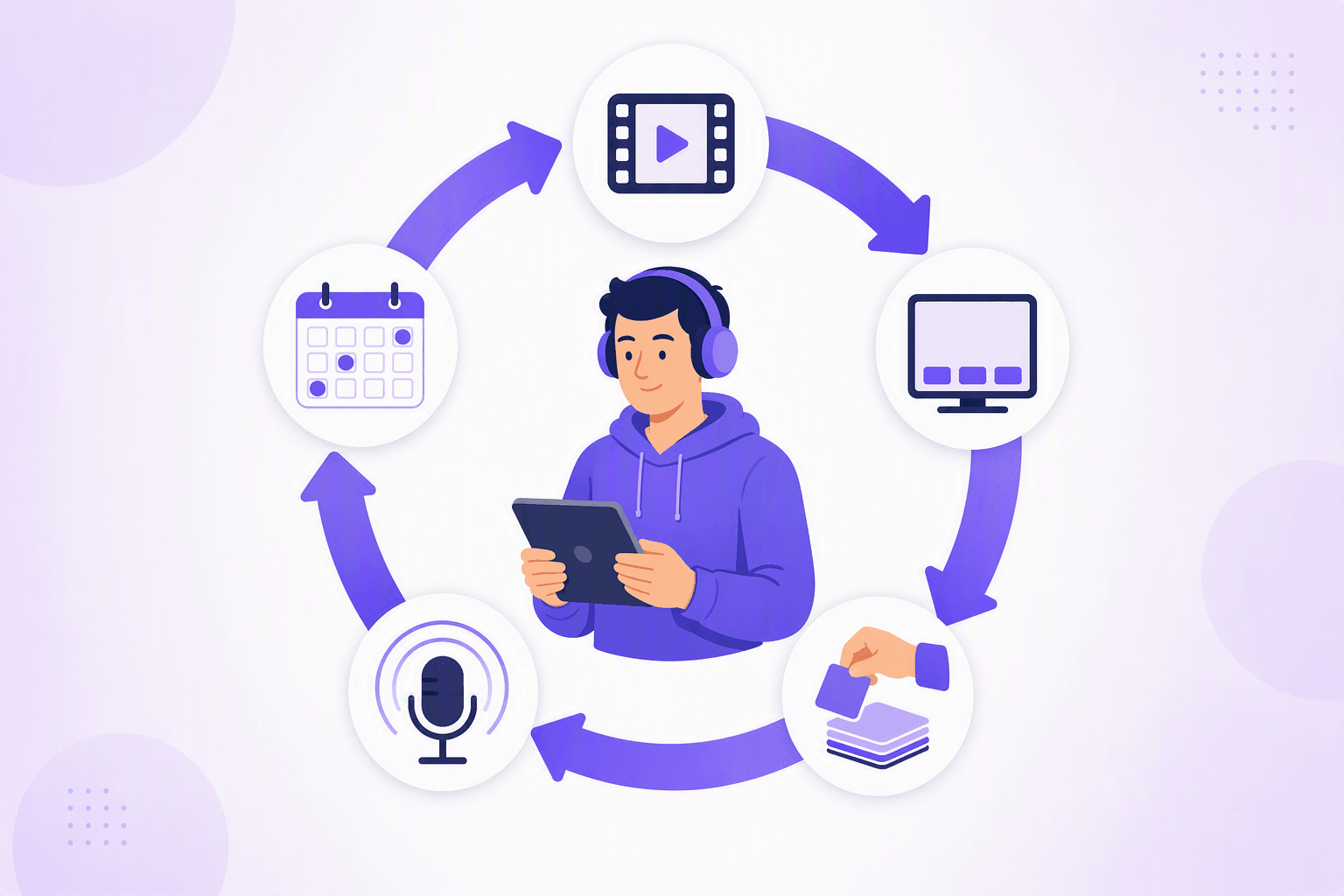
Step 1: pick one scene under 30 seconds
Choose a scene with:
- Clear audio
- One or two speakers
- A situation you might live through (greeting, apology, ordering, inviting)
If you use Wordy, this is the core idea: learn from real clips, not from isolated word lists. If you are comparing tools, see best language learning apps.
Step 2: watch once with Japanese subtitles
Japanese subtitles help you map sound to kana and kanji. If you are still early, start with English subtitles for the first pass, then switch to Japanese for repetition.
If you cannot read kana yet, prioritize that first. It is the fastest skill upgrade you can buy yourself.
For a deeper kana and script foundation, you can pair this with Japanese alphabet complete guide.
Step 3: mine 3 to 7 items, not 30
From one clip, extract:
- 1 key phrase (the "line")
- 2 to 5 useful words
- 1 grammar pattern you notice
More than that becomes a backlog you never review.
Step 4: shadow the line, then shadow the rhythm
Shadowing means repeating immediately after the speaker. Start by copying timing and intonation, even if your pronunciation is imperfect.
Do 10 reps. Then do 10 reps focusing only on rhythm and pitch movement, not individual consonants.
Step 5: review with spaced repetition
If you do not review, you are relying on luck. Spaced repetition is how you turn "I recognized it once" into "I can use it."
A practical schedule:
- Same day: 5 minutes
- Next day: 3 minutes
- Day 3: 3 minutes
- Day 7: 5 minutes
- Day 14: 5 minutes
Pronunciation: what anime teaches well (and what it distorts)
Anime is great for vowel clarity. Japanese vowels are stable: a, i, u, e, o.
Pronunciation approximations you can trust:
- あ = "ah"
- い = "ee"
- う = "oo" (often softer, closer to "oo" with relaxed lips)
- え = "eh"
- お = "oh"
Anime can distort:
- Whispery breathiness for effect
- Overly sharp consonants in emotional scenes
- Dramatic pauses that are not conversational
Pitch accent: notice it, do not obsess
Japanese has pitch accent, and it affects naturalness. You do not need perfect pitch accent to be understood, but you should avoid building bad habits.
Your best move is to imitate native audio from short clips. Repetition trains your ear gradually, and you will improve without turning every word into a theory project.
Choosing the right anime for your level
The best anime for learning is the one you will rewatch. Rewatching is not a compromise, it is the mechanism.
Use this table as a rough filter.
| Level | Best genres for learning | Why | What to avoid early |
|---|---|---|---|
| Beginner (A1-A2) | slice-of-life, school, workplace comedy | everyday vocabulary, predictable situations | historical speech, heavy fantasy politics |
| Intermediate (B1-B2) | romance, mystery, sports | varied emotions, natural dialogue, repetition of themes | rapid-fire comedy with dense wordplay |
| Advanced (C1+) | legal, political, period drama, sci-fi | specialized vocabulary, nuance, pragmatics | none, but expect lots of lookups |
🌍 A Japan-specific detail: honorifics are not optional
Anime constantly uses name plus honorific, like 田中さん (tah-NAH-kah san). In real Japanese, dropping さん can sound too intimate or too blunt unless you are close. Listening for when characters switch from さん to 呼び捨て (yoh-bee-SOO-teh, using a bare name) teaches you real social distance cues.
Building a "real life" bridge from anime Japanese
Anime gives you input. You still need output, but output should be controlled and safe.
Use polite Japanese as your default output
Even if your anime is casual, your real life practice should start polite:
- です (des)
- ます (mahs)
- お願いします (oh-neh-GUY-shee-MAHS)
- すみません (soo-mee-MAH-sen)
This prevents most social mistakes.
Then add casual speech with people you trust
Casual speech is not "less correct." It is relationship language.
A good progression:
- Learn the polite form
- Recognize the casual form in anime
- Use casual only after you have a real relationship context
Learn greetings and farewells from real contexts
Anime farewells are often emotional. Real life has more routine endings.
Use how to say goodbye in Japanese to separate dramatic さようなら (sah-YOH-nah-rah) from everyday またね (MAH-tah-neh) and じゃあね (JAH-neh).
Romance lines: treat them as culture, not templates
Anime love confessions are iconic, but they are not everyday speech. Even 愛してる (eye-shee-TEH-roo) can feel intense in real life.
If you want to understand what you are hearing, and what people actually say instead, read how to say I love you in Japanese.
A weekly plan (30 minutes a day) for anime-based Japanese
Consistency beats intensity. Here is a plan that fits into real schedules.
Days 1-2: one clip, deep study
- Pick one scene under 30 seconds
- Extract 1 phrase + 5 words
- Shadow 20 times total
- Add items to review
Days 3-4: two clips, lighter study
- Pick two scenes under 20 seconds each
- Extract 1 phrase from each
- Shadow 10 times each
- Review yesterday’s items
Day 5: listening-only day
- Rewatch your studied clips without subtitles
- Try to catch particles and endings
- Do not add new material
Day 6: output day
- Record yourself shadowing your best clip
- Compare rhythm and vowel length
- Write 5 original sentences using your target phrase
Day 7: reset and rewatch
- Rewatch one full episode for enjoyment
- Notice how often your learned phrase appears
- Choose next week’s "anchor scene"
💡 The 'anchor scene' trick
Pick one scene you love and keep it for a month. When you can understand it without subtitles and shadow it smoothly, you have proof of progress, and that keeps motivation stable.
Common mistakes anime learners make (and how to fix them)
Mistake 1: learning rare words instead of frequent ones
Anime has niche vocabulary: magic systems, ranks, invented terms. It is fun, but it does not pay rent in real conversations.
Fix: track frequency by your own exposure. If you hear it across multiple shows, it is worth learning.
Mistake 2: trusting English subtitles
Subtitles are adaptations, not transcripts. They often compress meaning, remove politeness, or change jokes.
Fix: use Japanese subtitles when possible, and treat English subtitles as a gist tool, not a dictionary.
Mistake 3: copying pronouns and speech endings
This is the fastest way to sound unnatural.
Fix: copy neutral verbs, set phrases, and polite requests first. Let pronouns come later, and learn them with social rules attached.
Mistake 4: not reviewing
Without review, you are watching entertainment, not studying.
Fix: keep your extraction small and your review consistent. Five minutes daily beats one hour once a week.
Using anime clips like a language lab (what to listen for)
When you replay a line, listen for these features:
- Particles: は (wah), が (gah), を (oh), に (nee), で (deh)
- Verb endings: ます (mahs), た (tah), て (teh), ない (nye)
- Softeners: ちょっと (CHOHT-toh), たぶん (tah-BOON), かな (kah-NAH)
- Backchannels: うん (oon), ええ (ehh), そう (soh)
This is where anime becomes a serious tool. You are training segmentation and grammar intuition, not just memorizing quotes.
Bringing it all together with Wordy
Wordy’s approach matches what works: short, replayable movie and TV clips, interactive subtitles, and built-in review. Anime is especially compatible with this because scenes are naturally segmented and emotionally memorable.
If you want to keep your learning media-based, start from the blog index and build a small cluster: greetings, apologies, and everyday phrases, then add anime clips as your listening gym.
Near the end of your first month, add one topic you personally care about, like slang. Just keep it recognition-first, and be careful with what you repeat out loud.
For more context on entertainment-driven vocabulary, you can also compare with anime vocabulary complete guide, then return to this guide for the study method.
The bottom line
Anime can absolutely help you learn Japanese, but the payoff comes from repetition, not binge-watching. Study short clips, prioritize neutral phrases, shadow for pronunciation, and review with spaced repetition, and you will build Japanese you can actually use.
Frequently Asked Questions
Can you really learn Japanese from anime?
Is anime Japanese the same as real Japanese?
Should I use romaji when learning Japanese from anime?
What anime is best for Japanese beginners?
How many Japanese speakers are there, and where is Japanese spoken?
Sources & References
- Ethnologue (SIL International), Ethnologue: Languages of the World, 27th ed., 2024
- The Japan Foundation, Survey Report on Japanese-Language Education Abroad, 2021
- NHK Broadcasting Culture Research Institute, Japanese Language and Communication (broadcast language guidance), ongoing
- NationaI Institute for Japanese Language and Linguistics (NINJAL), research publications on contemporary Japanese usage, ongoing
- Krashen, S., The Input Hypothesis: Issues and Implications, 1985
Start learning with Wordy
Watch real movie clips and build your vocabulary as you go. Free to download.


