Quick Answer
Anime vocabulary is real Japanese, but it is filtered through character types, honorifics, and dramatic speech. This guide teaches the words you actually hear in anime, how to pronounce them, what they really mean, and which ones can sound rude or unnatural in everyday conversation.
Anime vocabulary is mostly everyday Japanese, but anime amplifies it through honorifics, character speech styles, and slang, so the key is learning what the words mean and when they sound natural vs theatrical. Below you will learn high-frequency anime words with simple pronunciations, plus the cultural rules that explain why characters talk the way they do.
| English | Japanese | Pronunciation | Formality |
|---|---|---|---|
| Thanks | ありがとう | ah-ree-GAH-toh | casual |
| Thank you (polite) | ありがとうございます | ah-ree-GAH-toh goh-ZYE-mass | polite |
| Sorry | ごめん | goh-MEHN | casual |
| Sorry (polite) | すみません | soo-mee-MAH-sen | polite |
| Amazing / wow | すごい | soo-GOY | casual |
| Are you okay? | 大丈夫? | dye-JOH-boo? | casual |
| Wait! | 待って! | MAH-tteh! | casual |
| I got it / understood | わかった | wah-KAH-ttah | casual |
Why anime Japanese sounds different (and why that matters)
Japanese is spoken by roughly 123 million native speakers worldwide (Ethnologue, 2024). Anime reaches far beyond Japan, but the language you hear is not a neutral “textbook register.”
Anime scripts are written to signal personality fast. That is why you hear strong pronouns, sharp sentence endings, and archaic styles that real people rarely use outside jokes.
"Role language is a set of speech patterns that index a character type, not a realistic speaker. It is effective in fiction, but learners should treat it as a stylistic code rather than a model for daily conversation."
NINJAL (National Institute for Japanese Language and Linguistics), research on 役割語 (yakuwarigo)
If you want a foundation for real greetings first, pair this guide with how to say hello in Japanese and how to say goodbye in Japanese.
The 4 “layers” of anime vocabulary you should learn
1) Core everyday Japanese
These are words you will hear in anime and also in real life. They are high value because you can safely reuse them.
2) Relationship markers
Honorifics, titles, and “who outranks whom” words. Anime uses these constantly because social hierarchy is a major storytelling tool.
3) Emotion reactions
Short bursts like えっ or まじで that show surprise, disbelief, or excitement. They are common in real speech, but tone matters.
4) Character speech and catchphrases
Samurai talk, villain talk, “cute” endings, and signature verbal tics. Understand them for comprehension, but do not copy them blindly.
💡 A simple rule for learners
If a word changes depending on who is speaking (pronouns, sentence endings, tough-guy insults), treat it as comprehension-first. If it works for everyone (thanks, sorry, wait), it is production-safe.
Core anime words you can use in real life
Below are the “safe” staples. You will hear them across genres, from slice-of-life to shōnen.
ありがとう
Pronunciation: ah-ree-GAH-toh.
Meaning: “thanks.” In anime it can be heartfelt or casual, but it is always useful.
Use ありがとうございます (ah-ree-GAH-toh goh-ZYE-mass) for teachers, coworkers, strangers, and customer service.
ごめん
Pronunciation: goh-MEHN.
Meaning: “sorry” in a casual way. You will hear ごめんね (goh-MEHN-neh) to soften it.
For a more standard polite apology, use すみません (soo-mee-MAH-sen). It can also mean “excuse me.”
大丈夫
Pronunciation: dye-JOH-boo.
Meaning: “okay,” “fine,” “no problem,” or “are you okay?” depending on intonation. Anime uses it constantly in rescue scenes and awkward moments.
A common pattern is 大丈夫? (dye-JOH-boo?) as “You okay?”
すごい
Pronunciation: soo-GOY.
Meaning: “amazing,” “great,” “impressive.” It is a safe reaction word, but avoid overusing it the way anime characters do.
In real conversation, you can also say すごいね (soo-GOY-neh) to sound friendlier.
ちょっと
Pronunciation: CHOH-ttoh.
Meaning: literally “a little,” but in anime and real life it often functions as a soft refusal or hesitation.
Example nuance: ちょっと… (CHOH-ttoh…) can mean “uh, that’s kind of…” without finishing the sentence.
本当
Pronunciation: hon-TOH.
Meaning: “really?” or “true.” You will hear 本当? (hon-TOH?) as a surprised check.
Polite version: 本当ですか (hon-TOH dess-kah).
Honorifics and titles: the social grammar of anime
Anime makes relationships visible through naming. If you ignore this, you miss subtext.
| English | Japanese | Pronunciation | Note |
|---|---|---|---|
| -san (neutral polite) | さん | sahn | Default for adults you are not close with. |
| -kun (often to boys/juniors) | くん | koon | Used by seniors, teachers, bosses, or close friends. |
| -chan (cute/intimate) | ちゃん | chahn | Common for kids, close friends, pets, and nicknames. |
| -sama (very respectful) | さま | SAH-mah | Customers, deities, or exaggerated respect in fiction. |
| senpai (senior) | 先輩 | sen-PAI | School clubs, workplaces, mentorship dynamics. |
| sensei (teacher/doctor) | 先生 | sen-SEH | Teachers, doctors, politicians, artists in some contexts. |
さん
Pronunciation: sahn.
This is the safest default. In real life, using someone’s family name plus さん is polite and normal.
Anime sometimes drops honorifics to show intimacy or disrespect. That is meaningful, not random.
先輩
Pronunciation: sen-PAI.
It means a senior in a shared institution. It is not “teacher,” and it is not automatically romantic.
If you want the “junior” counterpart, you will sometimes hear 後輩 (koh-HIGH), but it is used less directly as address.
先生
Pronunciation: sen-SEH.
In anime, characters call teachers 先生 constantly. In real life, you also use it for doctors and some professions.
If you call a random older person 先生, it can sound sarcastic unless they actually have that role.
🌍 Why honorifics hit so hard in school anime
Japanese school settings make status legible: year level, club hierarchy, and teacher roles. Honorifics and titles let writers show closeness, distance, and power without explaining it. That is why a single “-san” vs “-chan” switch can feel like a plot event.
Reaction words you hear everywhere (and how to say them naturally)
These are short, high-frequency, and easy to misread if you only know dictionary meanings.
えっ
Pronunciation: eh?
Meaning: “Huh?” or “What?” It signals surprise or confusion.
In subtitles it is often “What?!” but the real function is a quick reaction.
うそ
Pronunciation: OO-soh.
Meaning: “No way,” “you’re kidding,” or literally “lie.” Anime uses it for disbelief.
A common stronger version is うそでしょ (OO-soh deh-SHOH), “Seriously?”
まじ
Pronunciation: MAH-jee.
Meaning: “seriously?” in casual speech. You will hear まじで (MAH-jee deh), “for real.”
Avoid it in formal contexts. It is slang, not rude, but it is casual.
やばい
Pronunciation: yah-BYE.
Meaning depends on context: danger, trouble, or “this is insanely good.” Anime leans on it as an all-purpose intensity marker.
If you want a safer “this is bad,” use まずい (mah-ZOO-ee) in some contexts, but note it also means “tastes bad.”
なるほど
Pronunciation: nah-roh-HOH-doh.
Meaning: “I see,” “that makes sense.” It is common in anime explanation scenes and also in real meetings.
It can sound a bit “thinking out loud,” so そうなんだ (SOH nahn-dah) may feel more casual among friends.
Pronouns in anime: understand them, but be careful using them
Pronouns are where many learners accidentally sound aggressive, flirtatious, or like they are roleplaying.
| English | Japanese | Pronunciation | Note |
|---|---|---|---|
| I (neutral, common) | 私 | wah-TAH-shee | Polite default, used by all genders in formal settings. |
| I (casual, often masculine) | 僕 | boh-koo | Common among boys/men, can be gentle or youthful. |
| I (rough, masculine) | 俺 | oh-REH | Very common in anime, but can sound blunt depending on context. |
| you (neutral but situational) | あなた | ah-NAH-tah | Used when needed, but names are often preferred. |
| you (very direct) | お前 | oh-MAE | Common in rival talk, can be rude in real life. |
| you (very rude) | てめえ | teh-MEH | Fighting words, mostly avoid. |
私
Pronunciation: wah-TAH-shee.
This is the safest “I,” especially for learners. It works in polite speech and many casual contexts.
Anime characters may switch away from 私 to signal toughness or intimacy. That is style, not necessity.
俺
Pronunciation: oh-REH.
It is common for male characters, especially confident or rough ones. In real life, many men use it with close friends, but it can sound blunt with strangers.
If you are unsure, use 私 or just avoid pronouns entirely, which Japanese often does.
お前
Pronunciation: oh-MAE.
In anime it can be “buddy” in a rough friendship, or a threat in a fight. In real life, it is risky unless you are very close and the relationship supports it.
If you want to sound natural, use the person’s name plus さん, or drop “you” altogether.
⚠️ Pronouns are not required in Japanese
Japanese frequently omits “I” and “you” when context is clear. Copying anime pronouns is the fastest way to sound unnatural. When in doubt, use names, titles, or no subject at all.
Sentence endings: why characters sound “cute,” “tough,” or “old”
Sentence-final particles and endings are a major anime tool. They are real, but heavily stylized.
だよ
Pronunciation: dah-yoh.
Adds an explanatory, friendly tone: “It is, you know.” Anime uses it constantly in casual speech.
だね
Pronunciation: dah-neh.
Means “right?” or “isn’t it?” It invites agreement.
よ
Pronunciation: yoh.
Adds emphasis, like “I’m telling you.” Overusing it can sound pushy, so listen to how often real speakers use it in slice-of-life scenes.
ぞ
Pronunciation: zoh.
A rough, masculine emphasis. In anime it is common for tough guys, villains, and commanders.
In real life it can sound theatrical unless you are in a very casual male friend group.
でござる
Pronunciation: deh goh-ZAH-roo.
Old-fashioned, samurai-flavored role language. Understand it, enjoy it, but do not use it seriously unless you are intentionally joking.
“Confession” and romance words anime made famous
Romance anime teaches real phrases, but timing and directness differ from many real interactions.
If you want a deeper guide to romantic language, see how to say I love you in Japanese.
好き
Pronunciation: SKI.
Meaning: “like” or “love” depending on context. In anime confessions, 好きです (SKI dess) is a big deal.
In daily life, 好き is also used casually for preferences: コーヒーが好き (koh-HEE gah SKI), “I like coffee.”
大好き
Pronunciation: dye-SKI.
Meaning: “really like,” “love.” In anime it is often emotional, but it can also be lighthearted among friends.
告白
Pronunciation: koh-KOO-hah-koo.
Meaning: “confession,” usually romantic in school contexts. The “kokuhaku” scene is a genre staple.
Culturally, it reflects a narrative of defining the relationship clearly, even though real dating culture is more varied.
付き合う
Pronunciation: tsu-kee-AH-oo.
Meaning: “to go out with,” “to date.” Anime often makes it a clear yes/no moment.
In real life, people may use softer steps first, but the verb itself is standard.
Anime slang vs real-life risk: what to avoid copying
Some words are common in anime because conflict is entertaining. In real life, they can escalate situations fast.
ばか
Pronunciation: bah-KAH.
Means “idiot.” It can be playful among close friends, but it can also be insulting.
Regional nuance matters: in Kantō it is common, while Kansai often uses アホ (AH-hoh) more casually.
くそ
Pronunciation: KOO-soh.
Literally “shit,” used like “damn it.” You will hear it in frustration scenes.
If you want a full map of severity and safer alternatives, read our guide to Japanese swear words.
死ね
Pronunciation: sheh-NEH.
Means “die.” In anime it appears in fights, but in real life it is extremely aggressive and unacceptable.
Treat it as comprehension-only.
⚠️ Anime conflict language is not 'cool Japanese'
Words like てめえ (teh-MEH) and 死ね (sheh-NEH) are not edgy shortcuts to fluency. They are socially costly. Learn them so you understand scenes, then choose neutral speech when you talk.
Mini “watch list”: what each genre teaches best
Anime is not one register. Use genre strategically.
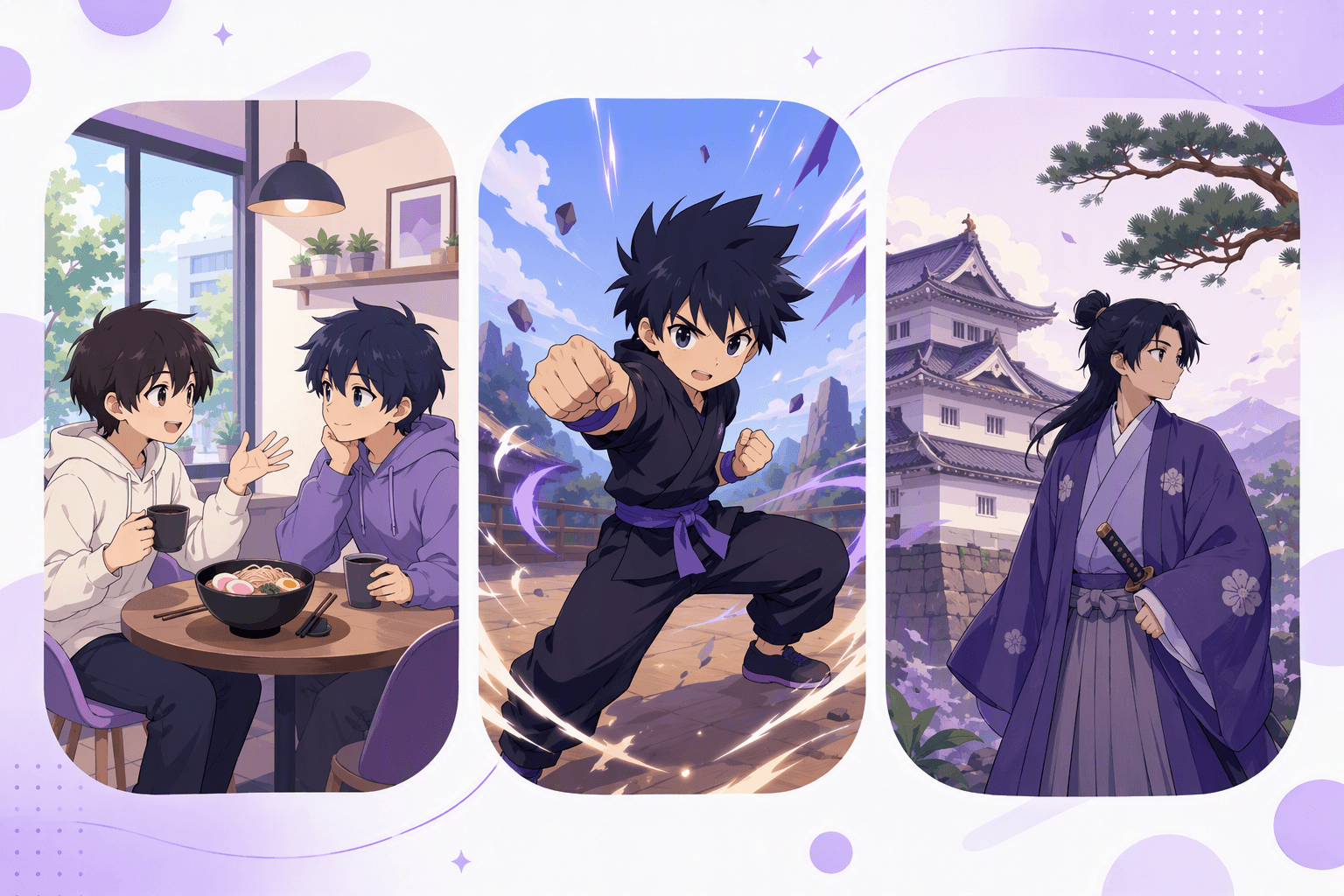
Slice-of-life
Best for: natural pacing, everyday fillers, polite casual speech. You get more realistic turn-taking and fewer catchphrases.
Listen for: なるほど (nah-roh-HOH-doh), そうなんだ (SOH nahn-dah), ちょっと (CHOH-ttoh).
Shōnen battle
Best for: clear emotions, repeated phrases, motivation speeches. Great for memorizing, risky for copying tone.
Listen for: 俺 (oh-REH), お前 (oh-MAE), いくぞ (ee-KOO-zoh), やるぞ (yah-ROO-zoh).
Historical and fantasy
Best for: exposure to polite forms, archaic vocabulary, and honor systems. Great comprehension training.
Listen for: でござる (deh goh-ZAH-roo), 申す (moh-SOO), and exaggerated さま (SAH-mah).
A practical way to learn anime vocabulary with clips
You do not need to memorize 500 words at once. You need repeated, contextual exposure.
- Pick one scene type (greetings, apologies, arguments).
- Capture 5 to 10 short lines and shadow them for rhythm.
- Write down one “safe” reusable phrase and one “comprehension-only” phrase.
- Review with spaced repetition.
This is also why clip-based learning works well: you hear the same word with different emotions and different characters. If you want more structured practice ideas, start at the Wordy blog or go straight to learn Japanese.
Quick comparison: anime-style vs real-life default
| Function | Anime you often hear | Safer real-life default | Pronunciation |
|---|---|---|---|
| “I” | 俺 | 私 | oh-REH vs wah-TAH-shee |
| “you” | お前 | 名前 + さん | oh-MAE vs (name) + sahn |
| “amazing” | すげえ | すごい | soo-GEH vs soo-GOY |
| “seriously?” | まじで? | 本当? | MAH-jee deh vs hon-TOH |
| “damn it” | くそ | しまった | KOO-soh vs shee-MAH-ttah |
🌍 Why 'safe defaults' matter in Japanese
Japanese politeness is not just being nice, it is choosing forms that fit distance, age, and setting. The Japan Foundation reports Japanese is studied by millions worldwide, and many learners first meet it through pop culture. Using neutral defaults helps you communicate without accidentally performing a character.
The one cultural concept that explains a lot: “role language”
Anime speech is full of signals that Japanese audiences recognize instantly. Linguists often discuss this as 役割語 (yakuwarigo), language that indexes a role.
That is why a character who says 俺 and ぞ feels different from one who says 私 and です. The words do not only carry dictionary meaning, they carry social meaning.
Once you see that, anime becomes a powerful listening resource instead of a trap.
If you want to build your core greeting toolkit alongside anime listening, revisit how to say hello in Japanese and how to say goodbye in Japanese, then keep this guide as your “what did they just say?” reference.
Frequently Asked Questions
Is anime Japanese the same as real Japanese?
What are the most common Japanese words in anime?
What does やばい mean in anime?
Can I call someone お前 like in anime?
Why do anime characters say だってばよ or でござる?
Sources & References
- Ethnologue. Ethnologue: Languages of the World, 27th edition, 2024
- The Japan Foundation. Japanese-Language Education Overseas, 2021
- 国立国語研究所 (NINJAL). 日本語の役割語 (Yakuwarigo) 研究資料, 2010-
- 文化庁 (Agency for Cultural Affairs). 国語に関する世論調査 (Survey on the National Language), 2023
Start learning with Wordy
Watch real movie clips and build your vocabulary as you go. Free to download.


