Quick Answer
Japanese has two main adjective types: い-adjectives, which conjugate directly, and な-adjectives, which use な before nouns and です in polite statements. Learn how to identify, conjugate, and use both types naturally in real Japanese.
Japanese has two main adjective types: い-adjectives and な-adjectives. い-adjectives, such as 大きい /oːkii/ meaning “big,” conjugate by changing their endings, while な-adjectives, such as 静か /ɕizɯka/ meaning “quiet,” need な /na/ before a noun and use a copula such as です /desɯ/ in a full sentence.
This distinction is one of the most useful early Japanese grammar patterns because adjectives appear everywhere: greetings, food reactions, descriptions, romance, complaints, and anime dialogue. Japanese has roughly 123 million first-language speakers according to Ethnologue, so learning the standard patterns gives you access to an enormous range of real speech across Japan and Japanese-speaking communities worldwide.
The key is not to memorize every ending separately. Learn which adjective family a word belongs to, then you can produce natural present, past, negative, and connecting forms. This guide also explains the famous exceptions that confuse beginners.
If you are starting from zero, pair this with our Japanese language overview and Japanese pronunciation guide. Clear pronunciation makes adjective endings much easier to hear in dialogue.
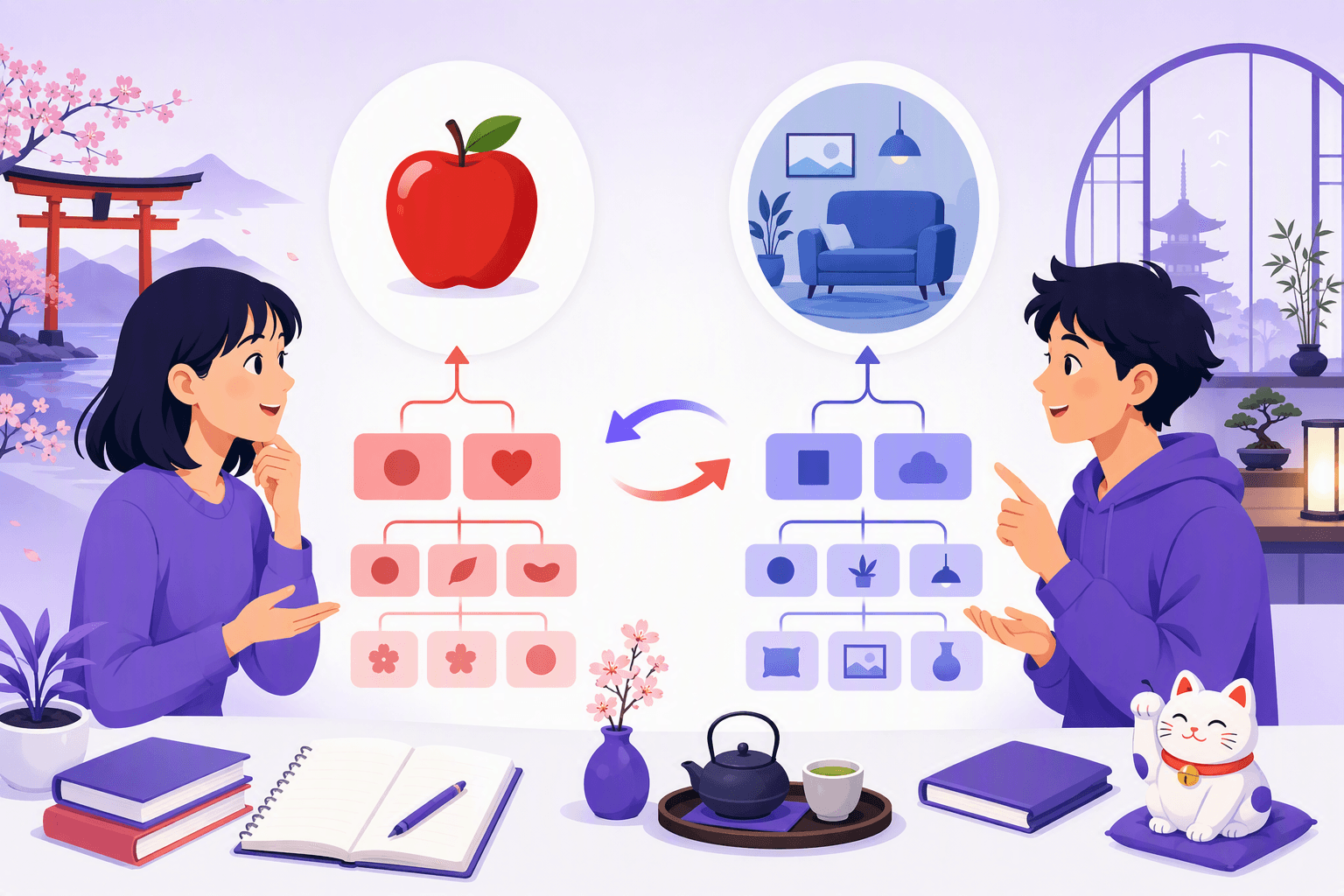
The two core Japanese adjective families
Japanese grammar calls an adjective 形容詞 /keːjoːɕi/. Traditional descriptions divide many descriptive words into い形容詞 /i keːjoːɕi/ and な形容詞 /na keːjoːɕi/.
The labels describe what happens before a noun. An い-adjective attaches directly to the noun, while a な-adjective uses な /na/ between the description and the noun.
| Type | Before a noun | Meaning |
|---|---|---|
| い-adjective | 大きい犬 /oːkii inɯ/ | a big dog |
| な-adjective | 静かな犬 /ɕizɯka na inɯ/ | a quiet dog |
This is not merely a spelling rule. The two groups take different endings, and choosing the wrong pattern is one of the fastest ways to sound unnatural.
Natsuko Tsujimura’s An Introduction to Japanese Linguistics treats these forms as distinct grammatical classes, not as direct copies of English adjectives. That matters because English uses one broad adjective category, while Japanese divides descriptive language according to how it connects to nouns and sentences.
い-adjectives: the conjugating adjectives
Most い-adjectives end in い /i/ in their dictionary form. They can stand before a noun, finish a sentence, become negative, become past, and link to another idea without needing です /desɯ/ as part of the adjective itself.
Common examples include 新しい /ataɾaɕii/ for “new,” 高い /takai/ for “expensive” or “high,” and 面白い /omoɕiɾoi/ for “interesting” or “funny.”
| English | Japanese | IPA | Example meaning |
|---|---|---|---|
| big | 大きい | /oːkii/ | big |
| small | 小さい | /tɕiisai/ | small |
| new | 新しい | /ataɾaɕii/ | new |
| expensive, high | 高い | /takai/ | expensive, high |
| cheap | 安い | /jasɯi/ | inexpensive |
| interesting, funny | 面白い | /omoɕiɾoi/ | interesting, funny |
| hot weather | 暑い | /atsɯi/ | hot weather |
| cold weather | 寒い | /samɯi/ | cold weather |
The basic い-adjective pattern
Take 高い /takai/, meaning “expensive” or “high.” Remove the final い /i/ and attach the relevant ending.
| Meaning | Japanese | IPA |
|---|---|---|
| is expensive | 高い | /takai/ |
| is not expensive | 高くない | /takakɯ nai/ |
| was expensive | 高かった | /takakatta/ |
| was not expensive | 高くなかった | /takakɯ nakatta/ |
| is expensive, and... | 高くて | /takakɯte/ |
| expensively | 高く | /takakɯ/ |
For a polite sentence, add です /desɯ/ after the completed adjective:
-
この店は高いです。
この店は高いです。 /kono mise wa takai desɯ/
This shop is expensive. -
昨日の映画は面白かったです。
昨日の映画は面白かったです。 /kinoː no eːɡa wa omoɕiɾokatta desɯ/
Yesterday’s movie was interesting.
The polite marker です /desɯ/ adds politeness, but it does not create the past or negative meaning. The adjective ending does that work.
The く form
The く /kɯ/ form is especially productive. It can make an adverb, connect a clause, or form the negative with ない /nai/.
-
早く話してください。
早く話してください。 /hajakɯ hanaɕite kɯdasai/
Please speak quickly. -
この部屋は明るくて広いです。
この部屋は明るくて広いです。 /kono heja wa akaɾɯkɯte hiɾoi desɯ/
This room is bright and spacious. -
今日は暑くないです。
今日は暑くないです。 /kjoː wa atsɯkɯ nai desɯ/
It is not hot today.
In real conversation, these endings are very audible. Training with scene-based listening is effective because you hear how the same adjective changes with context. A character might say 面白い /omoɕiɾoi/ in a neutral reaction, then 面白くない /omoɕiɾokɯ nai/ when dismissing a show.
な-adjectives: descriptive nouns that need な
な-adjectives often look like nouns because they do not conjugate in the same way as い-adjectives. Before a noun, they take な /na/. At the end of a sentence, they use a copula such as だ /da/ or です /desɯ/.
Common examples include 静か /ɕizɯka/ for “quiet,” 便利 /beŋɾi/ for “convenient,” and 有名 /jɯːmeː/ for “famous.”
| English | Japanese | IPA | Before a noun |
|---|---|---|---|
| quiet | 静か | /ɕizɯka/ | 静かな場所 /ɕizɯka na baɕo/ |
| convenient | 便利 | /beŋɾi/ | 便利なアプリ /beŋɾi na apɯɾi/ |
| famous | 有名 | /jɯːmeː/ | 有名な俳優 /jɯːmeː na haijɯː/ |
| healthy, energetic | 元気 | /ɡeŋki/ | 元気な子ども /ɡeŋki na kodomo/ |
| pretty, clean | きれい | /kiɾeː/ | きれいな部屋 /kiɾeː na heja/ |
| safe | 安全 | /aŋzeŋ/ | 安全な場所 /aŋzeŋ na baɕo/ |
The basic な-adjective pattern
Use 静か /ɕizɯka/ to see the complete pattern.
| Meaning | Japanese | IPA |
|---|---|---|
| is quiet | 静かだ | /ɕizɯka da/ |
| is quiet, polite | 静かです | /ɕizɯka desɯ/ |
| is not quiet | 静かではない | /ɕizɯka dewa nai/ |
| is not quiet, casual | 静かじゃない | /ɕizɯka dʑa nai/ |
| was quiet | 静かだった | /ɕizɯka datta/ |
| was quiet, polite | 静かでした | /ɕizɯka deɕita/ |
| was not quiet | 静かではなかった | /ɕizɯka dewa nakatta/ |
| quietly | 静かに | /ɕizɯka ni/ |
| quiet and... | 静かで | /ɕizɯka de/ |
Examples:
-
この町は静かです。
この町は静かです。 /kono matɕi wa ɕizɯka desɯ/
This town is quiet. -
ここは静かではありません。
ここは静かではありません。 /koko wa ɕizɯka dewa aɾimasen/
This place is not quiet. -
彼は元気に話しています。
彼は元気に話しています。 /kaɾe wa ɡeŋki ni hanaɕite imasɯ/
He is speaking energetically.
The ending に /ni/ often turns a な-adjective into an adverb. This is similar to the way く /kɯ/ works with い-adjectives, but the families keep their own patterns.
The major trap: words ending in い that are not い-adjectives
Beginners often assume that every word ending in い /i/ is an い-adjective. That rule works often, but it has important exceptions.
The best-known examples are きれい /kiɾeː/, meaning “pretty” or “clean,” and きらい /kiɾai/, meaning “disliked.” Both are な-adjectives.
| Word | IPA | Type | Correct noun phrase |
|---|---|---|---|
| きれい | /kiɾeː/ | な-adjective | きれいな花 /kiɾeː na hana/ |
| きらい | /kiɾai/ | な-adjective | きらいな食べ物 /kiɾai na tabemono/ |
| 有名 | /jɯːmeː/ | な-adjective | 有名な人 /jɯːmeː na hito/ |
| 嫌い | /kiɾai/ | な-adjective | 嫌いな歌 /kiɾai na ɯta/ |
You would not say きれいい部屋. The correct phrase is きれいな部屋 /kiɾeː na heja/, meaning “a clean or beautiful room.”
⚠️ Do not trust the final い alone
きれい /kiɾeː/ and きらい /kiɾai/ are な-adjectives even though they end in い /i/. Learn each new adjective with a short noun phrase, such as きれいな部屋 /kiɾeː na heja/, rather than memorizing the word in isolation.
The irregular adjective いい
The adjective いい /ii/, meaning “good,” is irregular in most conjugated forms. Its historical form よい /joi/ supplies the stem.
| Meaning | Japanese | IPA |
|---|---|---|
| good | いい | /ii/ |
| not good | よくない | /jokɯ nai/ |
| was good | よかった | /jokatta/ |
| was not good | よくなかった | /jokɯ nakatta/ |
| good and... | よくて | /jokɯte/ |
| often, well | よく | /jokɯ/ |
Examples:
-
この映画はよかった。
この映画はよかった。 /kono eːɡa wa jokatta/
This movie was good. -
今日はあまりよくない。
今日はあまりよくない。 /kjoː wa amaɾi jokɯ nai/
Today is not very good.
The same pattern appears in compounds such as かっこいい /kakko ii/, meaning “cool” or “good-looking.” You may hear かっこよくない /kakko jokɯ nai/ rather than a form based on いい /ii/.
Adjectives and Japanese culture: directness depends on context
Japanese adjectives do more than describe objects. They help speakers manage tone, modesty, and social distance.
For example, calling someone きれい /kiɾeː/ can mean “beautiful,” “pretty,” or “well put together,” depending on the context. Calling food 美味しい /oiɕii/, meaning “delicious,” is a direct compliment, but it is also a common, low-risk response to hospitality.
The adjective 大丈夫 /daijoːbɯ/ is another cultural workhorse. It can mean “okay,” “fine,” “safe,” “no thank you,” or “no problem” depending on the situation. Grammatically, it is a な-adjective, so 大丈夫です /daijoːbɯ desɯ/ is a normal polite sentence. Pragmatically, though, the listener needs the situation to understand whether you are accepting help or politely refusing it.
🌍 Adjectives often carry the social message
In Japanese, a mild adjective can be more natural than a strong judgment. Saying 少し難しいです /sɯkoɕi muzɯkaɕii desɯ/, meaning “it is a little difficult,” may soften criticism of a plan, request, or problem. The wording communicates both the evaluation and the speaker's wish to preserve harmony.
This aligns with the attention Japanese grammar gives to register and relationship. Seiichi Makino and Michio Tsutsui’s A Dictionary of Basic Japanese Grammar repeatedly distinguishes plain forms from polite forms because grammar choices signal social positioning, not only factual meaning.
How adjectives work in real sentences
Japanese adjectives usually come before nouns, unlike many English descriptions that can appear after a linking verb.
| English | Japanese | IPA |
|---|---|---|
| a new phone | 新しい電話 | /ataɾaɕii deŋwa/ |
| an interesting book | 面白い本 | /omoɕiɾoi hoŋ/ |
| a convenient station | 便利な駅 | /beŋɾi na eki/ |
| a famous restaurant | 有名なレストラン | /jɯːmeː na ɾesɯtoɾaŋ/ |
They can also make full statements:
-
この本は面白いです。
この本は面白いです。 /kono hoŋ wa omoɕiɾoi desɯ/
This book is interesting. -
この駅は便利です。
この駅は便利です。 /kono eki wa beŋɾi desɯ/
This station is convenient.
Notice that Japanese does not change the adjective for a plural noun. A single book and many books can both be 面白い /omoɕiɾoi/. There is also no grammatical gender agreement, unlike in French, Spanish, Italian, or German.
A practical way to memorize adjective types
Do not store an adjective as a translation alone. Store it with one useful grammatical frame.
For い-adjectives, learn the plain positive and negative pair:
- 高い /takai/, 高くない /takakɯ nai/
- 面白い /omoɕiɾoi/, 面白くない /omoɕiɾokɯ nai/
- 難しい /muzɯkaɕii/, 難しくない /muzɯkaɕikɯ nai/
For な-adjectives, learn the noun and sentence frames:
- 静かな場所 /ɕizɯka na baɕo/, 静かです /ɕizɯka desɯ/
- 便利なアプリ /beŋɾi na apɯɾi/, 便利です /beŋɾi desɯ/
- 元気な人 /ɡeŋki na hito/, 元気です /ɡeŋki desɯ/
This method helps you avoid translating word by word from English. It also prepares you to recognize the forms when characters speak quickly in shows. For more listening-focused study, see our guide to learning Japanese with anime and Japanese listening practice.
Common mistakes to avoid
Adding な after an い-adjective
Do not say 大きな犬 /oːki na inɯ/ as a routine version of “big dog” when practicing the standard adjective pattern. 大きい犬 /oːkii inɯ/ is the productive い-adjective form.
大きな /oːki na/ exists, but it is a special fixed attributive form with a more literary or stylistic feel. Treat it as vocabulary, not as evidence that い-adjectives normally use な /na/.
Using です to create the negative
This is incorrect:
- 高いですない
Use 高くないです /takakɯ nai desɯ/ instead. The negative belongs on the い-adjective itself.
For a な-adjective, the negative goes through the copula structure:
- 静かではないです /ɕizɯka dewa nai desɯ/
- 静かじゃないです /ɕizɯka dʑa nai desɯ/
Forgetting that 好き is a な-adjective
好き /sɯki/, meaning “liked” or “fond of,” behaves as a な-adjective. You say 好きな映画 /sɯki na eːɡa/ for “a movie I like” and 映画が好きです /eːɡa ɡa sɯki desɯ/ for “I like movies.”
This is useful for romance phrases too. Japanese expressions of affection do not map neatly onto English adjective structure, so read our guide on how to say I love you in Japanese for the social nuance behind 好き /sɯki/ and related expressions.
The essential rule to remember
Use an い-adjective directly before a noun and conjugate its final い /i/. Use a な-adjective with な /na/ before a noun and with だ /da/ or です /desɯ/ in a sentence.
Once that split feels automatic, Japanese descriptions become far easier to understand and create. Practice by noticing adjectives in greetings, introductions, and farewells too, especially in phrases from our guides to saying hello in Japanese and saying goodbye in Japanese.
Frequently Asked Questions
What are the two main types of Japanese adjectives?
How can I tell whether a Japanese adjective is an い-adjective or な-adjective?
Do Japanese adjectives change for singular and plural nouns?
Why does いい become よくない instead of いくない?
Can な-adjectives be used without a noun?
Sources & References
- National Institute for Japanese Language and Linguistics, Corpus of Everyday Japanese Conversation
- Agency for Cultural Affairs, Japanese Language Resources, accessed 2026
- Tsujimura, Natsuko, An Introduction to Japanese Linguistics, Wiley-Blackwell
- Makino, Seiichi and Tsutsui, Michio, A Dictionary of Basic Japanese Grammar, The Japan Times
- Ethnologue, Japanese, 27th edition, 2024
Start learning with Wordy
Watch real movie clips and build your vocabulary as you go. Free to download.


