Japanese Language Overview: Writing Systems, Pronunciation, and How to Learn
Quick Answer
Japanese is a major world language spoken by about 125 million people, mainly in Japan. It uses three writing systems (hiragana, katakana, kanji), has relatively consistent pronunciation, and relies heavily on context and politeness levels. This overview explains how Japanese works and how to start learning it efficiently.
Japanese is a language with about 125 million native speakers, and it works very differently from English mainly because of its three writing systems (hiragana, katakana, kanji) and its politeness-driven communication style. If you understand how Japanese sounds map to kana, how kanji carries meaning, and how formality changes verb endings, you can start learning efficiently without feeling lost.

| English | Japanese | Pronunciation | Formality |
|---|---|---|---|
| Hello | こんにちは | kohn-nee-CHEE-wah | polite |
| Good morning | おはよう | oh-hah-YOH | casual |
| Good morning (polite) | おはようございます | oh-hah-YOH goh-zah-ee-MAHS | formal |
| Thank you | ありがとう | ah-ree-GAH-toh | casual |
| Thank you (polite) | ありがとうございます | ah-ree-GAH-toh goh-zah-ee-MAHS | formal |
| Excuse me / sorry | すみません | soo-mee-MAH-sen | polite |
| Yes | はい | hai | polite |
| No | いいえ | ee-EH | polite |
Who speaks Japanese, and where?
Japanese is overwhelmingly concentrated in Japan, which is part of what makes the language feel culturally cohesive. Ethnologue reports roughly 125 million native speakers, placing Japanese among the world’s largest languages by native population (Ethnologue, 2024).
Japanese is also studied widely abroad. The Japan Foundation’s survey on Japanese-language education abroad counted learners in many countries and tracks long-term growth in Japanese study driven by education, business, and pop culture (The Japan Foundation, 2021).
Why Japanese feels "high context"
Japanese conversation often leaves out information that English forces you to say. Subjects like "I" or "you" are frequently omitted when the context is clear.
That is not laziness, it is a normal feature of the language. It also means listening practice is essential, because you learn to infer what is unsaid from tone, situation, and shared knowledge.
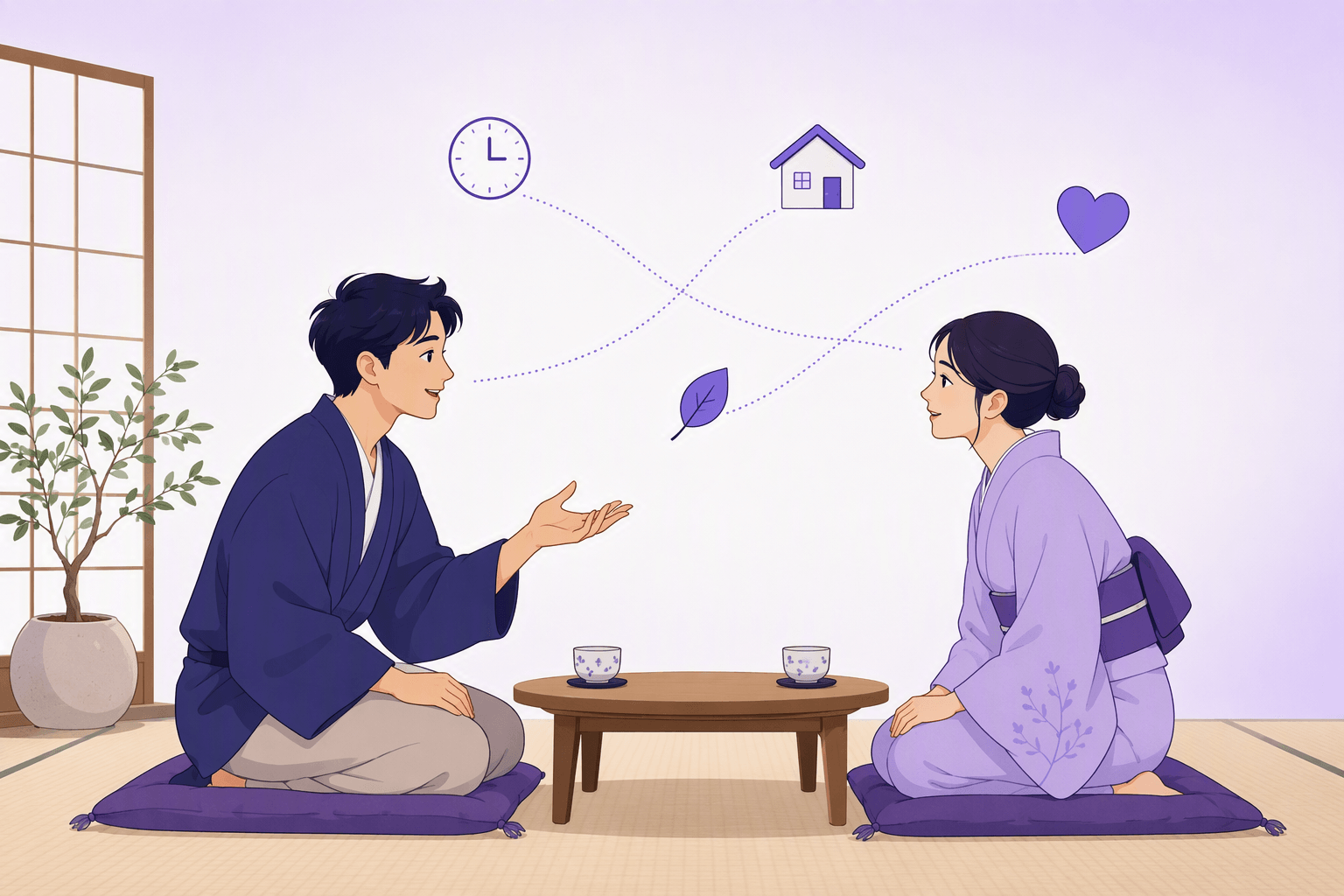
"Politeness is not something that is added on to language, it is built into the way interaction is organized."
Stephen C. Levinson, pragmaticist and co-author of Politeness: Some Universals in Language Usage (Brown & Levinson, 1987)
How Japanese sounds: pronunciation basics that actually matter
Japanese pronunciation is more consistent than English spelling, but it has a few traps. The good news is that once you learn the sound system, kana reading becomes predictable.
If you want a structured start, pair this overview with Wordy’s Japanese listening practice on real clips at /learn/japanese.
Mora timing (why Japanese rhythm feels different)
Japanese is often described as mora-timed. Practically, that means each kana beat tends to take similar time.
For learners, this shows up in words like とうきょう (Tokyo), pronounced "toh-kyoh" with a long vowel. If you rush long vowels, you can accidentally say a different word.
Long vowels
Long vowels are meaning-changing. For example, おばさん (oh-bah-san) and おばあさん (oh-bah-ah-san) are different words.
In katakana, long vowels are often marked with ー, as in コーヒー (KOH-hee) for coffee.
ん (the special "n")
The kana ん is not always a clean English "n". Before b, p, or m sounds, it often becomes more like "m".
Example: しんぶん (newspaper) is often heard like "sheem-boon" in natural speech.
Pitch accent (what to do as a learner)
Japanese has pitch accent, meaning the melody pattern can distinguish words. Beginners do not need to master it immediately, but you should train your ear early.
A practical approach is to imitate full phrases from native audio. Movie and TV clips help because you copy pitch, timing, and emotion together, not as isolated syllables.
The three Japanese writing systems (and what each one is for)
Japanese uses hiragana, katakana, and kanji in the same sentence. This is normal, not advanced.
The fastest way to reduce overwhelm is to learn what each system does, then learn them in the order that supports real reading.
Hiragana: the grammar backbone
Hiragana is used for:
- Grammar endings (like です, ます)
- Many common native words
- Furigana, the small kana above kanji that shows pronunciation
Hiragana is the first script most learners should master. It unlocks basic sentences and dictionary lookup.
If you are starting from zero, use our step-by-step guide: how to learn katakana, then circle back and make sure hiragana is equally automatic.
Katakana: loanwords, emphasis, and sound effects
Katakana is used for:
- Loanwords (コンピューター, "kohm-PYOO-tah")
- Foreign names (マリア, "mah-REE-ah")
- Onomatopoeia and manga sound effects (ドキドキ, "doh-kee-doh-kee")
- Visual emphasis, like italics in English
Katakana is also where pronunciation surprises happen. Loanwords are adapted to Japanese sound rules, so "McDonald’s" becomes マクドナルド (mah-koo-doh-NAH-roo-doh).
Kanji: meaning and efficiency
Kanji are characters with meaning, originally borrowed from Chinese writing and adapted over time. They let Japanese pack meaning into fewer symbols, which is why real Japanese text is not written only in kana.
A single kanji can have multiple readings. That sounds scary, but in practice you learn readings through words, not through isolated characters.
💡 The fastest way to learn kanji without burning out
Learn kanji as part of vocabulary you actually meet in context. If you learn 食べる (tah-BEH-roo) together with a clip where someone says it while eating, you remember meaning, sound, and usage at once.
Japanese sentence structure: what changes from English
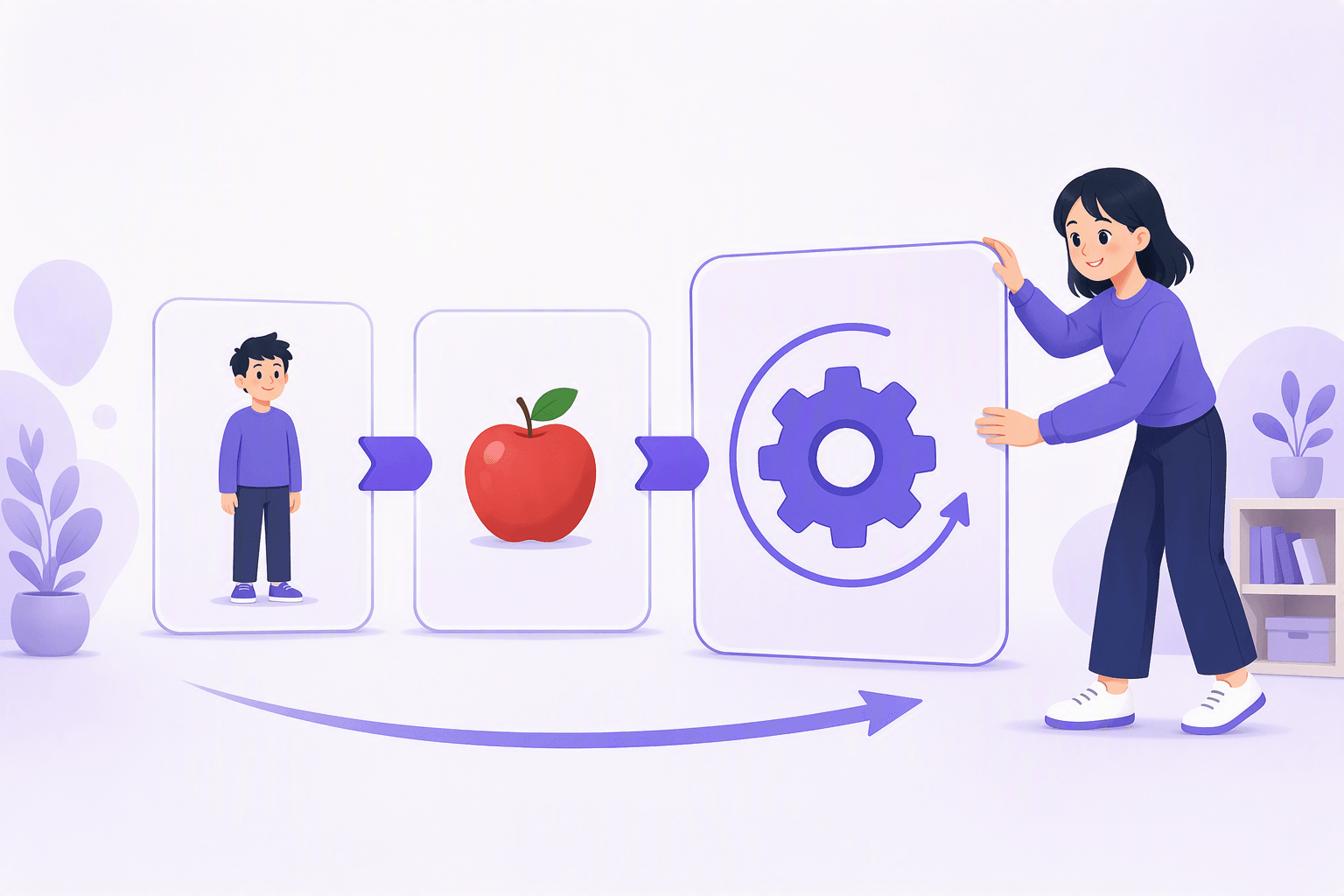
Japanese is typically described as SOV: subject, object, verb. The verb tends to come at the end, and particles mark grammatical roles.
You do not need to memorize a lot of theory, but you do need to accept that Japanese builds meaning differently.
Particles: the small words that carry the grammar
Particles like は (wa), が (ga), を (oh), に (nee), で (deh) tell you what a word is doing in the sentence.
A beginner-friendly mental model:
- は (wa) sets the topic, "as for X"
- が (ga) often marks the subject or highlights new information
- を (oh) marks the direct object
- に (nee) points to a time, destination, or target
- で (deh) marks where an action happens or the means
Particles are also where subtitles can mislead you. English translations often hide them, so you must learn them by hearing many examples.
Dropping pronouns
Japanese often avoids "you" (あなた, ah-NAH-tah) and even "I" (わたし, wah-TAH-shee). Using pronouns too much can sound stiff, intimate in the wrong way, or even confrontational.
In real dialogue, names, titles, or nothing at all are common. This is one reason learning from TV and movies is so effective: you see how relationships change word choice.
Politeness levels: the feature you cannot ignore
Politeness in Japanese is not just being "nice". It is a grammatical system that signals social distance, role, and situation.
You will hear at least three broad styles early:
- Casual (plain form)
- Polite (です/ます, "des/mas")
- Honorific and humble language (敬語, keigo, "KAY-goh") in formal settings
Casual vs polite in one glance
Here is the same idea in two styles:
| Meaning | Casual | Pronunciation | Polite | Pronunciation |
|---|---|---|---|---|
| "I eat" | 食べる | tah-BEH-roo | 食べます | tah-BEH-mahs |
| "I went" | 行った | EE-ttah | 行きました | ee-kee-MAH-shtah |
| "It's tasty" | おいしい | oh-EE-shee | おいしいです | oh-EE-shee des |
Casual is common among friends, family, and in inner thoughts. Polite is the safe default with strangers, coworkers, and service encounters.
Why keigo is hard, and how to approach it
Keigo is challenging because it is not one set of endings. It is a set of choices: honorific verbs, humble verbs, polite forms, and set phrases.
Do not try to "finish" keigo early. Learn the most common polite patterns first, then add keigo in chunks you actually need, like workplace greetings.
🌍 Service Japanese is its own dialect
In shops and restaurants, you will hear fixed expressions like いらっしゃいませ (ee-rah-SHAH-ee-MAH-seh). You are not expected to reply with the same phrase. A simple こんにちは (kohn-nee-CHEE-wah) or ありがとうございます (ah-ree-GAH-toh goh-zah-ee-MAHS) is enough.
Vocabulary: where Japanese is easier than you think
Japanese vocabulary has two big advantages for learners.
First, many everyday words are short and repeatable once you know kana. Second, loanwords in katakana can give you quick wins, even though they are "Japanized" in pronunciation.
Cognates, but with Japanese sound rules
Common examples:
- テレビ (teh-REH-bee) from "television"
- バス (bah-soo) from "bus"
- アイスクリーム (ah-ee-soo koo-REE-moo) from "ice cream"
These are not perfect English matches, but they are a real bridge. Learn them with audio so you do not pronounce them in an English way that Japanese listeners will miss.
Onomatopoeia is not optional
Japanese uses sound-symbolic words constantly, not only in manga. You will hear:
- ぺこぺこ (peh-koh-peh-koh), very hungry
- どきどき (doh-kee-doh-kee), heart pounding
- しーん (sheen), awkward silence
These words carry emotion and atmosphere. They are also extremely common in TV dialogue, which makes them perfect for clip-based learning.
If you like learning through anime specifically, start with our Japanese anime learning guide and anime vocabulary.
Common beginner mistakes (and how to fix them fast)
Most Japanese learning frustration is predictable. Fixing a few habits early saves months.
Mixing up は and が
Many learners want a single rule. Real Japanese uses both in nuanced ways.
A practical fix is to learn set patterns first, like:
- これはXです (koh-REH wah X des), "This is X"
- Xが好きです (X gah SOH-kee des), "I like X"
Then expand by imitation from real dialogue, not by overthinking.
Overusing あなた
In English, "you" is neutral. In Japanese, あなた can sound intimate, distant, or pointed depending on context.
Use names, titles, or omit the pronoun. You will hear this constantly in dramas and everyday speech.
Speaking too "textbook"
Textbook Japanese is often correct but stiff. Native speech uses contractions and rhythm changes.
Examples you will hear:
- じゃない (jah NAI) instead of ではない (deh wah NAI)
- てる (teh-roo) instead of ている (teh EE-roo)
💡 A simple rule for naturalness
Learn one polite version and one casual version of the same phrase, then practice switching based on who is speaking to whom. This mirrors how Japanese is actually used.
How to start learning Japanese in 2026 (a realistic plan)
A good plan balances three things: decoding (reading), comprehension (listening), and retrieval (speaking and writing). Most learners over-invest in one and neglect the others.
Step 1: Master kana quickly, then stop "studying" it
Aim to read hiragana and katakana without sounding out each character. For many learners, this takes 1 to 3 weeks of daily practice.
After that, keep kana alive by reading real words, not by doing endless charts.
Step 2: Build a high-frequency core vocabulary
Frequency matters because it multiplies your comprehension. A few thousand common words cover a large share of everyday dialogue.
For structured vocabulary building, you can also pair this overview with foundational lists like 100 most common French words as a model of how frequency lists work, even though the language differs.
Step 3: Listen every day, even when you understand little
Japanese is fast, and it compresses information through context. Daily listening trains your brain to segment words and particles.
Movie and TV clips are ideal because they give you:
- Clear situations
- Repeated phrases
- Emotional cues that make meaning stick
Wordy is built for this style of learning, with short clips and interactive subtitles at /learn/japanese.
Step 4: Add kanji gradually, tied to words you already know
Do not start with 2,000 kanji flashcards. Start with the kanji inside your most-used vocabulary.
When you learn 見る (MEE-roo, "to see"), you also learn that 見 carries a meaning related to seeing, and it appears in words you will meet again.
Step 5: Learn politeness as a skill, not a chapter
Politeness is not a one-time unit. It is a continuous choice.
A strong beginner milestone is being able to:
- Speak politely by default (です/ます)
- Understand casual speech in shows
- Switch to casual with friends if appropriate
Japanese through pop culture: what movies and anime teach well (and what they do not)
Japanese media is a powerful learning tool, but it is not a perfect mirror of daily life.
What you learn well from shows
You learn:
- Turn-taking and backchanneling (うん, ええ, そう)
- Apologies and softeners (すみません, ちょっと)
- Set phrases for greetings and goodbyes
To build that foundation, start with:
What you should treat carefully
Some characters speak in exaggerated styles, dialects, or rough masculine speech that can sound rude in real life.
Swearing is also portrayed differently across genres. If you are curious, read our guide to Japanese swear words, but treat it as cultural literacy, not a starter kit.
Love language is culturally loaded
English "I love you" is common. Japanese 愛してる (ah-EE-sheh-teh-roo) is strong and comparatively rare in everyday couples.
Many relationships use softer expressions, actions, or implied meaning. For a nuanced breakdown, see how to say I love you in Japanese.
A quick cultural map: what Japanese communication prioritizes
Japanese often prioritizes harmony, role awareness, and indirectness, especially in public or formal contexts. This does not mean people are dishonest, it means they manage friction differently.
Indirect refusals
Instead of a direct "no", you may hear:
- ちょっと… (CHOH-tto), "well, that's a bit..."
- 考えておきます (kahn-GAH-eh-teh oh-KEE-mahs), "I'll think about it"
Learning these patterns helps you understand real intent. It also prevents you from sounding blunt when you do not mean to.
Backchanneling (listening noises) is expected
In English, too many "uh-huhs" can feel interruptive. In Japanese, small responses show engagement.
Common ones:
- うん (oon), casual "yeah"
- へえ (heh-EH), "oh, really?"
- そうなんだ (SOH nahn-dah), "I see"
These are everywhere in natural dialogue, so they are high-value listening targets.
Keep going: the best next steps
If you want a clean learning path, do this next:
- Lock in greetings and daily phrases with audio.
- Build kana fluency and start reading simple captions.
- Listen to short clips daily and steal whole sentences, not single words.
For more Japanese-specific guides, browse the Wordy blog and keep your learning anchored in real speech, not only textbooks.
Frequently Asked Questions
How many people speak Japanese?
Is Japanese hard to learn for English speakers?
Do I need to learn kanji to learn Japanese?
What is the difference between hiragana and katakana?
What level of Japanese is needed to watch anime without subtitles?
Sources & References
- Ethnologue (SIL International), Ethnologue: Languages of the World, 27th edition, 2024
- The Japan Foundation, Survey Report on Japanese-Language Education Abroad, 2021
- National Institute for Japanese Language and Linguistics (NINJAL), Japanese language resources and research publications, accessed 2026
- Agency for Cultural Affairs (Japan), Japanese Language and Writing guidance and publications, accessed 2026
- Brown, P. & Levinson, S.C., Politeness: Some Universals in Language Usage, Cambridge University Press, 1987
Start learning with Wordy
Watch real movie clips and build your vocabulary as you go. Free to download.


