Quick Answer
Japanese listening practice works best when you use short, understandable clips repeatedly: first for the overall meaning, then for sounds and vocabulary, then without subtitles. Focus on rhythm, reductions, particles, and everyday reactions instead of trying to understand every word on the first listen.
Japanese listening practice improves fastest when you repeatedly work with short, understandable native clips instead of trying to survive long, difficult audio. Listen once for the situation, check a transcript or Japanese subtitles, replay until the sounds become words, then listen again without support. This method trains the exact skill learners need: recognizing Japanese in real time.
Japanese has roughly 123 million first-language speakers, overwhelmingly centered in Japan, according to Ethnologue's 27th edition. That concentration means learners can access an enormous range of native media, from public broadcasting and street interviews to dramas, gaming streams, podcasts, and everyday conversation.
The hard part is not a lack of material. It is choosing audio at the right level and using it actively. If you have only been reading beginner dialogues, start by strengthening sound awareness with Japanese pronunciation fundamentals before expecting yourself to follow fast television dialogue.
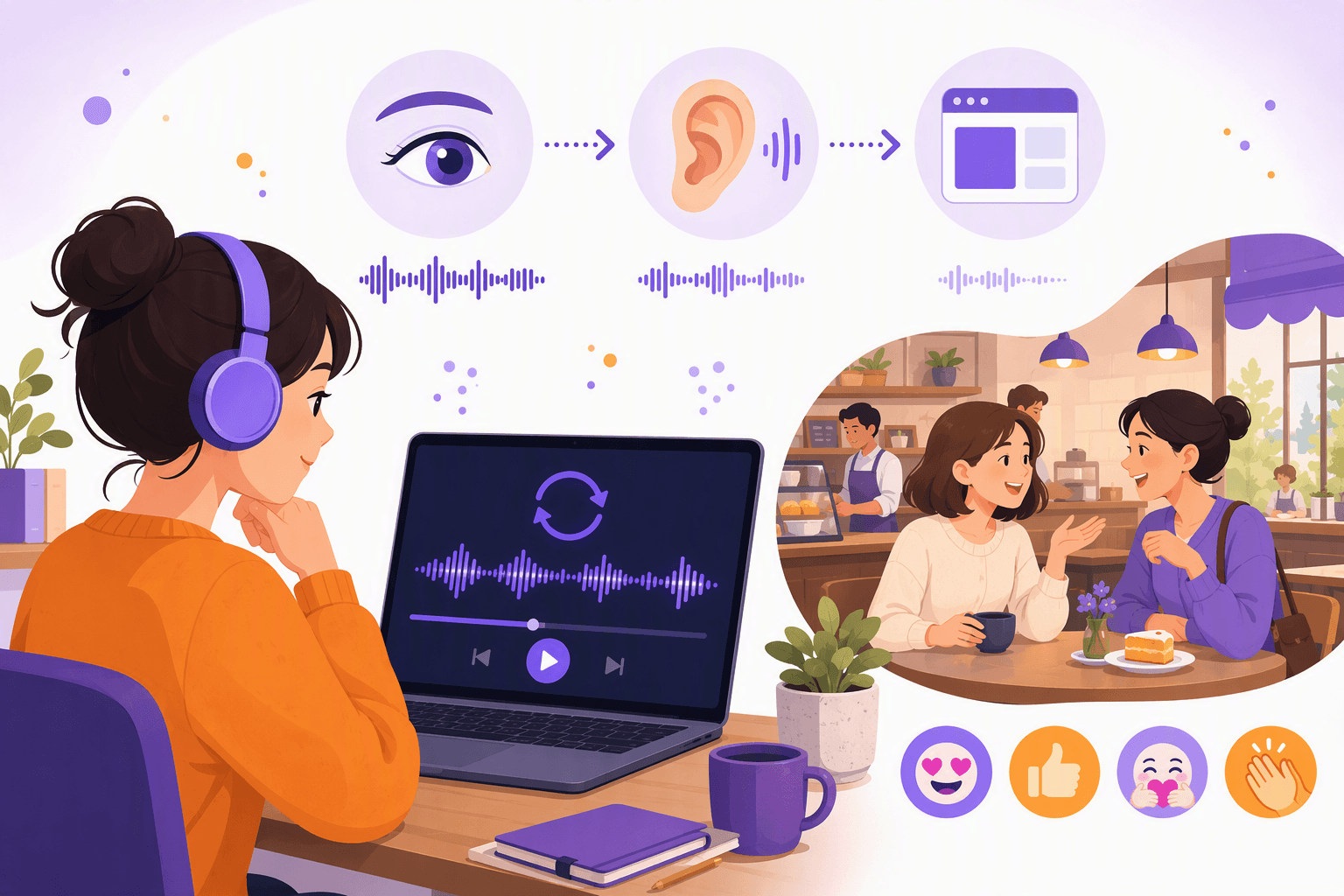
Why Japanese Listening Feels So Difficult
Japanese listening is demanding for reasons that are different from kanji, grammar drills, or textbook reading. Native speech does not arrive in neat units with vocabulary glosses and pauses between words.
Japanese has no audible spaces
In writing, spaces are rare, but kanji, kana, punctuation, and line breaks still help your eyes identify units. In speech, a sentence such as 日本語を勉強しています, /nihoŋɡo o beŋkjoː ɕiteimasɯ/, comes as one connected stream.
A learner who knows 日本語, /nihoŋɡo/, and 勉強する, /beŋkjoː sɯɾɯ/, can still miss the sentence because they have not yet built automatic recognition. Listening practice turns familiar vocabulary into instantly recognizable sound patterns.
Everyday speech leaves things unsaid
Japanese speakers commonly omit subjects and objects when context makes them obvious. Instead of repeating 私は, /watɕi wa/, a speaker may simply say 行ったよ, /itta jo/, meaning that they went, but leaving the person understood from the conversation.
That omission is efficient for native speakers, but it can unsettle learners who wait for an explicit subject. Train yourself to ask who is being discussed, what happened, and how the speaker feels before translating every clause.
Sounds change in fast speech
Words can blend together, vowels can weaken, and common patterns can contract. The formal phrase ではありません, /dewa aɾimasẽɴ/, is often heard as じゃありません, /dʑa aɾimasẽɴ/, in ordinary speech.
Likewise, ている, /te iɾɯ/, frequently becomes てる, /teɾɯ/. A character saying 何してるの, /naɲi ɕiteɾɯ no/, may be much harder to catch than the textbook form 何をしていますか, /naɲi o ɕiteimasɯ ka/.
Rhythm matters more than stress
Japanese is mora-timed: each mora, or timing unit, has a place in the rhythm. Long vowels, the final nasal ん, /ɴ/, and small っ, /Q/, all take timing.
For example, 学生, /ɡakɯseː/, has four morae: が, く, せ, い. Say it as gahk-KOO-say, not as one compressed syllable. The listening benefit is immediate: when your mouth can track the rhythm, your ear can better segment it.
💡 Do not chase every word
Your first task is to identify the situation, relationship, emotional tone, and key action. Native listeners also use context to interpret incomplete sentences. Build the habit of understanding the message before analyzing every grammar point.
The Three-Pass Method for Japanese Listening Practice
The most reliable routine uses the same short clip several times with a different goal each time. A clip of 10 to 45 seconds is enough. It could be a drama exchange, a creator's introduction, a scene from a film, or an everyday conversation recording.
Listening researchers Larry Vandergrift and Christine Goh emphasize that effective listening instruction includes planning, monitoring, and evaluation. In practical terms, this means listening with a purpose, checking what happened, and identifying why a section was difficult.
Pass one: listen for the scene
Listen without pausing and without subtitles. Do not write anything down yet.
Ask four simple questions:
- Who is talking?
- Where are they?
- What is the main topic?
- Is the mood friendly, tense, surprised, embarrassed, or formal?
If you understand only 40 to 60 percent, that is often a productive difficulty level. If you understand almost nothing, choose easier material. If you understand every line instantly, use the clip for fluency and pronunciation rather than discovery.
Pass two: confirm the words
Now turn on Japanese subtitles or use a transcript. Read while listening, and mark three kinds of gaps:
- Words you know but did not recognize by sound
- Grammar or vocabulary you do not know
- Connected speech that looked different from what you expected to hear
Do not create a list of 25 new words from one clip. Pick three to five high-value expressions, especially phrases that recur in ordinary conversation.
Pass three: replay and shadow
Listen again without reading. Pause after one line, then repeat it aloud with the speaker's timing, pitch movement, and pauses.
This is shadowing in a manageable form. You do not need a perfect imitation. The point is to connect hearing, processing, and producing the same sequence quickly.
For a wider explanation of this clip-based approach, see our guide on learning Japanese with anime. Anime can provide memorable scenes, but choose clips with clear everyday context rather than battle speeches or exaggerated character voices.
Learn to Catch the Signals That Organize Conversation
Japanese listeners do not decode every sound from scratch. They notice small markers that predict what comes next: agreement, hesitation, contrast, surprise, a request, or a change of topic.
| English | Japanese | Pronunciation | Note |
|---|---|---|---|
| Well, you know | あの | ah-NOH | A filler used while thinking or introducing a topic. |
| Um | えっと | EH-toh | A hesitation marker before a response. |
| I see | なるほど | nah-roo-HOH-doh | Signals understanding, often after an explanation. |
| Really? | マジで | MAH-jee deh | Casual surprise or disbelief. |
| But | でも | DEH-moh | Introduces contrast or a soft objection. |
| So | だから | dah-KAH-rah | Marks a reason or conclusion. |
| That is why | だからさ | dah-KAH-rah sah | Casual continuation, often heard in animated conversation. |
| Right? | だよね | dah yoh-NEH | Invites agreement or checks shared understanding. |
あの
The filler あの, /ano/, does not usually carry content by itself. It buys the speaker time or gently opens a topic, much like a hesitation marker in English.
When you hear it, do not wait for a dictionary meaning. Treat it as a sign that the important phrase is about to arrive.
なるほど
なるほど, /naɾɯhodo/, signals that a speaker has understood an explanation or recognized a point. It is common in interviews, workplace talk, and friendly conversation.
Because it often comes after someone explains something, it helps you identify the structure of a scene even when the explanation itself was difficult.
だよね
だよね, /da jo ne/, combines an assertion with a request for agreement. It is conversational and relationship-sensitive: the speaker assumes the listener shares the perspective.
A line ending in だよね, /da jo ne/, is not merely factual. It often carries warmth, reassurance, or an invitation to agree.
🌍 Listening means hearing relationships
Japanese speech changes according to social distance, age, setting, and role. A manager, a close friend, and a fictional school rival may express the same idea with different endings. Notice whether a speaker uses です, /desɯ/, plain forms, honorific language, or casual contractions before copying a phrase yourself.
Build a 30-Minute Daily Routine
Consistency matters more than heroic study sessions. The Japan Foundation's JLPT materials show that listening tasks require several abilities at once: understanding an overall situation, identifying key details, following an immediate response, and processing natural-speed exchanges.
Use this 30-minute routine five days a week.
| Minutes | Activity | What to do |
|---|---|---|
| 5 | Warm-up | Listen to familiar audio with no subtitles |
| 10 | Focus clip | Use the three-pass method on one short clip |
| 5 | Phrase review | Rehear and repeat three useful expressions |
| 5 | Easy listening | Follow simpler content for overall meaning |
| 5 | Reflection | Note one sound pattern and one comprehension gap |
The final five minutes are more valuable than they look. Write a specific observation such as: I missed てる, /teɾɯ/, because I expected ている, /te iɾɯ/. That turns a vague sense of failure into a skill you can train tomorrow.
Choose Material by Level, Not by Popularity
The best Japanese audio is not necessarily the most famous show, the fastest podcast, or the most difficult news program. It is material where you understand enough to make useful predictions.
Beginner: predictable situations
Use greetings, shopping exchanges, self-introductions, weather, routines, and classroom-style conversations. You should be able to infer much of the scene from a few known words.
Practice basic social phrases until they are audible as whole units. For example, こんにちは, /koɲɲitɕiwa/, is pronounced kohn-NEE-chee-wah, and ありがとうございます, /aɾiɡatoː ɡozaimasɯ/, is ah-ree-GAH-toh goh-zah-ee-MAHSS. Review practical greetings through our guide to saying hello in Japanese.
Intermediate: scripted natural dialogue
Dramas, slice-of-life anime, vlogs, cooking videos, and interviews are useful here. They provide visual context, recurring speakers, and enough natural overlap to stretch your listening.
Choose scenes about everyday problems: meeting someone, making plans, apologizing, ordering food, or discussing work. Emotional scenes help memory because tone makes intentions clearer.
Advanced: unscripted and specialized audio
At higher levels, use radio discussions, news analysis, comedy, gaming streams, documentaries, and podcasts. These add interruptions, references, regional accents, and topic-specific vocabulary.
The National Institute for Japanese Language and Linguistics developed the Corpus of Everyday Japanese Conversation to document real interaction. Real conversation is messier than textbook dialogue: people restart sentences, overlap, laugh, trail off, and rely heavily on shared context. That messiness is exactly what advanced learners need to experience.
Use Subtitles Without Becoming Dependent on Them
Subtitles are a tool, not a test failure. The problem is not using them. The problem is leaving them on from the first second and never returning to sound-only listening.
Use this order:
- No subtitles for a first impression
- Japanese subtitles to verify sounds and wording
- No subtitles again to test recognition
- Optional native-language subtitles only if the scene's meaning remains unclear
Japanese subtitles are generally better for learning than English subtitles because they make the spoken form visible. They also reveal particles, sentence endings, and contractions that English translation may omit.
For example, a translation might render もう帰るの, /moː kaeɾɯ no/, simply as “Are you leaving already?” The Japanese line contains もう, /moː/, “already,” 帰る, /kaeɾɯ/, “leave or go home,” and の, /no/, which softens or marks the question. Seeing the text lets you reconnect those pieces to the sound.
Stop Treating Every Unknown Word as the Problem
A missed word may not be the reason you failed to understand. Often the real obstacle is one of these:
- You did not recognize a word you already studied.
- You lost track of who was being discussed.
- You missed a sentence-ending cue.
- You expected formal Japanese but heard casual Japanese.
- You tried to translate before the next phrase arrived.
John Field's Listening in the Language Classroom distinguishes between bottom-up processing, recognizing sounds and words, and top-down processing, using context and expectation. Strong Japanese listeners use both at once.
If two friends walk into a restaurant and one says お腹すいた, /onaka sɯita/, you do not need to identify every phonetic detail to predict that food may be discussed. Context gives your ear a useful head start.
⚠️ Do not copy every line from fiction
Some media contain insults, gendered character speech, rough first-person pronouns, or language designed to establish a dramatic persona. Learn to recognize it, but do not assume it is safe for everyday use. Our Japanese swear words guide explains why tone and relationship matter so much.
Measure Progress the Right Way
Do not measure listening progress by asking whether you understood a brand-new native podcast perfectly. Measure whether an old clip that once sounded like noise now sounds segmented and meaningful.
Keep a small listening log with these columns:
| Clip | First-listen understanding | New recognition | Next focus |
|---|---|---|---|
| Café scene | Main topic only | Heard じゃ, /dʑa/, clearly | Practice casual negatives |
| Vlog introduction | About 70 percent | Caught なるほど, /naɾɯhodo/ | Follow connectors |
| Drama scene | Mood and key action | Heard てる, /teɾɯ/ | Track omitted subjects |
After two weeks, revisit the same material without subtitles. Familiarity is not cheating. It proves that your brain has created faster sound-to-meaning connections.
A Better Long-Term Goal Than Perfect Understanding
Your aim is not to understand every word from every Japanese speaker. Native speakers do not always catch every line in a noisy station announcement, a regional comedy show, or a technical discussion.
Aim to become comfortable with uncertainty. Catch the main meaning, recognize high-frequency chunks, use context, and ask for clarification when needed. Phrases for parting and reconnecting with people matter too, so practice natural Japanese goodbyes alongside your listening routine.
Short, repeated clips give you the strongest foundation. Once everyday speech begins to sound like connected language rather than a blur, longer shows, podcasts, and conversations become far more rewarding.
Frequently Asked Questions
How can I improve Japanese listening quickly?
Why can I read Japanese but not understand it when spoken?
Should I use Japanese subtitles when practicing listening?
How much Japanese listening should I do every day?
Is anime good for Japanese listening practice?
Sources & References
- Ethnologue, Japanese, 27th edition, 2024
- The Japan Foundation, Japanese-Language Proficiency Test Official Practice Workbook, accessed 2026
- National Institute for Japanese Language and Linguistics, Corpus of Everyday Japanese Conversation, accessed 2026
- NHK Broadcasting Culture Research Institute, Japanese Language Resources, accessed 2026
- Vandergrift and Goh, Teaching and Learning Second Language Listening, Routledge
Start learning with Wordy
Watch real movie clips and build your vocabulary as you go. Free to download.


