Japanese Hanami Culture: How Cherry Blossom Viewing Really Works (and What to Say)
Quick Answer
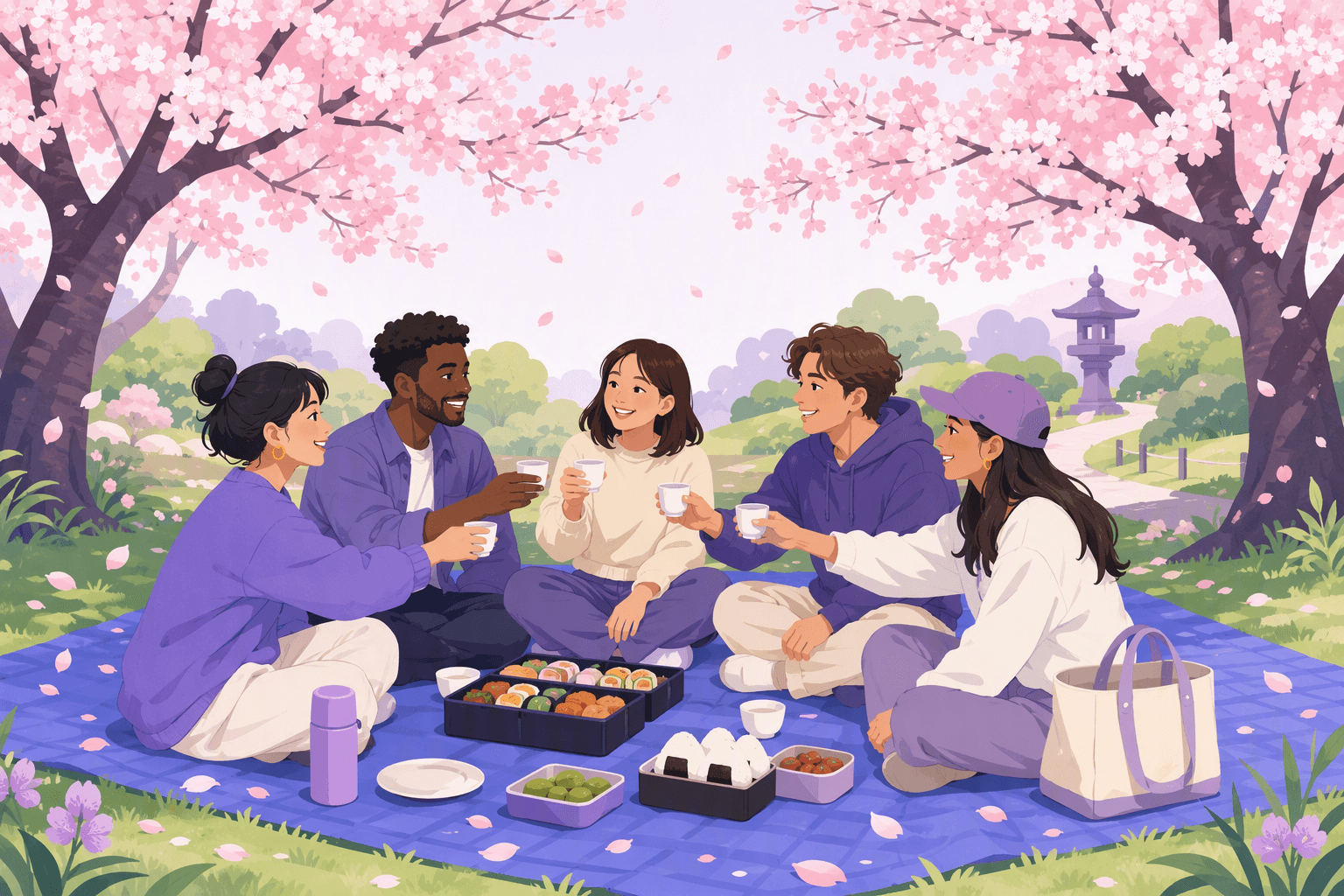
Hanami (花見, hah-NAH-mee) is Japan's tradition of gathering to view cherry blossoms, usually with a picnic under sakura trees. In practice, it is equal parts seasonal appreciation and social event: reserving a spot, sharing food and drinks, and using polite, low-pressure conversation. This guide explains what happens at hanami, the etiquette that matters, and the Japanese phrases you will actually hear.
Hanami (花見, hah-NAH-mee) is Japan's tradition of gathering to view cherry blossoms, usually by eating and drinking under sakura trees, and it comes with a few social rules: arrive prepared, keep the space tidy, respect the trees and neighbors, and use friendly, low-pressure Japanese like お疲れ様 (oh-TSOO-kah-reh-SAH-mah) and 乾杯 (kahn-PAH-ee) to fit in naturally.
Japan has about 123 million people, and Japanese is spoken by roughly 123 million speakers worldwide (Ethnologue, 27th edition, 2024). That scale matters because hanami is not a niche custom, it is a nationwide seasonal habit, from family strolls to company parties.
If you want a quick refresher on basic greetings before you go, start with how to say hello in Japanese. For leaving politely at the end of the night, how to say goodbye in Japanese pairs well with the hanami phrases below.
| English | Japanese | Pronunciation | Formality |
|---|---|---|---|
| Cherry blossom viewing | 花見 | hah-NAH-mee | casual |
| Cherry blossoms | 桜 | sah-KOO-rah | casual |
| Full bloom | 満開 | mahn-KAI | polite |
| Let's do a toast | 乾杯しよう | kahn-PAH-ee shee-YOH | casual |
| Cheers! | 乾杯 | kahn-PAH-ee | polite |
| Thanks for your hard work | お疲れ様 | oh-TSOO-kah-reh-SAH-mah | polite |
| Excuse me / sorry | すみません | soo-mee-mah-SEN | polite |
| Thank you very much | ありがとうございます | ah-ree-GAH-toh goh-zah-ee-MAHSS | formal |
What hanami actually is (beyond "looking at flowers")
Hanami is seasonal appreciation, but it is also social choreography. People go because the blossoms are beautiful, and because spring is a culturally safe excuse to gather without a big reason.
You will see two main styles. The first is walking hanami, a stroll along a river or through a park, maybe with a coffee. The second is picnic hanami, sitting on a tarp (often blue) with food, drinks, and a group.
Why sakura feels so big in Japan
Cherry blossoms are brief, and that short peak is part of the point. The Japan Meteorological Agency tracks blossom observations, and many people follow the updates like a seasonal calendar (Japan Meteorological Agency, accessed 2026).
In cultural history, sakura has been linked to ideas of impermanence and seasonal change. If you have read Donald Keene's work on Japanese aesthetics, you will recognize how often Japanese literature returns to seasonal imagery as a way to talk about emotion without stating it directly.
Hanami is not one event, it is many micro-events
A hanami "party" can be four friends sharing convenience-store snacks, or a large company group with a designated organizer. The etiquette you need depends on which one you are in.
If you are invited by coworkers, treat it like a work-adjacent event. If you are going with friends, it is looser, but cleanliness and consideration still matter.
When hanami happens: sakura season and timing
Most visitors plan for "late March to early April," but Japan stretches far north to south. Blooming typically starts earlier in Okinawa and later in Tohoku and Hokkaido, and the timing shifts year to year.
The practical rule is: plan around forecasts, but accept uncertainty. Locals do the same, which is why you will hear people talk about 満開 (mahn-KAI), "full bloom," and also 散る (chee-roo), "to fall," when petals start dropping.
💡 A realistic planning mindset
If you only have one travel week, pick a region and plan flexible day trips rather than chasing blossoms across the country. Locals often do hanami in their nearest park, not at a famous spot.
Where hanami happens: parks, rivers, shrines, and "everyday" spots
Tourist guides highlight famous places, but most hanami is local. Neighborhood parks, university campuses, and riverside paths often have better vibes than crowded headline locations.
The Japan National Tourism Organization summarizes major viewing areas and the general season (JNTO, accessed 2026). Use that for inspiration, then ask locals where they go after work.
Day hanami vs 夜桜
夜桜 (yo-ZAH-koo-rah) means "night sakura." You may see lanterns and light-ups, especially in big parks.
Night viewing can feel more festive, but also louder. If you prefer calm, go early morning, when runners and dog-walkers share the space and the light is soft.
The social mechanics: how a hanami picnic works
If you have never done a Japanese group picnic, the biggest surprise is how organized it can be.
Someone arrives early to reserve a spot. People bring food and drinks, and there is usually a shared understanding that you contribute something, even if it is small.
場所取り: reserving the spot
場所取り (bah-SHOH-toh-ree) is "spot saving." In some groups, a junior employee is asked to do it, which is why you will hear jokes about it.
If someone did this for your group, acknowledge it. お疲れ様 (oh-TSOO-kah-reh-SAH-mah) is a natural, socially safe phrase that fits work groups and friend groups.
/oh-TSOO-kah-reh-SAH-mah/
Literal meaning: You must be tired, thanks for your effort
“場所取り、お疲れ様!”
Thanks for saving the spot!
A high-frequency phrase in Japan for acknowledging effort. At hanami, it is perfect for the person who arrived early, carried supplies, or organized the group.
Food culture: why hanami snacks look the way they do
Hanami food is portable, shareable, and low-mess. Bento, fried chicken, onigiri, and seasonal sweets show up because they travel well and work for groups.
Seasonal foods are part of the pleasure. If you see 桜餅 (sah-KOO-rah moh-CHEE), it is a spring sweet associated with sakura season.
In broader context, Japanese seasonal eating is often discussed through the lens of washoku, which UNESCO lists as an Intangible Cultural Heritage emphasizing seasonality and social practice (UNESCO, accessed 2026). Hanami fits that pattern: food, season, and community in one place.
Drinks and toasts
乾杯 (kahn-PAH-ee) is the standard toast. If you are with coworkers, wait until the group is ready, and follow the lead of the most senior person.
If you do not drink alcohol, it is usually fine to toast with a soft drink. The key is participating in the moment, not what is in your cup.
/kahn-PAH-ee/
Literal meaning: A toast
“じゃあ、乾杯!”
Alright, cheers!
Used for toasts in casual and formal settings. At hanami, it often marks the 'start' of the picnic even if people were already chatting.
Hanami etiquette that actually matters
Most hanami etiquette is not mysterious. It is the same public-space logic as anywhere, but Japan tends to enforce it socially rather than through confrontation.
Protect the trees, do not treat sakura like props
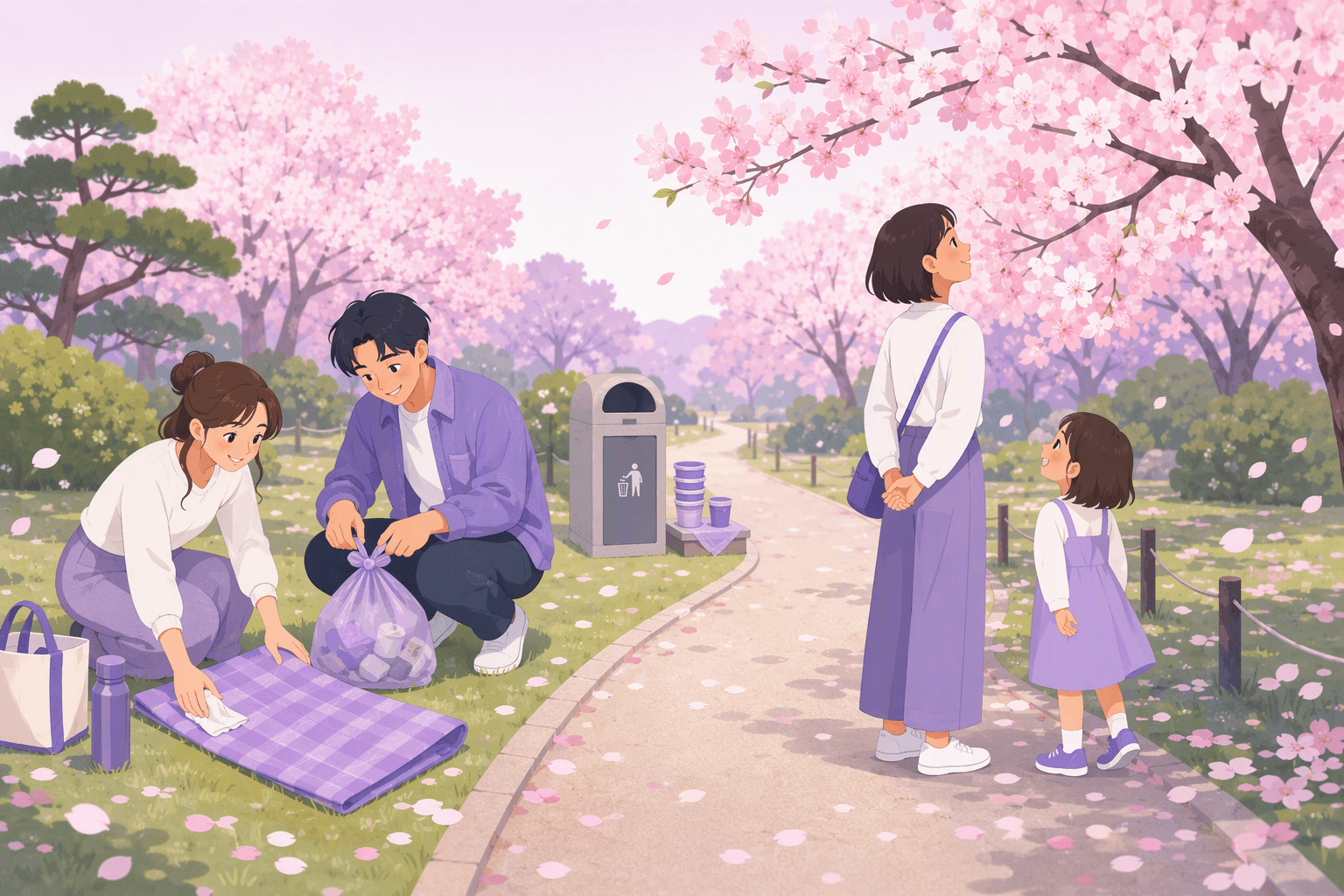
Do not climb trees, break branches, or shake them for petals. Even if you see someone doing it, it is still a bad look.
A good mental model comes from sociologist Erving Goffman's work on face and public behavior: people try to avoid scenes that force others to react. Damaging trees or being disruptive creates a situation where someone must correct you, which is exactly what most people want to avoid.
Clean up completely
Bring a trash bag. If bins are full, take your trash with you.
Many parks have specific rules during blossom season, including restrictions on grills, amplified music, and alcohol. Follow posted signs, and if you are unsure, ask staff with すみません (soo-mee-mah-SEN).
/soo-mee-mah-SEN/
Literal meaning: Excuse me
“すみません、ゴミはどこに捨てますか?”
Excuse me, where do we throw away trash?
A versatile phrase for getting attention politely, apologizing lightly, or asking for help. At hanami, it is the safest way to approach staff or nearby groups.
Noise and space: the invisible boundary
Hanami can be lively, but there is still an expectation of not spilling into other groups' space. Keep your tarp footprint reasonable, and do not block walking paths.
If you are in a crowded park, assume your voice carries. If you want a louder party vibe, choose a location known for it, or go to an izakaya after.
Bathroom strategy is part of etiquette
This sounds minor, but it affects everyone. Public toilets get crowded during peak bloom weekends.
Go before you settle in, and keep tissues and hand sanitizer. Planning this quietly is one of the easiest ways to be the "good guest" without saying much.
What to say at hanami: natural Japanese that fits the moment
You do not need poetic Japanese. Simple, situational phrases are what people actually use.
花見
花見 (hah-NAH-mee) is the word you will hear most. It can mean the act of viewing, the picnic, or the whole event.
If you want to sound natural, pair it with verbs like する (to do) or 行く (to go): 花見する, 花見に行く.
桜
桜 (sah-KOO-rah) is "cherry blossoms" or "cherry tree," depending on context. People often say 桜がきれい (the blossoms are pretty) or 桜が咲いた (they bloomed).
If you are learning Japanese through media, you will hear 桜 used as a seasonal marker in dramas and anime. For more media-based learning ideas, browse the Japanese language overview and then pick a clip-based routine that matches your level.
満開
満開 (mahn-KAI) means "full bloom." It is common in weather updates and casual talk.
It is also a safe conversation starter with strangers: 今年、満開早いですね, "Full bloom is early this year, huh."
夜桜
夜桜 (yo-ZAH-koo-rah) is night viewing. If you see a poster for a light-up, it may mention 夜桜ライトアップ.
If you are inviting someone, 夜桜見に行かない? is casual and friendly.
ありがとうございます
ありがとうございます (ah-ree-GAH-toh goh-zah-ee-MAHSS) is your all-purpose gratitude. Use it when someone shares food, makes space, or helps you find something.
If you want a deeper set of gratitude expressions, pair this article with how to say thank you in Japanese.
/ah-ree-GAH-toh goh-zah-ee-MAHSS/
Literal meaning: Thank you
“飲み物、ありがとうございます。”
Thank you for the drink.
A default polite thank you. At hanami, it is especially useful because sharing is constant, and small thanks keep the atmosphere smooth.
Hanami conversation topics that feel natural (and safe)
If you are not sure what to talk about, Japanese small talk often leans on shared context: weather, season, food, and logistics.
These topics work well:
- The blossoms: 満開, petals falling, how long it will last
- Food: what someone brought, where they bought it
- Plans: where to go next, what time to leave
- Work-friendly: how busy things are lately, without complaining too hard
💡 A simple conversation formula
Comment plus soft agreement works well: "きれいですね" plus "ですよね". You do not need long sentences to sound friendly.
Hanami and politeness: why the vibe is friendly but not intimate
Hanami is social, but it is not automatically personal. You can be warm without oversharing.
Linguist Haruo Shirane's writing on classical Japanese literature highlights how seasons and nature imagery carry emotional weight in Japanese culture. In modern hanami, that shows up as indirectness: people can express feeling through the scene itself, not through direct statements.
If you are with someone you like, keep it light. If you want romantic language, learn it separately and use it in the right context, not as a public performance. For that, how to say I love you in Japanese is a better fit than trying to force romance into a group picnic.
Common mistakes visitors make (and how to avoid them)
Treating hanami like a photoshoot first, picnic second
Photos are fine, but do not monopolize space or block paths for long. Take your shots, then step aside.
If you are in a shrine or temple area, be extra careful. Quiet respect is part of the atmosphere.
Over-drinking in public
Some groups drink a lot, but public self-control is still expected. If you are not sure, match the pace of the group.
If you need to decline, a simple 今日は控えます (I will take it easy today) is usually enough.
Bringing nothing
You do not need to bring a fancy dish. Snacks, drinks, cups, wet wipes, or a trash bag are all valuable.
If someone insists you do not need to bring anything, bring something small anyway. It signals awareness.
Using aggressive language because you heard it in anime
Hanami is not the place to test edgy vocabulary. If you are curious about what not to say, our guide to Japanese swear words explains severity and context so you can recognize words without accidentally using them.
A simple hanami checklist (what locals actually pack)
Keep it practical:
- A tarp (or a small picnic mat)
- Trash bags (at least two)
- Wet wipes, tissues, hand sanitizer
- Drinks and cups
- Easy share food (onigiri, snacks)
- A light jacket, evenings get cold in early spring
- Portable phone charger
If you are going at night, add a small light. If you are going with kids, add extra wipes and a change of clothes.
Learning Japanese through hanami scenes in movies and TV
Hanami scenes are common because they give writers a ready-made setting: groups, transitions, confessions, goodbyes. You will hear seasonal vocabulary and polite group language in a single scene.
This is where clip-based learning shines. If you like studying through real dialogue, build a small deck of phrases from hanami scenes and review them with spaced repetition. If you use Anki, our Anki for language learning guide shows how to keep cards short and audio-first.
🌍 Why hanami dialogue is learner-friendly
Hanami scenes often include repeated, predictable lines: greetings, compliments about the blossoms, offers of food, and polite thanks. That repetition makes it easier to notice pronunciation and rhythm, especially if you rewatch short clips.
Closing: how to enjoy hanami without overthinking it
Hanami is simple: show up, appreciate the blossoms, contribute to the group, and leave the place cleaner than you found it. If you can say 花見 (hah-NAH-mee), 桜 (sah-KOO-rah), 乾杯 (kahn-PAH-ee), and お疲れ様 (oh-TSOO-kah-reh-SAH-mah), you can handle most real situations politely.
When you are ready to expand beyond seasonal talk, keep your basics sharp with how to say hello in Japanese and how to say goodbye in Japanese, then start collecting phrases from real scenes you enjoy. For more Japanese learning paths, browse the Japanese learning page.
Frequently Asked Questions
What does hanami mean in Japanese?
Is hanami only for cherry blossoms?
What is the most important hanami etiquette rule?
Do Japanese people drink alcohol at hanami?
When is the best time to see cherry blossoms in Japan?
Sources & References
- Japan Meteorological Agency, 'Cherry Blossom (Sakura) Information', accessed 2026
- Japan National Tourism Organization (JNTO), 'Cherry Blossoms (Sakura)', accessed 2026
- UNESCO, 'Washoku, traditional dietary cultures of the Japanese', accessed 2026
- Ethnologue, 27th edition, 2024
Start learning with Wordy
Watch real movie clips and build your vocabulary as you go. Free to download.


