Quick Answer
To learn Japanese fast, focus on three levers: (1) reading basics (hiragana and katakana) in the first week, (2) high-frequency vocabulary and sentence patterns, and (3) daily listening to real spoken Japanese with repeatable clips. Japanese has about 125 million native speakers (Ethnologue, 27th ed., 2024), so your biggest speed boost comes from building comprehension early so you can learn directly from native media instead of translating in your head.
Learning Japanese fast means doing the right things in the right order: learn kana first, build a small set of high-frequency words and sentence patterns, and then spend daily time listening to real Japanese you can replay and understand. A realistic “fast” timeline is 90 days to reach survival conversation and strong beginner listening, if you study most days and prioritize comprehension over memorizing isolated facts.

What “fast” actually looks like for Japanese
“Fast” does not mean fluent in a month.
It means you stop wasting time on low-return tasks and you build momentum, so every week makes the next week easier.
Japanese is spoken by about 125 million native speakers (Ethnologue, 27th ed., 2024). That scale matters because it means there is endless native content, but you only benefit once you can decode it.
The three speed levers
-
Decoding: kana reading, basic pronunciation, and the ability to hear word boundaries.
-
Frequency: the words and patterns you meet constantly, not rare textbook vocabulary.
-
Repetition with meaning: replaying short, understandable chunks until they become automatic.
This aligns well with Stephen Krashen’s work on comprehensible input: you improve fastest when you understand messages, not when you only manipulate rules.
A quick reality check on time and consistency
If you can do 60 minutes/day, you can move quickly.
If you can do 20 minutes/day, you can still progress, but “fast” becomes “steady.”
💡 The fastest learners do fewer things
Pick one structured path for grammar, one system for vocabulary, and one daily listening routine. The speed killer is collecting resources and switching methods every week.
The 90-day plan (what to do each week)
This plan assumes you are starting from zero or near zero.
If you already know kana, start at Day 8.
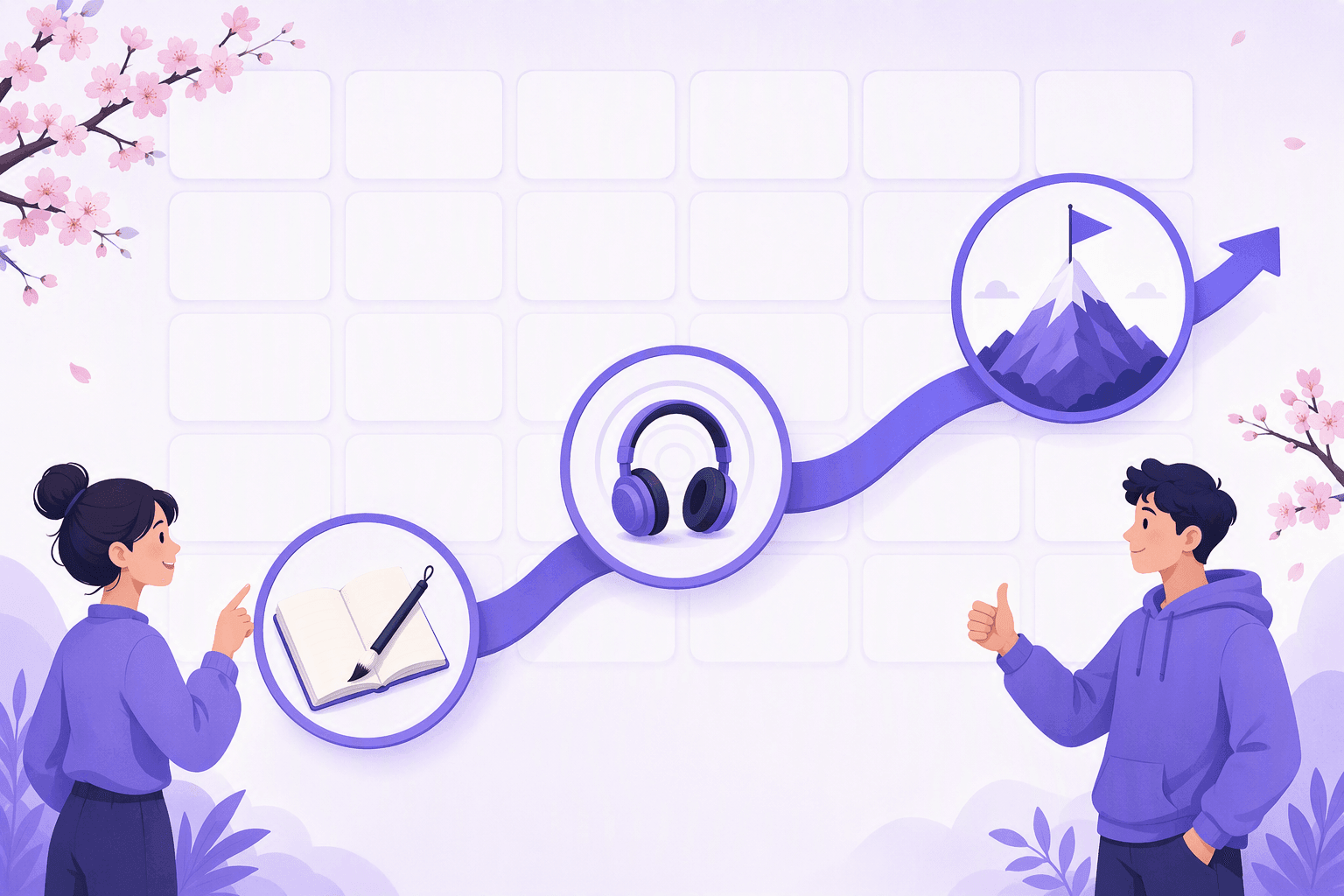
Days 1 to 7: Kana, sound system, and your first real phrases
Your goal is not pretty handwriting.
Your goal is to read and recognize kana quickly enough that subtitles and dictionaries are usable.
Learn hiragana and katakana in parallel
Many learners do hiragana first, then katakana.
That works, but parallel learning keeps you from treating katakana as “optional,” and katakana appears everywhere in modern Japanese.
Use a strict loop: learn a small set, read them in words, then write them once or twice.
If you want a structured plan, see how to learn hiragana and how to learn katakana.
Build a tiny “starter deck” of spoken phrases
Do not wait until you “know grammar” to speak.
Start with phrases you will actually hear in shows and daily life.
Here are four that appear constantly, with mora-accurate pronunciation:
| English | Japanese | Pronunciation | Formality |
|---|---|---|---|
| Hello | こんにちは | kohn-NEE-chee-wah | polite |
| Thank you (polite) | ありがとうございます | ah-ree-GAH-toh goh-zah-ee-MAHSS | formal |
| Excuse me / sorry | すみません | soo-mee-mah-SEN | polite |
| Nice to meet you (set phrase) | よろしくお願いします | yoh-roh-SHEE-koo oh-neh-GAH-ee-shee-mahss | formal |
Pair this with a deeper greeting guide: how to say hello in Japanese.
Days 8 to 30: Core grammar patterns and high-frequency vocabulary
This is where most learners slow down, because they try to learn everything.
Instead, learn a small number of patterns that generate lots of sentences.
Use one beginner grammar spine
Pick one beginner textbook or course and finish the first chunk.
The point is not to “collect grammar,” it’s to stop guessing.
Tae Kim’s Guide to Japanese Grammar is a common free reference, and Genki is a common classroom text. Choose one and commit for 30 days.
Learn words as parts of sentences
Japanese words change meaning depending on particles and context.
So learn them in short, repeatable sentences.
Example pattern set to master early:
- X は Y です (X is Y)
- X が すきです (I like X)
- X を たべます (I eat X)
- X に いきます (I go to X)
When you learn a noun, plug it into all four patterns.
That is faster than memorizing a list.
Your daily schedule (60 minutes)
- 20 min: grammar lesson + 5 example sentences
- 20 min: vocabulary review (spaced repetition)
- 20 min: listening with replay (short clips)
If you can do 90 minutes/day, add more listening, not more grammar.
Days 31 to 60: Listening becomes the main course
If you want speed, you need your brain to adapt to real Japanese timing.
Japanese is mora-timed, and beginners often “compress” sounds. That is why mora-accurate repetition matters.
The clip method (why it works)
Pick a clip that is 5 to 20 seconds long.
Listen once with subtitles, then without, then repeat until you can shadow it.
This is the same logic behind deliberate practice: you isolate a small unit, get feedback, and repeat.
If you want a full method, see how to learn a language with movies.
What to listen to (beginner-friendly choices)
- Slice-of-life anime and everyday dramas
- Cooking shows and travel segments
- YouTube street interviews with subtitles
Avoid fast debate shows and historical dramas early. The vocabulary density is brutal.
Research on movie vocabulary coverage (Webb & Rodgers, Applied Linguistics) shows that comfortable viewing requires very high lexical coverage. That is why short clips beat full episodes early: you can reach “high coverage” inside a tiny segment and actually learn from it.
Speaking starts here, even if you feel unready
Do 2 sessions/week of speaking, 15 to 30 minutes.
Use a tutor, language exchange, or a conversation partner.
Your goal is not perfect grammar. It is to stop freezing.
A simple speaking script:
- Self-introduction
- What you did today
- What you like watching
- One question for the other person
Days 61 to 90: Kanji strategy, output, and “real life” Japanese
By now, you should understand a surprising amount of slow, everyday Japanese.
Now you make it durable.
Kanji: learn it as a reading tool, not an art project
Kanji scares learners because it looks infinite.
It is not infinite, but it is large, and the fastest approach is pragmatic.
Use kanji to:
- recognize words you already know
- read menus, signs, and subtitles
- disambiguate homophones
The Agency for Cultural Affairs (文化庁) provides official guidance around commonly used characters (常用漢字). You do not need to master them all early, but it helps to know there is a defined “common use” set.
A fast kanji routine:
- 10 to 15 new characters/week
- always tied to words you already know
- always with example compounds
If you want a curated start, see our most common kanji list.
Build “situational bundles”
Japanese is highly situational.
So instead of random sentences, build bundles you can deploy:
- convenience store
- ordering food
- meeting someone new
- asking for help
- texting a friend
This is also where phrase guides help. For example, how to say goodbye in Japanese is not just “one word,” it’s a set of choices based on timing and relationship.
Pronunciation: the fastest fixes that prevent fossilized mistakes
Japanese pronunciation is not hard in the “many new sounds” sense.
It is hard in the rhythm sense.
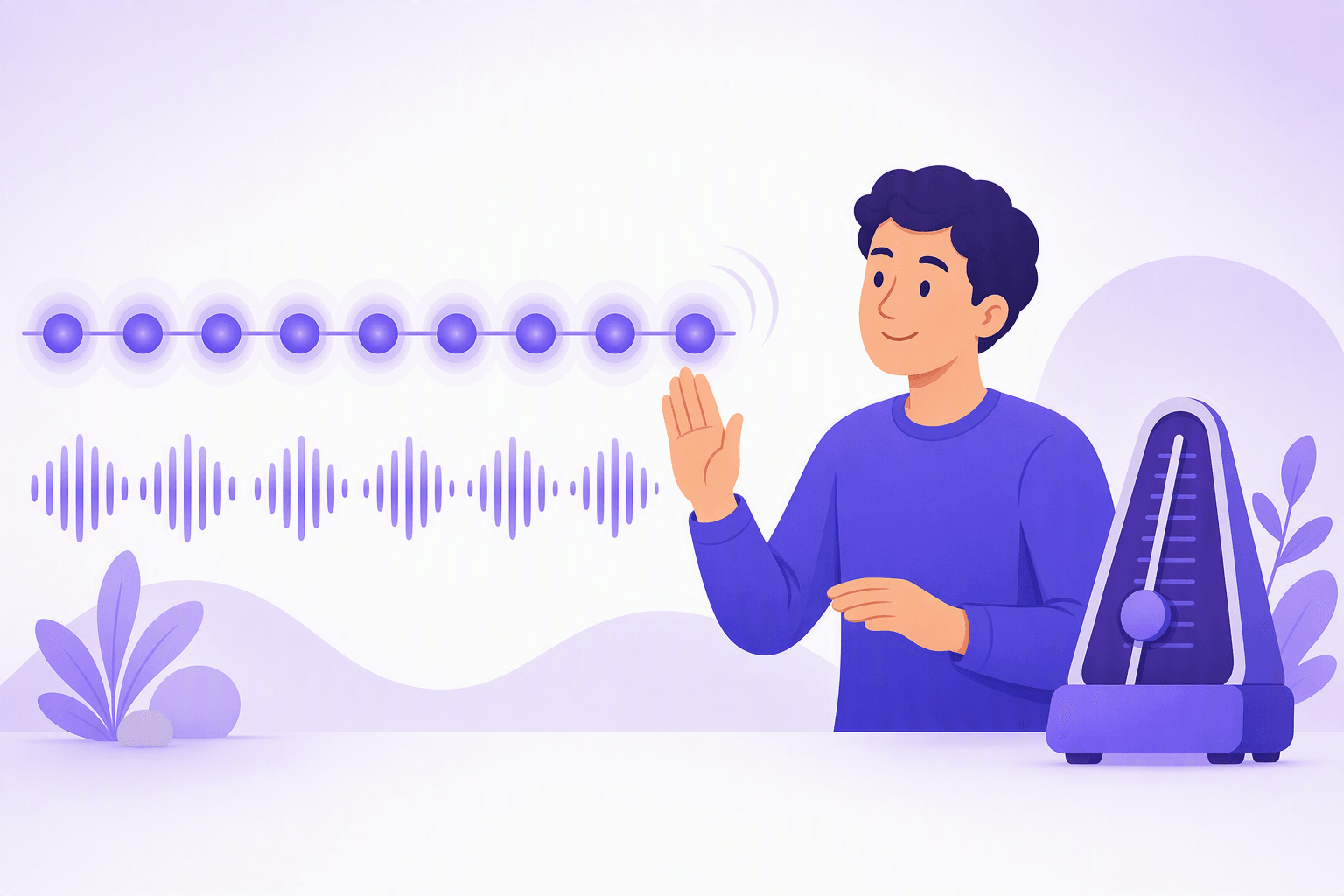
Mora timing: do not swallow beats
Common beginner error: collapsing two morae into one.
Examples:
- せいざ (seiza) is SAY-za, two morae, not “SEH-zah”
- がくせい (gakusei) is gahk-KOO-say, not “gah-KAY”
If you train this early, your listening improves faster because you stop expecting English-like stress patterns.
The small っ and the ん are real beats
- まって (matte) is MAHT-teh, the pause matters
- こんにちは (kohn-NEE-chee-wah) includes the ん beat
Shadowing clips forces you to respect these beats.
Pitch accent: do not obsess at Day 1
Pitch accent matters, but it is not the first bottleneck.
Your first bottleneck is understanding and being understood.
Once you can hear phrases clearly, you can refine accent by copying native audio.
David D. McNeill’s work on gesture and speech is a useful reminder that communication is more than perfect phonetics. In real conversation, clarity, timing, and confidence often matter more than a subtle accent pattern.
Vocabulary: what to learn first (and what to skip)
Fast learners are ruthless about frequency.
Start with function words and “glue”
You need the glue words that make sentences work:
- particles (は, が, を, に, で)
- common verbs (する, いく, くる, ある, いる)
- everyday adjectives (いい, すごい, こわい)
Then add nouns that match your life.
If you want a frequency-based starting point, our 100 most common Japanese words is a practical baseline.
Skip these early traps
- rare kanji readings with no context
- “word of the day” lists unrelated to your input
- memorizing polite business phrases you will not use yet
⚠️ Do not learn slang from lists first
Slang without context is easy to misuse. If you are curious, learn it from scenes where you can see relationship, tone, and consequences. If you want to understand what not to say, start with Japanese swear words as a comprehension guide, not a speaking guide.
Grammar: the minimum that unlocks a lot
Japanese grammar feels different because it is.
Word order is flexible, subjects drop, and politeness is built into verb endings.
Learn politeness as a system, not as “extra words”
You will hear:
- casual plain forms with friends
- です/ます forms in service and polite talk
Treat politeness like “settings,” not like separate languages.
A fast approach:
- learn one pattern in polite form
- learn the same pattern in plain form
- practice switching
Particles: learn them through meaning, not labels
Many explanations turn particles into abstract rules.
Instead, tie them to simple meanings:
- は: topic, “as for”
- が: focus, “it is X that”
- を: direct object marker
- に: destination, time point, receiver
- で: location of action, means
Then confirm by seeing them in clips.
This is also where Anna Wierzbicka’s work on meaning and cultural scripts is helpful as a mindset: particles encode how Japanese packages information, so you learn faster when you focus on what the speaker is doing, not just the translation.
A weekly routine you can actually sustain
Fast learning is mostly boring consistency.
Here is a weekly template that works for many learners.

Weekly plan (beginner)
- 5 days: 60 minutes/day study
- 2 days: lighter review (20 to 30 minutes) plus fun listening
Daily plan (60 minutes)
- 10 min: quick review (old cards only)
- 20 min: grammar lesson + write 5 sentences
- 20 min: clip listening + shadowing
- 10 min: read something short (subtitles, graded reader, or a menu)
How to measure progress without fooling yourself
Good metrics:
- You can shadow a 10-second clip smoothly.
- You recognize the same phrase in a different show.
- You can explain your day in 5 sentences without freezing.
Bad metrics:
- “I finished 50 lessons.”
- “I collected 2,000 flashcards.”
- “I watched 10 hours with English subtitles.”
Cultural shortcuts that make Japanese easier to understand
Language is social.
If you misunderstand the social layer, you will misunderstand the words.
Indirectness is often politeness, not vagueness
Japanese often avoids direct “no.”
You will hear softeners, hedges, and partial answers.
This fits well with research on politeness and facework in interaction, such as Brown and Levinson’s Politeness: Some Universals in Language Usage. You do not need to memorize theory, but you should expect indirect refusals and read the room.
Set phrases are not robotic, they are relationship markers
Phrases like よろしくお願いします are not literal.
They are social glue.
That is why they appear constantly in workplaces, introductions, and requests.
If you want a fun example of how context changes meaning, compare romantic phrases in media with real usage. Our how to say I love you in Japanese shows why 愛してる (AH-ee-shee-teh-roo) is rarer in everyday life than learners expect.
Using Wordy-style clip learning (without turning it into passive watching)
Apps that use real clips can be extremely efficient, but only if you interact with the audio.
Rules:
- Keep clips short.
- Repeat until you can predict the next word.
- Save only the words you will see again soon.
If you want more options, our best apps to learn Japanese with anime compares tools built around native video.
Common mistakes that slow learners down (and quick fixes)
Mistake 1: Waiting to speak until you are “ready”
Fix: speak with a script and repeat it weekly.
You will feel repetitive. That is the point.
Mistake 2: Treating kanji as step one
Fix: kana first, then kanji as you meet words.
Mistake 3: Studying only “clean” Japanese
Fix: include real speech early, but in controlled doses.
A 10-second clip repeated 10 times beats a 20-minute episode half-understood.
For more pitfalls, see common language learning mistakes.
A simple next step
If you want to learn Japanese fast, start today with one concrete action: learn 15 kana, then use them to read real words, then listen to one short clip and repeat it until it feels easy. After that, follow the 90-day structure and keep your daily routine small enough that you can do it even on busy days.
For more Japanese learning paths, browse the Wordy blog and the Japanese learning page.
Frequently Asked Questions
Can I learn Japanese fast without living in Japan?
How long does it take to reach conversational Japanese?
Should I learn hiragana and katakana before anything else?
Is it better to start with anime or textbooks?
How many words do I need to understand Japanese shows?
Sources & References
- Ethnologue, 27th edition, 2024
- Japan Foundation, Japanese-Language Education Overseas (Survey), accessed 2026
- Agency for Cultural Affairs (文化庁), Japanese Language and Writing guidance, accessed 2026
- Webb, S. & Rodgers, M.P.H., research on lexical coverage of movies, Applied Linguistics
- Krashen, S., The Input Hypothesis: Issues and Implications, Longman
Start learning with Wordy
Watch real movie clips and build your vocabulary as you go. Free to download.


