Quick Answer
Anime has become one of the most popular reasons people start learning Japanese, and the right app can turn shows like Demon Slayer, Spirited Away, and Your Name from passive entertainment into structured vocabulary and grammar practice. The best apps to learn Japanese with anime in 2026 fall into three camps: curated clip apps with translations baked in, browser extensions for sentence mining on Netflix, and dedicated anime platforms. This ranked list covers seven options, each with method, price, and the kind of Japanese learner it suits.
The best apps to learn Japanese with anime in 2026 are Wordy for curated clips with built-in translations, Migaku for sentence mining on Netflix and Crunchyroll, and Animelon for free full episode study. Choose based on whether you want a ready library, a power-user pipeline, or a free deep-dive platform.
Japanese has roughly 125 million native speakers (Ethnologue, 27th edition, 2024), and the Japan Foundation counts about 3.8 million people studying Japanese as a foreign language worldwide. A large share of that audience starts because of anime, which is exactly why the app ecosystem around anime learning has grown so quickly.
Before the rankings, pair this guide with our best anime movies to learn Japanese shortlist, and if you want a wider app comparison see best language learning apps.
Why Anime Works (and Sometimes Doesn't) for Japanese Learning
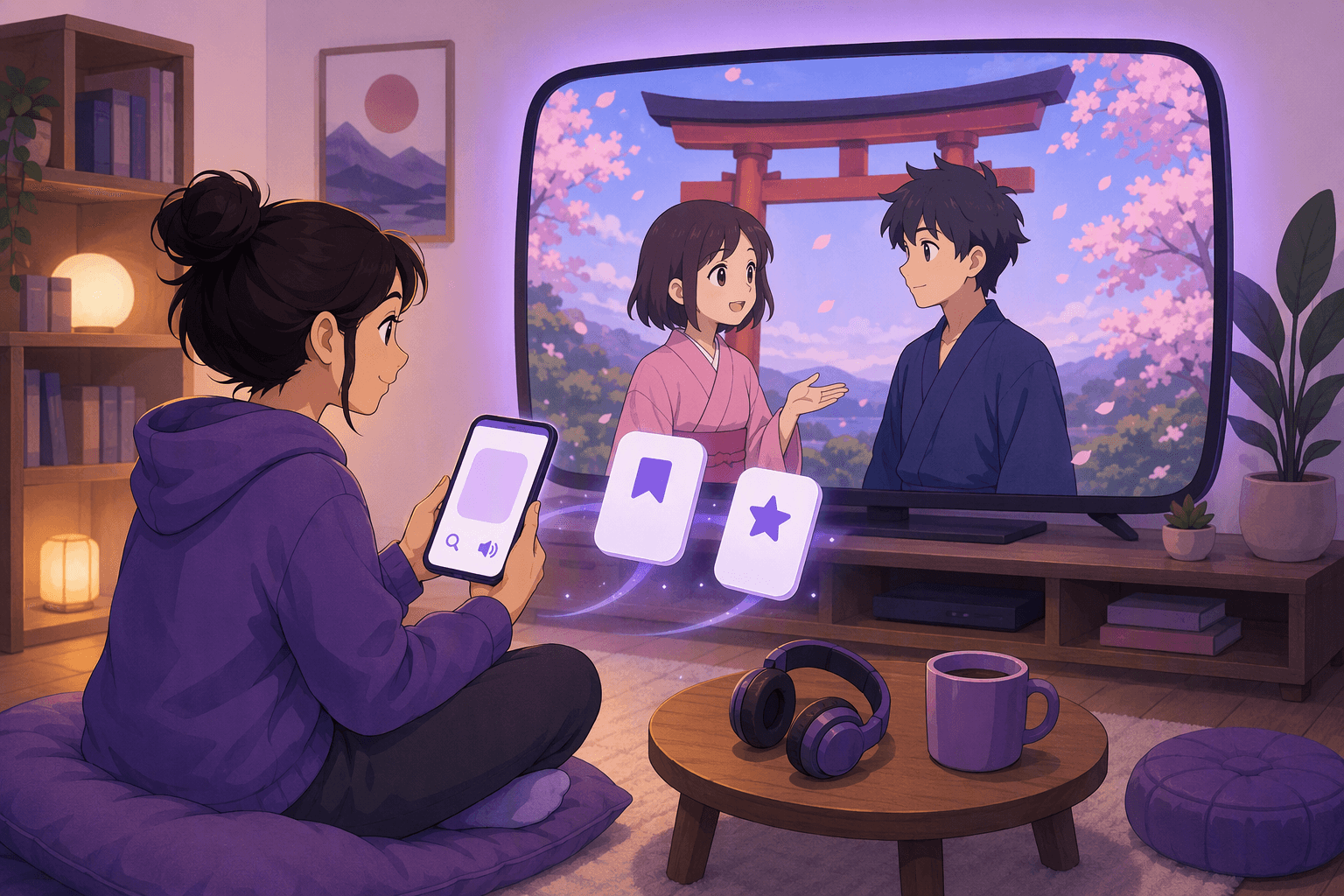
Anime is high-quality comprehensible input. You get tone, facial expressions, pacing, and a story that makes you want to keep listening. Stephen Krashen's input hypothesis argues that learners acquire language most effectively when they receive understandable messages slightly above their current level (Krashen, 1985). Anime, paired with subtitles you can control, fits that description well.
"We acquire language in only one way: when we understand messages."
Stephen Krashen, The Input Hypothesis (1985)
The complication is that anime Japanese is not neutral Japanese. Several patterns repeat across shows that you should know about.
First, anime characters often use exaggerated speech registers. Tough male characters use forms like 俺 (ore) and rough sentence endings like だぜ (da ze). Cute female characters use 〜わよ (wa yo) and 〜のよ (no yo), patterns that sound dated or theatrical in real Tokyo speech. Children's anime can over-use 〜だよ (da yo) endings that no adult would use at work.
Second, anime is heavy on Tokyo-standard 標準語 (hyōjungo) but mixes in invented dialects for villains, samurai, and rural characters. Regional speech, archaic verb forms, and pseudo-Kansai dialect appear constantly. These are fun to recognize but useless if you reproduce them in conversation.
Third, action and fantasy genres bias your vocabulary toward swords, demons, and special techniques. Useful for the show, useless for ordering ramen.
🌍 Anime Japanese vs natural Japanese
The Agency for Cultural Affairs runs an annual National Language Survey (文化庁国語に関する世論調査) tracking how Japanese is actually spoken. The gap between that data and anime dialogue is large. Real workplace and student speech leans heavily on polite forms (です・ます), softeners, and pauses. If you only learn from anime, you will sound either too rough, too theatrical, or both. The fix is simple: keep anime, but balance it with one neutral source, like a podcast or textbook.
What to Look For in a Japanese Anime-Learning App
Five criteria separate a real anime-learning tool from a streaming app with subtitles.
- Click-to-translate: You should be able to tap any word and see meaning, reading, and part of speech without leaving the scene.
- Furigana support: Kanji with hiragana readings above is essential below intermediate level.
- Spaced repetition tied to scenes: A word you saw in episode 3 should come back for review with the same scene, not as a flashcard with no context.
- Curated or filterable difficulty: Beginner content separated from advanced content saves hours.
- Real Japanese audio, not narration: Synthetic voices skip the rhythm and intonation that make Japanese hard.
If an app misses three or more of these, treat it as a supporting tool, not the core.
💡 Prerequisite: learn kana first
Before any anime app helps you, learn hiragana and katakana. Both kana sets together take most learners two to three weeks of light daily practice. Apps that show you romaji forever quietly cap your ceiling, because all real Japanese reading uses kana plus kanji. The Japan Foundation's beginner curriculum assumes kana within the first two weeks.
7 Best Apps for Learning Japanese with Anime in 2026
1. Wordy (best overall, best for mobile)
Wordy is a language-learning app built around real movie and TV clips, including a strong Japanese catalog that mixes anime, live-action drama, and film. The method is simple: you watch a curated 30 to 90 second scene, tap any word for instant translation and reading, and that word gets saved to your deck tied to the exact scene where you met it. Spaced repetition brings the same scene back later, with a tap to confirm whether you still remember it. Speech recognition compares your pronunciation to the actor's.
The Japanese catalog covers more than just anime, which is a real advantage. You can study with anime when you want stylized input, then switch to live-action drama or film for natural conversational speech. There are over 15,000 curated clips across the library, with new content added regularly. Furigana shows automatically on kanji, and a tap reveals readings and meanings.
Wordy launched in 2024 from Budapest, Hungary, with coverage in TechCrunch (September 2024). It has crossed 500,000 users with a 4.7 to 4.8 star rating across 13,000 plus reviews on the App Store and Google Play. The pricing model includes a free tier, a 7-day trial, and monthly, annual, and lifetime plans. Apps are available on iOS, Android, Chrome, and the web.
Verdict: If you want the lowest-friction way to learn Japanese with anime and real video on your phone, Wordy is the best 2026 pick. The weakness is that you cannot import outside videos, so power users who insist on mining their own shows will prefer Migaku. Try the free tier at wordy.info before paying.
2. Migaku (best for sentence mining)
Migaku is a browser extension plus companion app aimed at advanced self-learners. It overlays interactive Japanese subtitles on Netflix, Crunchyroll, YouTube, and other platforms, and lets you create flashcards from any sentence with audio, screenshot, and dictionary lookup in one click. The cards sync to Anki or Migaku's own SRS.
The strength is total control. You decide what to mine, you build your own deck from shows you actually want to watch, and the result is a personalized study set that mirrors your interests. The weakness is setup time. New users routinely spend an hour configuring extensions, Anki templates, and dictionaries before their first card.
Verdict: Best for power users who already know they want to mine sentences from real anime and who are comfortable with Anki. Subscription pricing, roughly mid-tier for the category. Skip if you want simple mobile-first study.
3. Animelon (free, anime-only)
Animelon is a free platform with full anime episodes and interactive Japanese, English, and romaji subtitles, plus an integrated dictionary. You can hover any word for meaning, save words to a deck, and study them later. The library is large enough for years of content.
The catch is that Animelon operates in a gray legal zone, the UI feels dated, and the experience is desktop-only. There is no mobile app of comparable quality. Audio and video quality vary.
Verdict: A surprisingly capable free option for desktop learners who want full anime episodes with click translation. Use it as a free supplement, not your only tool. Best paired with a structured course like Wordy or Bunpo.
4. JPDB (best for vocabulary by show)
JPDB is a Japanese reading and vocabulary platform built around frequency lists for specific anime, manga, novels, and games. Pick a show, study its top 500 or 1,000 words in advance, and you arrive at episode one already understanding the high-frequency vocabulary.
The method is research-backed: Paul Nation's work on vocabulary acquisition shows that learners who control the top 2,000 to 3,000 frequency words can follow most everyday speech. JPDB applies that idea per show. The interface is text-first and intimidating at the start, with a learning curve that scares off casual users.
Verdict: Best for intermediate learners who want to prepare vocabulary before watching a specific anime. Free with optional donations. Combine with a clip-based app for the actual viewing.
5. Language Reactor (free Chrome extension)
Language Reactor adds clickable dual subtitles to Netflix and YouTube. You see Japanese and English side by side, click any word for definitions, and replay lines easily. It also includes an autopause feature and saves word history.
Its main limitation is platform coverage. It works with what is on Netflix and YouTube, which means anime selection depends on regional Netflix licensing, not on a curated language-learning library. There is no spaced repetition built in, and you must pair it with Anki for serious vocabulary retention.
Verdict: Excellent free tool for Netflix anime, especially as a first step before paying for anything. Best as a supplement, not a complete system.
6. LingoDeer (structured Japanese course)
LingoDeer is a structured Japanese app built by linguists, with a curriculum that starts from kana and progresses through JLPT N5 and N4 grammar. It is not anime-based, but it pairs well with anime apps because it builds the grammar foundation that anime alone cannot teach systematically.
Lessons cover sentence patterns, particles, verb conjugation, and reading practice. Audio is recorded by native speakers, not synthesized. The weakness is that LingoDeer alone does not give you authentic listening to fast natural speech.
Verdict: Use LingoDeer as your grammar backbone while you use Wordy or Migaku for anime input. Subscription priced similarly to other major language apps. Free trial available.
7. Bunpo (Japanese grammar app)
Bunpo focuses exclusively on Japanese grammar, organized by JLPT level from N5 through N1. Each grammar point has explanations, examples, and practice exercises. It is the cleanest grammar reference in app form, useful both for self-study and as a lookup tool while watching anime.
Bunpo is not anime-based, but you will end up here every time you encounter a grammar pattern in a show and need a clear explanation. The free tier covers N5 basics. The paid tier unlocks all levels.
Verdict: Essential pairing for any anime-first learner. Treat it as a grammar dictionary you study from, not a daily course.
Anime to Pair with Each App
Difficulty matters more than genre when you choose what to watch.
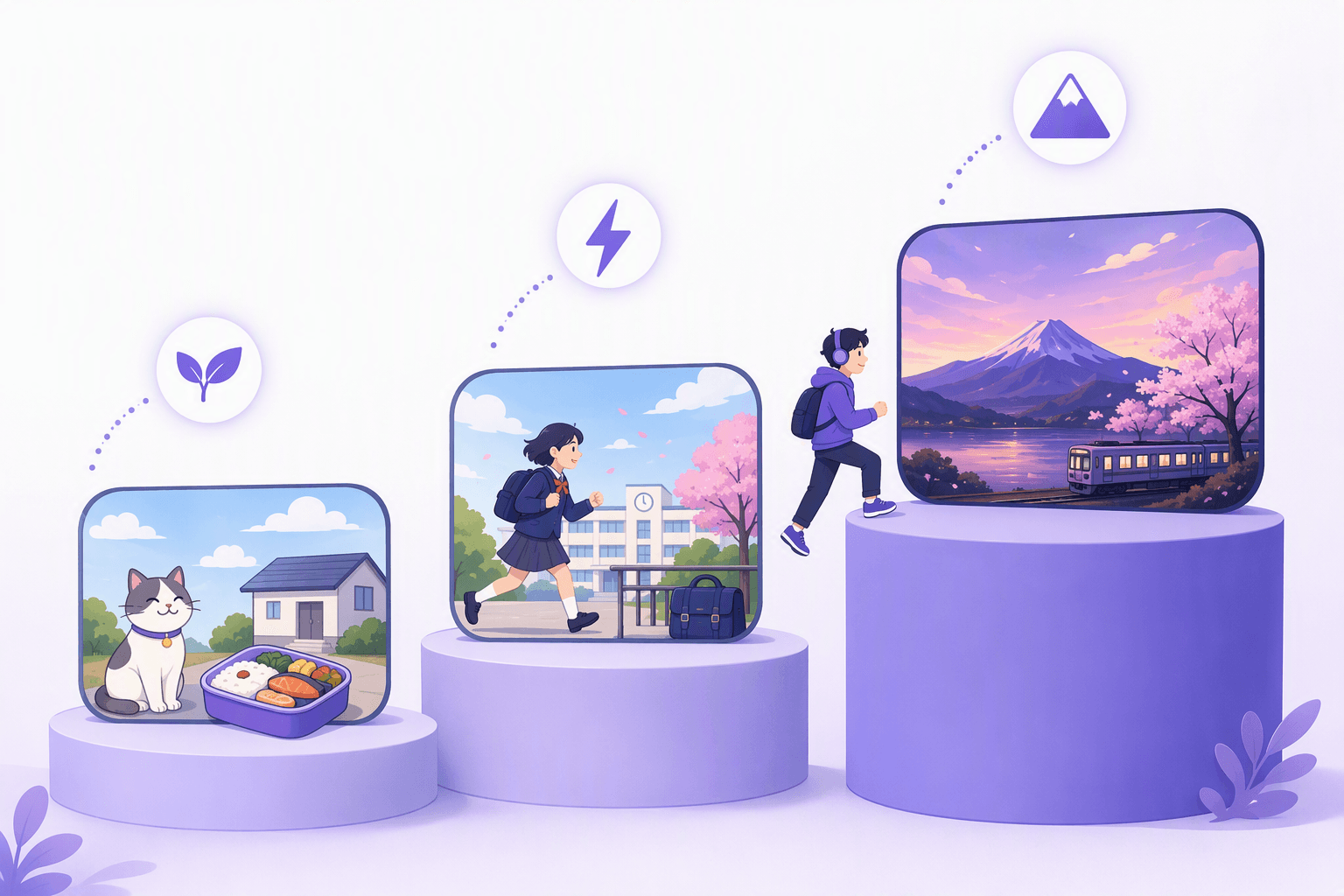
Beginner-friendly:
- Yotsuba&! (manga, simple everyday vocabulary)
- Doraemon (clear pronunciation, repetitive structures)
- Shirokuma Café (slow speech, common conversation patterns)
- Polar Bear Café (similar profile)
Intermediate:
- My Hero Academia (action vocabulary mixed with school dialogue)
- Spy x Family (family conversation, some thriller vocabulary)
- Demon Slayer (atmospheric but watch for archaic forms)
Advanced:
- Studio Ghibli films like Spirited Away and My Neighbor Totoro
- Your Name (mixed dialect, fast natural speech)
- Death Note (formal speech and rapid monologue)
For a deeper breakdown by genre and difficulty, see our best anime movies to learn Japanese guide.
How to Actually Learn from Anime (Not Just Watch)
Three habits separate learners from viewers.
First, set a subtitle rule. For beginners, watch with Japanese subtitles plus English on the side. For intermediate learners, switch to Japanese-only and replay difficult lines. Pure passive English-subtitle watching is fine for entertainment but builds almost no Japanese.
Second, log new vocabulary. Whether you use Wordy's built-in deck, Migaku to Anki, or a paper notebook, the act of saving a word tied to context is what turns recognition into recall. Krashen's input hypothesis assumes you understand the input. If you let unknown words pass without noting them, you skip the comprehension step that drives acquisition.
Third, repeat scenes. The Japan Foundation's pedagogy materials recommend repeated listening for intonation and rhythm acquisition. Watch a one-minute scene three times, then shadow it aloud. Speech recognition tools like Wordy's give immediate feedback. This single habit moves listening from passive to active faster than anything else.
⚠️ The anime-only trap
You can spend two years watching anime with subtitles and still be unable to introduce yourself in Japanese. Input alone does not build production. Pair anime input with at least one weekly speaking session, even structured self-talk into your phone. Output is a separate skill that needs its own practice.
For more on what makes a language app effective beyond Japanese, see our Duolingo review and best language learning apps guides. If you want a focused starting page for Japanese on Wordy, see Wordy's Japanese page.
Final Verdict
If you want the simplest path: install Wordy, study one curated Japanese clip per day, and add Bunpo for grammar lookup. That combination covers input, vocabulary review, pronunciation feedback, and grammar reference, all from your phone.
If you are a power user who wants total control over what you mine: Migaku plus Anki plus Crunchyroll. Expect a setup day, then enjoy a workflow that scales with any show you want to watch.
If you want zero spend: Animelon plus Language Reactor plus a free SRS app. Slower setup, slower pace, but real progress over months.
Whatever you pick, the rule is the same. Watching anime is entertainment. Studying anime with the right tool, even for 20 minutes a day, is language learning. Pick a tool from this list, commit for 60 days, and your relationship with Japanese will change.
Frequently Asked Questions
Can you actually learn Japanese from anime?
Best beginner anime for Japanese learning?
Free apps for Japanese anime learning?
Wordy vs Migaku for Japanese?
Should I avoid certain anime as a learner?
Sources & References
- Ethnologue, 27th edition, 2024
- Agency for Cultural Affairs (文化庁), National Language Survey
- Japan Foundation (国際交流基金), Survey of Japanese-Language Education Abroad
- Krashen, S., The Input Hypothesis, Longman, 1985
- TechCrunch, 'Wordy's new app helps you learn vocab while watching movies & TV shows,' September 2024
Start learning with Wordy
Watch real movie clips and build your vocabulary as you go. Free to download.


