Quick Answer
Duolingo is a strong beginner-friendly app for building a daily habit and learning core vocabulary and basic sentence patterns, but it will not make you fluent by itself. Its biggest gaps are real-time conversation skills, listening to fast natural speech, and deeper grammar control. The best results come from using Duolingo as a structured warm-up, then adding native input (movies, podcasts) and speaking practice.
Duolingo is worth using if you want a reliable daily habit and a guided path through beginner vocabulary and sentence patterns, but it will not make you fluent by itself. Treat it as your structured warm-up, then add real listening and real speaking to cover the skills Duolingo cannot fully simulate.
If you are learning English specifically, remember the scale of the target: English has roughly 1.5 billion speakers worldwide when you combine native and second-language speakers (Ethnologue, 27th edition, 2024). That global reach is exactly why “textbook English” is not enough, you need exposure to accents, speed, and informal usage.
You can pair this review with practical next steps like our best movies to learn English list, and if you want to understand informal speech, start with English slang.
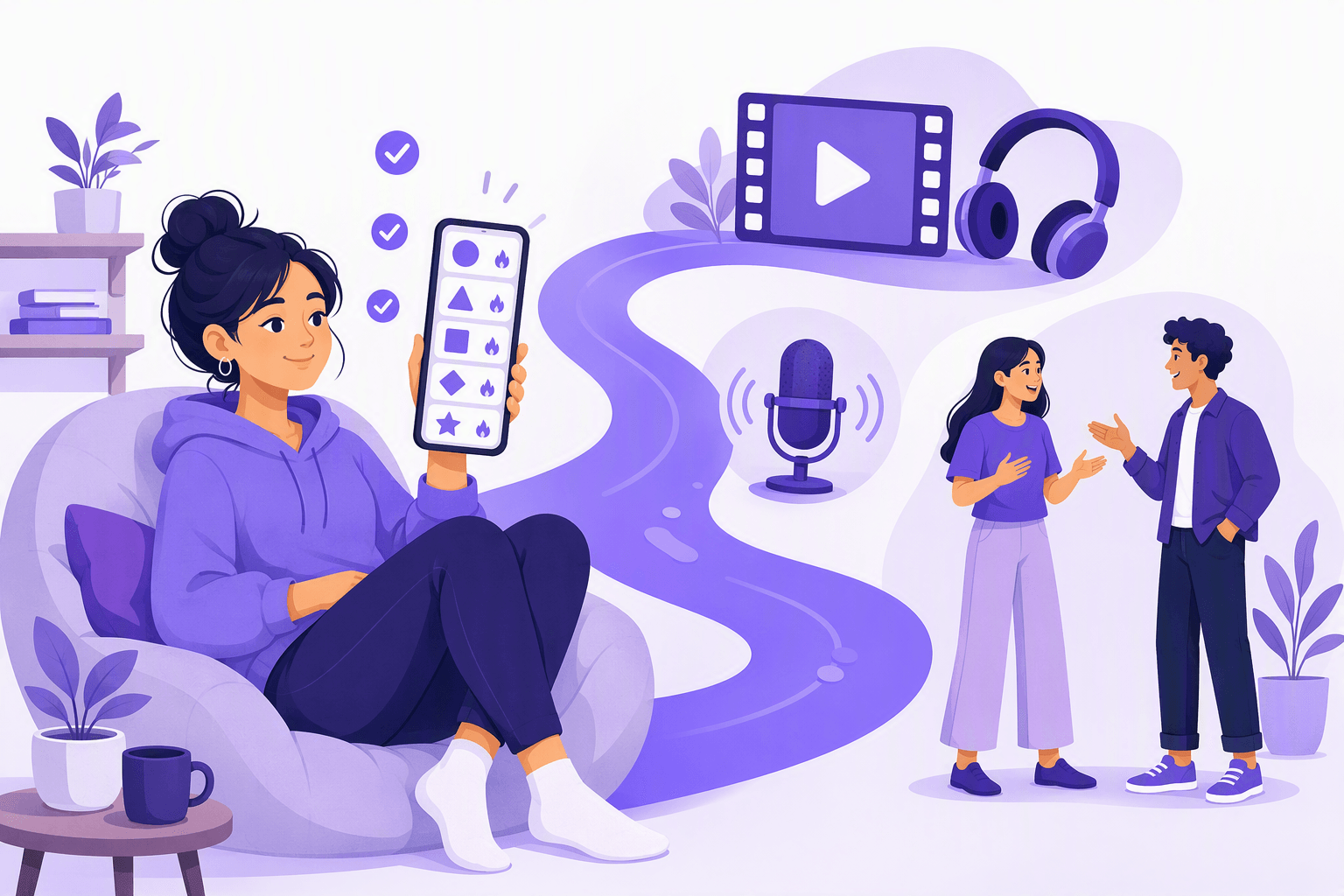
What Duolingo is best at (and what it is not)
Duolingo’s core strength is behavior design: it makes it easy to show up every day. For many learners, that consistency is the difference between “I tried” and “I progressed.”
Its core weakness is skill transfer. Tapping word tiles and translating short sentences does not automatically become fast listening, spontaneous speaking, or confident writing.
What Duolingo does well
Duolingo is particularly good for:
- Absolute beginners who need a clear starting point and low friction.
- High-frequency vocabulary exposure through repeated retrieval.
- Basic sentence patterns that build familiarity with word order.
- Motivation loops (streaks, goals, reminders) that keep you studying.
From a learning-science angle, this aligns with retrieval practice and spaced repetition principles. Robert Bjork’s work on “desirable difficulties” is often discussed in education research, and Duolingo’s frequent recall prompts can support memory, especially early on.
What Duolingo does not do well
Duolingo is not designed to fully train:
- Real-time conversation management (turn-taking, repairs, hesitation strategies).
- Listening to fast, reduced speech (the way people actually talk).
- Pragmatics (what is polite, blunt, funny, or awkward in context).
- Deep grammar control beyond the patterns you have drilled.
Second-language acquisition researchers like Bill VanPatten emphasize that learners need lots of meaningful input, not just rule explanations, to build an internal system for the language. Duolingo provides some input, but it is still a controlled environment.
How Duolingo lessons map to real proficiency
Most learners want a simple answer: “What level will I reach?” The honest answer depends on time, consistency, and what you do outside the app.
The CEFR scale (A1 to C2) is the most widely used public framework for describing ability (Council of Europe, CEFR). Duolingo content can support early CEFR progress, but CEFR levels are about what you can do in real life, not what you can complete in an app.
A realistic outcome for many learners
For many motivated beginners, Duolingo can help you reach:
- A1 to A2: basic introductions, simple questions, common daily topics.
- Some learners push into low B1 territory in reading and controlled listening, especially if they add extra input.
Where it usually lags is speaking fluency and listening to natural speech. You can “know” a structure and still not recognize it when it is spoken quickly.
Why app progress can feel faster than real progress
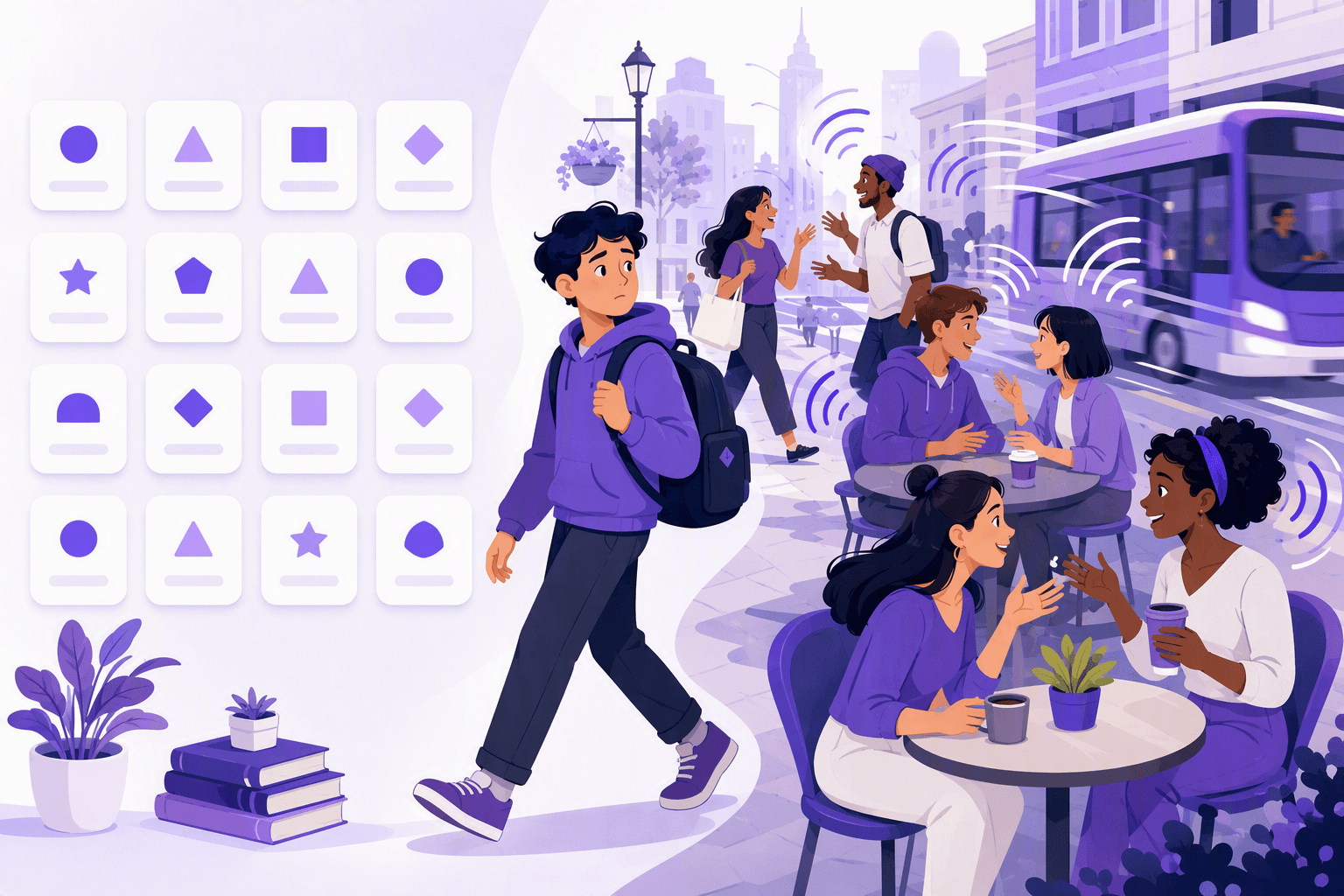
Apps give you clean feedback and predictable tasks. Real life gives you noise, accents, interruptions, slang, and social pressure.
That mismatch is normal. It does not mean Duolingo “failed,” it means you need training that matches the performance environment.
💡 A practical benchmark
If your goal is conversation, measure progress by minutes of real listening and minutes of real speaking per week, not by streak length. Keep the streak if it helps, but do not confuse it with proficiency.
Duolingo’s method: what is happening under the hood
Duolingo’s public materials describe a mix of spaced repetition, adaptive practice, and short interactive tasks (Duolingo, accessed 2026). Those are good ingredients, but the recipe matters.
Strength: retrieval practice in small doses
Short lessons encourage frequent recall. That is useful for building a base lexicon and basic patterns.
If you are learning English, that base matters because high-frequency words dominate everyday speech. A small set of common words accounts for a large share of running text, which is why frequency-based study is so efficient early on.
You can reinforce that with our 100 most common English words list when you want a clear target for “what to learn next.”
Limitation: controlled language vs natural language
Duolingo sentences are curated. Natural English is messy:
- People drop sounds and words.
- People use fillers and softeners.
- People use idioms, slang, and cultural references.
If you want to understand real informal English, you eventually have to meet it directly. That includes everything from everyday slang to stronger language, which is why guides like English swear words exist as comprehension tools, not as “go say this” recommendations.
Duolingo for English learners: what makes English uniquely tricky
English is not “hard” because of one single rule. It is tricky because it combines:
- Inconsistent spelling-to-sound mapping (through, though, thought).
- Stress-timed rhythm (unstressed syllables reduce heavily).
- Phrasal verbs (get up, get over, get by) that change meaning with particles.
- Global variation across regions and accents.
The British Council regularly frames English as a global language used across education, work, and international communication (British Council, accessed 2026). That global spread means you will hear many “correct” versions of English.
The listening problem: reduced speech
A common Duolingo plateau is: “I can read it, but I cannot catch it.”
That is often reduced speech. For example:
- “What are you doing?” becomes “Whatcha doing?”
- “Did you eat yet?” becomes “Jeet yet?”
Duolingo cannot fully simulate the range of reductions and accents you will hear. You need authentic input.
The vocabulary problem: slang and register
English has strong register differences. The English you use in a job interview is not the English you use in a group chat.
If you only learn neutral textbook sentences, you will understand formal contexts first, and struggle in casual ones. That is why pairing Duolingo with real media and a slang guide helps, for example English slang.
🌍 A useful mindset for English
Because English is used across so many countries and communities, sounding “native” is not the only valid goal. A more useful goal is sounding clear, appropriate for the situation, and confident with your own accent.
An honest pros and cons list
Duolingo is popular for good reasons. It also creates predictable frustrations.
Pros
- Excellent for building a daily study habit.
- Beginner-friendly, low intimidation.
- Strong at repeated exposure to common words and patterns.
- Easy to fit into small time windows.
Cons
- Limited training for spontaneous speaking.
- Listening practice is narrower than real-world speech.
- Grammar explanations can feel thin or inconsistent depending on the course.
- Progress can feel “game-like” rather than performance-based.
How to use Duolingo effectively (a plan that actually works)
If you only do Duolingo, you will mostly get better at Duolingo tasks. The fix is simple: keep Duolingo, but add two complementary blocks.
Paul Nation’s work on language learning highlights the need for balance across meaning-focused input, meaning-focused output, language-focused learning, and fluency development. Duolingo covers part of language-focused learning and some controlled input, but you must add the rest.
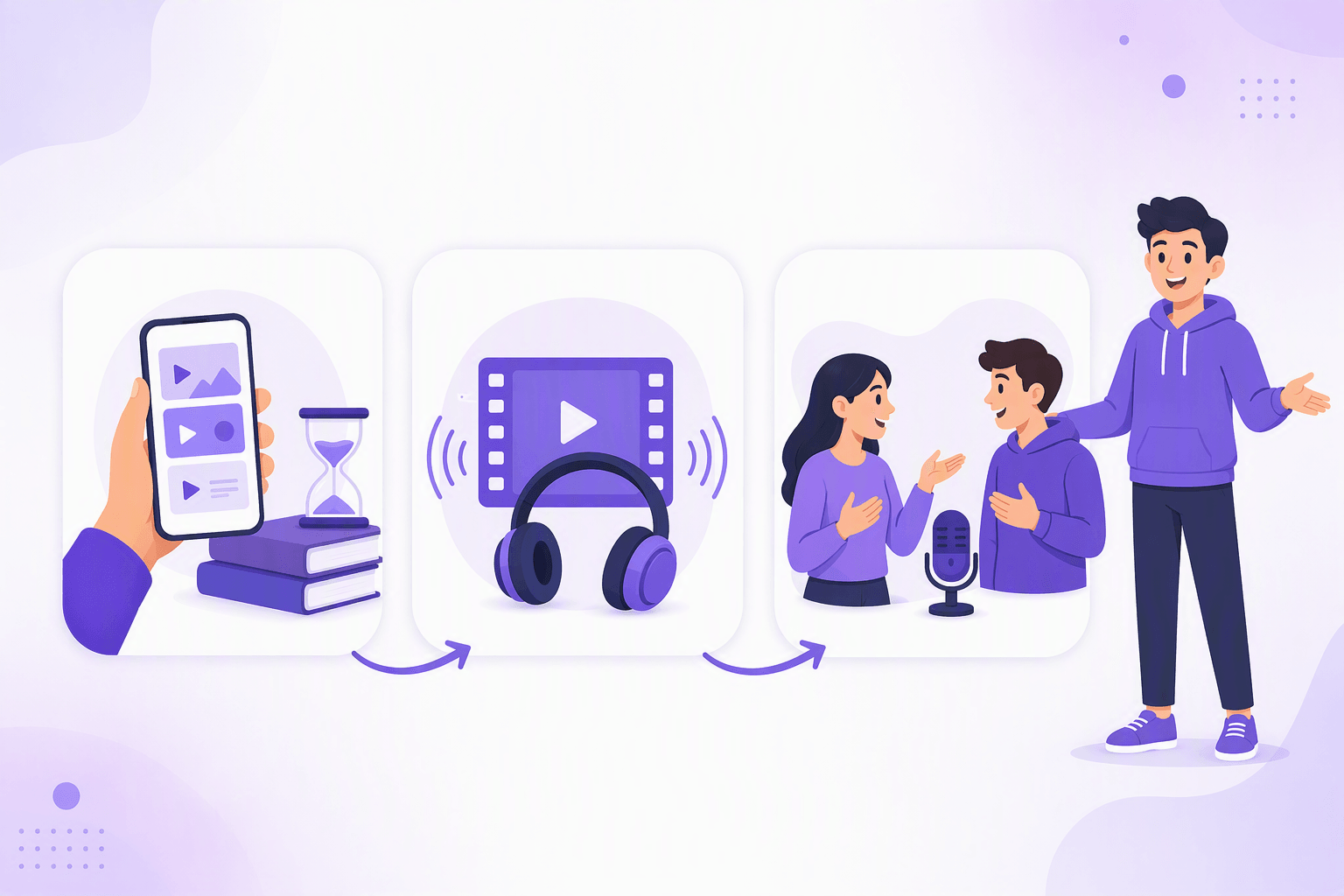
Step 1: Use Duolingo as your daily warm-up
Do 10 to 20 minutes. Keep it easy enough that you can do it even on busy days.
Your goal here is consistency and maintenance, not hero sessions.
Step 2: Add authentic listening every day
Aim for 15 to 30 minutes of listening you can mostly follow. If it is too hard, slow down or choose easier content.
Movies and TV are especially useful because you get facial cues, context, and repeated phrases. Use our best movies to learn English picks to avoid content that is too fast or too technical early on.
Step 3: Add speaking twice a week
Speaking is the skill most apps undertrain. You can do:
- A tutor session.
- A language exchange.
- Structured self-talk with prompts.
The key is real-time production. Even 20 minutes twice a week changes your trajectory.
⚠️ Avoid the 'silent learner' trap
If you wait until you feel ready to speak, you will wait too long. Start speaking with simple scripts and repeat them. Fluency is built through repetition under time pressure, not through perfect knowledge.
Duolingo vs alternatives: what to choose based on your goal
There is no single best app. There is a best toolchain for your outcome.
If your goal is travel basics
Duolingo is a good fit. You will get survival phrases and recognition of common structures.
If you want extra practical coverage, add a focused phrase resource and real listening.
If your goal is passing an exam
Duolingo can help with vocabulary and basic grammar patterns, but exams often require:
- Writing structure
- Listening to long passages
- Formal register
Use Duolingo as support, not as the core.
If your goal is conversation
Duolingo is a starter. You need speaking practice and authentic listening.
A movie-clip approach can help bridge the gap between “learner sentences” and real speech. Wordy is built around short scenes with interactive subtitles and review, which is useful when your main pain point is listening comprehension rather than memorizing isolated words.
For broader app comparisons, see our best language learning apps guide.
Common misconceptions that slow learners down
“I finished a section, so I mastered it”
Completion is not mastery. Mastery is fast recall and fast recognition in new contexts.
If you cannot understand the same structure in a movie scene, you have not stabilized it yet.
“I need more grammar explanations”
Sometimes you do. Often you need more examples.
Linguist Steven Pinker, in his writing on language and the mind, emphasizes that humans learn patterns from exposure. For second-language learners, that means examples plus feedback beat explanation alone.
“I’m bad at languages”
Most people are not bad at languages. They are underexposed to the language.
If you are learning English, you are competing with the sheer volume of English content online. That is a challenge, but it is also an advantage, because you can get massive input for free.
What results does research suggest?
Independent research on app effectiveness exists, but you should read it carefully. Studies differ in design, time-on-task, and what “learning” means.
A widely cited external evaluation is Vesselinov and Grego’s report on Duolingo effectiveness (CUNY). It suggests measurable progress for many learners, especially at beginner levels, but it does not imply that app-only study replaces real interaction.
Duolingo’s own published materials also describe how it measures learning outcomes and iterates on course design (Duolingo, accessed 2026). That is useful context, but it is still a company reporting on its own product, so treat it as one input among several.
A quick reality check: what “fluency” requires
Fluency is not a badge you unlock. It is a bundle of abilities:
- Understanding speech at natural speed
- Speaking with reasonable speed and low hesitation
- Reading with comfort
- Writing with control
- Handling different situations and registers
For English, the register piece matters more than many learners expect. You might be able to discuss work topics but still miss jokes, sarcasm, or casual slang.
If you want a concrete skill to add early, learn numbers well. Numbers show up everywhere: dates, prices, times, addresses. Use our English numbers guide to make that automatic.
Verdict: who should use Duolingo in 2026?
Duolingo is a smart choice if you are a beginner who needs structure, motivation, and a daily routine. It is also useful as a maintenance tool when you are busy.
Duolingo is not enough if your goal is confident conversation or understanding real media. For that, you must add authentic input and speaking, and you should expect your listening skill to lag behind your reading at first.
If you want a simple next step: keep Duolingo, then watch one short English clip per day with subtitles you can control, and speak out loud twice a week. That combination fixes the most common Duolingo plateau without requiring a total reset.
To keep building your English outside app sentences, browse the Wordy blog and start with content that matches your daily life, not just your textbook topics.
Frequently Asked Questions
Is Duolingo worth it in 2026?
Can Duolingo make you fluent?
How long should I use Duolingo each day?
What are Duolingo’s biggest weaknesses?
What should I use with Duolingo to improve faster?
Sources & References
- Duolingo, Duolingo Blog: How Duolingo measures learning, accessed 2026
- Vesselinov, R. & Grego, J., The Effectiveness of Duolingo: A Research Report, City University of New York
- Council of Europe, Common European Framework of Reference for Languages (CEFR)
- Ethnologue, 27th edition, 2024
- British Council, The English Effect and global English learning resources, accessed 2026
Start learning with Wordy
Watch real movie clips and build your vocabulary as you go. Free to download.


