Quick Answer
The most common language learning mistakes are over-focusing on rules, under-training listening, and reviewing vocabulary without spaced repetition or real context. Fix them by building a simple loop: short daily input you can understand, targeted speaking, and structured review of words you actually meet in real sentences.
Common language learning mistakes usually come down to training the wrong things: learners spend too much time on rules and apps that feel productive, and too little time understanding real speech, building usable vocabulary, and reviewing it in a way the brain actually retains.
If you are learning English specifically, these mistakes matter even more because English is spoken across dozens of countries and accents, and you will meet huge variation in pronunciation, slang, and speed. Ethnologue estimates about 1.5 billion English speakers worldwide (Ethnologue, 27th edition, 2024), which means your goal is not one “perfect” English, it is flexible comprehension and clear, functional output.
This guide focuses on the most common failure patterns I see, plus practical fixes you can apply this week. For more English-specific input practice, pair this with our list of best movies to learn English.
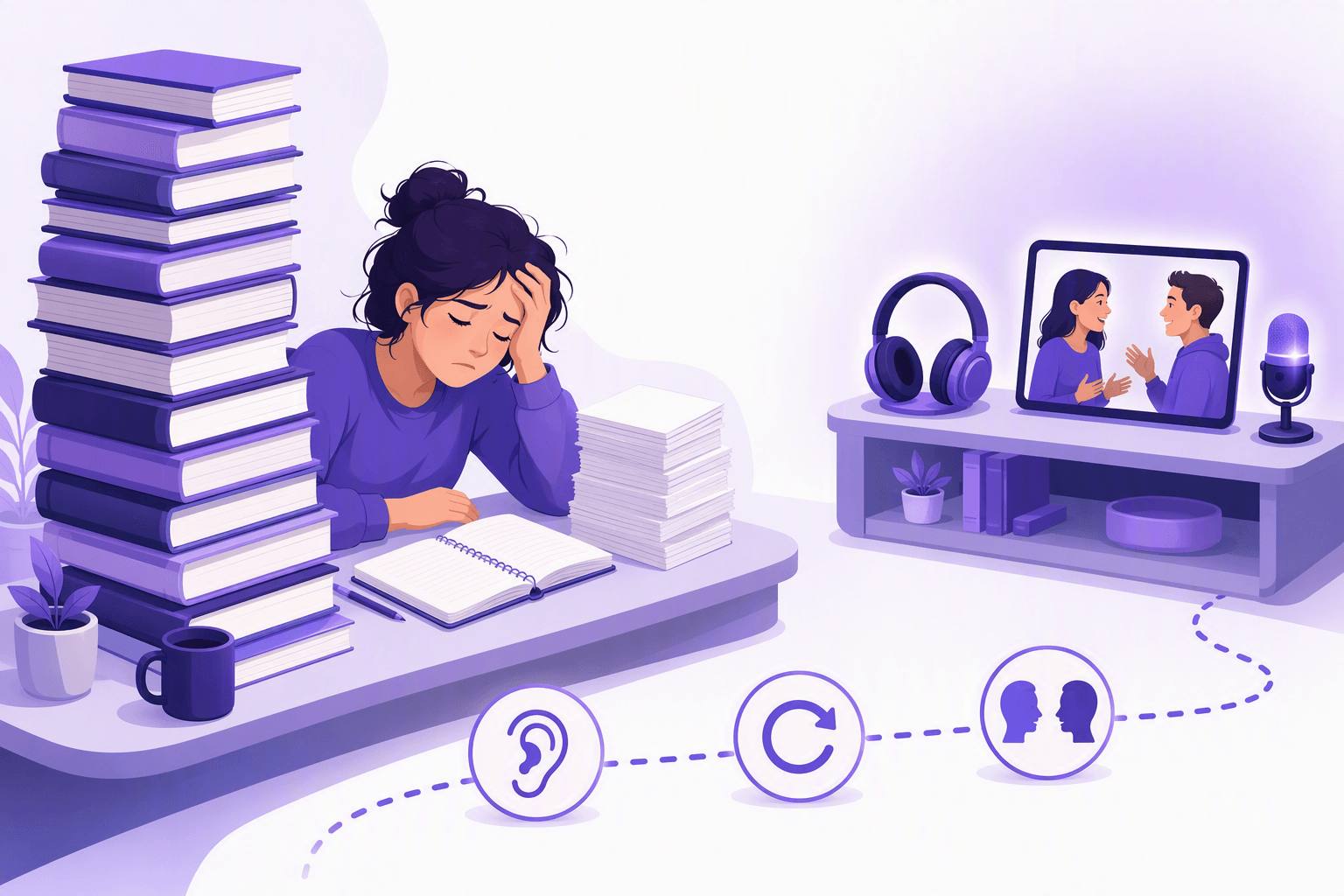
Why these mistakes happen (and why they feel like progress)
Many mistakes persist because they produce a strong feeling of learning. You can “finish” a grammar chapter, complete a streak, or memorize a list, and it looks measurable.
But language ability is closer to athletic skill than academic knowledge. The CEFR framework describes proficiency in terms of what you can do in real situations, not what you can explain about the language (Council of Europe, CEFR Companion Volume, 2020).
In How Languages are Learned (Oxford University Press), Patsy Lightbown and Nina Spada emphasize that learners benefit from meaningful exposure and opportunities to use the language, not only from explicit instruction. In Second Language Acquisition (Cambridge University Press), Rod Ellis similarly distinguishes between knowing rules and developing the ability to process language in real time.
Mistake 1: Studying a lot, but not listening enough
If you only read and do exercises, your brain never gets trained on the signal: real audio, real speed, real reductions.
Spoken English compresses words: “going to” becomes “gonna,” “did you” becomes “didja,” and entire syllables disappear in casual speech. You cannot “think” your way into hearing that, you have to train it.
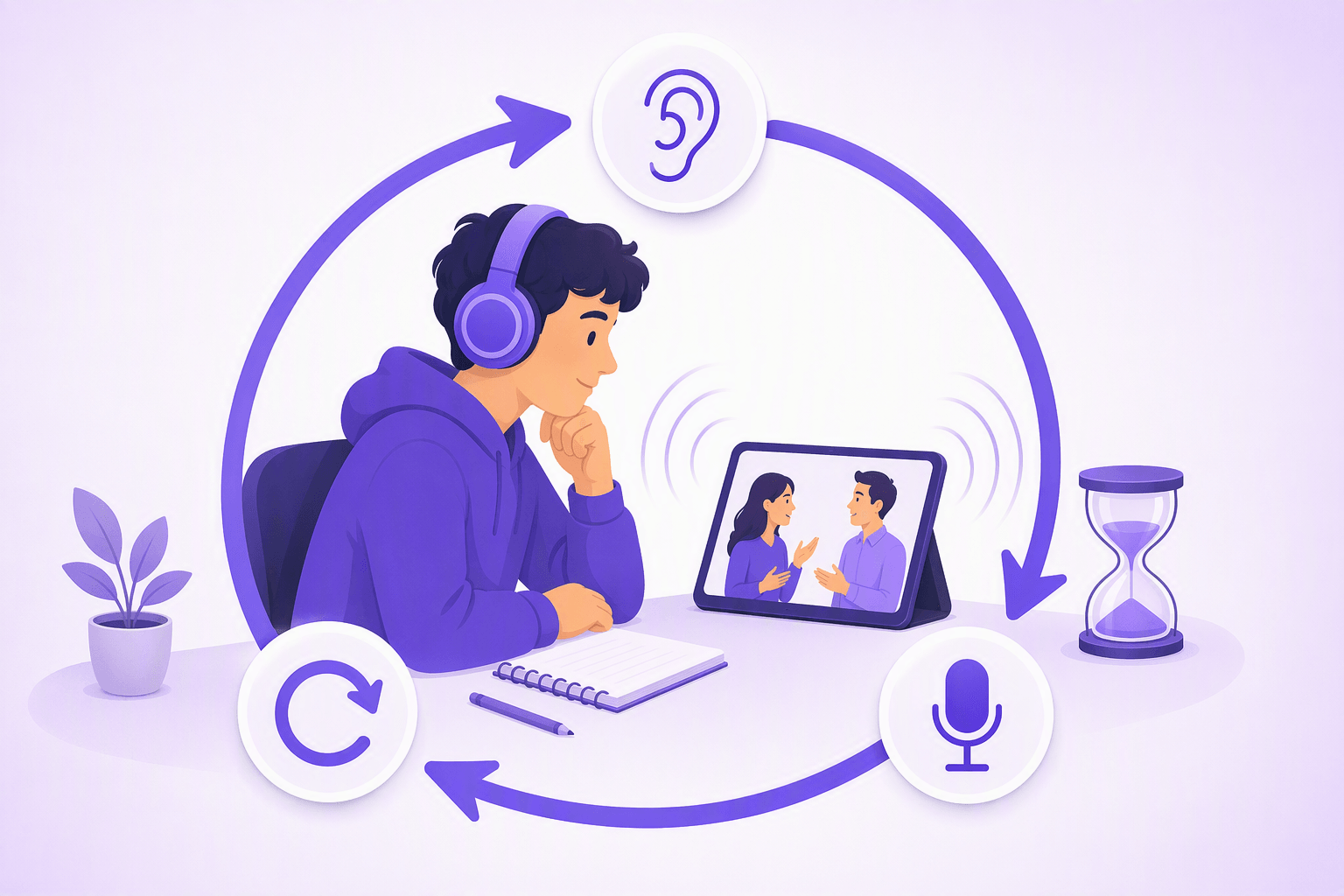
Fix: build a daily listening loop
Pick one short clip (20 to 60 seconds). Listen three times: first for gist, second with transcript, third without transcript.
Then shadow it: repeat along with the speaker, matching rhythm and stress. If you want a structured way to do this with native clips, start with our best movies to learn English list and reuse the same scenes for a week.
💡 A useful target
If you can understand 80% of a clip without pausing, it is in the sweet spot. Under 50% is usually too hard for efficient learning, and you will guess more than you learn.
Mistake 2: Treating vocabulary as isolated words
Many learners memorize “word = translation” and feel fast progress. Then they try to speak and nothing comes out, because real usage lives in phrases, collocations, and patterns.
English is full of “word partnerships”: make a decision, take a shower, heavy rain, strong coffee. Knowing the single words is not enough.
Fix: store vocabulary as chunks
Instead of learning “decision,” learn “make a decision.” Instead of “advice,” learn “give someone advice” and “a piece of advice.”
When you review, test yourself by producing a short sentence, not by recognizing a translation. Recognition is the easiest skill, and it hides weakness.
If you need a foundation of high-frequency words to build chunks from, use our 100 most common English words as a base and immediately turn each word into a sentence you might actually say.

Mistake 3: Over-focusing on grammar explanations
Grammar matters, but grammar explanations are not the same as grammar skill. Learners often become “grammar fluent” and conversation stuck.
A classic example in English is articles: you can memorize rules for “a/an/the” and still hesitate in real speech. The processing speed is the issue, not the rule list.
Fix: learn grammar through minimal pairs and patterns
Use short contrast sets:
- I went to school. vs I went to the school.
- I’m at home. vs I’m at the home. (rare and context-specific)
Then find the pattern repeatedly in input. For articles, our English articles guide is most useful when you read it once, then notice the same patterns in real text and audio for a week.
Mistake 4: Avoiding speaking until you feel “ready”
Many learners delay speaking because they fear mistakes, accent, or being judged. The result is that they can understand a lot but cannot produce even simple sentences under pressure.
ACTFL proficiency descriptions make it clear that speaking ability grows through performance, not through silent study (ACTFL Proficiency Guidelines, accessed 2026).
Fix: start with controlled output
Do not start with free conversation. Start with rehearsed, high-utility scripts:
- introducing yourself
- ordering food
- asking for clarification
- describing your day in 5 sentences
Record yourself. Then compare to a native clip and adjust one thing at a time: stress, vowel clarity, or linking.
⚠️ A common trap
If you only speak with other learners at your level, you may build a shared accent and shared errors. Mix in native audio and occasional correction, even if most of your practice is solo.
Mistake 5: Using subtitles in a way that blocks listening growth
Subtitles can help, but they can also become a crutch. If your eyes do all the work, your ears stay weak.
This is especially true with English because spelling often does not match pronunciation. You can “know” a word in writing and still not recognize it in speech.
Fix: switch subtitle modes on purpose
Use a three-step approach:
- No subtitles: test comprehension.
- English subtitles: confirm what you heard.
- No subtitles again: lock it in.
If you always use subtitles, you never practice step 1, which is the real skill you need in meetings, travel, and daily life.
Mistake 6: Confusing “exposure” with “practice”
Watching hours of content in the background feels like immersion, but passive exposure often produces weak gains. Your attention is split, and you do not notice new forms.
In The Lexical Approach (Language Teaching Publications), Michael Lewis argues that noticing and storing chunks is central. You cannot notice what you are not attending to.
Fix: add one active task to every session
Choose one:
- write down 5 useful phrases
- repeat 10 seconds of audio until it feels smooth
- summarize the clip in 2 sentences
- ask and answer one question about what you watched
One active task turns entertainment into training without making it miserable.
Mistake 7: Reviewing at the wrong times (or not at all)
Forgetting is normal. The mistake is assuming forgetting means you are bad at languages, then switching methods every week.
Spaced repetition works because it schedules review near the moment you are about to forget. Many learners either cram or never revisit words.
Fix: adopt a simple spaced schedule
A practical schedule:
- same day: quick review
- next day: short review
- day 3 or 4: review again
- week 2: review again
- month 1: review again
If you already use flashcards, make sure your cards include a sentence and audio when possible. If you want a deeper explanation of why this works, see our guide to spaced repetition for language learning.
Mistake 8: Setting goals that are too vague to guide daily study
“I want to be fluent” is not a plan. It does not tell you what to do today.
The CEFR “can-do” style is useful because it turns fluency into tasks: “can follow the main points of a clear standard speech,” “can write a simple email,” and so on (Council of Europe, CEFR Companion Volume, 2020).
Fix: pick one measurable weekly outcome
Examples:
- Understand one 60-second clip without subtitles.
- Hold a 5-minute conversation about work.
- Write a 150-word message with no translator.
Then build your week around that outcome. Motivation improves when progress is visible.
Mistake 9: Ignoring pronunciation until it becomes a fossilized habit
Pronunciation is not about sounding “native.” It is about being understood, and understanding others.
In English, stress and rhythm carry meaning. Compare:
- I didn’t say he stole the money.
- I didn’t say he stole the money.
The same words can imply different meanings depending on stress.
Fix: prioritize stress, not perfection
Work on:
- word stress (pho-TOG-ra-phy vs pho-to-GRAPH-ic)
- sentence stress (content words louder, function words reduced)
- linking (next_to, want_to)
Our English pronunciation guide is most effective when you apply it to one short clip repeatedly, not when you read it once and move on.
Mistake 10: Learning slang too early, or using it in the wrong setting
Slang is fun, and it makes you feel “inside” the culture. But it can backfire if you use it at work, with strangers, or in the wrong country.
English slang also changes fast. A phrase that sounds current in one community can sound outdated or strange in another.
Fix: learn slang as recognition first
Treat slang as listening vocabulary before speaking vocabulary. You want to understand it when you hear it, but you do not need to use it immediately.
If you want a safe, learner-friendly map of what is common and what is risky, use our English slang guide. For regional nuance, compare with our American slang guide and British slang guide.
🌍 A real-world English politeness pattern
In many English-speaking workplaces, sounding professional is less about fancy words and more about softening. Phrases like "Could you..." and "Would you mind..." often matter more than perfect grammar. This is one reason learners who only study textbooks can sound abrupt without meaning to.
Mistake 11: Not learning numbers, dates, and “boring” survival language
Learners often postpone numbers because they feel dull. Then they cannot understand prices, times, addresses, phone numbers, or meeting dates.
This creates unnecessary stress in real life, and it blocks progress because you avoid situations where numbers appear.
Fix: automate the basics
Spend one week on numbers and time expressions until they feel automatic. Then revisit monthly.
Start with our numbers in English guide and practice by reading numbers out loud: prices, years, sports scores, percentages, and phone numbers.
Mistake 12: Measuring yourself against the wrong standard
A common emotional mistake is comparing your speaking to a native speaker’s speaking. That comparison is unfair and demotivating.
A better comparison is: “Can I do more than last month?” Language learning is long-term skill building.
OECD education data consistently shows that sustained learning outcomes come from consistent habits and time-on-task, not from short bursts of intensity (OECD, Education at a Glance, 2024).
Fix: track one skill metric
Pick one:
- minutes of focused listening per week
- number of clips you can understand without subtitles
- number of conversations per month
- number of words you can actively use in sentences
Tracking reduces anxiety because you can see cause and effect.
A realistic weekly plan that avoids most mistakes
You do not need a complicated system. You need a loop you can repeat.
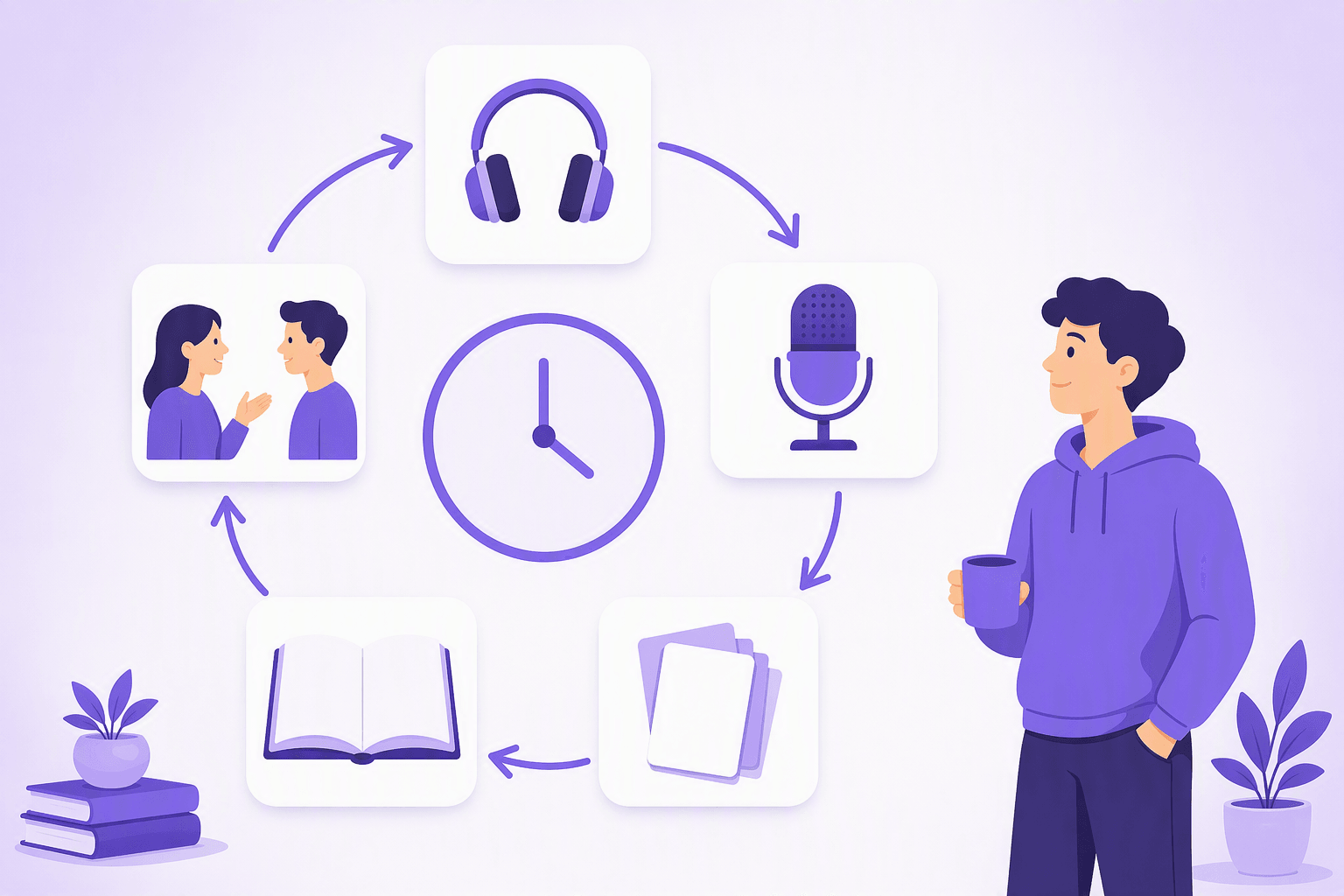
The 5-day core loop (30 to 45 minutes/day)
Day 1 to Day 3
- 10 minutes: one short clip, repeated listening
- 10 minutes: shadowing (repeat with the speaker)
- 10 minutes: vocabulary chunks from the clip, then quick review
Day 4
- 15 minutes: read something easy, then summarize out loud
- 15 minutes: flashcard review of the week’s chunks
Day 5
- 20 minutes: speaking practice (rehearsed script or tutor)
- 10 minutes: listen again to your original clip, no subtitles
Weekend: optional “fun input” that still helps
Watch a longer episode or movie segment for enjoyment. Keep subtitles if needed, but pick 3 moments to replay and practice actively.
If you want to learn through real scenes, Wordy’s approach is built around repeated short clips, interactive subtitles, and review of the words you actually encountered, not random lists. Keep it simple: one clip, many repetitions, then move on.
What to do if you keep making the same mistake
Repeated mistakes are usually not a character flaw. They are a training design problem.
If you keep forgetting words, your reviews are too rare or too easy. If you keep freezing when speaking, your speaking tasks are too hard and too unstructured. If you cannot understand speech, your listening is too difficult and not repeated enough.
Also consider the social side. English is global, but norms differ: directness, humor, and what counts as “rude” varies across regions. If you are curious about taboo language and why it can damage first impressions, read our English swear words guide as recognition knowledge, not as a speaking checklist.
A quick self-audit (use this today)
Write down your last 7 days of study and answer:
- How many minutes of focused listening did I do?
- Did I repeat any audio, or did I always move on?
- Did I practice speaking in any form?
- Did I review vocabulary in sentences, or as isolated words?
- Did I rely on subtitles every time?
Your answers will point to the one mistake that is costing you the most.
Closing: the fastest fix is usually less content, more repetition
Most learners do not need a new app, a new textbook, or a new method. They need fewer materials and more deliberate repetition with real language.
If you want a practical next step, pick one scene from a show you like, repeat it all week, and build your vocabulary list from that scene only. Then compare how you feel on day 7, your comprehension will usually jump more than it would from seven different “new” lessons.
For more ways to build real-world English, browse the Wordy blog and start with best movies to learn English.
Frequently Asked Questions
What is the biggest mistake in language learning?
Is it bad to learn grammar first?
How many minutes a day should I study a language?
Why do I understand written text but not spoken language?
Do I need to speak from day one?
Sources & References
- Ethnologue, 27th edition, 2024
- Council of Europe, Common European Framework of Reference for Languages (CEFR), Companion Volume, 2020
- OECD, Education at a Glance, 2024
- American Council on the Teaching of Foreign Languages (ACTFL), Proficiency Guidelines, accessed 2026
- British Council, LearnEnglish resources and research summaries, accessed 2026
Start learning with Wordy
Watch real movie clips and build your vocabulary as you go. Free to download.


