Quick Answer
American slang is informal vocabulary used in the US to sound casual, current, and socially in-the-know. This guide teaches 55+ common American slang words and phrases with pronunciation, tone, and when to avoid them, so you can understand movies, texts, and everyday conversation without guessing.
American slang is the set of informal words and phrases Americans use to sound casual, funny, or socially connected, and this guide gives you the most common ones with pronunciation and when to use them (or avoid them).
If you are learning English for the US, slang matters because it shows up everywhere: in texts, in workplaces with relaxed culture, and especially in movies and TV. Wordy’s movie-clip approach is built for this kind of real listening practice, and it pairs well with a solid base of standard English like our English slang overview and English pronunciation guide.
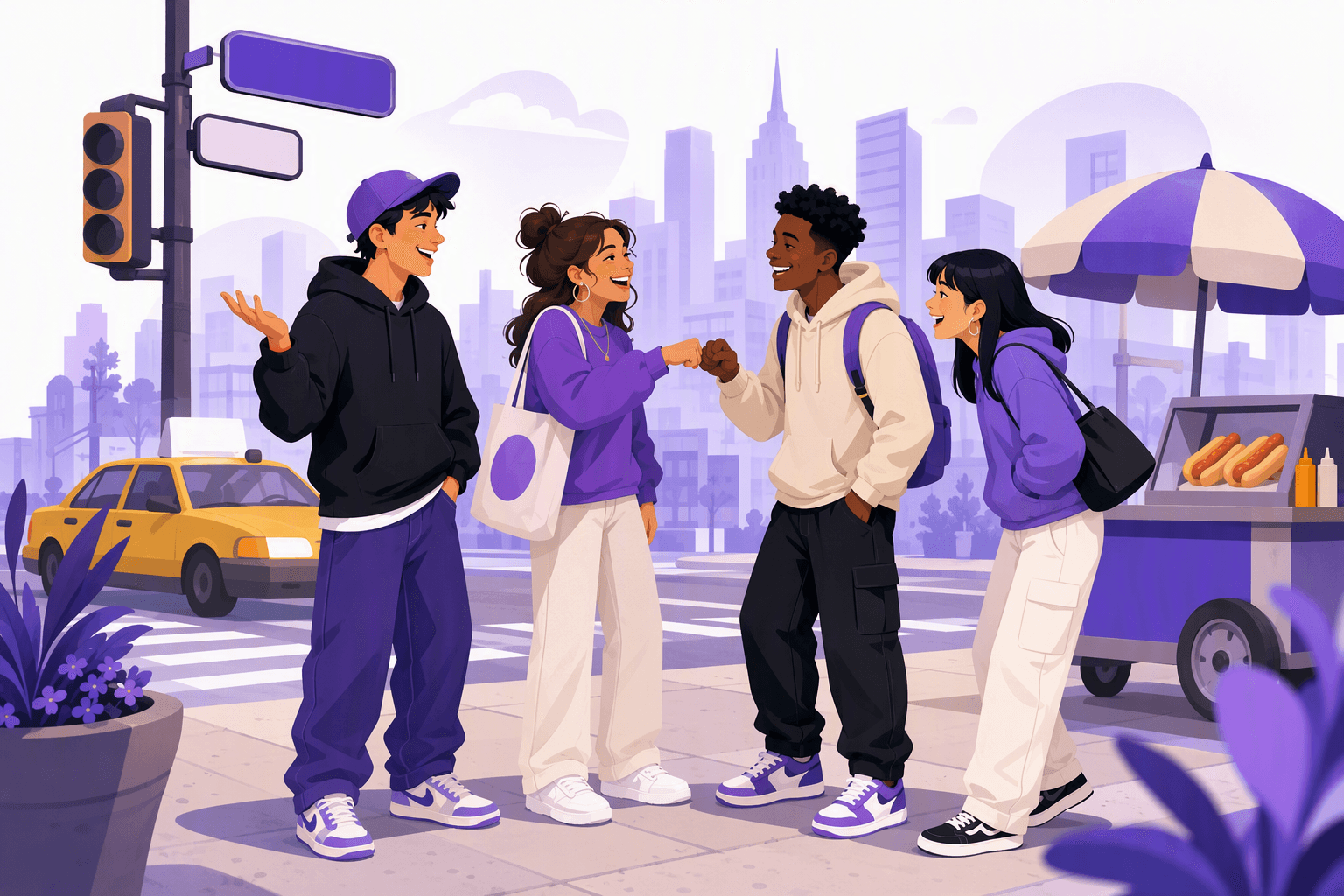
| English | Pronunciation | Formality |
|---|---|---|
| What's up? | WUTS up | casual |
| No worries. | noh WUR-eez | casual |
| My bad. | my BAD | casual |
| I'm down. | im DOWN | slang |
| I'm good. | im GOOD | casual |
| That's wild. | thats WYLD | slang |
| For real. | fer REEL | slang |
| No cap. | noh KAP | slang |
| That's fire. | thats FYR | slang |
| I'm dead. | im DED | slang |
| It's giving... | its GIV-ing | slang |
| Lowkey... | LOH-kee | slang |
Why American slang is hard (and how to learn it faster)
Slang is not just vocabulary, it is social meaning. The same word can sound friendly, sarcastic, or rude depending on tone, relationship, and setting.
In sociolinguistics, this is the core idea behind how people use language to build identity and belonging. Penelope Eckert’s work on communities of practice is useful here: slang spreads through groups that share daily life, not just through dictionaries.
A few real numbers that matter
English is the most widely spoken language in the world by total speakers, with about 1.5 billion speakers in Ethnologue’s 27th edition (2024). That global scale is why internet slang travels fast, but American slang still has a US flavor in pronunciation, rhythm, and cultural references.
In the United States, the Census Bureau tracks language use at home through the American Community Survey. English dominates daily life, but the US is multilingual, and that multilingual reality constantly feeds new words into American English (U.S. Census Bureau, accessed 2026).
💡 The fastest way to learn slang
Treat slang like listening training, not memorization. Learn one phrase, then collect 5 to 10 real examples from movies, TV, and YouTube. If you want clip-based practice, start with our best movies to learn English list and focus on scenes with casual dialogue.
How to use this guide (so you do not sound awkward)
You will see pronunciation in a simple General American style with stress in capitals. Use it as a rhythm guide, not a perfect phonetic transcription.
Also, do not force slang into every sentence. In American English, sounding natural often means using fewer special words, not more.
Core American slang for everyday conversation
These are high-frequency, low-risk phrases you can use with friends, classmates, and many coworkers in casual teams.
What's up?
Pronunciation: WUTS up
Meaning: A casual greeting that can also mean “How are you?” or “What’s going on?”
Typical replies:
- “Not much.”
- “Hey, what’s up?”
- “All good.”
If you want more greeting options, compare it with standard greetings in how to say hello in English.
No worries
Pronunciation: noh WUR-eez
Meaning: “It’s fine,” “Don’t stress,” or “You’re welcome.”
In the US, it is common in service situations too, but it can sound too casual in very formal contexts.
My bad
Pronunciation: my BAD
Meaning: “That was my fault.” It is brief, friendly, and often used for small mistakes.
Better than a heavy apology when the problem is minor, like bumping into someone or forgetting to send a link.
I'm good
Pronunciation: im GOOD
Meaning: Usually “No thanks” or “I’m fine.”
Example:
- “Want some coffee?”
- “I’m good, thanks.”
I'm down
Pronunciation: im DOWN
Meaning: “I’m interested,” “I agree,” or “I want to join.”
Example:
- “We’re getting tacos later.”
- “I’m down.”
⚠️ Common learner mistake
Do not confuse “I’m down” with “I’m feeling down.” The first means you want to do something. The second means you feel sad.
For real
Pronunciation: fer REEL
Meaning: “Seriously,” “I agree,” or “That’s true.”
It is often used as a reaction:
- “That exam was brutal.”
- “For real.”
Reaction slang you will hear in US movies and texts
American slang is packed with short reactions. These are common in dialogue-heavy scenes, which is why movie clips are so useful.
That's wild
Pronunciation: thats WYLD
Meaning: “That’s shocking,” “That’s crazy,” or “That’s unbelievable.”
Tone can be amused or disapproving. Context decides.
That's fire
Pronunciation: thats FYR
Meaning: “That’s excellent,” usually about music, food, fashion, or an idea.
It is informal and youthful. In older workplaces, it can sound performative.
I'm dead
Pronunciation: im DED
Meaning: “That’s extremely funny.”
It is not literal. It is a hyperbole reaction, similar to “I’m dying (laughing).”
If you want a deeper explanation of tone and where it fits, see what does LOL mean and how it differs from spoken reactions.
It's giving...
Pronunciation: its GIV-ing
Meaning: “It resembles,” “It has the vibe of,” or “It’s serving the energy of.”
Example:
- “That outfit is giving 90s.”
- “This meeting is giving chaos.”
This phrase is heavily influenced by online culture and LGBTQ+ ballroom-related “giving” and “serving” patterns that later spread widely. Use it only if you actually hear it around you.
Lowkey...
Pronunciation: LOH-kee
Meaning: “Kind of,” “secretly,” or “in a subtle way.”
Example:
- “I lowkey love that song.”
- “I’m lowkey stressed.”
For nuance and examples, compare with what does lowkey mean.
Internet-driven slang that Americans use offline
Not all internet slang becomes spoken slang, but some terms cross over and become normal in US conversation.
Here, dictionaries help you confirm that a term is not just a one-week meme. The OED and Merriam-Webster sometimes add or discuss high-impact slang, and their usage notes are a good reality check (OED, accessed 2026; Merriam-Webster, accessed 2026).
No cap
Pronunciation: noh KAP
Meaning: “No lie,” “I’m serious.”
Example:
- “That was the best burger I’ve had, no cap.”
If you want the full meaning and tone, read what does no cap mean.
Rizz
Pronunciation: RIZ
Meaning: Charisma, especially the ability to flirt or attract someone.
Example:
- “He’s got rizz.”
- “That was a rizz move.”
For context and how people actually use it, see what does rizz mean.
Sus
Pronunciation: SUSS
Meaning: Suspicious, questionable, or not trustworthy.
It became mainstream through gaming culture, especially Among Us, then spread into everyday speech.
For a clean breakdown, see what does sus mean.
Based
Pronunciation: BAYST
Meaning: A term of approval that can mean “confidently yourself” or “I agree,” often with an online political edge depending on community.
Because tone varies a lot, it is safer to understand it than to use it. If you do use it, keep it with friends who already talk that way.
For nuance, see what does based mean.
American regional slang (use with care)
The US is huge, and slang can be intensely local. A phrase that sounds normal in one city can sound strange somewhere else.
This is where slang research and dialect awareness matter. John McWhorter’s writing on American English often highlights how history, migration, and identity shape everyday speech, including informal vocabulary.
Hell(a)
Pronunciation: HEL-uh
Meaning: “Very” or “a lot,” strongly associated with Northern California.
Example:
- “That line is hella long.”
- “It’s hella cold today.”
If you are not in a place where people say it, it can sound like you are performing a stereotype.
Y'all
Pronunciation: YALL
Meaning: Second-person plural “you,” strongly associated with the South but now common across the US, especially in friendly group talk.
Example:
- “Are y’all ready?”
- “I’ll see y’all tomorrow.”
Many Americans use it because standard English lacks a clear plural “you.” Still, in some formal writing, it can look too casual.
Wicked
Pronunciation: WIK-id
Meaning: “Very,” associated with New England, especially Massachusetts.
Example:
- “That’s wicked expensive.”
The Midwest "Ope"
Pronunciation: OHp
Meaning: A small exclamation when you bump into someone, squeeze past, or realize a minor mistake.
Example:
- “Ope, sorry.”
- “Ope, let me get past you.”
It is subtle and often said under the breath. Learners can overdo it, so listen first.
🌍 Why movies can mislead you on regional slang
A character’s slang is part of character writing. A New York cop, a California surfer, and a Texas high schooler are built from different speech stereotypes. Use movies to train your ear, but confirm with real people in your area before adopting strongly regional phrases.
Slang in texting vs slang in speaking
Some slang is mostly typed. Some is mostly spoken. Some works in both.
Pew Research Center’s reporting on social media use helps explain why typed slang spreads so quickly in the US: large shares of Americans use major platforms, and short-form video accelerates imitation (Pew Research Center, accessed 2026).
Typed-first slang you will see a lot
- “DM me” (DEE-EM mee): message me privately
- “IRL” (EYE-ar-ELL): in real life
- “TL;DR” (TEE-ELL DEE-ar): summary, too long didn’t read
If you want the meaning and tone for TL;DR, see what does TL;DR mean.
Spoken-first slang that often looks weird in text
- “My bad.”
- “No worries.”
- “I’m down.”
These can look too blunt in writing without tone. Add “haha,” “all good,” or a friendly emoji if you text casually, but keep it professional at work.
Slang, politeness, and when it becomes rude
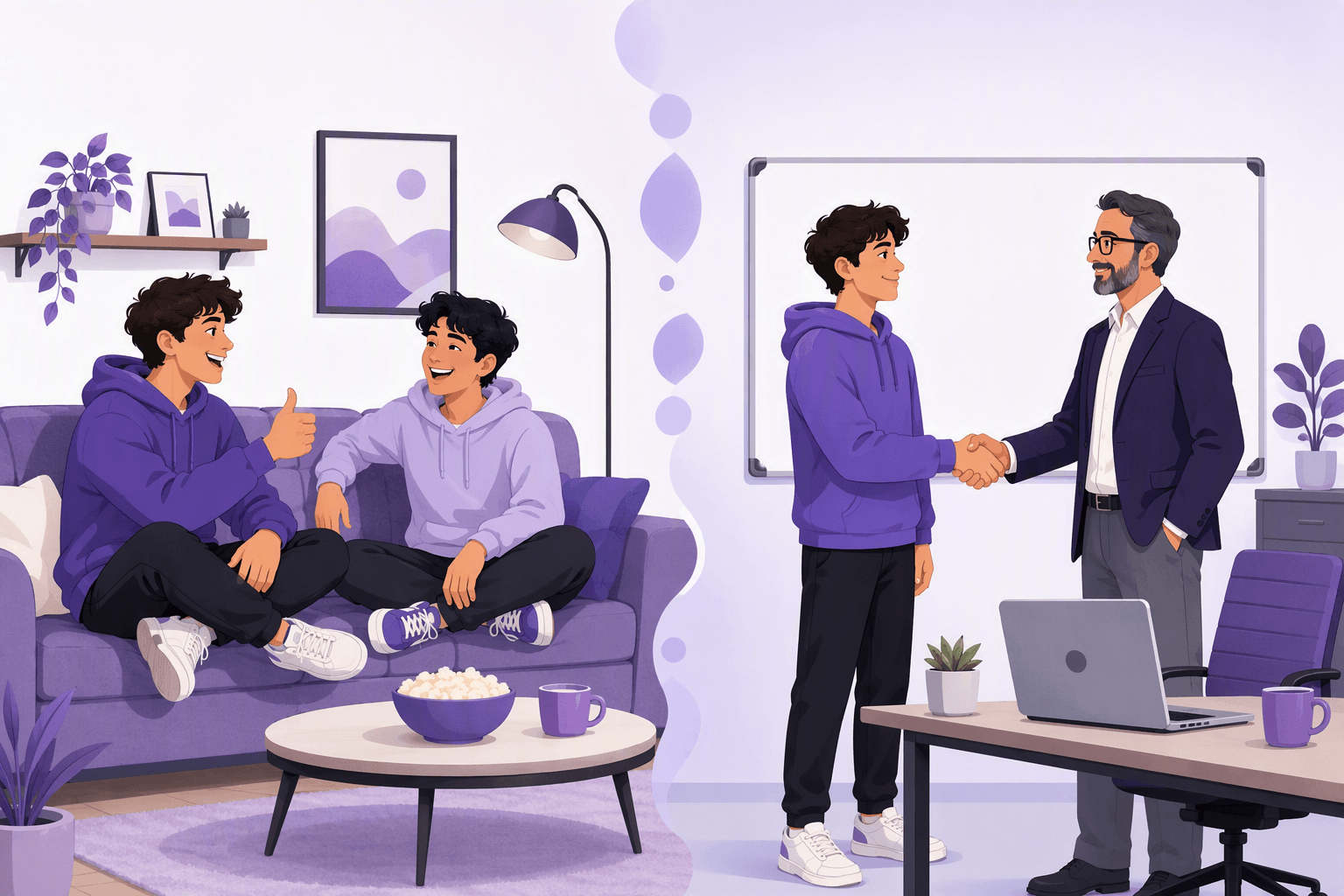
A lot of learner problems come from using slang in the wrong power situation. Talking to a friend is different from talking to a professor, a manager, or a customer.
Pragmatics research on politeness, including the classic framework by Brown and Levinson in Politeness: Some Universals in Language Usage (Cambridge University Press), is a good lens: people manage each other’s “face” constantly. Slang can feel friendly, but it can also feel too familiar.
⚠️ Avoid these as a learner
Skip insults, sexual slang, and profanity until you understand the social rules. If you want to recognize strong language in movies, use our English swear words guide as a comprehension tool, not a checklist to copy.
Mini “translation” map: safer standard English alternatives
If you are unsure, use a neutral phrase. You will still sound natural, just less trendy.
| Slang | English | Pronunciation | Note |
|---|---|---|---|
| That's wild. | That's surprising. | thats ser-PRY-zing | Works in any setting. |
| That's fire. | That's really good. | thats REE-lee GOOD | Safer at work. |
| I'm down. | I'd like to. | yd LYK too | Polite and clear. |
| No cap. | Seriously. | SEER-ee-us-lee | Avoids internet tone. |
| It's giving... | It feels like... | it FEELZ lyk | More widely understood. |
| I'm dead. | That's hilarious. | thats huh-LAIR-ee-us | Clear in speech and writing. |
How American slang shows up in movies and TV
Scripted dialogue compresses reality, but it is still one of the best ways to learn how Americans actually sound: interruptions, reductions, and quick reactions.
If you want to train this, focus on three things:
- Stress: Americans punch key words, then reduce the rest.
- Speed: slang is often short because it fits fast turn-taking.
- Emotion: slang is frequently a reaction, not a content word.
A practical routine:
- Watch one short clip with subtitles.
- Repeat the line out loud, matching stress.
- Swap in a safer alternative and notice how the vibe changes.
For more listening-first learning ideas, pair this with chatgpt for language learning to generate extra examples and role-plays, then verify them against real clips.
A quick note on numbers in American slang
Americans use numbers in casual ways that confuse learners:
- “a couple” often means about 2, but can mean a small number.
- “a few” often means 3 to 5, but it is flexible.
- “a minute” can mean “a while,” not 60 seconds.
If numbers are a weak spot, review English numbers so you can separate literal counting from casual exaggeration.
Practice: sound natural without trying too hard
Pick 5 phrases from the Quick Reference and practice them in short, realistic lines:
- “What’s up? You good?”
- “My bad, I forgot.”
- “No worries, I got it.”
- “That’s wild.”
- “I’m down.”
Then record yourself and check two things: stress and vowel reduction. If you say every word clearly and evenly, it will sound less American than the slang itself.
Where to go next
If you want broader modern slang beyond the US focus, read English slang. If your goal is understanding strong language in movies, use English swear words for recognition and severity, not imitation.
To learn slang the way Americans actually hear it, study it in context. Wordy’s clip library makes that easy because you can replay the same line until the rhythm and tone feel automatic, then move on to the next scene.
Frequently Asked Questions
What is American slang?
Is American slang the same as internet slang?
What American slang should I avoid as a learner?
How do I know if a slang word is outdated?
Do Americans use slang in professional settings?
Sources & References
- U.S. Census Bureau, 'Language Use in the United States' (American Community Survey), accessed 2026
- Ethnologue, English, 27th edition, 2024
- Oxford English Dictionary (OED), selected entries for contemporary slang, accessed 2026
- Merriam-Webster Dictionary, selected entries and usage notes, accessed 2026
- Pew Research Center, reports on social media use in the United States, accessed 2026
Start learning with Wordy
Watch real movie clips and build your vocabulary as you go. Free to download.


