Quick Answer
British slang is informal, everyday English used across the UK, especially in conversation, texting, and pop culture. This guide explains common UK slang words and phrases, how they sound, what they mean in context, and which ones are regional, so you can understand British TV and speak more naturally without sounding rude.
British slang is the informal vocabulary and phrasing you hear in everyday UK conversation, especially among friends, in pubs, on public transport, and in modern British TV. Learn a core set of common expressions plus the cultural rules around tone and politeness, and you will understand British dialogue much faster without sounding blunt or accidentally rude.

| English | English (UK) | Pronunciation | Formality |
|---|---|---|---|
| Thanks / bye (casual) | Cheers | CHEERZ | casual |
| Friend / person (casual) | Mate | MAYT | casual |
| Very good | Brilliant | BRILL-yuhnt | casual |
| I'm tired | I'm knackered | eye'm NAK-uhd | casual |
| That's annoying / unfair | That's rubbish | thats RUB-ish | casual |
| Do you want to...? | Fancy...? | FAN-see | casual |
| A lot / very | Proper | PROP-uh | slang |
| A bit / somewhat | A tad | uh TAD | casual |
Why British slang matters (and why it's tricky)
English is the world's most widely spoken language, with roughly 1.5 billion speakers when you count native and second-language speakers (Ethnologue, 2024). But English is not one uniform thing, and the UK alone contains multiple national varieties and hundreds of local accents (Wells, 1982).
Slang adds another layer: it changes fast, it's social, and it depends heavily on tone. The same word can sound friendly, teasing, or aggressive depending on the speaker and situation.
"Slang is a marker of in-group identity: it signals who belongs, who doesn't, and how close people are."
Peter Trudgill, sociolinguist (Trudgill, 2000)
If you want a broader baseline first, start with modern everyday expressions in our English slang overview. Then come back here for the UK-specific meanings and usage rules.
The most useful British slang words (with pronunciation and real-life use)
Below are high-frequency UK slang items you'll hear across England, Scotland, Wales, and Northern Ireland. Some are more regional than others, but all are common in British media.
Cheers
Pronunciation: "CHEERZ"
Meaning: "thanks" and sometimes "bye." In a pub, it also means "toasting" (like "cheers!" in American English), but in the UK it's extremely normal as "thanks."
Example:
- "Cheers for that."
- "Right, cheers, see you later."
Cultural note: In service situations, "cheers" can sound friendly and normal, especially among younger adults. If you want safer and slightly more neutral, "thank you" works everywhere.
Mate
Pronunciation: "MAYT"
Meaning: friend, or a casual way to address someone. It can be warm ("Alright, mate?") or confrontational ("Listen, mate.") depending on tone.
Example:
- "You alright, mate?" (A common hello, not a deep question.)
Tip: If you are unsure, use "mate" with friends, not with strangers in formal settings.
Brilliant
Pronunciation: "BRILL-yuhnt"
Meaning: very good, great, perfect. British English uses enthusiastic positives like this constantly.
Example:
- "Brilliant, thanks."
Knackered
Pronunciation: "NAK-uhd"
Meaning: exhausted, very tired.
Example:
- "I'm absolutely knackered."
This is one of the safest, most useful UK words for daily life.
Rubbish
Pronunciation: "RUB-ish"
Meaning: garbage (noun) and also "nonsense" or "bad quality" (adjective).
Example:
- "The film was rubbish."
- "That's rubbish!"
If you're learning through clips, you'll hear "rubbish" a lot in family-friendly shows because it avoids stronger swearing.
Fancy
Pronunciation: "FAN-see"
Meaning: to want, to feel like, to find attractive (romantically or aesthetically).
Examples:
- "Fancy a coffee?"
- "Do you fancy him?"
This is a classic British softener because it feels less direct than "Do you want...?"
Proper
Pronunciation: "PROP-uh"
Meaning (slang): very, really, genuinely.
Example:
- "That's proper funny."
Use it sparingly. Overusing "proper" can sound like you're performing an accent.
Sorted
Pronunciation: "SOR-tid"
Meaning: arranged, handled, fixed.
Example:
- "Don't worry, it's sorted."
Gutted
Pronunciation: "GUT-id"
Meaning: very disappointed.
Example:
- "I'm gutted I missed it."
Dodgy
Pronunciation: "DOJ-ee"
Meaning: suspicious, unreliable, low quality, or unsafe.
Examples:
- "That looks dodgy."
- "It's a bit of a dodgy area at night."
Skint
Pronunciation: "SKINT"
Meaning: broke, no money.
Example:
- "Can't come out, I'm skint."
Chuffed
Pronunciation: "CHUFT"
Meaning: pleased, proud, happy (often mildly, in a very British way).
Example:
- "I'm well chuffed with that."
Taking the mick
Pronunciation: "TAY-king thuh MIK"
Meaning: teasing, mocking, not being serious. You will also hear "taking the piss," which is stronger and ruder.
Example:
- "Are you taking the mick?"
To be buzzing
Pronunciation: "BUZ-ing"
Meaning: excited, thrilled.
Example:
- "I'm buzzing for the weekend."
Lush
Pronunciation: "LUSH"
Meaning: really nice, delicious, great. Commonly associated with Wales and the West Country, but understood widely.
Example:
- "This cake is lush."
Fit
Pronunciation: "FIT"
Meaning: attractive (slang).
Example:
- "He's fit."
Naff
Pronunciation: "NAF"
Meaning: uncool, tacky, a bit embarrassing.
Example:
- "That outfit is naff."
Gobsmacked
Pronunciation: "GOB-smakt"
Meaning: shocked, amazed.
Example:
- "I was gobsmacked when she said yes."
Brolly
Pronunciation: "BROL-ee"
Meaning: umbrella.
Example:
- "Grab your brolly, it's chucking it down."
Chav
Pronunciation: "CHAV"
Meaning: a stereotype for someone seen as loud, lower-class, and badly behaved. It is socially loaded and often classist.
Example:
- "Don't call people a chav." (Best advice for learners.)
⚠️ Avoid class-loaded labels
Words like "chav" can punch far above their dictionary meaning because they touch class and identity. As a learner, treat them as comprehension vocabulary, not speaking vocabulary, unless you are very sure of the social context.
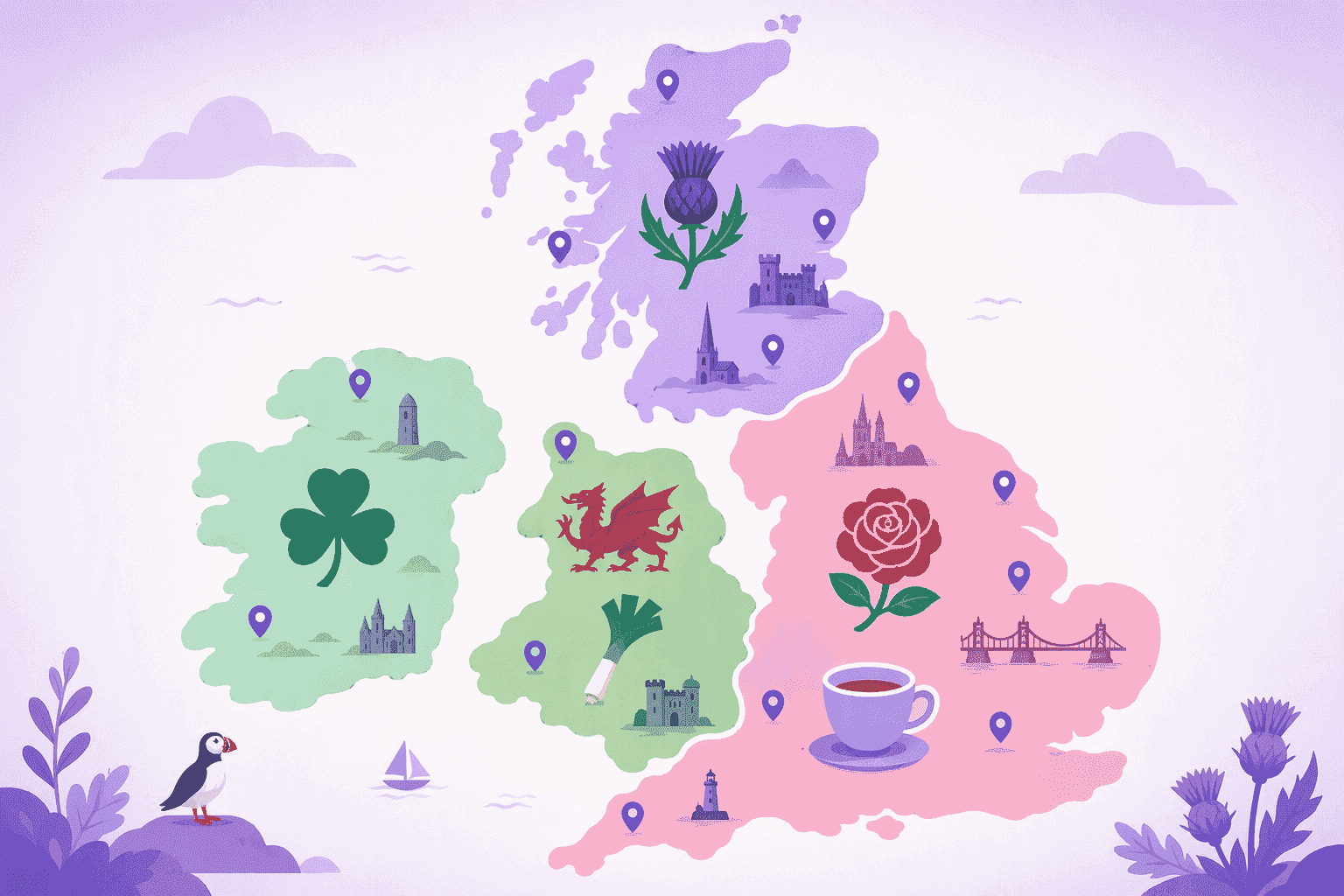
Regional UK slang: what changes across England, Scotland, Wales, and Northern Ireland
The UK is small geographically, but linguistically dense. J.C. Wells documents substantial accent variation across the British Isles, and slang often follows those speech communities (Wells, 1982).
Use this section to recognize what you hear in shows and conversations, without feeling you must copy it immediately.
Scotland
A few Scottish items you'll hear a lot in Scottish TV and in cities like Glasgow and Edinburgh:
- "Wee" (pronounced "WEE"): small. Example: "A wee bit."
- "Aye" (pronounced "EYE"): yes.
- "Nae" (pronounced "NAY"): no, not.
- "Pure" (pronounced "PYOOR"): very. Example: "That's pure brilliant."
Northern Ireland
Common in Belfast and across Northern Ireland:
- "Craic" (pronounced "KRAK"): fun, gossip, good atmosphere. Example: "What's the craic?"
- "Dead on" (pronounced "DED on"): okay, fine, approved. Example: "That's dead on."
Wales and the West Country
You may hear:
- "Lush" (pronounced "LUSH"): really nice.
- "Alright?" as a greeting used constantly (this is UK-wide, but it stands out to learners because it replaces "Hello, how are you?").
London and multicultural youth slang
London slang changes quickly and overlaps with Multicultural London English (MLE). If you want a safe starting point, learn to understand it first, then speak it only with peers.
Examples you may hear:
- "Bare" (pronounced "BAIR"): a lot. Example: "That's bare expensive."
- "Mandem" (pronounced "MAN-dem"): a group of male friends.
🌍 Why copying London slang can backfire
Some London youth slang is strongly tied to age, neighborhood, and identity. Using it as an outsider can sound forced, even if your grammar is perfect. Focus on understanding it in clips, then choose neutral UK slang (like "cheers" and "knackered") for your own speech.
British politeness: the hidden rules behind slang
British conversation often uses indirectness and softeners, especially with strangers. This is not about being "less honest," it's about managing social distance and avoiding sounding demanding.
Here are reliable patterns you will hear in real dialogue:
Softening requests
Instead of "Give me a coffee," you will hear:
- "Could I get a coffee, please?"
- "Any chance of a coffee?"
- "Fancy making a brew?" (with friends)
If you want more request patterns, pair this guide with how to say please in English and excuse me and sorry in English.
Understatement and "quite"
In UK speech, "quite" often means "fairly" rather than "extremely." So "It's quite good" can mean "It's decent," not "It's amazing."
This is one reason learners misread British feedback at work or in school.
Banter vs rudeness
"Banter" is playful teasing, but it depends on relationship and timing. If you are new to a group, avoid teasing first, and mirror what others do.
If you want to understand where the line is, read our English swear words guide for severity and context.
British slang you will hear in TV-style dialogue (mini scenes)
Wordy teaches through short, repeatable scenes, which is ideal for slang because you learn the tone, not just the dictionary meaning. Here are mini-dialogues you can practice out loud.
Scene 1: after work
- "You coming for a pint?"
- "Can't, I'm knackered."
- "Fair. See you tomorrow."
- "Cheers, mate."
Scene 2: plans changed
- "The train's cancelled."
- "That's rubbish."
- "Yeah, proper annoying."
- "We'll get a taxi, it's sorted."
Scene 3: good news
- "I got the job!"
- "No way, that's brilliant!"
- "I'm buzzing."
- "I'm well chuffed for you."
Common learner mistakes (and how to avoid them)
Using slang in formal settings
British slang is not "wrong," but it can be inappropriate in interviews, emails, or customer service. Keep slang for peers and casual talk.
If you need safe workplace language, start with neutral phrases and add slang later.
Overusing one favorite word
Learners often latch onto one item like "proper" or "mate" and repeat it too much. Native speakers spread their informal markers across many small choices (intonation, softeners, tag questions), not one repeated slang word.
Confusing UK vs US meanings
Some everyday words are not slang, but they cause real confusion:
- "Pants" often means underwear in the UK.
- "Biscuit" is closer to a cookie.
- "Chips" are fries.
For foundational vocabulary that stays stable across accents, build your base with guides like numbers in English and months in English.
How to learn British slang fast with movie and TV clips
Slang sticks when you learn it as a full line, with a face, a situation, and a reaction. That is exactly what film and TV provide.
Use this 3-step method:
- Pick one short scene and replay it until you can shadow the rhythm.
- Save the whole sentence, not just the slang word.
- Swap one element at a time (change the noun, keep the structure).
If you want to train listening with real speech daily, start on Wordy's English learning page, then browse more guides on the Wordy blog.
Frequently Asked Questions
Is British slang the same as British English?
What British slang should I avoid as a learner?
Do Americans understand British slang?
What is the most common British slang word?
How can I learn British slang from movies and TV without copying mistakes?
Sources & References
- Oxford English Dictionary (OED), Oxford University Press, ongoing edition
- British Council, LearnEnglish: UK English and language use, 2024-2026
- Ethnologue, English (27th edition), SIL International, 2024
- Trudgill, Peter, Sociolinguistics: An Introduction to Language and Society (4th ed.), Penguin, 2000
- Wells, J.C., Accents of English, Cambridge University Press, 1982
Start learning with Wordy
Watch real movie clips and build your vocabulary as you go. Free to download.


