Quick Answer
English food culture is less about one national cuisine and more about shared habits in English-speaking places: how people order politely, handle tipping or splitting the bill, and make small talk at meals. This guide explains the real phrases, unspoken rules, and regional differences across the US, UK, Canada, Australia, and more.
English food culture is the set of everyday habits around eating in English-speaking places: how people order, how they show politeness, how they handle tipping or splitting the bill, and what they consider normal meal timing and small talk. Because English is a global language, the “culture” is not one cuisine, it is a set of shared social patterns with strong regional differences between the US, UK, Canada, Australia, and other communities.
If you want to hear these patterns in real speech, movies and TV are unusually useful because food scenes are full of quick, natural lines, interruptions, and polite softeners. For listening practice, pair this guide with best movies to learn English and notice how often ordering and table talk show up.
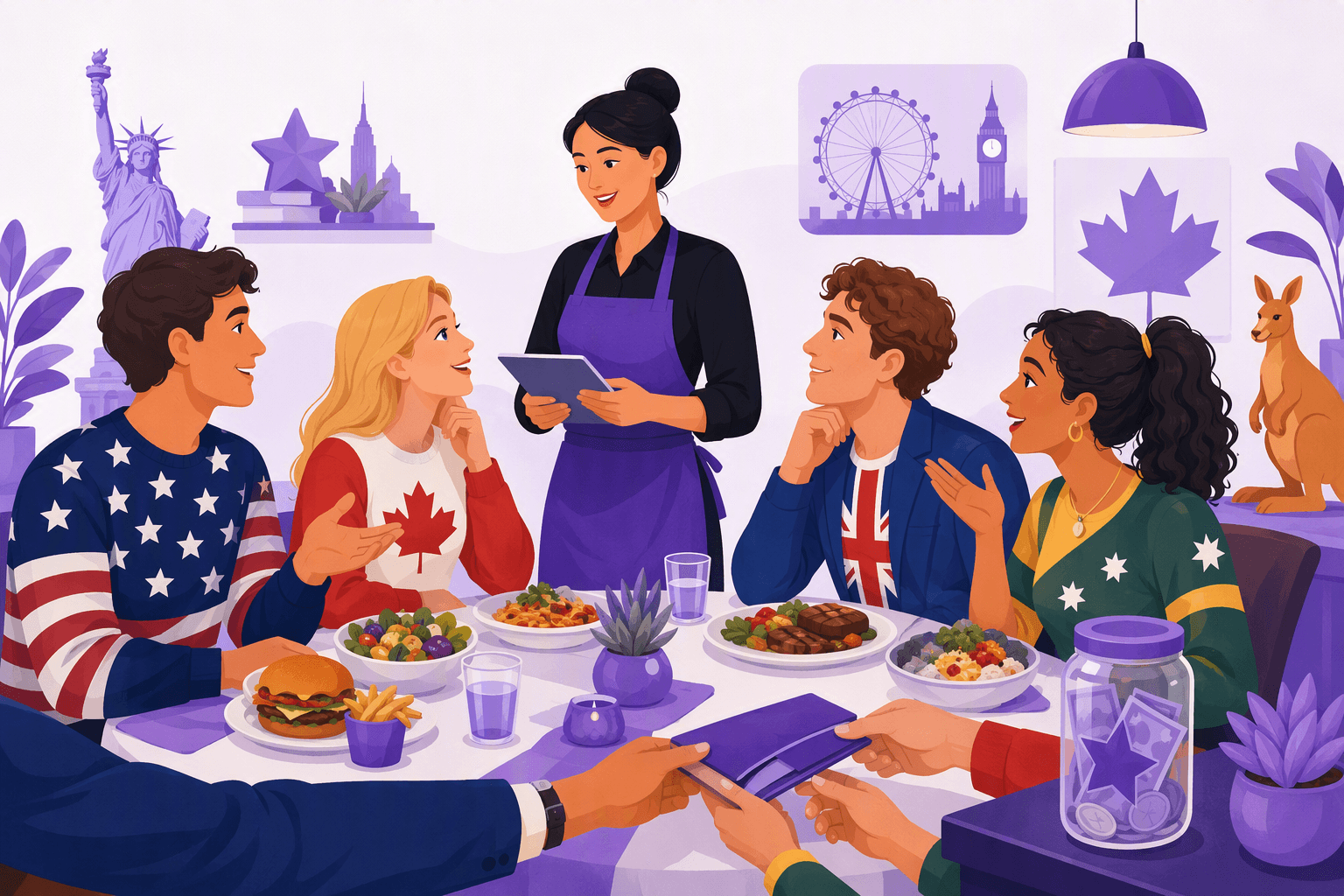
Why “English food culture” is global, not one country
English has about 1.5 billion speakers worldwide when you include native and second-language speakers (Ethnologue, 27th edition, 2024). That means “English food culture” is really a cluster of cultures that share a language, not a single national tradition.
You will still see recurring patterns across many English-speaking settings:
- Politeness is often expressed through indirect language, not just “please.”
- Restaurants have a predictable script: greeting, drink order, food order, check or bill, tip or no tip.
- Small talk is expected in many situations, but it is usually light and non-intrusive.
For a useful lens on why indirectness feels polite in English, Deborah Tannen’s work on conversational style is a good reference point. It helps explain why “Could I get…” can feel friendlier than “Give me…,” even when both are grammatically correct.
The biggest cultural split: US vs UK restaurant norms
If you learn only one thing, learn this: the US and UK share a lot of vocabulary, but restaurant expectations can feel very different.
Tipping expectations
In the US, tipping is part of the social contract of eating out. People often tip servers, bartenders, and delivery drivers, and not tipping can be read as a strong negative signal unless something went seriously wrong.
In the UK, tipping exists, but it is less automatic. Many restaurants add a service charge, and customers may tip a smaller amount or round up. The same “leave 20%” mindset does not transfer cleanly.
⚠️ Avoid the 'tipping math' trap
If you are traveling, do not guess based on your home country. Check whether a service charge is already included, then follow local norms. In the US, tipping is often expected even when service feels minimal, because it is built into how the job is paid.
“Check” vs “bill”
In American English, the restaurant paper you pay is usually the “check” (CHEK). In British English, it is usually the “bill” (BIL). Both words exist in both varieties, but using the local one makes you sound more natural.
Server style and pacing
In the US, servers may check in more often: “How’s everything tasting?” “Can I get you anything else?” In the UK, service can be less interruption-heavy, especially in pubs, where ordering at the bar is common.
These are tendencies, not rules. In big cities and tourist areas, you will see mixed styles.
Meal timing: what people mean by breakfast, lunch, dinner, and tea
Meal words look simple, but they carry cultural timing.
Breakfast
Breakfast is usually the morning meal. In the US, it can be quick (cereal, toast, coffee) or a weekend event (pancakes, eggs, brunch).
Lunch
Lunch is typically midday and often shorter on workdays. In many US workplaces, lunch can be 30 to 60 minutes. In the UK, lunch can be a sandwich meal, a pub lunch, or a hot meal depending on the setting.
Dinner vs supper
“Dinner” often means the main evening meal, but in some families it can mean the main meal of the day, even if it is midday. “Supper” is used more in some regions (parts of the US, Canada, and the UK) and can sound homey or traditional.
Tea
In the UK, “tea” can mean the drink, a light afternoon meal, or in some regions an early evening meal. This is one of the classic points of confusion: someone can invite you for “tea” and mean food, not just a cup of tea.
Linguist Kate Fox, in her writing on English social behavior, points out how much everyday etiquette is carried by small, routine interactions. Meal words are a good example: they encode schedule, class signals, and family tradition.
Ordering in English: the polite scripts people actually use
Ordering is one of the most learnable parts of food culture because it follows a script. The key is to sound polite without sounding overly formal.
Here are safe, natural patterns with pronunciation:
- “Could I get the burger, please?” (kood eye GET thuh BUR-ger pleez)
- “I’ll have the salmon, please.” (AYL HAV thuh SAM-uhn pleez)
- “Can we start with the fries?” (kan wee START with thuh FRYZ)
- “What do you recommend?” (wut doo yoo reh-kuh-MEND)
In many English-speaking contexts, indirectness is a politeness tool. That is why “Could I…” and “Can I…” are so common.
💡 A simple ordering template
Use: softener + item + please. Examples: "Could I get the chicken sandwich, please?" "Can I have the soup, please?" "I’ll have the pasta, please."
If you want more restaurant-ready lines, see English travel phrases for airport and hotel language that overlaps with dining.
The hidden skill: how to customize food without sounding rude
In the US and Canada especially, customization is normal. People ask for substitutions, sauces on the side, and allergy changes.
The politeness trick is to frame it as a question, not a demand:
- “Could I get that without onions?” (kood eye GET that wih-THOUT UN-yuhnz)
- “Is it possible to swap the salad for fries?” (iz it POS-uh-buhl tuh SWAP thuh SAL-uhd fer FRYZ)
- “Can I get the dressing on the side?” (kan eye GET thuh DRESS-ing on thuh SYD)
In the UK, customization exists but can be less expected in some traditional settings. In pubs and casual chains, it is common.
Allergies and dietary restrictions
Clear, direct language is better than being subtle:
- “I’m allergic to peanuts.” (AYM AL-er-jik tuh PEE-nuhts)
- “Does this have dairy?” (duhz this hav DAIR-ee)
- “Is this vegan?” (iz this VEE-guhn)
This is one place where being indirect can be risky. Safety beats politeness.
Paying: splitting the bill, “going Dutch,” and awkward moments
Money talk is where learners often feel stress, and where culture differs.
Splitting the bill
In the US, splitting is common among friends, but the method varies. Some places split evenly, some split by item, and some do not split at all.
Useful lines:
- “Can we split the check?” (kan wee SPLIT thuh CHEK)
- “Separate checks, please.” (SEP-er-it CHEKS pleez)
- “Let’s split it evenly.” (lets SPLIT it EE-vuhn-lee)
In the UK:
- “Can we split the bill?” (kan wee SPLIT thuh BIL)
- “Can we pay separately?” (kan wee PAY SEP-er-it-lee)
“Going Dutch”
“Go Dutch” means each person pays their own share. It is understood, but it can sound slightly old-fashioned or overly explicit in some groups. Among close friends it can be fine, but in dating contexts it can carry social meaning.
🌍 A cultural reality: money talk signals relationship
In many English-speaking settings, who pays is not only about money. It signals closeness, status, and intention. If you are unsure, offer once, then accept the group’s decision without pushing.
Takeout, takeaway, and delivery: the vocabulary differences that matter
Food culture today is not only restaurants. It is apps, delivery, and eating at home.
Takeout vs takeaway
In the US and Canada, “takeout” is common. In the UK, Australia, and New Zealand, “takeaway” is common. Both are understood widely.
- takeout (TAYK-owt)
- takeaway (TAYK-uh-way)
Merriam-Webster is a good reference for how these terms are defined and used in American English (accessed 2026).
To-go
In the US, “to-go” is extremely common:
- “Can I get that to-go?” (kan eye GET that tuh GOH)
- “A coffee to-go, please.” (uh KAW-fee tuh GOH pleez)
In the UK, you might hear “to take away” or “takeaway coffee.”
Leftovers and “doggy bag”
“Leftovers” are normal in the US, and taking food home is common. “Doggy bag” is an older phrase for a container to take leftovers, but many people now just say:
- “Can I get a box for this?” (kan eye GET uh BOKS fer this)
- “Could we get this wrapped up?” (kood wee GET this RAPD UP)
Table talk: what people say while eating
Food scenes in English media teach a lot because they show the rhythm of conversation: short turns, quick reactions, and polite appreciation.
Compliments that sound natural
- “This is really good.” (this iz RIH-lee GOOD)
- “I love this.” (eye LUV this)
- “You have to try this.” (yoo hav tuh TRY this)
Offering and sharing
- “Do you want to try some?” (doo yoo WAHNT tuh TRY sum)
- “Help yourself.” (help yer-SELF)
- “Want a bite?” (wahnt uh BYT)
The polite refusal
English often uses soft refusals to avoid sounding harsh:
- “I’m good, thanks.” (AYM GOOD thangks)
- “No, I’m okay.” (NOH, AYM oh-KAY)
- “Maybe later.” (MAY-bee LAY-ter)
If you want to understand how tone changes meaning, slang can be a shortcut. Compare “I’m good” (polite refusal) with slangy “I’m good” that can sound final or dismissive depending on tone. For more on tone-heavy expressions, see English slang.
Home meals and invitations: what to bring, what to say, what not to do
A lot of “food culture” happens in homes, not restaurants.
Potlucks and shared meals
A potluck is a group meal where each person brings a dish. It is common in the US and Canada at workplaces, schools, and community events (Merriam-Webster, accessed 2026).
Useful lines:
- “What should I bring?” (wut shood eye BRING)
- “Do you have any allergies?” (doo yoo hav EN-ee AL-er-jeez)
- “I can bring dessert.” (eye kan BRING dih-ZERT)
Store-bought food is often acceptable. The social signal is effort and participation, not culinary skill.
Dinner invitations and timing
If someone says “Come over at 7,” arriving exactly at 7 is usually safe in the US and Canada, but in some social circles arriving 5 to 15 minutes later can be normal. In the UK, punctuality can be valued, but it depends on formality.
When in doubt, ask:
- “Should I come right at 7?” (shood eye KUM RYT at SEV-uhn)
If you need number pronunciation for times and party planning, English numbers helps you avoid common mistakes like “thirteen” vs “thirty.”
Alcohol, pubs, and the social rules around rounds
In the UK and Ireland especially, pubs are a major part of social food culture, even when people are not eating a full meal.
Buying rounds
A “round” is when one person buys drinks for the group, then someone else buys the next set. It is a social system that signals fairness and belonging.
Useful lines:
- “It’s my round.” (its my ROWND)
- “What are you having?” (wut ar yoo HAV-ing)
- “I’ll get the next one.” (AYL GET thuh NEKST wuhn)
In the US, rounds exist too, but the practice is less universal and more group-dependent.
🌍 Round culture is about trust
If you join a round, people may expect you to take a turn later. If you do not want to participate, it is fine to say so early, politely, so it does not look like you are trying to get free drinks.
Food and identity: why “comfort food” matters in English
Some food words are cultural concepts, not just items.
Comfort food
“Comfort food” means food that feels emotionally reassuring, often linked to childhood or home. It is a common topic in conversation and media.
- comfort food (KUM-fert FOOD)
This concept is useful because it invites storytelling. People talk about comfort food when they talk about family, stress, weather, and nostalgia.
“Healthy eating” and moral language
English food talk often carries moral framing: “good” food, “bad” food, “cheat day.” Public health messaging also shapes the vocabulary people use.
The USDA Dietary Guidelines for Americans (2020-2025) is one example of an authoritative source that influences how “balanced meals” and “added sugars” are discussed in US contexts.
How movies and TV teach English food culture fast
Food scenes are dense with real language:
- interruptions (“Wait, what did you order?”)
- polite softeners (“Could we maybe…?”)
- fast service interactions (“Still or sparkling?”)
- relationship signals (“I’ll get this.”)
When you watch, listen for three things:
- The opener: how people get the server’s attention.
- The ordering grammar: “I’ll have…” vs “Can I get…”
- The closing: “Can we get the check?” and goodbye rituals.
For a structured way to practice, use a clip-based approach where you replay short scenes until the rhythm feels automatic. That is the fastest path from knowing words to sounding socially comfortable.
Common mistakes learners make (and how to fix them)
Sounding too direct
“Give me a coffee” can sound rude in many contexts. Switch to:
- “Could I get a coffee, please?” (kood eye GET uh KAW-fee pleez)
Over-apologizing
Saying “Sorry” before every request can make you sound anxious. Use “Excuse me” to get attention, then a polite request.
If you want a deeper look at apology and attention-getting language, how to say excuse me in English is a practical companion.
Using swear words as emphasis
Some learners copy strong language from media without realizing the social cost. Food culture includes casual complaining, but swearing can change how people read you instantly.
If you are unsure about intensity, avoid it. If you want to understand the scale, see English swear words for severity and context.
A practical mini-playbook for your next meal in English
Use this as a simple sequence you can rehearse:
- Greeting: “Hi.” (HY)
- Seating: “Table for two, please.” (TAY-buhl fer TOO pleez)
- Drinks: “Just water for me, thanks.” (just WAW-ter fer mee thangks)
- Order: “Could I get the chicken, please?” (kood eye GET thuh CHIK-uhn pleez)
- Check-in: “Everything’s great, thanks.” (EV-ree-thingz GRAYT thangks)
- Paying: “Can we split the check?” (kan wee SPLIT thuh CHEK)
- Leaving: “Thanks, have a good one.” (thangks, hav uh GOOD wuhn)
None of these lines are fancy. They are culturally safe, widely understood, and easy to deliver under pressure.
Learn food culture the way natives do: by hearing it daily
Food culture is not memorizing menus. It is hearing the same social scripts in dozens of small moments until your brain predicts them automatically.
If you want a steady stream of real examples, build a routine around short scenes, repeated listening, and copying the exact timing of polite phrases. For more learning methods that work with real media, browse the Wordy blog and start with one topic you will use this week.
Frequently Asked Questions
Is tipping part of English food culture everywhere?
What is the most polite way to order food in English?
How do you ask for the bill in American vs British English?
What does 'potluck' mean in English-speaking countries?
What should I talk about at the table in English?
Sources & References
- Ethnologue, English, 27th edition, 2024
- Merriam-Webster Dictionary, entries for 'potluck' and 'takeout', accessed 2026
- Cambridge Dictionary, entries for 'check' and 'bill' (restaurant meaning), accessed 2026
- Emily Post Institute, Tipping and Dining Etiquette guidance, accessed 2026
- USDA Dietary Guidelines for Americans 2020-2025
Start learning with Wordy
Watch real movie clips and build your vocabulary as you go. Free to download.


