Quick Answer
English is the language of travel, at airports, hotels, and restaurants worldwide you can communicate in English. Key phrases include: “Where is...?” (/wɛr ɪz/), “How much does this cost?” (/haʊ mʌtʃ dʌz ðɪs kɒst/), “Could I have the bill, please?” (/kʊd aɪ hæv ðə bɪl/) and “I need help, please.” (/aɪ niːd hɛlp/).
The short answer
English is the global language of travel, if you know one sentence in English, you can communicate almost anywhere. The most important one is: "Could you help me, please?" (/kʊd juː hɛlp miː pliːz/), it instantly shows you need help and you are polite, at any airport, hotel, or on the street.
According to Ethnologue 2024, nearly 1.5 billion people use English for daily communication, which makes it the world’s most widespread lingua franca. Linguist David Crystal (The Cambridge Encyclopedia of the English Language, Cambridge University Press, 2019) says English is the only language that is official or widely used on every continent. It is also the de facto standard language of aviation, tourism, and the hotel industry.
“English is not just a language, it is the code that the world’s travelers use to communicate with each other. Anyone who learns a few polite phrases becomes part of this global conversation right away."
(British Council, English Language Teaching: Global Research Report, 2023)
This guide includes 50+ essential English travel phrases, grouped by situation: airport and customs, hotel, restaurant, transport, shopping, and emergencies. For each sentence, you get pronunciation, a real example sentence, and cultural context. This helps you know when and how to use it.
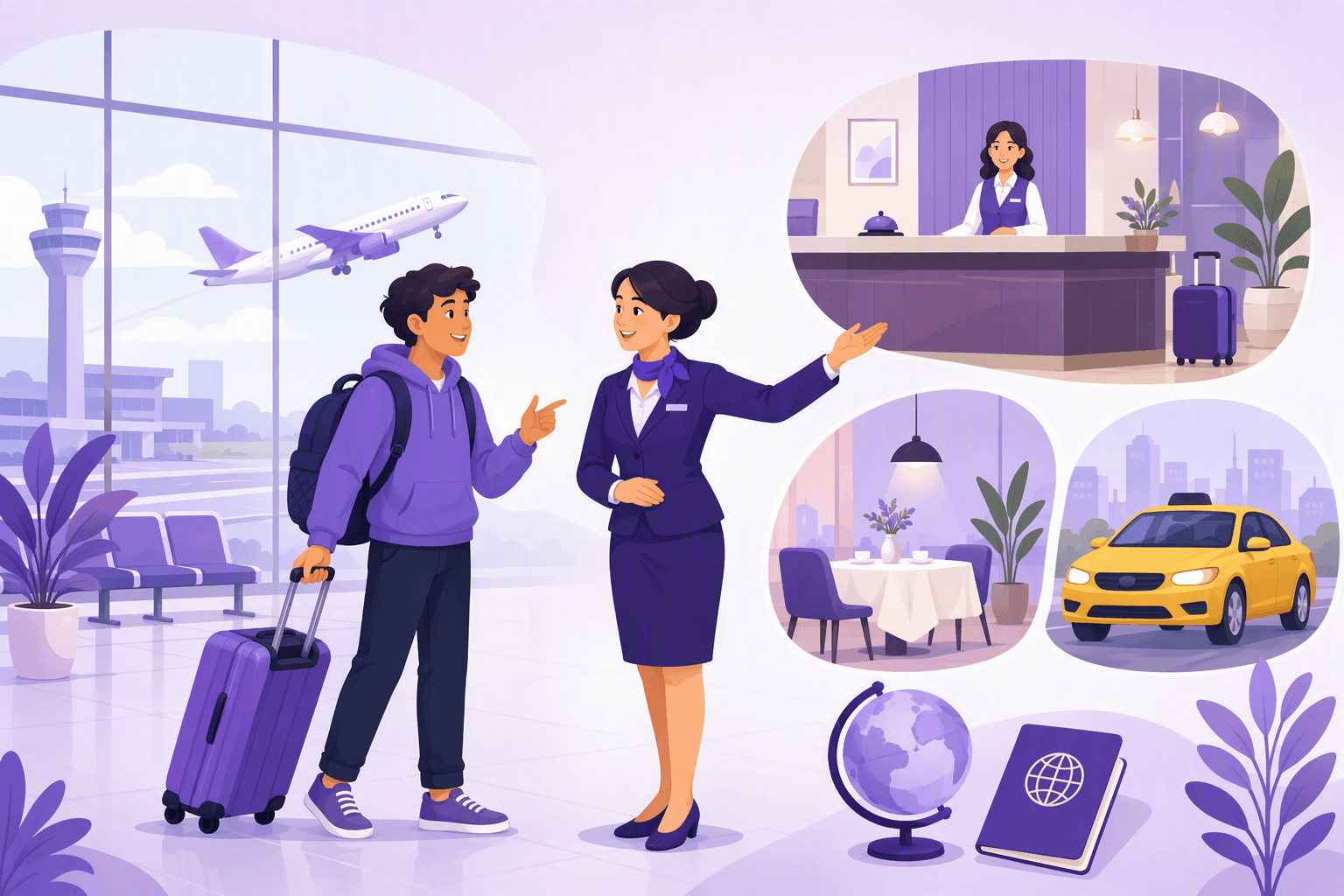
Quick overview: the 12 most important English travel phrases
| English | Pronunciation | Formality |
|---|---|---|
| Where is...? | /wɛr ɪz/ | polite |
| How much does this cost? | /haʊ mʌtʃ dʌz ðɪs kɒst/ | polite |
| Could you help me, please? | /kʊd juː hɛlp miː pliːz/ | polite |
| I have a reservation | /aɪ hæv ə rɛzərˈveɪʃən/ | formal |
| Could I have the bill, please? | /kʊd aɪ hæv ðə bɪl pliːz/ | polite |
| I don't understand | /aɪ doʊnt ʌndərˈstænd/ | polite |
| Please speak more slowly | /pliːz spiːk mɔːr ˈsloʊli/ | polite |
| I need a doctor | /aɪ niːd ə ˈdɒktər/ | polite |
| Help! | /hɛlp/ | casual |
| Thank you | /θæŋk juː/ | polite |
| Please | /pliːz/ | polite |
| Excuse me | /ɪkˈskjuːz miː/ | polite |
Airport and customs
Modern airports have English signs almost everywhere. Still, a few key sentences make you more independent. This matters most at customs and immigration, where officers often ask questions in English. The British Council says English is the primary communication language at all major international airports.
Where is the gate?
//wɛr ɪz ðə ɡeɪt//
Literal meaning: Where is the gate?
“Excuse me, where is gate B12?”
Excuse me, where is gate B12?
At the airport, 'gate' means the boarding gate, not the entrance. If you are lost, ask the staff. Airport workers are used to international passengers.
The Where is...? structure is the most flexible way to ask for directions in English. Swap the place: Where is the baggage claim?, Where is the customs?, Where is the exit?.
Is this seat taken?
//ɪz ðɪs siːt ˈteɪkən//
Literal meaning: Is this seat taken?
“Excuse me, is this seat taken? Can I sit here?”
Excuse me, is this seat taken? Can I sit here?
You can use this in a waiting area, on a bus, or on a plane. If the seat is free, the answer is: 'No, go ahead.' If it is taken: 'Yes, sorry.'
Do you have anything to declare?
//duː juː hæv ˈɛniθɪŋ tə dɪˈklɛr//
Literal meaning: Do you have anything to declare?
“Do you have anything to declare?, No, just personal items.”
Do you have anything to declare?, No, just personal items.
Customs officers ask this question. A standard answer is: 'No, just personal belongings.' Stay calm and brief. Customs officers ask routine questions.
💡 Useful airport words
A few key terms you will see on signs: Departures, Arrivals, Boarding, Gate, Baggage claim, Customs, Immigration, Transit. You do not need to say these. You just need to recognize them, then you will move around with more confidence.
Hotel and accommodation
English-speaking hotel staff, whether in London, New York, or Dubai, are used to international guests and are happy to help. The check-in process is almost the same everywhere. You give your name, show your passport, and get your key.
I have a reservation
//aɪ hæv ə rɛzərˈveɪʃən//
Literal meaning: I have a reservation
“Good evening. I have a reservation under the name Kovács.”
Good evening. I have a reservation under the name Kovács.
At reception, greet first: 'Good morning / afternoon / evening.' This is basic politeness in English and sets a positive tone. The phrase 'under the name' means the booking is in that name.
Could I have a room for two nights?
//kʊd aɪ hæv ə ruːm fər tuː naɪts//
Literal meaning: Could I have a room for two nights?
“Could I have a double room for two nights, please?”
Could I have a double room for two nights, please?
'Could I have...?' is a basic polite request in English. Room types: 'single room', 'double room', 'twin room', 'suite'.
What time is check-out?
//wɒt taɪm ɪz tʃɛk aʊt//
Literal meaning: What time is check-out?
“What time is check-out? Can I leave my luggage here?”
What time is check-out? Can I leave my luggage here?
Check-out is usually between 11 a.m. and 12 p.m. If you want to stay longer, ask: 'Is a late check-out possible?' They usually allow it for an extra fee.
Could I have an extra towel?
//kʊd aɪ hæv ən ˈɛkstrə ˈtaʊəl//
Literal meaning: Could I have an extra towel?
“Excuse me, could I have an extra towel and some more soap?”
Excuse me, could I have an extra towel and some more soap?
In hotels, requests work best with 'Could I have...' or 'Could you bring me...'. Avoid 'Give me...'. It sounds rude in English.
🌍 Tipping in English-speaking hotels
In the United States, it is common to tip the bellhop and housekeeping: $1 to $2 per bag, and $2 to $5 per day for room cleaning. In the United Kingdom, it is less expected, but people still appreciate it. In Australia and New Zealand, tipping is not required, but it is accepted.
Restaurant and café
English-speaking restaurant culture can feel different, especially in the United States. Servers often come back to the table regularly. The experience is more interactive. A few sentences are enough to order and pay with confidence.
I'd like a table for two
//aɪd laɪk ə ˈteɪbl fər tuː//
Literal meaning: I'd like a table for two
“Hi, I'd like a table for two, please. Do you have a reservation?”
Hi, I'd like a table for two, please. Do you have a reservation?
In the United States and the United Kingdom, many restaurants require a reservation. If you do not have one: 'We don't have a reservation, do you have anything available?'
Could I see the menu?
//kʊd aɪ siː ðə ˈmɛnjuː//
Literal meaning: Could I see the menu?
“Could I see the menu, please? And could we get some water?”
Could I see the menu, please? And could we get some water?
In the United States, the menu is often already on the table, and the server usually brings free water automatically. In the United Kingdom and Australia, this is less automatic, so it is worth asking.
I'll have...
//aɪl hæv//
Literal meaning: I'll have...
“I'll have the grilled salmon and a side salad, please.”
I'll have the grilled salmon and a side salad, please.
'I'll have...' is the natural way to order. 'I want...' is correct, but it can sound too direct in a restaurant. 'I'll have...' sounds more polite and natural.
The bill, please / Check, please
//ðə bɪl pliːz / tʃɛk pliːz//
Literal meaning: The bill, please
“Excuse me, could we get the bill, please?”
Excuse me, could we get the bill, please?
Important cultural difference: in the United Kingdom and Australia people say 'bill'. In the United States and Canada people say 'check'. Both are understood everywhere. In the United States, the server often brings the check without you asking.
🌍 Restaurant tipping: USA vs. UK
In the United States, restaurant tips are 18 to 20%. This is the usual minimum because servers rely on tips for much of their income. The math is simple: multiply the bill by 0.2. In the United Kingdom, 10 to 12% is common. Sometimes they add a service charge automatically, check the bill before you pay. In Australia and New Zealand, tipping is not required, but people are happy to receive it.
Transport
Public transport in English-speaking cities, whether the London Underground, the New York subway, or buses in Sydney, uses English signs and usually English announcements. A few sentences help if you miss a connection or cannot find your stop.
How do I get to...?
//haʊ duː aɪ ɡɛt tuː//
Literal meaning: How do I get to...?
“Excuse me, how do I get to the city centre?”
Excuse me, how do I get to the city centre?
This is the most natural way to ask for directions in English. You can add: 'Is it far from here?', 'Can I walk?' or 'Should I take the bus or the subway?'
Where is the nearest...?
//wɛr ɪz ðə ˈnɪərɪst//
Literal meaning: Where is the nearest...?
“Where is the nearest ATM / pharmacy / subway station?”
Where is the nearest ATM / pharmacy / subway station?
With the word 'nearest', you can find almost anything. Useful places: 'ATM', 'pharmacy', 'hospital', 'taxi stand', 'bus stop'.
Could you take me to...?
//kʊd juː teɪk miː tuː//
Literal meaning: Could you take me to...?
“Could you take me to this address, please?”
Could you take me to this address, please?
One of the most useful sentences in a taxi. If you are not sure about pronunciation, show your phone with the destination. In the United States and the United Kingdom, Uber and Lyft or Bolt are very common. With these apps, you often do not need to say anything.
How much does it cost?
//haʊ mʌtʃ dʌz ɪt kɒst//
Literal meaning: How much does it cost?
“How much does it cost to get to the airport by taxi?”
How much does it cost to get to the airport by taxi?
In a taxi, ask the price before you leave, especially if there is no meter, or if the driver offers a 'flat rate'. With Uber and similar apps, you see the price before booking, which makes things easier.
Shopping
From malls to outdoor markets in English-speaking countries, prices are usually posted and bargaining is not common. Exceptions include antique shops, flea markets, and some tourist markets. These sentences help you shop.
How much is this?
//haʊ mʌtʃ ɪz ðɪs//
Literal meaning: How much is this?
“Excuse me, how much is this? And is it on sale?”
Excuse me, how much is this? And is it on sale?
'How much is this?' and 'How much does this cost?' mean the same, but the first sounds a bit more casual. 'Is it on sale?' helps you check for a discount. 'On sale' means discounted. 'For sale' means available to buy.
Do you have this in...?
//duː juː hæv ðɪs ɪn//
Literal meaning: Do you have this in...?
“Do you have this in a larger size / in blue?”
Do you have this in a larger size / in blue?
Clothing sizes vary by country: S, M, L, XL, or numeric sizes. If you do not know your size, ask: 'Could I try this on?'
Can I try this on?
//kæn aɪ traɪ ðɪs ɒn//
Literal meaning: Can I try this on?
“Can I try this on? Where is the fitting room?”
Can I try this on? Where is the fitting room?
'Fitting room' (US: 'dressing room') is where you try clothes on. Some stores limit how many items you can take in at once. If they say 'maximum 6 items', it is a normal policy, not personal.
Asking for help and emergencies
No one plans an emergency, but these sentences can be lifesavers in a critical moment. In the United States the emergency number is 911, in the United Kingdom it is 999, in Australia and most other English-speaking countries it is 000 / 112.
I need help!
//aɪ niːd hɛlp//
Literal meaning: I need help!
“I need help! Please call an ambulance!”
I need help! Please call an ambulance!
In an urgent situation, this is the simplest and most effective sentence. If you can only say 'Help!' (/hɛlp/), that is enough. People understand it immediately in English-speaking countries.
I don't understand
//aɪ doʊnt ʌndərˈstænd//
Literal meaning: I don't understand
“I'm sorry, I don't understand. Could you repeat that?”
I'm sorry, I don't understand. Could you repeat that?
Do not be afraid to say this. Native speakers are used to learners and will often repeat or simplify. 'I'm sorry, my English is not very good' is also a helpful opener. It often makes the other person more patient.
Please speak slowly
//pliːz spiːk mɔːr ˈsloʊli//
Literal meaning: Please speak more slowly
“Could you speak more slowly, please? I'm still learning English.”
Could you speak more slowly, please? I'm still learning English.
Many native speakers, especially Americans, speak fast and reduce sounds. People usually respond kindly to 'Could you speak more slowly?' 'Could you write it down?' is also very useful.
I've lost...
//aɪv lɒst//
Literal meaning: I've lost...
“I've lost my passport. Where is the nearest police station?”
I've lost my passport. Where is the nearest police station?
If you lose documents, go to the nearest police station right away and ask for a lost property report. Your insurance company and your embassy may ask for it. Keep a separate photocopy of your passport.
Call the police!
//kɔːl ðə pəˈliːs//
Literal meaning: Call the police!
“Call the police! I've been robbed!”
Call the police! I've been robbed!
United States: 911, United Kingdom: 999, Australia: 000, Canada: 911. If you cannot call, shout: 'Help! Call the police!' People around you will act. 'I've been robbed' and 'I've been attacked' are also important in emergencies.
Cultural tips
🌍 UK vs. USA: Different English, different habits
The United Kingdom and the United States have many cultural and language differences. As a traveler, they can surprise you. British people often use more formal politeness formulas. 'Could I possibly...' and 'Would you mind...' are more common than in the United States. A British person would not cut in line. The 'queue' is almost sacred in the United Kingdom. Disrupting it is a serious social offense.
In the United States, communication is friendlier and more direct. Even a cashier may ask 'How are you today?' This is not a real question. It is a polite formula. A good answer is: 'I'm great, thanks! And you?' British people sometimes find this openness too much. Your preference depends on your cultural background.
Emergency numbers: United States and Canada: 911, United Kingdom: 999, Australia: 000, New Zealand: 111, Ireland: 112 / 999.
💡 British vs. American English: Key differences for travelers
A few words worth knowing in both varieties:
| English | British English | American English |
|---|---|---|
| Restroom | Toilet / Loo | Restroom / Bathroom |
| Subway | Underground / Tube | Subway |
| Restaurant bill | Bill | Check |
| Vacation | Holiday | Vacation |
| Pharmacy | Chemist / Pharmacy | Drugstore / Pharmacy |
| Elevator | Lift | Elevator |
| Gas station | Petrol station | Gas station |
| Luggage | Luggage / Baggage | Luggage / Baggage |
People understand both varieties in both countries. If you use British words in the United States, or the other way around, nobody will be surprised.
Travel phrasebook: quick summary
| Situation | Useful phrase in English | Meaning in English |
|---|---|---|
| Airport | Where is the gate? | Where is the gate? |
| Customs | Just personal belongings. | Just personal belongings. |
| Hotel check-in | I have a reservation under... | I have a reservation under... |
| Hotel request | Could I have an extra...? | Could I have an extra...? |
| Check-out | What time is check-out? | What time is check-out? |
| Restaurant | I'll have... / The bill, please. | I'll have... / The bill, please. |
| Directions | How do I get to...? | How do I get to...? |
| Taxi | Could you take me to...? | Could you take me to...? |
| Shopping | How much is this? | How much is this? |
| Trying on clothes | Can I try this on? | Can I try this on? |
| Help | I need help! / Help! | I need help! / Help! |
| Emergency | Call the police! | Call the police! |
| Communication | Please speak more slowly. | Please speak more slowly. |
| Repeating | Could you repeat that? | Could you repeat that? |
Practice with real English content
The most effective way to remember these phrases is to hear and see them in real context. English movies, series, and podcasts are not only entertaining, they also teach natural pronunciation, speed, and cultural references.
Check our guide to the best movies to learn English, with selected recommendations from both British and American productions. If you want to improve while you travel, our app helps you learn words and phrases naturally on the learn English with Wordy page, while you watch your favorite series.
Also, read our guides on essential English greeting phrases. Travel is not only about sentences, it is also about connections.
Frequently Asked Questions
What are the most important English sentences for travel?
How do you ask “Where is...?” in English?
How do you book a hotel in English?
How do you ask for help in English in an emergency?
How do you say “I don't understand, please repeat” in English?
Sources & References
- Crystal, David (2019). The Cambridge Encyclopedia of the English Language. Cambridge University Press.
- British Council (2023). English Language Teaching: Global Research Report.
- Merriam-Webster Dictionary (2026). merriam-webster.com.
- Ethnologue (2024). English: World Language Status, 27th edition.
Start learning with Wordy
Watch real movie clips and build your vocabulary as you go. Free to download.


