Quick Answer
English music vocabulary includes words such as beat, chorus, lyrics, melody, gig, and album. Learn how to describe songs, instruments, concerts, genres, and your musical taste with natural examples and clear pronunciation.
English music vocabulary helps you talk about what you hear, from a song’s beat and lyrics to the genre, chorus, and atmosphere of a live show. Learn the core words first, then use natural opinion phrases such as “This song is catchy” or “I’m really into this artist” to discuss music with confidence.
Music is especially useful for English learners because it repeats language in memorable patterns. English has about 1.5 billion total speakers worldwide according to Ethnologue, and English-language music travels across many of those communities, from global pop and hip-hop to film soundtracks and independent scenes.
A song is not always classroom English. Lyrics may use slang, dialect, fragments, or strong language, so pair music listening with resources such as this guide to English slang. The goal is not to copy every lyric. It is to recognize what words mean, how they sound in rhythm, and when they are appropriate.
| English | Pronunciation | Note |
|---|---|---|
| song | SAWNG | A piece of music with singing or lyrics. |
| music | MYOO-zik | Organized sound, including songs and instrumental works. |
| singer | SING-er | A person who sings. |
| band | BAND | A group of musicians who perform together. |
| artist | AR-tist | A musician, singer, songwriter, or performer. |
| lyrics | LEER-iks | The words that are sung in a song. |
| melody | MEL-uh-dee | The main sequence of musical notes you can sing or remember. |
| beat | BEET | The regular pulse that helps organize music. |
| rhythm | RITH-um | The pattern of long, short, stressed, and unstressed sounds. |
| album | AL-bum | A collection of songs released together. |
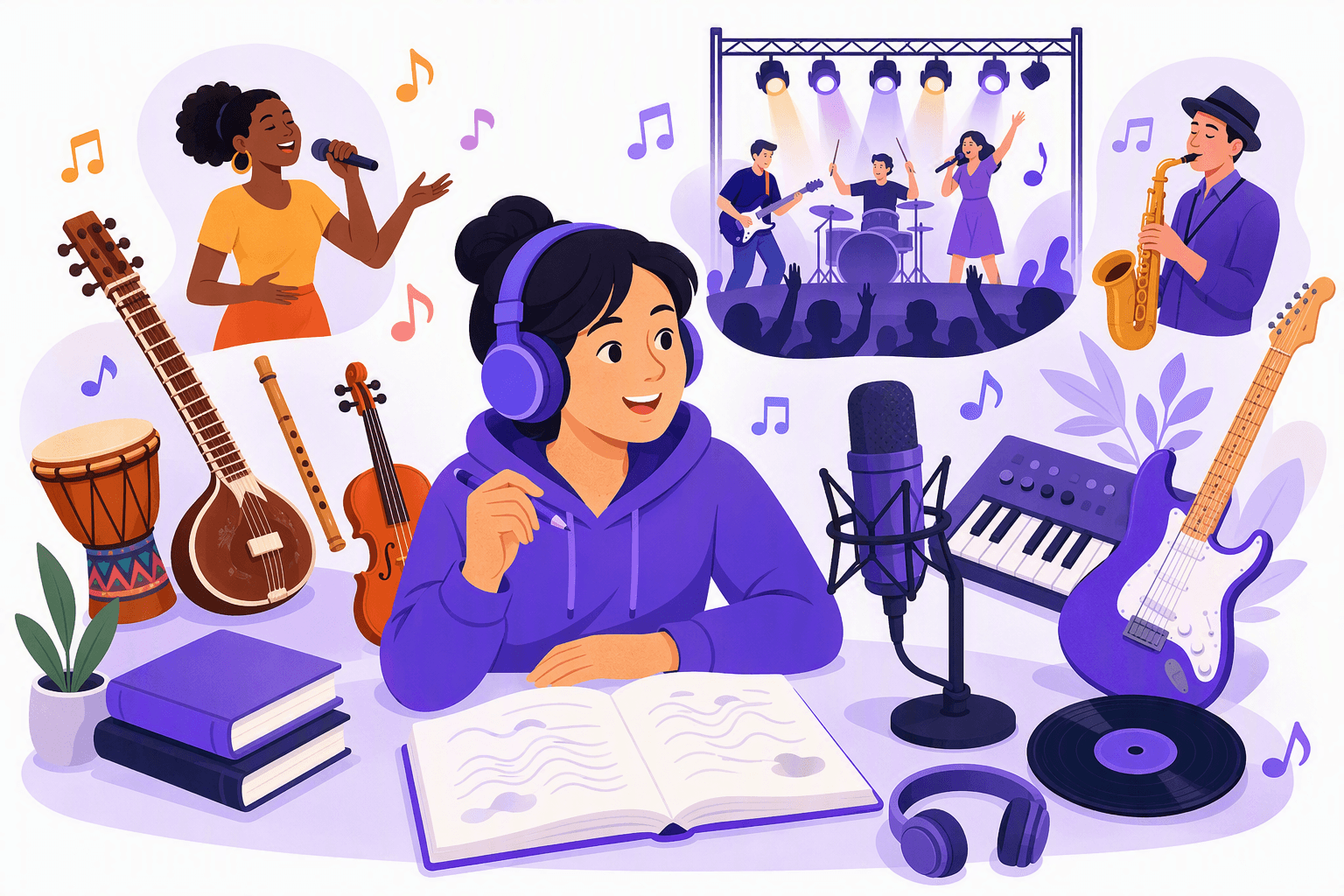
The essential parts of a song
A song is made from several sections and sound layers. Knowing these terms helps when someone says that they love the chorus but skip the intro, or when a producer talks about changing the arrangement.
In everyday conversation, people do not need technical music theory to use these words. They use them to explain why a track stays in their head, feels emotional, or works well at a party.
Verse
A verse /vɜːrs/ is a section whose lyrics usually change each time it returns. Verses often tell the story, add details, or develop an idea.
In a pop song, the first verse may introduce a situation, while the second verse adds a new perspective. You can say: “The second verse is my favorite part.”
Chorus
A chorus /ˈkɔːrəs/ is the repeated central section of a song. It commonly has the strongest hook, the most memorable words, and the melody listeners sing along with.
“The chorus is so catchy” is one of the most natural comments you can make about a song. A hook /hʊk/ is the memorable musical or lyrical idea that grabs attention, often within the chorus but not always.
Bridge
A bridge /brɪdʒ/ is a contrasting section that connects major parts of a song. It may introduce new chords, a different melody, or a change in emotional intensity before the final chorus.
Not every song has a bridge. When it does, listeners may call it “the bridge” even if they cannot explain its musical structure: “Wait for the bridge, it’s incredible.”
Intro and outro
An intro /ˈɪntroʊ/ is the opening section. An outro /ˈaʊtroʊ/ is the ending section, sometimes called the ending.
A long intro can build anticipation. An abrupt outro can make a song feel unfinished on purpose, especially in experimental pop, electronic music, or punk.
Instrumental
An instrumental /ˌɪnstrəˈmɛntəl/ is music without singing, or the section of a song where instruments play without vocals. A karaoke track is often an instrumental version of a familiar song.
You might say, “The instrumental is beautiful,” meaning you particularly like the music behind the voice. In hip-hop, people also call the music behind the rap the beat /biːt/.
🌍 Lyrics are not always standard English
Song lyrics regularly bend grammar to fit rhythm, rhyme, character, or style. A lyric such as “ain’t no” may be intentional and culturally meaningful, but it is not suitable for every academic or professional context. Check a reliable dictionary and notice who is speaking before adopting a phrase.
Vocabulary for instruments and performers
Musicians have different roles, even in a small band. A singer may write the song, but they may also perform material written by a separate songwriter, composer, or producer.
The Oxford English Dictionary tracks how many of these roles have expanded with recording technology. For example, a producer /prəˈduːsər/ can shape a recording’s sound, select instruments, guide performers, and organize the final track, not merely operate equipment.
| English | Pronunciation | Note |
|---|---|---|
| guitar | gih-TAR | A string instrument played by plucking or strumming. |
| bass | BAYS | A low-pitched guitar or the musician who plays it. |
| drums | DRUMZ | A set of percussion instruments played by a drummer. |
| keyboard | KEE-bord | An electronic instrument with piano-style keys. |
| piano | pee-AN-oh | A keyboard instrument with strings struck by hammers. |
| violin | vye-uh-LIN | A high-pitched string instrument played with a bow. |
| vocalist | VOH-kuh-list | A singer, often used in professional music contexts. |
| songwriter | SAWNG-ry-ter | A person who writes songs, especially lyrics and melodies. |
| composer | kum-POH-zer | A person who writes music, often instrumental or classical music. |
| producer | pruh-DOO-ser | A person who directs and shapes a recording. |
Music genres in English
A genre /ˈʒɑːnrə/ is a category of music with recognizable conventions. Genres overlap constantly, so labels are useful descriptions rather than strict rules.
The global recording business reflects that variety. IFPI reported global recorded-music revenue of US$29.6 billion for 2024 and 752 million paid subscription accounts at the end of that year. Streaming allows listeners to move easily between local scenes and international genres, often within one playlist.
Pop
Pop /pɑːp/ comes from “popular music.” It usually refers to accessible, melody-centered music designed for a wide audience.
Calling something pop is not an insult. Pop can include elaborate songwriting, strong production, and many influences from dance, rock, R&B, or electronic music.
Rock
Rock /rɑːk/ generally emphasizes electric guitars, bass, drums, and energetic performance. Subgenres include indie rock, punk rock, alternative rock, and hard rock.
Indie /ˈɪndi/ originally referred to independent labels, but today it often describes a particular guitar-based or intimate sound as well. “Indie” can therefore mean a business position, an aesthetic, or both.
Hip-hop
Hip-hop /ˈhɪp hɑːp/ is a cultural movement and musical field that includes rap, DJing, dance, visual art, and more. Rap /ræp/ specifically refers to rhythmic spoken vocal delivery.
When discussing artists, it is often more accurate to say “a hip-hop artist” than to assume every performer is only a rapper. The genre has regional styles, histories, and vocabulary that should be understood in context.
R&B
R&B /ˌɑːr ən ˈbiː/ stands for rhythm and blues. Contemporary R&B often combines soulful vocals with pop, hip-hop, electronic, gospel, and jazz influences.
Do not pronounce the letters as a single word. Say each letter: /ɑːr ən biː/. In writing, both “R&B” and “R and B” are common.
Electronic music
Electronic music /ɪˌlɛkˈtrɑːnɪk ˈmjuːzɪk/ is created or heavily shaped with electronic instruments and production tools. It includes house, techno, drum and bass, ambient, and many other styles.
A DJ /ˌdiː ˈdʒeɪ/ may select and mix recordings live, create transitions between tracks, or produce original music. A DJ set is different from a traditional band concert, but both are live performances.
Classical and jazz
Classical music /ˈklæsɪkəl ˈmjuːzɪk/ is a broad label for many traditions of composed concert music. Jazz /dʒæz/ is known for improvisation, rhythmic complexity, and a history rooted in African American communities.
Music scholar Philip Tagg, in Music’s Meanings, argues that listeners make meaning through sound, context, and shared cultural codes, not lyrics alone. That is why two people can hear the same instrumental track as relaxing, dramatic, nostalgic, or unsettling.
Describing songs naturally
You do not need technical language to give a clear opinion. English speakers use a small set of flexible adjectives to describe sound, mood, and performance.
| Word | IPA | Natural meaning | Example |
|---|---|---|---|
| catchy | /ˈkætʃi/ | Easy to remember | “That chorus is really catchy.” |
| upbeat | /ˈʌpbiːt/ | Lively and positive | “I need something upbeat for the drive.” |
| mellow | /ˈmɛloʊ/ | Soft, calm, and relaxed | “This is a mellow acoustic song.” |
| emotional | /ɪˈmoʊʃənəl/ | Strongly expressive or moving | “Her voice sounds so emotional.” |
| soulful | /ˈsoʊlfəl/ | Deeply expressive, often associated with soul music | “He has a soulful voice.” |
| energetic | /ˌɛnərˈdʒɛtɪk/ | Full of energy | “It has an energetic drumbeat.” |
| repetitive | /rɪˈpɛtətɪv/ | Repeating too much | “The lyrics are a little repetitive.” |
| atmospheric | /ˌætməsˈfɛrɪk/ | Creating a strong mood or setting | “The synths make it atmospheric.” |
A voice /vɔɪs/ can be raspy, clear, soft, powerful, breathy, or deep. A performance /pərˈfɔːrməns/ can be polished, raw, intimate, or high-energy.
For an opinion that sounds conversational, try these patterns:
- “I love the production on this track.”
- “The lyrics are a bit too repetitive for me.”
- “It starts slowly, but the beat drops after the intro.”
- “Her live vocals are stronger than the studio version.”
- “This song puts me in a good mood.”
- “I can’t get this melody out of my head.”
A track /træk/ is another word for a recorded song. It is common in playlists, reviews, and studio conversations. “What is your favorite track on the album?” sounds natural and specific.
💡 Learn whole opinion patterns
Instead of memorizing only “catchy” or “mellow,” memorize a full sentence such as “The chorus is really catchy” or “I’m in the mood for something mellow.” Full patterns are easier to retrieve when you are speaking.
Concert and live music vocabulary
A concert /ˈkɑːnsərt/ is a scheduled live music event. A gig /ɡɪɡ/ is usually a smaller or less formal live performance, although fans use it for large shows too.
A venue /ˈvɛnjuː/ is the place where an event happens, such as a stadium, theater, club, arena, or outdoor festival site. A festival /ˈfɛstəvəl/ usually features many artists over one or more days.
Here are useful sentences for a real event:
- “The venue opens at seven.”
- “We have tickets for the standing area.”
- “The band came on stage late.”
- “The crowd knew every word.”
- “The opening act was surprisingly good.”
- “They played three songs for the encore.”
An opening act /ˈoʊpənɪŋ ækt/ performs before the main artist. An encore /ˈɑːnkɔːr/ is an extra performance after the apparent end of the show, often requested by applause and cheering.
A setlist /ˈsɛtlɪst/ is the planned list of songs for a concert. Fans often discuss it online after a show: “Did they change the setlist tonight?”
The Library of Congress National Recording Registry preserves recordings judged culturally, historically, or aesthetically significant in the United States. That work is a useful reminder that music vocabulary carries history: a genre name, instrument, or performance style can point to particular communities and traditions.
Lyrics, slang, and strong language
Lyrics can teach spoken reductions, metaphor, and emotional language, but they require careful listening. A singer may stretch one syllable across several beats, drop sounds, or use a regional accent.
For example, gonna /ˈɡʌnə/ often represents “going to” in informal speech, while wanna /ˈwɑːnə/ represents “want to.” You may hear them in songs and casual dialogue, but avoid them in formal writing.
Some genres use profanity as part of artistic voice, storytelling, protest, humor, or character. Recognizing those words is different from using them. Read our English swear words guide to understand tone, severity, and context before repeating anything you hear.
Music videos and films can also improve listening because the visual context supports meaning. For more screen-based practice, see the list of best movies to learn English. Watch one short scene or music performance repeatedly, first for the general meaning and then for a few useful phrases.
A practical way to learn English through music
Choose a song you genuinely want to hear again. Motivation matters because repeated listening is what makes vocabulary, pronunciation, and rhythm familiar.
First, listen once without lyrics and identify the mood. Is it upbeat, melancholy, angry, dreamy, or playful? Then read the lyrics from an official source where possible, highlight three useful phrases, and listen again.
Next, speak or sing only a short section. Pay attention to stressed words, because English rhythm gives more time and force to meaningful words while smaller grammar words are often reduced. A song may not provide perfect everyday grammar, but it can sharpen your ear for connected speech.
Finally, make the language personal. Write a one-sentence review: “I like the bass line, but the lyrics feel repetitive.” Save new phrases with the song title and return to them later.
Music vocabulary becomes useful when it helps you share a real reaction. Learn the names of song parts, a few genre labels, and five opinion patterns, then use them whenever someone asks what you have been listening to.
Frequently Asked Questions
What are the most important music words to learn in English?
What is the difference between a chorus and a verse in English?
How do I talk about my music taste in English?
What does gig mean in English music vocabulary?
Why is music useful for learning English?
Sources & References
- IFPI, Global Music Report 2025
- Ethnologue, English, 27th edition, 2024
- Oxford English Dictionary, music entries, accessed 2026
- The Library of Congress, National Recording Registry, accessed 2026
- Philip Tagg, Music's Meanings: A Modern Musicology for Non-Musos, Mass Media Scholars and Music Students, The Mass Media Music Scholars' Press
Start learning with Wordy
Watch real movie clips and build your vocabulary as you go. Free to download.


