Quick Answer
English etiquette depends on country, setting, and relationship, but the safest rules are simple: greet people, respect personal space and queues, use polite requests, arrive on time, and avoid overly personal questions. Learn the customs that make everyday interactions in English-speaking places feel natural rather than awkward.
| English | Pronunciation | Formality |
|---|---|---|
| Excuse me. | ik-SKYOOZ mee | polite |
| Could you help me, please? | kood yoo HELP mee PLEEZ | polite |
| Would you mind...? | wood yoo MYND | formal |
| Thanks, I appreciate it. | THANKS eye uh-PREE-shee-ayt it | casual |
| After you. | AF-ter yoo | polite |
| Sorry, is this seat taken? | SOR-ee iz this SEET TAY-ken | polite |
English etiquette is not one fixed rulebook. It is a set of social habits that changes between the United States, the United Kingdom, Canada, Australia, Ireland, and other English-speaking communities. Still, visitors can make an excellent impression by greeting people, respecting personal space and queues, making requests politely, and avoiding personal questions too soon.
English has about 1.5 billion speakers worldwide when first-language and additional-language users are counted, according to Ethnologue's 27th edition. That global reach means English etiquette is especially varied, but everyday politeness has recognizable patterns across many places where English is used.
The key is not to sound stiff. It is to show that you recognize another person's time, comfort, and autonomy. If you are building conversational confidence, start with the practical phrases in our English greetings guide, then use the customs below to understand when and why people say them.
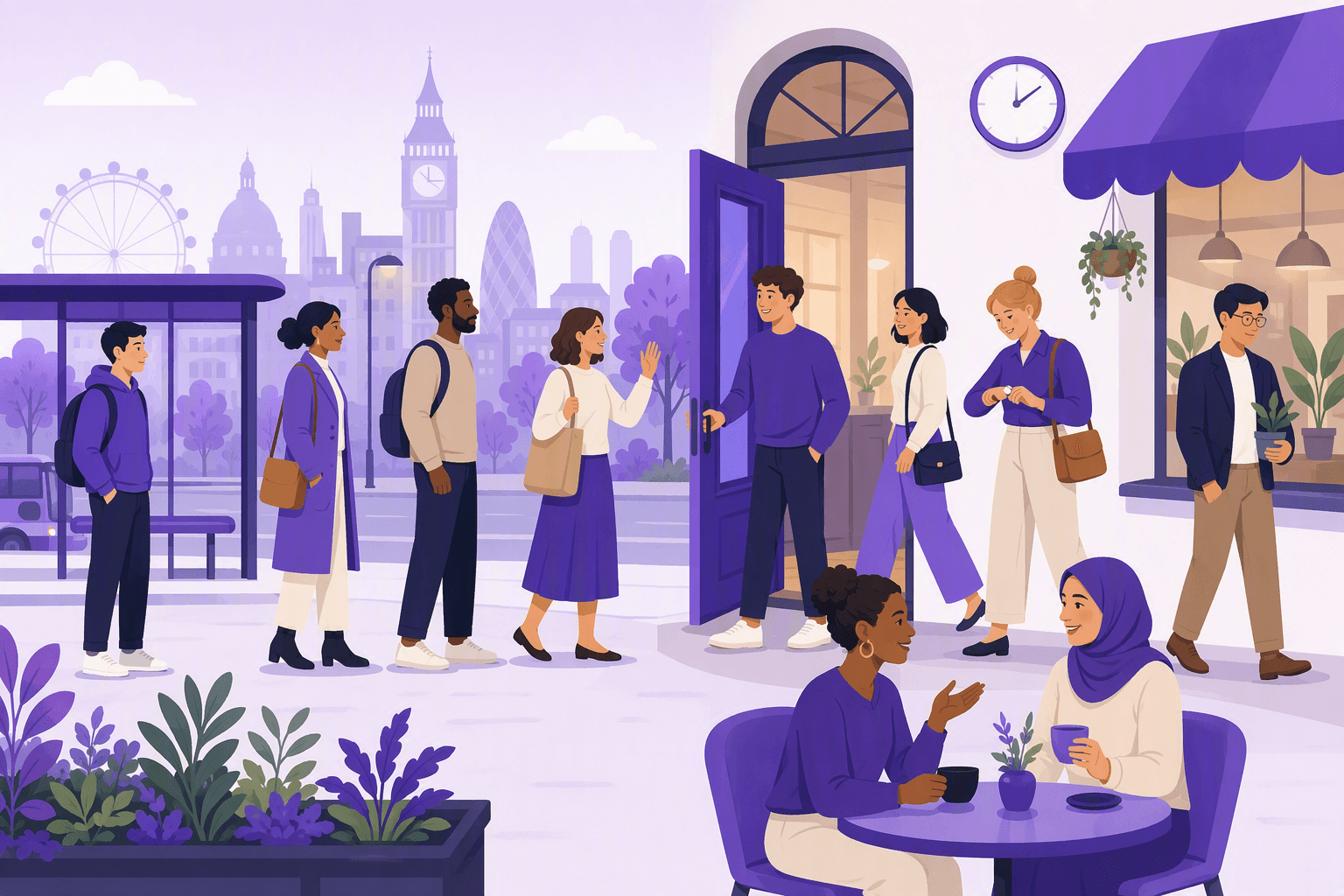
The central idea: politeness protects personal space
In English-speaking settings, polite behavior often means reducing pressure on other people. Instead of saying “Give me that,” a speaker may say “Could I have that, please?” /kʊd aɪ hæv ðæt pliːz/.
This is not dishonesty or unnecessary vagueness. It is a way of signaling respect. Brown and Levinson's Politeness: Some Universals in Language Usage describes how speakers protect one another's public self-image, often called face, through indirectness, apologies, and options.
For example, compare these requests:
| Direct request | More natural polite request |
|---|---|
| Open the window. | Could you open the window, please? |
| Move. | Excuse me, could I get past? |
| Tell me again. | Sorry, could you say that again? |
| I need help. | Could you help me for a moment? |
A direct sentence is not always rude. Friends, parents, colleagues in urgent situations, and people giving instructions may speak directly. But when you do not know someone well, a softener such as could, would, please, sorry, or excuse me is a reliable choice.
Greetings and first impressions
A brief greeting is expected in most ordinary interactions. Say hello /həˈloʊ/ to a coworker, cashier, neighbor, receptionist, or person you are meeting. In casual American English, hi /haɪ/ is equally normal.
In the UK, a shop employee may open with You all right? /ju ɔːl raɪt/. This is usually a greeting, not a serious question about your health. A short answer such as Yeah, thanks. You? /jæ θæŋks juː/ is enough.
Handshakes, hugs, and physical contact
A handshake remains common in professional introductions in the UK and US, although it is less automatic than it was before 2020. Make eye contact, use a moderate grip, and say your name clearly.
Hugs are more relationship-dependent. Friends and relatives may hug, but do not assume a hug is welcome with someone new. In many English-speaking cultures, personal space is treated as a sign of respect, especially in formal settings.
Names and titles
In the United States, first names appear quickly in many workplaces, universities, and services. A professor may introduce herself as Jennifer, and coworkers often use each other's first names even when they have different seniority levels.
In the UK, first names are also widespread, but professional titles can matter in medicine, academia, law, and formal correspondence. If unsure, start with Mr., Ms., Dr., or a person's stated title, then follow their lead.
💡 Use the name people give you
If someone says, “Hi, I’m Priya,” reply with “Nice to meet you, Priya” /naɪs tə miːt juː/. Do not shorten a name or create a nickname unless that person invites you to do so.
Small talk is social lubrication, not a test
Small talk can feel pointless to learners, but it performs an important social function. It shows friendliness before business, fills short silences, and helps people judge the tone of an interaction.
Deborah Tannen's work on conversational style shows that people can interpret the same conversational behavior differently depending on cultural expectations. In English, asking a low-stakes question often signals warmth rather than a demand for detailed information.
Safe small-talk topics include:
- Weather: Lovely day, isn't it? /ˈlʌvli deɪ ˈɪzənt ɪt/
- Travel: How was your trip? /haʊ wəz jʊr trɪp/
- Work or study: How's work going? /haʊz wɜːrk ˈɡoʊɪŋ/
- Local recommendations: Have you been here before? /hæv juː bɪn hɪr bɪˈfɔːr/
- Shared surroundings: This place is really busy today. /ðɪs pleɪs ɪz ˈrɪəli ˈbɪzi təˈdeɪ/
Keep your answer fairly brief, then return the question. If someone asks, How are you? /haʊ ɑːr juː/, the expected answer is commonly Good, thanks. How are you? It is usually not an invitation to describe every problem in your life.
For more natural check-ins and replies, see how to say how are you in English.
Topics to approach carefully
Money, salary, age, weight, religion, politics, immigration status, and relationship plans can be sensitive. These subjects are not forbidden, but they usually require trust, context, or an invitation from the other person.
A question such as How much do you make? /haʊ mʌtʃ duː juː meɪk/ may sound surprisingly intrusive to a new acquaintance in the US or UK. A safer conversation opener is to ask about a person's interests, local area, or plans for the weekend.
Queues, waiting, and public space
Queue etiquette is one of the clearest English-speaking social rules. In British English, a line of waiting people is a queue /kjuː/. In American English, people usually say line /laɪn/.
Do not cut in. Look for who arrived first, stand behind the last person, and ask Are you in line? /ɑːr juː ɪn laɪn/ if you are uncertain. If a queue is unclear, this small question prevents awkwardness.
Kate Fox's Watching the English identifies queuing as a highly meaningful British social ritual. The rule is not merely about efficiency. It represents fairness, self-control, and recognition that everyone is entitled to their turn.
Escalators, elevators, and shared areas
In many parts of London, people stand on the right side of escalators and walk on the left. This is especially important in Underground stations. Elsewhere in the UK and in the US, the local pattern can vary, so watch what residents do.
On buses, trains, and in waiting rooms, keep bags out of extra seats when space is limited. Use headphones for audio. If you need to pass someone, say Excuse me /ɪkˈskjuːz miː/ rather than silently pushing through.
🌍 The quiet acknowledgement
In smaller shops, lifts, hallways, and neighborhood streets, English speakers may give a quick smile, nod, or “Hi” /haɪ/ to strangers. You do not need to start a conversation. Acknowledging the other person is often enough.
Please, thank you, sorry, and excuse me
These four phrases carry much of everyday English politeness. They are short, frequent, and flexible.
Please /pliːz/ makes requests gentler. Thank you /θæŋk juː/ recognizes help, service, gifts, and effort. Sorry /ˈsɑːri/ can apologize, but it also softens an interruption or minor inconvenience. Excuse me is useful when you need attention, space, or clarification.
| Situation | Natural phrase |
|---|---|
| You need to pass someone | Excuse me, please. |
| You did not hear clearly | Sorry, could you repeat that? |
| Someone holds a door | Thank you, I appreciate it. |
| You bump into someone | Sorry about that. |
| You want a server's attention | Excuse me, when you have a moment. |
British English is famous for frequent sorry /ˈsɒri/. It may express regret, sympathy, uncertainty, or simply a wish not to impose. An English person may say Sorry, can I just ask...? even when they have done nothing wrong.
American speakers also use sorry, but may more often choose excuse me to get attention or move through a crowd. Neither choice is universally fixed, so pay attention to the local pattern.
Invitations, homes, and punctuality
When invited to someone's home, respond clearly. If you can attend, say Thanks for inviting me, I'd love to come /θæŋks fər ɪnˈvaɪtɪŋ miː aɪd lʌv tə kʌm/. If you cannot, decline warmly without offering a long explanation.
In the US and Canada, arriving exactly on time or within a few minutes is usually appropriate for a dinner invitation. In the UK, arriving a few minutes after the stated time can be normal for a relaxed social event, but not for a restaurant reservation, theater performance, interview, or work meeting.
If you will be late, send a message. A simple I'm running about ten minutes late, sorry /aɪm ˈrʌnɪŋ əˈbaʊt ten ˈmɪnɪts leɪt ˈsɑːri/ shows consideration.
Should you bring a gift?
For a casual dinner, flowers, chocolates, wine, or a small dessert are generally welcome, though not mandatory. Ask in advance if the host has dietary restrictions or does not drink alcohol.
Do not expect a grand tour of the home. Also, do not open cupboards, bedrooms, or private spaces without being invited. In some homes, taking off shoes is expected, while in others it is not. Look near the entrance or politely ask, Would you like me to take my shoes off? /wʊd juː laɪk miː tə teɪk maɪ ʃuːz ɔːf/.
Restaurants, service, and tipping
Polite restaurant behavior includes greeting staff, saying thank you, and being clear but calm when there is a problem. Rather than saying This is wrong, try Sorry, I think this may be the wrong order /ˈsɑːri aɪ θɪŋk ðɪs meɪ biː ðə rɔːŋ ˈɔːrdər/.
Tipping is one area where learners should avoid assuming that all English-speaking countries work alike. In the United States, a tip is strongly expected in many sit-down restaurants, bars, salons, and taxi services. In the UK, service charges are common in some restaurants, while tipping remains more discretionary.
In Australia and New Zealand, tipping exists but is generally less central to workers' pay than in the US. Check the bill, ask a local friend, or search current local guidance when traveling, because customs and service-charge practices can change.
For useful ordering language, our English food vocabulary guide covers the words you will see on menus and hear from servers.
Humor, teasing, and slang
Humor can create connection, but it is one of the easiest areas to misread. British humor often uses understatement, irony, and self-deprecation. American humor may be more openly enthusiastic, though every region and friend group has its own style.
Do not copy sarcasm before you understand the relationship. A phrase that sounds playful between close friends may sound hostile from a stranger. The same caution applies to slang, particularly insults and swear words.
Read our guide to English slang to recognize informal expressions, but treat recognition and use as separate skills. For strong language, see English swear words, where context, audience, and tone matter as much as dictionary meaning.
⚠️ Do not confuse confidence with bluntness
English speakers often value direct communication, especially at work, but direct does not mean abrupt. Add a greeting, a reason, and a polite closing. “Could you send the report by Friday? Thanks” sounds professional. “Send report Friday” can sound demanding.
How to learn etiquette from real English
Etiquette is heard in timing, facial expression, hesitation, and tone, not only in vocabulary lists. Films and TV shows are useful because you can observe who interrupts, how people refuse invitations, and how a casual request differs from a formal one.
Choose scenes set in restaurants, workplaces, family homes, airports, or shops. Listen for repeated phrases such as Would you mind...? /wʊd juː maɪnd/, No worries /noʊ ˈwɜːriz/, and After you /ˈæftər juː/. Then notice whether the reply is warm, rushed, formal, or joking.
Our list of best movies to learn English can help you find material with varied accents and social settings. Watch a short scene twice: first for the story, then for the small politeness choices between speakers.
The practical rule to remember
English etiquette is less about memorizing rigid customs than showing consideration. Greet people, wait your turn, respect distance, ask rather than demand, and use thank you generously.
When uncertain, a calm Excuse me, could you help me, please? /ɪkˈskjuːz miː kʊd juː help miː pliːz/ is almost always a good starting point. It is clear, courteous, and natural across a wide range of English-speaking settings.
Frequently Asked Questions
What are the most important English etiquette rules for visitors?
Is British etiquette different from American etiquette?
Is it rude to ask someone their age in English-speaking countries?
Do people in English-speaking countries expect tips?
How can I sound polite in English without sounding overly formal?
Sources & References
- Ethnologue, English, 27th edition, 2024
- British Council, The English Effect report
- Deborah Tannen, You Just Don't Understand, Ballantine Books
- Kate Fox, Watching the English, Hodder and Stoughton
- Brown and Levinson, Politeness: Some Universals in Language Usage, Cambridge University Press
Start learning with Wordy
Watch real movie clips and build your vocabulary as you go. Free to download.


