Quick Answer
The basics of English food vocabulary: breakfast, lunch, dinner. Watch for UK vs US differences: Brits may call the evening meal “supper” (though “dinner” is also common), while Americans usually say “dinner” for the evening meal. In a restaurant, the key sentence is: “I'd like [food], please.”
English is the most commonly learned second language in the world. According to Ethnologue’s 2024 data, nearly 1.5 billion people speak it as a first or second language. Food vocabulary is one of the first areas you use in real life, when ordering in a restaurant, shopping, hosting guests, or answering a simple everyday question: “What did you have for lunch?"
Food vocabulary also matters because British and American English differ very clearly here. What people in London call “chips” (French fries), people in New York call “fries”. British “aubergine” is American “eggplant”. These differences are not mistakes, they are the result of natural development in the two varieties, and both the Cambridge English Dictionary and the Oxford English Dictionary document them.
"The vocabulary of food and eating is one of the most culturally embedded domains of any language, it reflects history, migration, and the daily rhythms of social life."
(David Crystal, The Cambridge Encyclopedia of the English Language, Cambridge University Press, 2019)
This guide covers food vocabulary from start to finish, from meal names to fruits, vegetables, and meats, then restaurant phrases, and finally a British-American comparison.
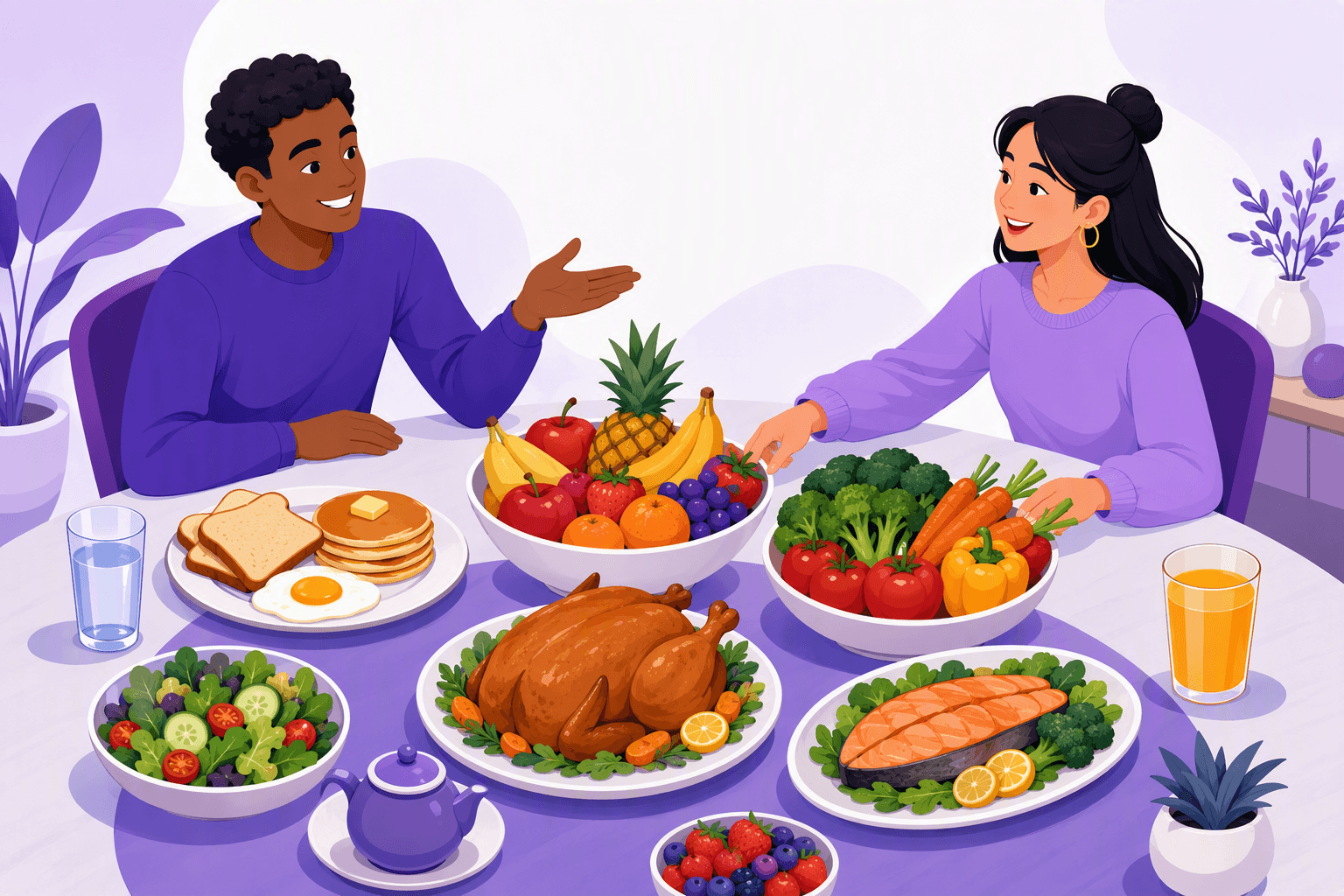
Meals in English
English has three main meals a day, but British and American English can differ in the names and typical times. The word “dinner”, for example, can mean different things depending on time and context.
| English | English | Pronunciation | Note |
|---|---|---|---|
| breakfast | breakfast | BREK-fust | Literally: 'breaking a fast' |
| lunch | lunch | lʌntʃ | Midday meal, roughly 12-14 |
| dinner / supper | dinner / supper | DIN-ur / SUP-ur | UK: dinner or supper; US: dinner |
| snack | snack | snæk | A small meal between main meals |
| meal | meal | miːl | A specific eating occasion |
| food | food | fuːd | Food in general |
| starter | starter / appetizer | STAR-tur / AP-uh-ty-zur | UK: starter; US: appetizer |
| main course | main course / entrée | meyn kors / ON-tray | In the US, entrée = main course! |
| dessert | dessert | dih-ZURT | Two 's' letters, do not confuse it with 'desert' |
⚠️ Dessert vs. Desert: A classic trap
dessert (dih-ZURT) is spelled with two “s” letters. desert (DEZ-urt) is spelled with one “s”. The pronunciation also differs: in dessert, the stress is on the second syllable. A good memory trick: you always want another dessert (two s’s), but you do not want another desert.
Fruits in English
English fruit vocabulary is mostly from Latin and Germanic roots, but many words entered the language through the colonial era and tropical trade. According to the Oxford English Dictionary, “mango” comes from the Tamil word māṅkāy, and “pineapple” comes from 17th-century explorers’ descriptions (the fruit’s shape reminded them of a pine cone, and its taste reminded them of an apple).
| English | Pronunciation | Note |
|---|---|---|
| apple | AP-ul | |
| banana | buh-NAH-nuh | |
| orange | OR-inj | |
| strawberry | STRAW-beh-ree | |
| grape | greyp | |
| lemon | LEM-un | |
| peach | peeʧ | |
| pear | pehr | |
| cherry | CHER-ee | |
| mango | MANG-goh | |
| pineapple | PY-nap-ul | Literally: 'pine apple' |
| watermelon | WAH-tur-mel-un |
The word “cherry” can refer to both sweet cherries and sour cherries. English does not use separate everyday words for them, both are “cherry”. If you want to be specific, say: sweet cherry or sour cherry.
Vegetables in English
When learning vegetable vocabulary, pay close attention to British-American differences. In the United Kingdom and the United States, people often use different words for the same vegetable. This affects both vocabulary learning and reading menus.
| English | Pronunciation | Note |
|---|---|---|
| potato | puh-TAY-toh | |
| tomato | tuh-MAY-toh | UK pronunciation: tuh-MAH-toh |
| carrot | KEHR-ut | |
| onion | UN-yun | |
| garlic | GAR-lik | |
| cucumber | KYOO-kum-bur | |
| pepper / bell pepper | PEP-ur / bel PEP-ur | |
| lettuce | LET-us | |
| broccoli | BROK-uh-lee | |
| spinach | SPIN-ij | |
| eggplant / aubergine | EGG-plant / OH-bur-zheen | US: eggplant; UK: aubergine |
| zucchini / courgette | zoo-KEE-nee / koor-ZHET | US: zucchini; UK: courgette |
🌍 British-American vegetable vocabulary: The most common differences
Food vocabulary is one area where British and American English differ a lot. The key pairs are: aubergine (UK) = eggplant (US), courgette (UK) = zucchini (US), coriander (UK) = cilantro (US), rocket (UK) = arugula (US). These words have Italian, French, and Spanish roots. They entered English through different migration waves on each continent.
Meats and proteins
One of the most important things to know about meat vocabulary is that the animal name and the meat name often differ. This comes from French-English bilingualism after the Norman Conquest (1066). Anglo-Saxon farmers used the original Germanic animal names, while Norman nobles at the table used the French words for the meat.
| English | Pronunciation | Note |
|---|---|---|
| chicken | CHIK-un | |
| beef | beef | The animal: cow/cattle |
| pork | pork | The animal: pig |
| lamb | læm | The 'b' is silent at the end |
| fish | fiʃ | |
| salmon | SAM-un | The 'l' is silent! |
| tuna | TYOO-nuh | |
| egg | eg | |
| cheese | ʧiːz | |
| tofu | TOH-fyoo |
💡 The silent 'l' in 'salmon'
salmon is pronounced /ˈsæmən/, people do not pronounce the “l”. This is one of the most common pronunciation mistakes learners make. Similar silent-consonant food words include: yolk (the 'l' is silent), almond (the 'l' is optionally silent). Merriam-Webster accepts both pronunciations for almond, but for salmon only the silent 'l' form is standard.
Breakfast foods
English breakfast is one of the most recognizable cultural food categories. According to the British Council, the "Full English Breakfast" is still one of the best-known British cultural symbols, and many learners associate it with familiar regions.
| English | Pronunciation | Note |
|---|---|---|
| toast | tohst | |
| cereal | SEER-ee-ul | |
| oatmeal / porridge | OHT-meel / POR-ij | US: oatmeal; UK: porridge |
| bacon | BAY-kun | |
| pancake | PAN-kayk | Thicker than a crêpe-style pancake |
| waffle | WOF-ul | |
| scrambled eggs | SKRAM-buld egz | |
| orange juice | OR-inj joos |
🌍 Full English vs. American Breakfast
A traditional British “Full English Breakfast” (or “fry-up”) includes: bacon, fried eggs, sausage, baked beans, toast, fried tomatoes, and mushrooms. People rarely eat it on weekdays, but it is common on weekends and in hotels. American breakfast, by contrast, often leans sweeter: pancakes or waffles with maple syrup, alongside bacon and eggs. Pancakes also differ between the UK and the US: an English pancake (thin, similar to a crêpe) differs from a thick, fluffy American pancake.
Drinks
Drink vocabulary also includes British-American differences, especially for soft drinks. English has one of the richest vocabularies for describing drinks. The Oxford English Dictionary includes more than 200 different drink entries.
| English | Pronunciation | Note |
|---|---|---|
| water | WAW-tur | |
| coffee | KOF-ee | |
| tea | tee | |
| milk | milk | |
| juice | joos | |
| soda / fizzy drink | SOH-duh / FIZ-ee drink | US: soda; UK: fizzy drink |
| beer | beer | |
| wine | wyne | |
| hot chocolate | hot CHOK-lit |
🌍 Soda, Pop, Fizzy Drink: Which one, and when?
English has several words for a soft drink, and they are strongly regional. Americans often say soda (East Coast) or pop (Midwest and Canada). In the UK, fizzy drink is the widely accepted neutral option. pop is a Northern England regional term. If you are not sure which variety you are dealing with, soft drink is neutral and understood everywhere. People commonly use it on planes, in hotels, and on menus.
Restaurant ordering phrases
Food vocabulary is not very useful if you cannot order food. The sentences and phrases below cover most restaurant situations, from asking for a table to paying.
| English | Pronunciation | Note |
|---|---|---|
| I'd like... / I'll have... | ayd lyk / ayl hæv | |
| Can I see the menu? | kæn ay see thuh MEN-yoo | |
| What do you recommend? | wot doo yoo rek-uh-MEND | |
| Is this dish spicy? | iz thiz diʃ SPY-see | |
| I'm vegetarian. | aym vej-uh-TEHR-ee-un | |
| I'm allergic to... | aym uh-LUR-jik too | |
| This is delicious! | thiz iz duh-LIʃ-us | |
| The bill, please. | thuh bil pleez | UK: bill; US: check |
In restaurants, the most polite way to order starts with “I'd like...” or “Could I have...”. Ordering with just a noun (for example, “Chicken!”) sounds unnatural and ruder in English than it does in some other languages. Always add please: “I'd like the chicken, please."
The British-American difference for asking for the bill is simple. In England, “The bill, please” is standard. In the United States, “Check, please” is standard. People understand both in both countries, but the local version sounds more natural.
British-American food glossary
Below is a summary of the most common British-American differences in food vocabulary. This table is especially useful if you watch British shows (where chips = French fries) or read American recipes (where eggplant = aubergine).
| English | British English | American English |
|---|---|---|
| French fries | chips | (French) fries |
| chips (snack) | crisps | chips |
| aubergine | aubergine | eggplant |
| zucchini | courgette | zucchini |
| coriander (herb) | coriander | cilantro |
| oatmeal / porridge | porridge | oatmeal |
| broiler | grill | broiler |
| baking tray | tin | pan / baking sheet |
| soft drink | fizzy drink | soda / pop |
| candy store | sweet shop | candy store |
💡 The most important rule: chips vs. fries
The most common misunderstanding is this: in British English, chips are French fries. In American English, people call the same thing fries or French fries. What Americans call chips (a crunchy packaged snack), the British call crisps. If you order fish and chips in London, you get fried fish and French fries, not fish and snack chips.
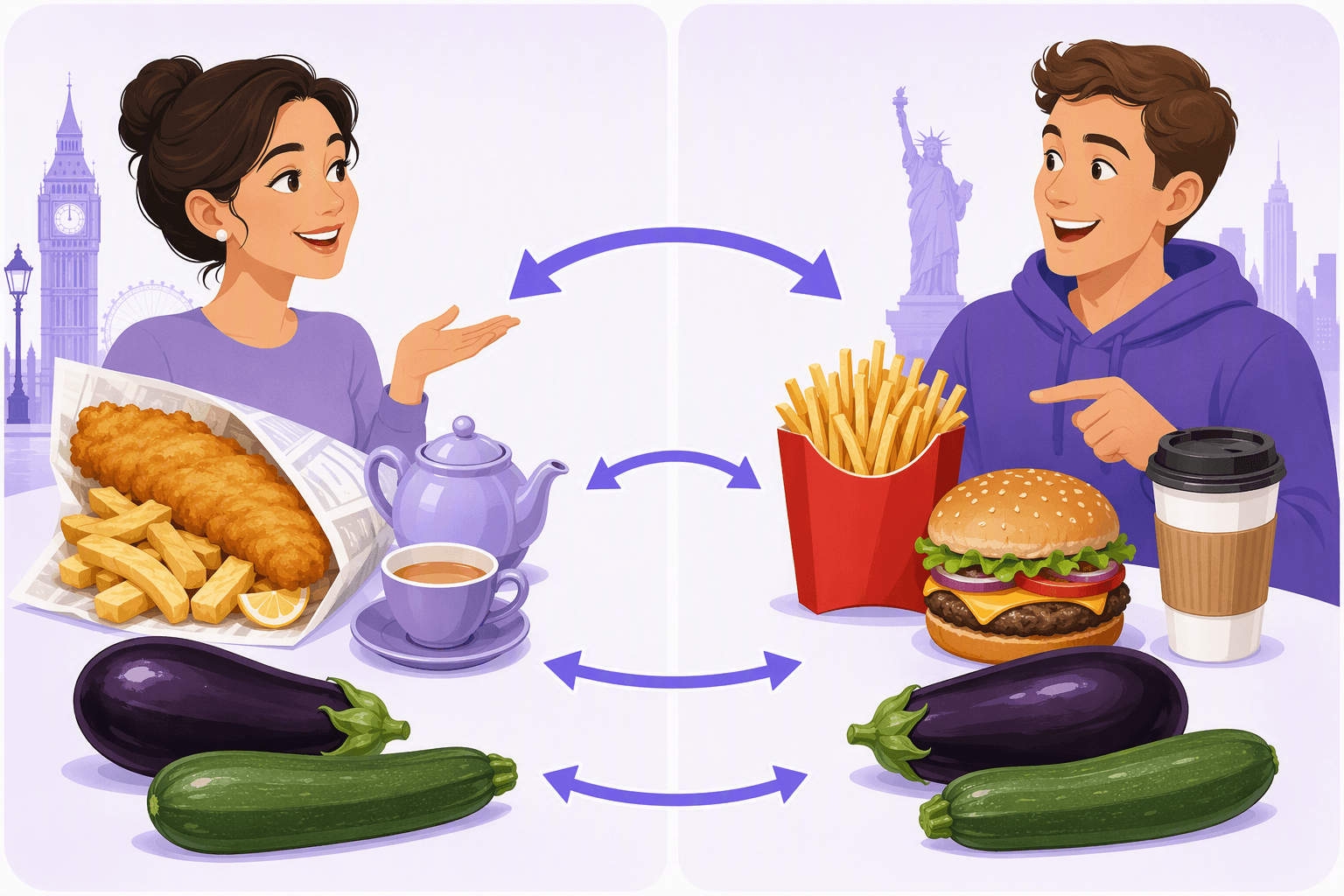
These differences are not new. British and American English have developed separately since the 1600s. In many cases, the British form is older, while the American form is a modified or shortened version of the original word. For example, the word eggplant comes from the fact that some white, egg-shaped varieties really do look like eggs.
Useful words to describe food
When ordering and describing food, flavor adjectives are essential. The words below help you say exactly what you want, or describe what you ate.
| English | English | Pronunciation |
|---|---|---|
| spicy | spicy | SPY-see |
| sweet | sweet | sweet |
| sour | sour | SOW-ur |
| salty | salty | SAWL-tee |
| bitter | bitter | BIT-ur |
| tasty / delicious | tasty / delicious | TAY-stee / duh-LIʃ-us |
| fresh | fresh | freʃ |
| cooked / boiled | cooked / boiled | kukt / boyld |
| fried | fried | fryde |
| baked / roasted | baked / roasted | baykd / ROH-stid |
| raw | raw | raw |
| hot | hot | hot |
| cold | cold | kohld |
These are especially useful in restaurants: “Is it very spicy?”, “Is it fresh?”, “How is it cooked?”. Common cooking methods include: grilled, steamed, stir-fried, deep-fried.
Practice with real English content
Food vocabulary sticks best in real life, when you hear these words in natural context. Restaurant scenes, cooking shows, and shopping dialogues are great sources of living vocabulary.
With Wordy, you can hear the words from this guide in English movies and series with interactive subtitles. When a food-related word appears, tap it to see the meaning, hear the pronunciation, and save it for review.
In our guide to the best movies to learn English, you will find several films with lots of food vocabulary, from British comedies to American dramas. Julie & Julia, Ratatouille, and Chef are especially rich in culinary vocabulary, and their restaurant dialogues include many real expressions.
Frequently Asked Questions
What are the three main meals called in English?
What’s the difference between “meal” and “food” in English?
How do you order in a restaurant in English?
What’s the difference between “eggplant” and “aubergine”?
How do you say different drinks in English?
Sources & References
- Crystal, David (2019). The Cambridge Encyclopedia of the English Language. Cambridge University Press.
- Merriam-Webster Dictionary (2026). merriam-webster.com.
- British Council (2023). English Language Teaching: Global Research Report.
- Oxford English Dictionary (2025). oed.com, food etymologies.
Start learning with Wordy
Watch real movie clips and build your vocabulary as you go. Free to download.


