What Does Sayonara Mean? The Real Tone, Timing, and Better Goodbyes in Japanese
Quick Answer
Sayonara (さようなら) means 'goodbye' in Japanese, but it often sounds formal and final, like a long separation rather than 'see you later.' In everyday life, Japanese speakers more often use alternatives like じゃあね, またね, or お先に失礼します depending on the relationship and situation.
Sayonara (さようなら, sah-yoh-NAH-rah) means "goodbye" in Japanese, but it often carries a more formal, more final tone than English "bye." In everyday situations, Japanese speakers usually choose softer goodbyes like またね (mah-tah-NEH) or じゃあね (jah-AH-neh), and they save さようなら for moments that feel like a real separation.
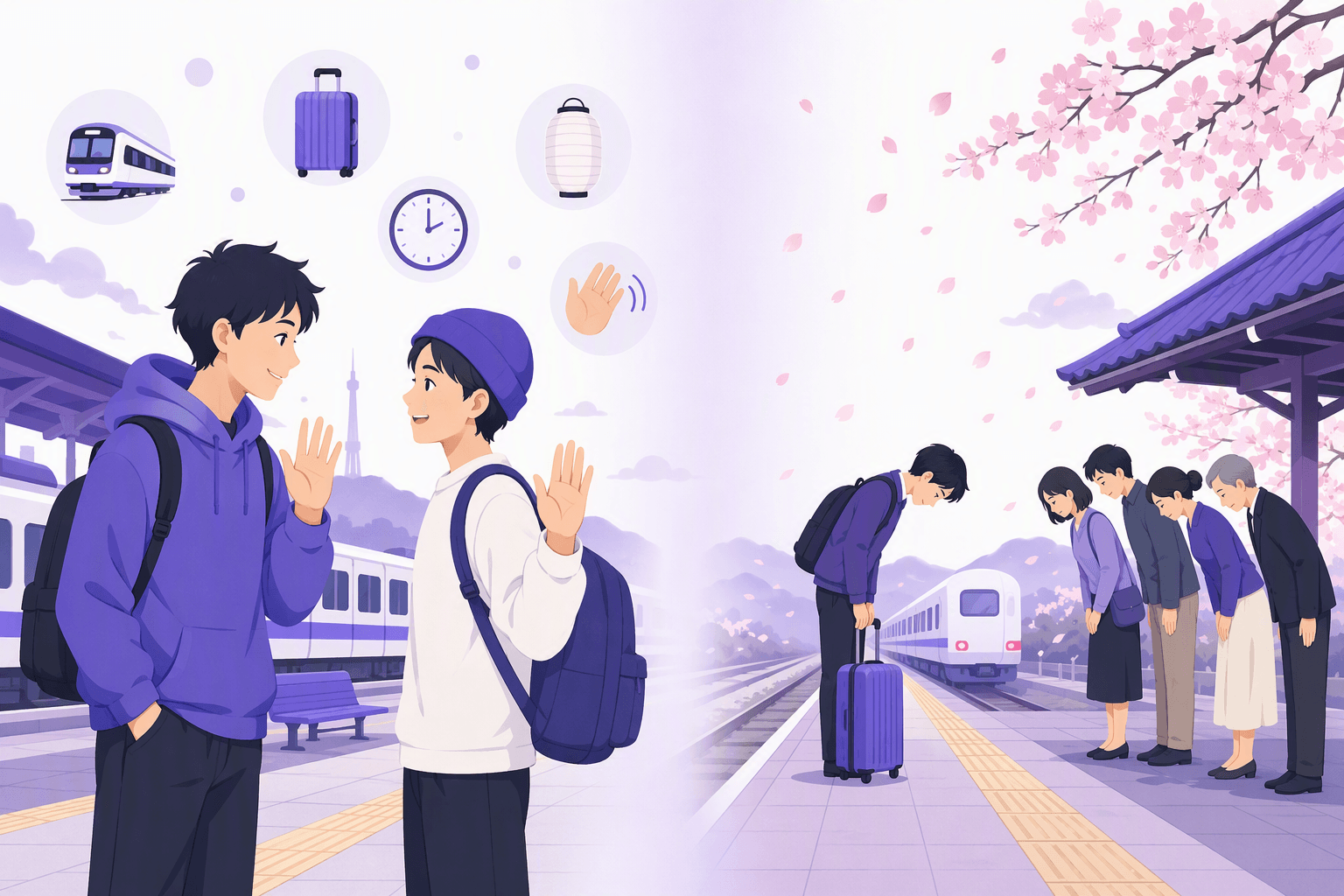
| English | Japanese | Pronunciation | Formality |
|---|---|---|---|
| Goodbye (formal, can feel final) | さようなら | sah-yoh-NAH-rah | formal |
| See you (casual) | またね | mah-tah-NEH | casual |
| Well then, see you (casual) | じゃあね | jah-AH-neh | casual |
| Bye-bye (casual, cute) | バイバイ | bah-ee-BAH-ee | casual |
| See you later (casual) | またあとで | mah-tah AH-toh-deh | casual |
| Excuse me for leaving first (work/school polite) | お先に失礼します | oh-SAH-kee-nee shee-REH-ee shee-MAHSS | polite |
| Thank you for your hard work (work closing) | お疲れ様です | oh-TSOO-kah-reh-SAH-mah dehss | polite |
The Short Answer: what "sayonara" really signals
In real Japanese, さようなら is not the default goodbye between friends.
It can sound like you are closing a chapter, not just ending a conversation.
That "finality" is partly cultural and partly pragmatic: Japanese goodbyes often encode relationship and situation more than literal meaning. If you want a daily-life "see you," you usually pick a phrase that explicitly keeps the connection open, like またね.
For a broader set of everyday farewells, see our goodbye guide. If you are building your basics from scratch, start with hello in Japanese.
Why learners overuse さようなら
Many learners meet さようなら early because it is easy to translate and easy to teach.
Textbooks like clean one-to-one mappings, but Japanese partings are often context-first. The result is a common learner mistake: using さようなら for "bye" after a casual coffee, which can sound unexpectedly heavy.
This is similar to other "textbook defaults" in Japanese where the literal translation is correct but the social fit is off. If you have ever learned keigo or honorifics, you have seen the same pattern: the grammar is not hard, the situation choice is.
How to pronounce さようなら (mora by mora)
さようなら has four morae: sa-yo-u-na-ra in kana rhythm, often realized as sa-yoo-na-ra in natural speech.
A clear English-friendly approximation is:
- さようなら = sah-yoh-NAH-rah
Common pronunciation mistakes
Many English speakers compress the middle into something like "sai-yo" or "syo," but Japanese timing wants separate beats.
Also, do not drop the final ら. It is light, but it is there.
If you want a reference point for standard pronunciation and accent patterns, NHK's accent dictionary is a solid benchmark (see citations).
What does さようなら literally mean?
Historically, さようなら is linked to a longer expression along the lines of "if it is so, then..." used when parting.
In modern Japanese, you do not need the historical grammar to use it correctly. What matters is the social meaning it has today: it is a conventional farewell that can imply distance, formality, or a longer gap.
Dictionaries like Kenkyusha list it straightforwardly as "goodbye," but that gloss does not capture the everyday tone choice. This is where pragmatics matters more than translation.
When さようなら sounds natural (and when it does not)
Natural situations for さようなら
It fits best when the separation is real, scheduled, or emotionally marked.
You will hear it in:
- Graduations and end-of-term moments (teachers to students, students to teachers)
- Moving away or leaving a community
- Formal speeches and announcements
- Stories and media when a character wants the goodbye to feel weighty
In these contexts, the "final" flavor is not a problem, it is the point.
Awkward situations for さようなら
It can feel odd when you are obviously going to see the person again soon.
Examples where it can sound too much:
- Leaving a friend group you meet weekly
- Ending a casual phone call
- Walking out of a shop after paying
- Saying goodbye to coworkers at the end of a normal day
In these cases, Japanese speakers usually choose a phrase that implies continuity, like またね, or a role-based phrase like お先に失礼します at work.
💡 A simple rule that works
If you expect to see the person again soon, prefer またね (mah-tah-NEH) or じゃあね (jah-AH-neh). If you are closing a chapter, さようなら is more likely to fit.
Better everyday alternatives (what people actually say)
Below are the goodbyes you will hear constantly in real life, TV, and movies.
If your goal is to sound natural, these are usually higher value than memorizing more "formal" farewells.
またね
またね (mah-tah-NEH) is the closest everyday match to "see you" or "see you later."
It is friendly and assumes you will meet again. You can say it to friends, classmates, and family.
/mah-tah-NEH/
Literal meaning: Again + sentence-ending particle 'ne' for shared feeling
“じゃ、またね。”
Alright, see you.
A default casual goodbye that implies you expect to meet again. It sounds warm because 'ne' invites agreement, like 'okay?' or 'right?' in tone.
じゃあね
じゃあね (jah-AH-neh) is like "well then, see you."
It often appears when you are wrapping up naturally, especially if you have been talking for a while.
/jah-AH-neh/
Literal meaning: Then + 'ne'
“じゃあね、気をつけて。”
See you, take care.
Very common at the end of a call or when leaving a hangout. It feels lighter than さようなら and does not imply a long separation.
バイバイ
バイバイ (bah-ee-BAH-ee) is a loanword goodbye.
It can sound cute, casual, and sometimes a bit childish, but adults do use it, especially with family or close friends.
Use it carefully in formal settings, it can feel too playful.
またあとで
またあとで (mah-tah AH-toh-deh) means "later" or "see you later."
It is practical when you will meet again the same day. You might say it at home, at school, or when splitting up during an outing.
お先に失礼します
お先に失礼します (oh-SAH-kee-nee shee-REH-ee shee-MAHSS) is a workplace and school classic.
It means "excuse me for leaving before you," and it is used when you leave while others are still working.
It is not a "goodbye" in the English sense, but it is the socially correct leaving line in many Japanese offices.
お疲れ様です
お疲れ様です (oh-TSOO-kah-reh-SAH-mah dehss) is another work staple.
It is often used as a greeting, a sign-off, and a general relationship-maintenance phrase among coworkers. If you watch Japanese workplace dramas, you will hear it constantly.
For a deeper look at how these phrases fit into politeness and role language, Haruo Shirane's work on Japanese language and culture is a useful frame for understanding why "the right phrase" depends on the social scene, not just the dictionary meaning.
"Sayonara" in movies and anime: why it shows up so much
In scripted media, さようなら is popular because it is emotionally legible.
A character saying さようなら signals separation even if you do not catch every word around it. Directors and writers use it as a narrative tool, not as a slice of casual realism.
That is why you might hear it more often in dramatic scenes than you will in a real Tokyo friend group.
If you like learning through clips, pair this article with our anime vocabulary guide to catch the surrounding phrases that often come with a "big goodbye."
🌍 A small cultural detail: school goodbyes
Many learners first hear さようなら in school settings, because it is a common teacher-student farewell at the end of the day or term. That school association can make it feel more formal or institutional than the casual goodbyes you use with friends.
How polite is さようなら?
It is not rude, and it is not a swear or taboo word.
But it is also not the most "polite" goodbye in the way learners sometimes assume. In Japanese, politeness is not only about formality, it is about appropriateness.
Research on politeness in Japanese pragmatics, including work by Sachiko Ide on discernment (wakimae), helps explain this: speakers often choose forms that match social roles and expectations, not just personal friendliness. That is why お先に失礼します can be "more polite" than さようなら at work, even though both can be said politely.
What to say instead: quick scenarios
Leaving friends after dinner
Use: またね, じゃあね, or 気をつけてね (kee oh-tsoo-keh-teh-neh, "take care").
Avoid: さようなら, unless you are leaving town or ending something.
Ending a phone call
Casual: じゃあね, またね.
More polite: 失礼します (shee-TSOO-reh shee-MAHSS), especially in business calls.
Leaving the office
Use: お先に失礼します.
Response you will hear: お疲れ様です.

Saying goodbye to someone moving away
This is where さようなら can fit, but many people still soften it with future-oriented lines:
- また会おうね (mah-tah ah-OH-neh, "let's meet again")
- 連絡してね (rehn-rah-koo shee-teh-neh, "keep in touch")
Breakups and heavy emotional scenes
Media uses さようなら a lot here.
In real life, people may still use it, but they may also avoid set phrases entirely and speak more directly. The absence of a conventional goodbye can itself signal emotional weight.
A note on "sayonara" vs "goodbye" in English
English "goodbye" can be neutral, casual, or serious depending on tone.
Japanese さようなら is more constrained: it is correct, but it is not neutral in many everyday contexts. This is a good example of why translation equivalents are not usage equivalents.
English speakers also borrowed the word, but they use it as a punchline: a jokey, slightly theatrical sign-off that no Japanese speaker would pick in the same spot.
If you enjoy these cross-language mismatches, our Japanese language overview connects them to broader features like register, role language, and context-heavy communication.
Mini practice: make your goodbyes sound native
Pick one default for each setting and stick to it until it becomes automatic.
- Friends: またね
- Phone with friends: じゃあね
- Work: お先に失礼します
- Work reply: お疲れ様です
Then add one "extra" line for warmth:
- 気をつけて (kee oh-tsoo-keh-teh, "take care")
- また連絡するね (mah-tah rehn-rah-koo soo-roo-neh, "I'll message again")
This is also where learning with real clips helps: you hear the goodbye plus the softening phrase plus the body language. If you are building a clip-based routine, our guide on how to learn a language with movies shows a practical way to turn scenes into repeatable practice.
Quick cultural guardrails (so you do not sound dramatic)
⚠️ Avoid accidental 'final goodbye' energy
If you say さようなら to someone you will see tomorrow, it can sound like you are upset, being formal on purpose, or making a point. Use またね or じゃあね for everyday partings, and save さようなら for real separations or formal announcements.
Where Japanese is spoken (and why usage still stays consistent)
Japanese is spoken by roughly 123 million speakers worldwide, according to Ethnologue (2024).
Most native speakers live in Japan, so regional variation exists but is less about "country differences" and more about local dialects and social settings. Even across dialects, the core idea remains: さようなら is understood everywhere, but it is not the casual default.
If you want to hear more natural everyday speech, pair this with our 100 most common Japanese words list so you recognize the small connective phrases that surround greetings and goodbyes.
Closing: the safest choice
If you only remember one thing, make it this: さようなら means goodbye, but it often sounds formal and final. For daily life, またね and じゃあね are usually the natural picks.
When you are ready to expand beyond goodbyes into relationship language, our guide to saying "I love you" in Japanese is a good next step, because it teaches the same skill: choosing phrases by context, not by dictionary gloss.
Frequently Asked Questions
Does sayonara mean goodbye forever?
Is it rude to say sayonara in Japan?
How do you pronounce sayonara correctly?
What is the difference between sayonara and mata ne?
Can I say sayonara on the phone or in a text?
Sources & References
- NHK Broadcasting Culture Research Institute, NHK日本語発音アクセント新辞典 (accessed 2026)
- Kenkyusha, 新和英大辞典 (accessed 2026)
- Agency for Cultural Affairs (文化庁), 国語に関する世論調査 (accessed 2026)
- Ethnologue: Languages of the World, Japanese language entry (2024)
Start learning with Wordy
Watch real movie clips and build your vocabulary as you go. Free to download.


