Quick Answer
Swiss German is a group of spoken Alemannic dialects used across German-speaking Switzerland, while Standard German is usually used for writing, news, and formal documents. You do not need to speak Swiss German to visit, but learning greetings like Grüezi and Hoi will make daily interactions warmer and easier.
Swiss German is the everyday spoken language of much of German-speaking Switzerland, but it is not the same as the Standard German you learn in most courses. You can absolutely communicate with Standard German, yet recognizing a few Swiss German greetings, sounds, and cultural habits will help you understand real conversations and make a better first impression. If you are already working on German greetings, Swiss German is the practical next step.
Switzerland has four national languages: German, French, Italian, and Romansh. According to the Swiss Federal Statistical Office, German is the main language for roughly 62% of the permanent resident population, or more than 5 million people in a country of about 9 million residents. In daily life, many of those speakers use a local Swiss German dialect rather than Standard German.
Swiss German, or Schweizerdeutsch /ˈʃvaɪtsɐdɔɪtʃ/, is a broad label for related Alemannic dialects. A person from Zürich, Bern, Basel, St. Gallen, and Valais may all say they speak Swiss German, while sounding distinctly different to one another.
| English | Swiss German | Pronunciation | Formality |
|---|---|---|---|
| Hello, politely | Grüezi | GRUE-eh-tsee | polite |
| Hello, casually | Hoi | HOY | casual |
| Hello, casually | Sali | SAH-lee | casual |
| Thank you | Merci | mehr-SEE | polite |
| Excuse me | Äxgüsi | EKS-gue-see | polite |
| Goodbye | Uf Widerluege | oof VEE-der-loo-eh-guh | polite |
| Enjoy your meal | En Guete | en GOO-eh-tuh | polite |
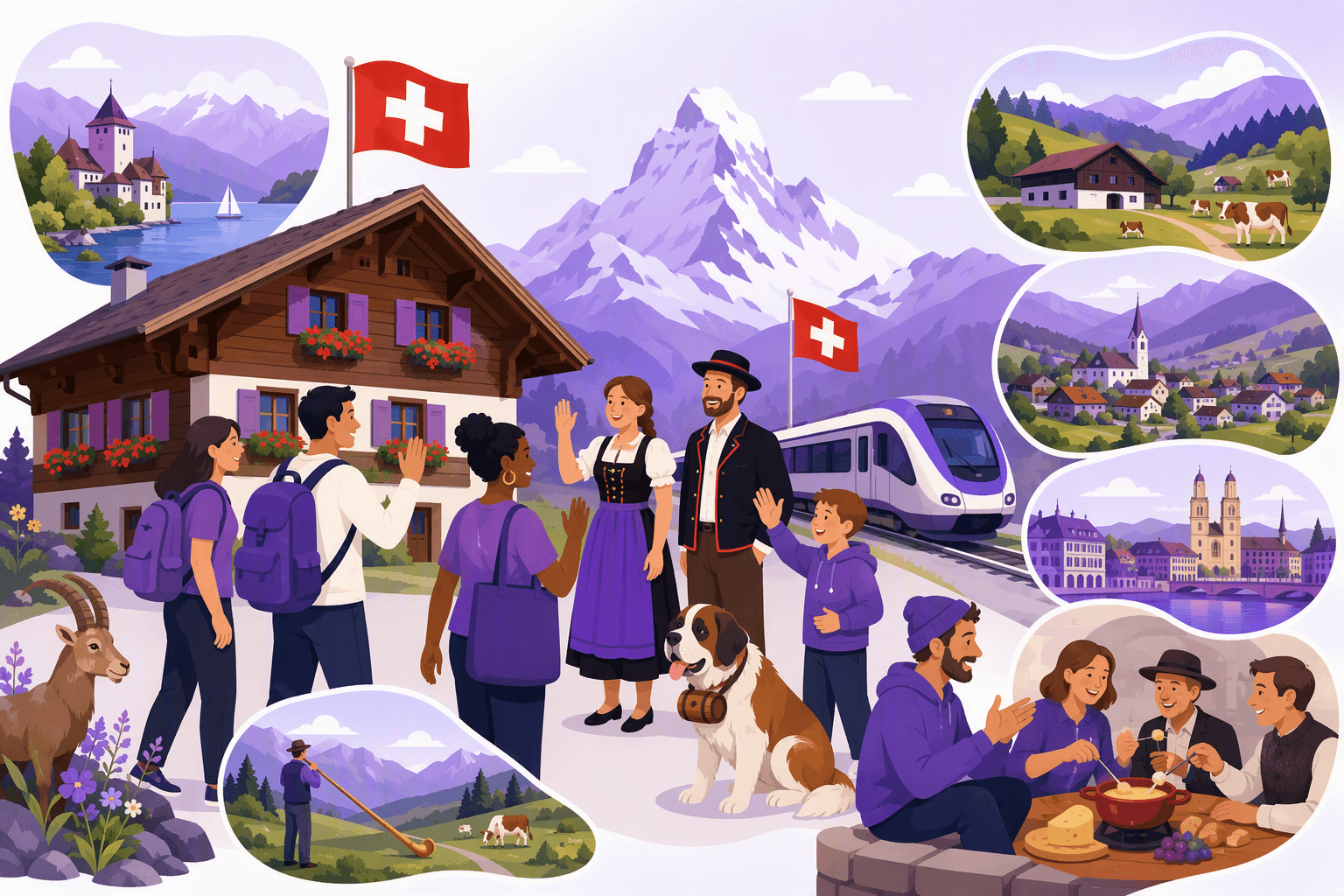
What Swiss German actually is
The label Schweizerdeutsch /ˈʃvaɪtsɐdɔɪtʃ/ does not describe one uniform spoken standard. It covers a dialect continuum, mostly within the Alemannic branch of Upper German. Borders between dialects are gradual, and a village only 20 kilometers away may use different vowels, words, or verb endings.
This matters because there is no one correct Swiss German accent to copy. A Zürich speaker might say Züri /ˈtsyri/ for Zürich, while a Bernese speaker has a noticeably slower rhythm and different vowel qualities. The goal for learners is recognition and respectful participation, not pretending that every Swiss region sounds the same.
Dialect geographer Rudolf Hotzenköcherle documented the remarkable density of regional variation in Die Sprachlandschaften der deutschen Schweiz. His work remains useful because it treats dialect differences as normal local systems, not as imperfect versions of German.
Schweizerdeutsch
Schweizerdeutsch /ˈʃvaɪtsɐdɔɪtʃ/ is primarily spoken. You hear it at home, in shops, on public transport, in school corridors, in sports clubs, and in much local entertainment.
Many Swiss people also text in dialect. Because Swiss German has no single official spelling, a message may look unfamiliar even when you know Standard German. Writers often spell words in ways that reflect how they pronounce them.
Hochdeutsch
Hochdeutsch /ˈhoːxdɔɪtʃ/, often called Standarddeutsch /ˈʃtandɐdɔɪtʃ/, is the shared written standard. It appears in newspapers, federal documents, school textbooks, job applications, contracts, and formal correspondence.
In Switzerland, this written form has local conventions known as Schweizerhochdeutsch /ˈʃvaɪtsɐˌhoːxdɔɪtʃ/. For example, Swiss Standard German normally uses ss instead of the letter ß /ɛsˈtsɛt/, even where German spelling from Germany would use it: dass /das/ rather than daß /das/.
Swiss German vs German: the differences you will notice
Swiss German can feel surprising to learners because the gap is larger than a few accent changes. Vocabulary, sound patterns, grammar, and everyday interaction all differ.
That said, Swiss people are accustomed to adjusting. If you answer in careful Standard German, most speakers can meet you there without making it awkward.
Pronunciation and rhythm
Swiss German often preserves sounds that Standard German changed over time. One famous example is the hard ch /x/ sound in words related to Standard German k /k/. In some dialects, the word for child is Chind /xɪnd/ rather than Kind /kɪnt/.
Swiss German also tends to use fuller, clearer vowel sounds than the reduced endings common in northern Standard German. The rhythm can make familiar words difficult to catch, especially when speakers talk quickly among themselves.
Do not worry about reproducing every local sound. Clear Standard German pronunciation is more useful than forcing an imitation of a dialect you have only heard online. Our German pronunciation guide can help you build that reliable base first.
Vocabulary
Some everyday Swiss words are different enough that they need to be learned as vocabulary. Velo /ˈvelo/ means bicycle, where Standard German in Germany commonly uses Fahrrad /ˈfaːʁʁaːt/. A Billet /biˈjɛ/ is a ticket, where many Germans would say Fahrkarte /ˈfaːʁkaʁtə/ or Ticket /ˈtɪkɛt/.
French has influenced Swiss German and Swiss Standard German, particularly in food, transport, and public life. That is why Merci /mɛʁˈsi/ is a routine thank-you across much of the country, even though Standard German classes usually begin with danke /ˈdaŋkə/.
The online Schweizerisches Idiotikon, a major dictionary project for Swiss German, records the depth and historical range of this vocabulary. It is a useful reminder that dialect words are not random slang. They have long local histories.
Grammar
Swiss German grammar differs from Standard German in several ways, but beginners do not need to master them immediately. One common pattern is the use of ha /ha/ for “have,” compared with Standard German haben /ˈhaːbn̩/.
The past tense also works differently in ordinary speech. Like many spoken varieties of German, Swiss German strongly favors perfect constructions rather than the simple past. You will hear forms corresponding to “I have gone” where an English speaker might expect “I went.”
Swiss German dialects also often use constructions with tun /tuːn/ plus an infinitive for emphasis or habitual action. These are natural within the dialect, but they are not a priority for a visitor trying to communicate politely.
Essential Swiss German phrases for real life
The safest strategy is simple: learn a few high-frequency phrases, use them naturally, and let local speakers lead the conversation. A friendly greeting carries more social value than a long memorized dialect speech.
Grüezi
Grüezi /ˈɡryətsi/ is the classic polite greeting. It is especially associated with Zürich and much of central and eastern Switzerland, and it works well with strangers, shop staff, neighbors, and older people.
/GRUE-eh-tsee/
Literal meaning: A polite greeting, historically related to 'God greet you'
“Grüezi, händ Sie das Billet?”
Hello, do you have the ticket?
A safe greeting in many German-speaking Swiss settings, especially when you do not know the person.
The rounded vowel is challenging. The IPA /y/ is made with the tongue position of /i/ but rounded lips. If that feels difficult, a clear attempt is enough. Do not replace the greeting with exaggerated pronunciation.
Hoi
Hoi /hɔɪ/ is an informal hello used with friends, classmates, colleagues you know well, and people of a similar age. It is warm and common, but it is not the best first choice when entering a formal shop or meeting someone senior.
/HOY/
Literal meaning: An informal hello
“Hoi, wie gaht's?”
Hi, how are you doing?
Use it after the relationship feels informal. It is common in relaxed everyday interactions.
The phrase wie gaht's? /vi ɡaːts/ corresponds to Standard German wie geht es? /vi ɡeːt ɛs/. You will often hear it, but answering in Standard German is completely acceptable.
Sali
Sali /ˈsɑli/ is another informal greeting, particularly familiar in several northern and central areas. It can be used as hello and sometimes as goodbye, depending on region and relationship.
It is more personal than Grüezi /ˈɡryətsi/. If you hear it first, replying with Sali /ˈsɑli/ is usually natural. If you are uncertain, Grüezi /ˈɡryətsi/ remains the safer opening.
Äxgüsi
Äxgüsi /ˈæksˌɡyzi/ means excuse me. Use it to get past someone, attract a server’s attention, or soften a small interruption.
/EKS-gue-see/
Literal meaning: Excuse me
“Äxgüsi, isch dä Platz frei?”
Excuse me, is this seat free?
Useful on trains, buses, and in cafés. It sounds locally aware without requiring advanced dialect grammar.
In more formal Standard German, you can say Entschuldigung /ɛntˈʃʊldɪɡʊŋ/. Both are understood, but Äxgüsi /ˈæksˌɡyzi/ is a small, friendly signal that you recognize local speech.
En Guete
En Guete /ən ˈɡuətə/ means enjoy your meal. Say it when people begin eating, including strangers seated nearby in a casual setting.
/en GOO-eh-tuh/
Literal meaning: A good one
“En Guete zäme!”
Enjoy your meal, everyone!
Common at lunch tables, workplace cafeterias, and informal restaurants. It is a small but appreciated social courtesy.
This is particularly useful because Swiss meal etiquette can be quietly communal. A brief acknowledgment before eating is normal, especially at a shared table. For more food language, see our German restaurant phrases.
Uf Widerluege
Uf Widerluege /ʊf ˈviːdərˌlyəɡə/ is a widely recognized Swiss German farewell, literally related to seeing each other again. It is a friendly, polite choice after a purchase, appointment, or conversation.
In Standard German, auf Wiedersehen /aʊf ˈviːdɐzeːən/ is always safe. For more ways to leave naturally, read how to say goodbye in German.
Cultural rules that matter more than perfect dialect
Swiss German is tied to local belonging, but visitors are not expected to perform it. The most successful approach is to show curiosity without assuming that one dialect represents the entire country.
Do not call it an accent
Calling Swiss German an accent can sound dismissive because the differences include grammar and vocabulary, not only pronunciation. “Swiss German dialects” is accurate, while Schweizerdeutsch /ˈʃvaɪtsɐdɔɪtʃ/ is the most natural local label.
Linguist Peter Trudgill’s work on dialects emphasizes that language varieties have their own patterns and social functions. That lens is useful here: Swiss German is not broken Standard German. It is a family of established regional varieties used in specific settings.
Expect switching, not a language test
A Swiss person may begin in dialect, hear your accent, and switch smoothly to Standard German or English. Accept the switch as helpful communication, not as criticism of your German.
You can say Ich lerne Deutsch /ɪç ˈlɛʁnə dɔɪtʃ/, meaning “I am learning German,” and continue calmly. Trying to insist on dialect before you can follow it often creates more pressure than connection.
🌍 A useful social rule
Use Swiss German greetings, but do not force Swiss German grammar. A polite Grüezi /ˈɡryətsi/, a sincere Merci /mɛʁˈsi/, and clear Standard German are a better combination than an over-rehearsed dialect performance.
Respect regional identity
Switzerland has 26 cantons, and local identity is meaningful. Zürich German is not Bernese German, and neither is interchangeable with Basel or Valais speech.
Avoid telling someone that their dialect sounds exactly like another region’s. If you are curious, ask which dialect they speak. People often enjoy explaining the local words that outsiders find surprising.
Learn through real audio
Swiss German is a listening challenge first. Text alone cannot teach you the speed, vowel length, and regional rhythm of real speech.
Watch clips with Swiss subtitles when available, replay short scenes, and connect a phrase to the situation where it appears. This method is especially helpful after you have a base in Standard German. For a broader listening routine, see how to learn a language with movies.
A realistic plan for learning Swiss German
Start with Standard German if you are a beginner. It gives you the grammar, reading ability, and vocabulary needed for school, work, travel, and official life across the German-speaking world.
Once you can manage everyday Standard German, choose one regional target based on where you live, work, study, or visit. Learn greetings and daily phrases first, then spend regular time listening to local speakers.
Keep a small notebook of words you hear repeatedly: Velo /ˈvelo/, Billet /biˈjɛ/, Znüni /ˈtsnyːni/ for a mid-morning snack, and Znacht /tsnaxt/ for dinner. Context will teach you which words are regional, which are informal, and which belong in Standard German writing.
Swiss German is not a barrier you must conquer before visiting Switzerland. It is an invitation to listen closely to a multilingual country where local speech has strong cultural value. Begin with Grüezi /ˈɡryətsi/, Merci /mɛʁˈsi/, and Uf Widerluege /ʊf ˈviːdərˌlyəɡə/, then let real conversations teach you the rest.
Frequently Asked Questions
Is Swiss German a different language from German?
Can I get by in Switzerland with Standard German?
What is the most common Swiss German greeting?
Why do Swiss people write in Standard German but speak dialect?
Is Swiss German hard for German speakers?
Sources & References
- Swiss Federal Statistical Office, Languages, religion and culture, accessed 2026
- Federal Office of Culture, Switzerland's four national languages, accessed 2026
- Schweizerisches Idiotikon, Dictionary of Swiss German, accessed 2026
- Duden, Schweizerhochdeutsch reference materials, accessed 2026
- Rudolf Hotzenköcherle, Die Sprachlandschaften der deutschen Schweiz, Verlag Sauerländer
Start learning with Wordy
Watch real movie clips and build your vocabulary as you go. Free to download.


