At the Restaurant in German: 35+ Phrases for Ordering, Paying, and Polite Talk
Quick Answer
To order at a restaurant in German, say Ich hätte gern... for I would like..., bitte for please, and Die Rechnung, bitte for the bill, please. These polite phrases work across Germany, Austria, and German-speaking Switzerland, whether you are ordering coffee, reserving a table, or paying.
| English | German | Pronunciation | Formality |
|---|---|---|---|
| A table for two, please | Einen Tisch für zwei, bitte. | EYE-nen tish fuer tsvy, BIT-tuh | polite |
| I would like... | Ich hätte gern... | ikh HET-tuh gairn | polite |
| Could I have the menu? | Könnte ich die Speisekarte haben? | KURN-tuh ikh dee SHPY-zuh-kar-tuh HAH-ben | polite |
| The bill, please | Die Rechnung, bitte. | dee REKH-noong, BIT-tuh | polite |
| Cheers! | Prost! | prohst | casual |
| That was delicious | Das war sehr lecker. | dahs vahr zair LEK-ker | casual |
Eating out in German is straightforward once you know a few polite phrases. Start with a greeting, use bitte /ˈbɪtə/ generously, and say Ich hätte gern... /ɪç ˈhɛtə ɡɛʁn/ to order. For a full foundation before your meal, review how to say hello in German.
German has around 90 million native speakers and is an official or co-official language in six European countries: Germany, Austria, Switzerland, Liechtenstein, Luxembourg, and Belgium. As Ulrich Ammon explains in Die Stellung der deutschen Sprache in der Welt, German has major regional variation, but restaurant politeness travels very well across these places.
The phrases below are useful in a formal restaurant, a relaxed beer garden, a bakery café, or a hotel breakfast room. Pronunciation differs slightly by region, especially in Austria and Switzerland, but standard German will be understood.
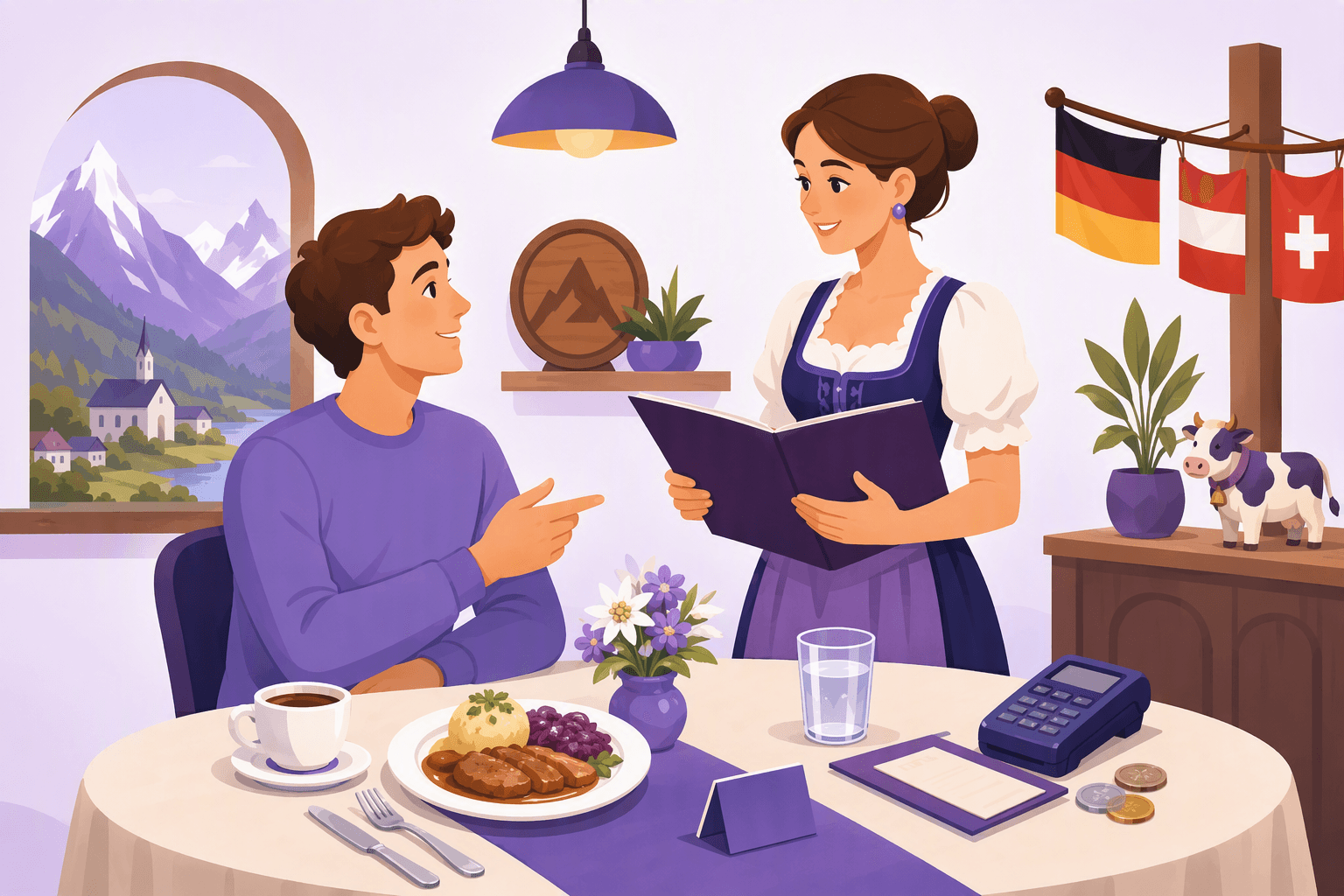
Before you sit down
In Germany, you may seat yourself at casual cafés and beer gardens, particularly when tables are open. At a more formal restaurant, wait near the entrance for staff or ask for a table.
A friendly greeting matters. Say Guten Tag /ˈɡuːtn̩ taːk/ during the day or Guten Abend /ˈɡuːtn̩ ˈaːbn̩t/ in the evening. In a small local restaurant, staff may greet you first, and returning the greeting is expected.
Einen Tisch für zwei, bitte.
Einen Tisch für zwei, bitte. /ˈaɪnən tɪʃ fyːɐ̯ t͡svaɪ ˈbɪtə/ means “A table for two, please.”
Change zwei /t͡svaɪ/ to eine Person /ˈaɪnə pɛʁˈzoːn/ if you are alone, drei /dʁaɪ/ for three people, or vier /fiːɐ̯/ for four. You do not need perfect grammar for the number to be understood.
/EYE-nen tish fuer tsvy, BIT-tuh/
Literal meaning: A table for two, please
“Guten Abend. Einen Tisch für zwei, bitte.”
Good evening. A table for two, please.
Useful at a restaurant entrance or when calling ahead. In casual cafés, you may simply choose an empty table.
Haben Sie einen Tisch frei?
Haben Sie einen Tisch frei? /ˈhaːbn̩ ziː ˈaɪnən tɪʃ fʁaɪ/ means “Do you have a free table?”
This is particularly useful without a reservation. The formal Sie /ziː/ is the correct default with restaurant staff, even if you are young and the venue feels informal.
Ich habe einen Tisch reserviert.
Ich habe einen Tisch reserviert. /ɪç ˈhaːbə ˈaɪnən tɪʃ ʁezeʁˈviːɐ̯t/ means “I have reserved a table.”
Add your name with auf den Namen... /aʊf deːn ˈnaːmən/. For example, Ich habe einen Tisch auf den Namen Smith reserviert means “I have reserved a table under the name Smith.”
🌍 Reservations are common
In popular restaurants, especially on Friday and Saturday evenings, reserving ahead is sensible. In German, a reservation is a Reservierung /ʁezɛʁˈviːʁʊŋ/. Arriving on time is treated as considerate, particularly when tables are booked in time slots.
Asking for the menu and drinks
The menu is usually called die Speisekarte /diː ˈʃpaɪzəˌkaʁtə/. A drinks menu may be called die Getränkekarte /diː ɡeˈtʁɛŋkəˌkaʁtə/.
You may hear staff ask Was möchten Sie trinken? /vas ˈmœçtn̩ ziː ˈtʁɪŋkn̩/, meaning “What would you like to drink?” The verb möchten /ˈmœçtn̩/ is a polite, softened form of “want.”
Könnte ich die Speisekarte haben?
Könnte ich die Speisekarte haben? /ˈkœntə ɪç diː ˈʃpaɪzəˌkaʁtə ˈhaːbn̩/ means “Could I have the menu?”
You can also say Die Speisekarte, bitte /diː ˈʃpaɪzəˌkaʁtə ˈbɪtə/. This shorter version is not rude, especially when paired with eye contact and a polite tone.
Was können Sie empfehlen?
Was können Sie empfehlen? /vas ˈkœnən ziː ɛmˈpfeːlən/ means “What can you recommend?”
This is an excellent phrase for regional dishes, seasonal specials, or an unfamiliar menu. Many German restaurants take pride in local ingredients, such as asparagus in spring, chanterelle mushrooms in late summer, or regional game dishes in autumn.
Ich hätte gern...
Ich hätte gern... /ɪç ˈhɛtə ɡɛʁn/ is the most reliable phrase for ordering. It means “I would like...” and is polite in nearly every setting.
You can point to a menu item and say Ich hätte gern das Schnitzel /ɪç ˈhɛtə ɡɛʁn das ˈʃnɪt͡sl̩/. For a drink, say Ich hätte gern ein Mineralwasser /ɪç ˈhɛtə ɡɛʁn aɪn mineˈʁaːlˌvasɐ/.
/ikh HET-tuh gairn/
Literal meaning: I would gladly have
“Ich hätte gern die Käsespätzle, bitte.”
I would like the cheese spaetzle, please.
This is the safest all-purpose ordering phrase. It is courteous but ordinary, not stiff or ceremonial.
Ich nehme...
Ich nehme... /ɪç ˈneːmə/ means “I will take...” It is slightly more direct than Ich hätte gern /ɪç ˈhɛtə ɡɛʁn/, but still natural and polite when you add bitte /ˈbɪtə/.
For example, Ich nehme die Suppe /ɪç ˈneːmə diː ˈzʊpə/ means “I’ll have the soup.” Use this after you have decided.
Essential German food and drink requests
A restaurant interaction often depends less on knowing every food word and more on expressing your needs clearly. Germans generally appreciate direct, calm requests.
Ohne...
Ohne... /ˈoːnə/ means “without.” It is one of the most useful words for dietary preferences.
Say ohne Zwiebeln /ˈoːnə ˈt͡sviːbl̩n/ for “without onions,” ohne Fleisch /ˈoːnə flaɪʃ/ for “without meat,” or ohne Milch /ˈoːnə mɪlç/ for “without milk.”
Ich bin Vegetarierin oder Vegetarier.
Ich bin Vegetarierin /ɪç bɪn veɡetaˈʁiːʁɪn/ is said by a woman, while Ich bin Vegetarier /ɪç bɪn veɡetaˈʁiːɐ̯/ is said by a man. Both mean “I am vegetarian.”
For vegan food, say Ich bin vegan /ɪç bɪn veˈɡaːn/. If you have an allergy, use Ich habe eine Allergie gegen... /ɪç ˈhaːbə ˈaɪnə ալɛʁˈɡiː ɡeːɡn̩/, meaning “I have an allergy to...”
Ist das scharf?
Ist das scharf? /ɪst das ʃaʁf/ means “Is that spicy?”
The adjective scharf /ʃaʁf/ can mean spicy, sharp, or hot depending on context. It is especially useful in international restaurants, where spice levels can vary widely.
Leitungswasser oder Mineralwasser?
Leitungswasser /ˈlaɪtʊŋsˌvasɐ/ is tap water. Mineralwasser /mineˈʁaːlˌvasɐ/ is mineral water, often bottled and available still or sparkling.
For sparkling water, ask for Wasser mit Kohlensäure /ˈvasɐ mɪt ˈkoːlənˌzɔɪʁə/. For still water, ask for stilles Wasser /ˈʃtɪləs ˈvasɐ/.
🌍 Water is usually ordered
Unlike many restaurants in the United States, German restaurants do not routinely bring free tap water to the table. Bottled water is a normal menu item, and sparkling mineral water is especially common. Asking for tap water is possible, but it may not be provided automatically.
During the meal
Once food has arrived, you may need extra cutlery, condiments, or a way to get the server's attention. Avoid calling loudly across the room. A small raised hand and Entschuldigung /ɛntˈʃʊldɪɡʊŋ/ are enough.
Entschuldigung
Entschuldigung /ɛntˈʃʊldɪɡʊŋ/ means “Excuse me.” Use it to get attention, move past someone, or begin a small request.
For a deeper look at this flexible word, see our German excuse-me guide.
Können wir noch etwas Brot bekommen?
Können wir noch etwas Brot bekommen? /ˈkœnən viːɐ̯ nɔx ˈɛtvas bʁoːt bəˈkɔmən/ means “Can we get some more bread?”
You can replace Brot /bʁoːt/ with Wasser /ˈvasɐ/, Besteck /bəˈʃtɛk/ for cutlery, or Servietten /zɛʁviˈɛtn̩/ for napkins.
Das war sehr lecker.
Das war sehr lecker. /das vaːɐ̯ zeːɐ̯ ˈlɛkɐ/ means “That was very delicious.”
This is a warm, natural compliment. Restaurant staff will appreciate it, particularly in family-run places. You can add Danke /ˈdaŋkə/, meaning “thank you.”
Politeness research by Penelope Brown and Stephen Levinson emphasizes that speakers protect one another’s social dignity through small linguistic choices. In a German restaurant, bitte /ˈbɪtə/, danke /ˈdaŋkə/, and a brief greeting do much of that work without elaborate small talk.
Asking for the bill and paying
German restaurant service is usually efficient but not rushed. Servers often leave you to enjoy your meal rather than bringing the bill automatically. When you are ready, you need to ask.
Die Rechnung, bitte.
Die Rechnung, bitte. /diː ˈʁɛçnʊŋ ˈbɪtə/ means “The bill, please.”
This is the key phrase to memorize. You can also say Zahlen, bitte /ˈt͡saːlən ˈbɪtə/, literally “Paying, please,” which functions naturally as “We would like to pay.”
/dee REKH-noong, BIT-tuh/
Literal meaning: The bill, please
“Entschuldigung, die Rechnung, bitte.”
Excuse me, the bill, please.
The bill is normally not brought until requested. Say this when the server passes nearby rather than waiting for them to return.
Zusammen oder getrennt?
Zusammen oder getrennt? /t͡suˈzamən ˈoːdɐ ɡəˈtʁɛnt/ means “Together or separately?”
Staff may ask this before processing payment. Zusammen /t͡suˈzamən/ means together, while getrennt /ɡəˈtʁɛnt/ means separately.
Splitting a bill is common in Germany, and many servers are used to separate payments by person or item. Tell them early if your group needs separate bills.
Mit Karte, bitte.
Mit Karte, bitte. /mɪt ˈkaʁtə ˈbɪtə/ means “By card, please.”
Card payment is increasingly widespread, but small businesses, rural restaurants, and traditional beer gardens may still prefer cash. Carrying some euros remains practical.
Stimmt so.
Stimmt so. /ʃtɪmt zoː/ means “Keep the change.”
This is how you tip naturally when paying in cash. If your total is €18.40 and you hand over €20, say Stimmt so /ʃtɪmt zoː/ if you want the server to keep the difference.
For a larger tip, state the total you want to pay. If the bill is €42, say Fünfzig, bitte /ˈfʏnft͡sɪç ˈbɪtə/ while giving your card or cash. This signals that you want to pay €50 in total.
💡 Tip before the transaction is finished
In many German restaurants, the server brings a portable card terminal to the table or handles cash directly. State the final total, including your tip, before confirming payment. Leaving coins after the card transaction is possible, but saying the total is more typical.
Toasting and leaving politely
A meal may end with coffee, dessert, or a final toast. If someone raises a glass, say Prost! /pʁoːst/, the everyday German equivalent of “Cheers!”
Maintain eye contact briefly when saying Prost /pʁoːst/. This is a familiar social convention in Germany, and it matters more in relaxed group meals than in a formal business lunch.
Auf Wiedersehen
Auf Wiedersehen /aʊf ˈviːdɐˌzeːən/ means “Goodbye” and is polite when leaving a restaurant. A lighter option is Tschüss /t͡ʃʏs/, but use Auf Wiedersehen /aʊf ˈviːdɐˌzeːən/ with staff you do not know.
Learn more options in our guide to saying goodbye in German.
A simple restaurant conversation
Here is a realistic exchange using the phrases above.
Server: Guten Abend. Haben Sie reserviert? /ˈɡuːtn̩ ˈaːbn̩t ˈhaːbn̩ ziː ʁezeʁˈviːɐ̯t/
Good evening. Do you have a reservation?
You: Ja, auf den Namen Garcia. /jaː aʊf deːn ˈnaːmən ɡaʁˈsiːa/
Yes, under the name Garcia.
Server: Möchten Sie etwas trinken? /ˈmœçtn̩ ziː ˈɛtvas ˈtʁɪŋkn̩/
Would you like something to drink?
You: Ich hätte gern ein stilles Wasser und ein Bier, bitte. /ɪç ˈhɛtə ɡɛʁn aɪn ˈʃtɪləs ˈvasɐ ʊnt aɪn biːɐ̯ ˈbɪtə/
I would like a still water and a beer, please.
You, later: Ich nehme das Schnitzel. Ist das scharf? /ɪç ˈneːmə das ˈʃnɪt͡sl̩ ɪst das ʃaʁf/
I’ll have the schnitzel. Is that spicy?
You, at the end: Entschuldigung, die Rechnung, bitte. /ɛntˈʃʊldɪɡʊŋ diː ˈʁɛçnʊŋ ˈbɪtə/
Excuse me, the bill, please.
Practice with real German scenes
Restaurant German is easier to remember when you hear the rhythm, pauses, and polite tone in context. Watch for ordering scenes in German films and series, then repeat one useful line aloud before moving on.
The Institut für Deutsche Sprache documents how everyday usage changes by setting and relationship. That is why a textbook-perfect sentence can sound different when spoken quickly at a busy counter. Learn the polite standard version first, then notice shorter real-world forms in dialogue.
For more practical vocabulary, see our German food vocabulary guide and essential German travel phrases. When you can greet, order, clarify, pay, and say goodbye, you can handle nearly any restaurant visit with confidence.
Frequently Asked Questions
How do you ask for the bill in German?
Do you tip at restaurants in Germany?
What is the most polite way to order food in German?
Can I use English in German restaurants?
Do German restaurants give free tap water?
Sources & References
- Goethe-Institut, German Language Information, accessed 2026
- Duden, Wörterbuch and language guidance, accessed 2026
- Institut für Deutsche Sprache, German language usage resources, accessed 2026
- Ulrich Ammon, Die Stellung der deutschen Sprache in der Welt, De Gruyter
- Brown and Levinson, Politeness: Some Universals in Language Usage, Cambridge University Press
Start learning with Wordy
Watch real movie clips and build your vocabulary as you go. Free to download.


