Quick Answer
The most common way to say hello in German is 'Hallo' (HAH-loh). It works across Germany, Austria, and Switzerland in both casual and neutral settings. Beyond Hallo, native speakers use time-of-day greetings like 'Guten Morgen,' regional favorites like 'Grüß Gott' in Bavaria and Austria, 'Moin' in northern Germany, and casual check-ins like 'Wie geht's?'
The Short Answer
The most common way to say hello in German is Hallo (HAH-loh). It works across Germany, Austria, Switzerland, and every other German-speaking region, at any time of day, and in both casual and moderately formal settings. But native speakers draw from a much richer set of greetings depending on context, region, and relationship.
German is spoken by over 130 million people worldwide and is an official language in six countries: Germany, Austria, Switzerland, Liechtenstein, Luxembourg, and Belgium. According to Ethnologue's 2024 data, it ranks among the top twelve most spoken languages globally. With that reach across Central Europe comes striking regional variety in how people greet each other, from Guten Tag in a Berlin office to Grüß Gott in a Viennese coffee house to Moin on the streets of Hamburg.
"German greetings reveal the regional identity of the speaker more immediately than almost any other feature of the language. A single word (Moin, Servus, or Grüezi) places a person geographically with remarkable precision."
(Ulrich Ammon, Die Stellung der deutschen Sprache in der Welt, De Gruyter, 2015)
This guide covers 17 essential German greetings organized by category: universal, time-of-day, casual, formal, regional, and slang. Each one includes pronunciation, an example sentence, and cultural context so you know exactly when and where to use it.

Quick Reference: German Greetings at a Glance
| English | German | Pronunciation | Formality |
|---|---|---|---|
| Hello | Hallo | HAH-loh | casual |
| Good day | Guten Tag | GOO-ten TAHK | polite |
| Good morning | Guten Morgen | GOO-ten MOR-gen | polite |
| Good evening | Guten Abend | GOO-ten AH-bent | polite |
| How are you? (informal) | Wie geht's? | vee GAYTS | casual |
| How are you? (formal) | Wie geht es Ihnen? | vee GAYT ess EE-nen | formal |
| Hey, what's up? | Na? | nah | slang |
| What's up? | Was geht? | vahs GAYT | slang |
| Hi (borrowed) | Hi | hee | casual |
| Greet God (Bavaria/Austria) | Grüß Gott | GREWS GOT | polite |
| Hello/Bye (Bavaria/Austria) | Servus | ZEHR-voos | casual |
| Hello (Switzerland) | Grüezi | GREW-eh-tsee | polite |
| Hello (Northern Germany) | Moin | moyn | casual |
| Hello hello (Northern Germany) | Moin Moin | moyn moyn | casual |
| Nice to meet you | Freut mich | froyt MIKH | polite |
| Nice to meet you (formal) | Sehr erfreut | zehr ehr-FROYT | formal |
| Goodbye (contrast) | Tschüss | chews | casual |
Universal Greetings
These greetings work across every German-speaking country and are understood by all speakers. The Duden, Germany's authoritative dictionary, lists them as standard High German (Hochdeutsch).
Hallo
/HAH-loh/
Literal meaning: Hello
“Hallo! Schön, dich zu sehen!”
Hello! Nice to see you!
The most universal German greeting. Works in every region and nearly every situation. Slightly more casual than 'Guten Tag' but never inappropriate.
Hallo is the safest greeting in German. It carries no regional baggage, works at any hour, and fits almost any level of formality. The stress falls on the first syllable: HAH-loh, not hah-LOH.
Unlike English "Hello," which can sound formal on its own, German Hallo sits in a comfortable middle ground: neutral enough for a shop, warm enough for friends. In professional emails, you will often see Hallo Herr Müller or Hallo Frau Schmidt as the standard opening.
💡 Hallo in Writing
In German emails and messages, Hallo followed by the person's name is the default semi-formal opening. For truly formal correspondence, use Sehr geehrte/r (Dear...). Among friends, Hi or Hey works just fine.
Guten Tag
/GOO-ten TAHK/
Literal meaning: Good day
“Guten Tag, Herr Direktor. Ich habe einen Termin um zehn.”
Good day, Director. I have an appointment at ten.
The standard polite greeting. Used in shops, offices, and with strangers. Equivalent to a firm, professional 'hello' in English.
Guten Tag is the textbook greeting, literally "good day." It is the go-to choice in professional and semi-formal situations: entering a shop, meeting someone for the first time, or addressing a colleague you are not close with.
In northern Germany, you will often hear just Tag! as a clipped, efficient version. This shortening is perfectly acceptable in everyday situations and reflects the matter-of-fact communication style common in the north.
Time-of-Day Greetings
German has three main time-based greetings that cover the full day. They follow a clear, predictable pattern.
Guten Morgen
/GOO-ten MOR-gen/
Literal meaning: Good morning
“Guten Morgen! Haben Sie gut geschlafen?”
Good morning! Did you sleep well?
Used from waking until around noon. Germans tend to switch to 'Guten Tag' or 'Mahlzeit' (mealtime greeting) right around lunchtime.
The standard morning greeting, used from sunrise until roughly noon. The transition to Guten Tag happens around midday, though the exact moment is less debated than in some other languages.
A shortened Morgen! is very common among coworkers and friends. Walking into the office and saying just Morgen! is completely natural.
Guten Abend
/GOO-ten AH-bent/
Literal meaning: Good evening
“Guten Abend, meine Damen und Herren.”
Good evening, ladies and gentlemen.
Used from roughly 6 PM onward. Common when entering restaurants, theaters, or formal evening events. More formal than 'Hallo' for evening encounters.
Guten Abend takes over in the late afternoon or early evening, typically from around 6 PM. It carries a slightly more formal, composed tone than Hallo and is the standard greeting at restaurants, theaters, and evening events.
Note that German does not use Gute Nacht (Good night) as a greeting; it is exclusively a farewell, said when someone is going to sleep. This is a common mistake for English speakers.
🌍 Mahlzeit: The Lunchtime Greeting
Around noon, especially in workplaces, you will hear Mahlzeit! (literally "mealtime"). It is a unique German convention, a greeting specifically for lunchtime. Responding with Mahlzeit! back is the standard reply. According to the Duden, this usage has been documented since the 19th century.
Casual Greetings
These are the greetings you will hear most among friends, family, and young people. They work across Germany but are less common in formal situations.
Wie geht's?
/vee GAYTS/
Literal meaning: How goes it?
“Hallo, Anna! Wie geht's dir?”
Hi, Anna! How are you?
The standard casual check-in. Unlike in English, Germans may actually answer honestly rather than with an automatic 'Fine.' Be prepared for a real response.
Wie geht's? is a contraction of Wie geht es dir? (How goes it for you?). It functions as both a greeting and a genuine question. One key cultural difference: Germans often give an honest answer rather than the automatic "Fine, thanks" common in English.
The formal version, Wie geht es Ihnen?, uses the formal pronoun Ihnen and is covered in the formal greetings section below.
Hi
/hee/
Literal meaning: Hi (English loanword)
“Hi! Bist du auch im Deutschkurs?”
Hi! Are you in the German course too?
Borrowed directly from English and widely used by younger Germans. Completely natural in casual settings, texting, and social media. Not appropriate in formal contexts.
Yes, Germans say Hi. English loanwords are deeply embedded in contemporary German, especially among younger speakers. Hi and Hey are standard casual greetings in text messages, social media, and face-to-face conversation among friends. The Goethe-Institut notes that English borrowings in German have accelerated sharply since the 2000s.
Formal Greetings
Essential for professional settings, meeting elders, or any situation where you want to demonstrate respect. German culture places significant weight on the distinction between the informal du (you) and the formal Sie (you). For more on navigating these registers, our German learning hub has interactive exercises.
Wie geht es Ihnen?
/vee GAYT ess EE-nen/
Literal meaning: How goes it for you? (formal)
“Guten Tag, Frau Professorin. Wie geht es Ihnen?”
Good day, Professor. How are you?
The formal version of 'Wie geht's?' Uses 'Ihnen' (formal you). Required with bosses, elders, officials, and anyone you address as 'Sie.'
The formal Sie pronoun is non-negotiable in many German interactions. Using du with someone who expects Sie can be perceived as disrespectful. When in doubt, always start with Sie and let the other person offer the du, a transition called Duzen, which is often explicitly proposed: Wollen wir uns duzen? (Shall we use du?).
Freut mich
/froyt MIKH/
Literal meaning: Pleases me
“Freut mich, Sie kennenzulernen, Herr Weber.”
Nice to meet you, Mr. Weber.
The standard first-meeting phrase. Can be extended to 'Es freut mich, Sie kennenzulernen' for extra formality. Respond with 'Gleichfalls' (likewise) or 'Mich auch' (me too).
The go-to phrase when meeting someone for the first time. Freut mich is the shorter, everyday version; Es freut mich, Sie kennenzulernen is the fully expanded formal form. The most natural responses are Gleichfalls (likewise) or Ganz meinerseits (entirely on my side).
Sehr erfreut
/zehr ehr-FROYT/
Literal meaning: Very pleased
“Sehr erfreut, Herr Botschafter.”
Very pleased to meet you, Ambassador.
A more elevated alternative to 'Freut mich.' Used in diplomatic, academic, and very formal social settings. Carries an old-fashioned elegance.
A step above Freut mich in formality. Sehr erfreut is the greeting you would use meeting a dignitary, a senior professor, or at a formal reception. It carries a polished, somewhat old-world elegance that signals high cultural awareness.
Regional Greetings
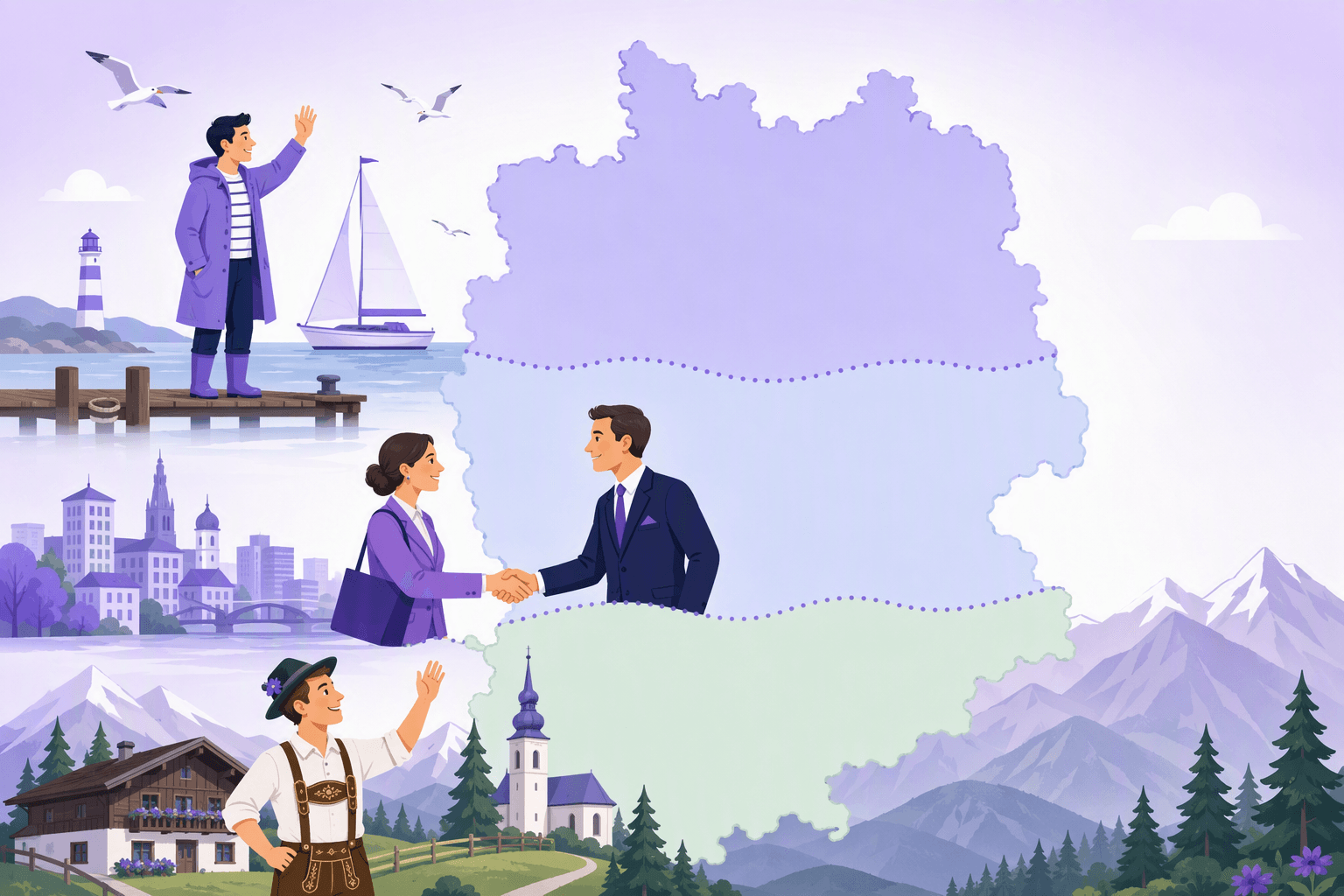
German-speaking regions have developed distinct greeting traditions that immediately reveal where a speaker is from. As linguist Ulrich Ammon documents, these regional forms are not slang but standard, respected greetings within their regions.
Grüß Gott
/GREWS GOT/
Literal meaning: Greet God
“Grüß Gott! Was darf's heute sein?”
Hello! What can I get you today?
The standard greeting in Bavaria (southern Germany) and Austria. Not a religious statement; it's simply the regional equivalent of 'Guten Tag.' Using it in Hamburg would sound out of place.
Grüß Gott is the default polite greeting across Bavaria and Austria. Despite the literal meaning ("Greet God," short for Gott grüße dich, "May God greet you"), it is not a religious expression in modern usage. Shopkeepers, bus drivers, doctors, and waiters all use it as their neutral, everyday greeting.
If you visit Munich, Vienna, or Salzburg, Grüß Gott is what you will hear dozens of times a day. Using it shows respect for local customs. Check out our guide to the best movies for learning German for Austrian and Bavarian films where you can hear these regional forms in action.
Servus
/ZEHR-voos/
Literal meaning: At your service (from Latin)
“Servus, Hansi! Lang nicht gesehen!”
Hey, Hansi! Long time no see!
Used in Bavaria, Austria, and parts of Switzerland. Works as both hello AND goodbye. Comes from Latin 'servus' (servant/at your service). Casual and friendly.
Servus has a fascinating etymology: it derives from the Latin servus humillimus (your most humble servant), but today it is simply a warm, casual greeting. It doubles as a farewell too: you can walk in saying Servus! and walk out saying the exact same thing.
Grüezi
/GREW-eh-tsee/
Literal meaning: Greet you (Swiss German)
“Grüezi mitenand! Willkommen im Restaurant.”
Hello everyone! Welcome to the restaurant.
The standard greeting in the German-speaking part of Switzerland. 'Grüezi mitenand' addresses a group. Instantly marks the speaker as Swiss.
Grüezi is the unmistakable Swiss German greeting. It comes from Gott grüeze dich (God greet you), the same root as Grüß Gott but with a distinctly Swiss form. The variant Grüezi mitenand (hello together) addresses a group. Using Grüezi in Switzerland shows cultural awareness and is always appreciated.
Moin
/moyn/
Literal meaning: Good/Pleasant (from Low German)
“Moin! Alles klar bei dir?”
Hey! Everything good with you?
The signature greeting of northern Germany, especially Hamburg, Schleswig-Holstein, and Lower Saxony. Used at ANY time of day, not just morning. Derived from Low German 'moi' (good), not from 'Morgen.'
Moin is perhaps the most misunderstood German greeting. Despite sounding like "morning," it has nothing to do with the time of day. It derives from Low German (Plattdeutsch) moi, meaning "good" or "pleasant." You will hear it at 8 AM and at 11 PM equally.
The doubled form Moin Moin is also common, though some purists in Hamburg insist that Moin alone is sufficient and that doubling it is "already too much talking," a joke that perfectly captures the dry northern German humor.
🌍 Germany's North-South Greeting Divide
Germany has a clear greeting divide. In the north, you hear Moin and Tach (a clipped Tag). In the south, it is Grüß Gott and Servus. In the middle, Guten Tag and Hallo dominate. Moving from Hamburg to Munich, you can literally track the cultural shift by the greetings you hear.
Slang Greetings
Young Germans, especially in urban areas, use these informal greetings among friends. They are not appropriate for formal settings.
Na?
/nah/
Literal meaning: Well?
“Na? Wie war dein Wochenende?”
Hey, what's up? How was your weekend?
One of the shortest greetings in any language. A single syllable that means 'hey, how's it going?' Very casual, very German. Often followed by a brief pause, waiting for the other person to fill in.
Na? is peak German efficiency: an entire greeting compressed into one syllable. It is a casual "hey, what's up?" that invites the other person to share what is new. The standard response is often just Na? right back, followed by actual conversation.
Was geht?
/vahs GAYT/
Literal meaning: What goes?
“Hey, was geht? Hast du Bock auf Kino?”
Hey, what's up? Do you feel like going to the movies?
German equivalent of 'What's up?' Common among younger speakers, especially in cities. The longer form 'Was geht ab?' is even more colloquial.
Was geht? is the direct German equivalent of "What's up?" and is especially common among teenagers and young adults. The extended version Was geht ab? (What's going off?) adds extra informality. Both are strictly casual.
Tschüss
/chews/
Literal meaning: Goodbye (from French 'adieu')
“Okay, ich muss los. Tschüss!”
Okay, I have to go. Bye!
Included here as a farewell contrast. The most common casual goodbye. Originally northern German but now used nationwide. The formal farewell is 'Auf Wiedersehen' (until we see again).
While Tschüss is a farewell rather than a greeting, it is worth including for contrast. It is the casual counterpart to the formal Auf Wiedersehen (until we see each other again). Interestingly, Tschüss originated as a northern German form. It was once considered informal and regional, but according to the Duden, it has become standard across all of Germany since the late 20th century.
How to Respond to German Greetings
Knowing how to greet someone is half the equation. Here is how to respond naturally.
Responses to Universal and Time-Based Greetings
| They Say | You Say | Notes |
|---|---|---|
| Hallo! | Hallo! / Hallo! Wie geht's? | Echo it back, optionally add a follow-up |
| Guten Tag | Guten Tag | Echo the same greeting |
| Guten Morgen | Guten Morgen / Morgen! | Echo, shortened version is fine |
| Guten Abend | Guten Abend | Echo the same greeting |
| Grüß Gott | Grüß Gott | Always echo regional greetings |
| Moin | Moin | One Moin back is sufficient |
Responses to Casual and Formal Greetings
| They Say | You Say |
|---|---|
| Wie geht's? | Gut, danke! Und dir? / Ganz gut, und selbst? |
| Wie geht es Ihnen? | Sehr gut, danke. Und Ihnen? |
| Na? | Na? / Gut, und dir? |
| Was geht? | Nicht viel. / Alles gut, bei dir? |
| Freut mich | Gleichfalls / Ganz meinerseits |
💡 The Echo Rule
When unsure how to respond to a German greeting, the safest strategy is to echo it back exactly. If someone says Grüß Gott, say Grüß Gott. If they say Moin, say Moin. Echoing shows you understand and respect the regional form.
🌍 Physical Greetings in German Culture
German greeting customs are more restrained than in many Romance language cultures. A firm handshake is the standard for first meetings and business contexts. Among close friends and family, a brief hug is common. Cheek kisses are less frequent than in France or Spain, though they do occur in some southern regions and among younger urban Germans. Direct eye contact during a handshake is important, as avoiding it can be perceived as untrustworthy.
Practice With Real German Content
Reading about greetings is a great first step, but hearing them spoken naturally by native speakers is what makes them stick. German-language films and shows on streaming platforms are excellent resources: Dark for standard German, Tatort for a mix of regional dialects, and Austrian productions for hearing Grüß Gott and Servus in context.
Wordy lets you take this further. You can watch German movies and shows with interactive subtitles, tapping on any greeting to see its meaning, pronunciation, and cultural context in real time. Instead of memorizing phrases in isolation, you absorb them from real conversations with authentic intonation and regional flavor.
For more German content, explore our blog for guides including the best movies to learn German. You can also visit our German learning page to start practicing with native content today.
Frequently Asked Questions
What is the most common way to say hello in German?
What is the difference between 'Hallo' and 'Guten Tag'?
What does 'Grüß Gott' mean and where is it used?
How do you say hello on the phone in German?
Is 'Moin' only used in the morning?
What are some slang ways to say hello in German?
Sources & References
- Duden, Deutsches Universalwörterbuch, 9th edition (2023)
- Goethe-Institut, German language and culture resources
- Ethnologue: Languages of the World, German language entry (2024)
- Ammon, Ulrich (2015). 'Die Stellung der deutschen Sprache in der Welt.' De Gruyter.
Start learning with Wordy
Watch real movie clips and build your vocabulary as you go. Free to download.


