Quick Answer
German articles tell you a noun’s gender and its role in the sentence. To use them correctly, choose definite vs indefinite (der/die/das vs ein/eine), then match the case (nominative, accusative, dative, genitive). This guide gives you the core patterns, shortcuts that actually work, and examples you’ll hear in real speech.
German articles are the small words like der, die, das (the) and ein, eine (a/an) that tell you both a noun’s gender and its case. If you learn the core article tables and a few high-frequency “preposition + article” chunks, you can stop guessing and start producing correct German sentences quickly.
German has around 90 to 100 million native speakers and is used as an official language across six European countries (Germany, Austria, Switzerland, Belgium, Luxembourg, Liechtenstein), plus widely as a second language in Europe (Ethnologue, 27th ed., 2024). That means you will hear article patterns constantly, whether you are watching crime shows, listening to football interviews, or ordering coffee.
If you want more everyday phrases to practice with real context, pair this guide with how to say hello in German and how to say goodbye in German. Articles become easier when you hear them repeated in natural speech.

What German articles do (and why English speakers struggle)
In English, “the” barely changes, and “a/an” only changes for sound. In German, the article changes to show:
- Definite vs indefinite: “the” (definite) vs “a/an” (indefinite)
- Gender: masculine, feminine, neuter
- Case: nominative, accusative, dative, genitive
A practical way to think about it: German uses articles as labels. They label the noun’s identity (the vs a) and its job in the sentence (subject, direct object, indirect object, possession).
Linguist and translator Mark Twain famously complained about German gender in his essay “The Awful German Language.” The joke lands because learners expect gender to be “logical,” but in German it is mostly a lexical feature you learn with the noun.
Pronunciation you actually need for articles
Articles are short, but they are high-frequency, so clarity matters.
- der: dare (rhymes with “air” in many accents)
- die: dee
- das: dahss
- ein: ine (like “line” without the L)
- eine: EYE-nuh
- einen: EYE-nen
- dem: dame
- den: dane
- des: dess
In fast speech, articles often reduce, but learners should start with clear forms. If you want a broader sound system overview, see our German pronunciation guide.
Definite articles: der, die, das (the)
Definite articles are used when the listener can identify the noun: “the book,” “the car,” “the problem we talked about.”
The core table (nominative)
Nominative is the “dictionary default,” used for the subject.
| Gender | Article | Example |
|---|---|---|
| masculine | der | der Mann (the man) |
| feminine | die | die Frau (the woman) |
| neuter | das | das Kind (the child) |
| plural (all genders) | die | die Kinder (the children) |
Two key points:
- Plural is always die in the definite form.
- Gender belongs to the noun, not the person or object’s real-world sex.
Duden’s grammar entries are a reliable reference for these paradigms (Duden, accessed 2026).
Indefinite articles: ein, eine (a/an)
Indefinite articles introduce something new or non-specific: “a book,” “an idea.”
The core table (nominative)
| Gender | Article | Example |
|---|---|---|
| masculine | ein | ein Mann |
| feminine | eine | eine Frau |
| neuter | ein | ein Kind |
| plural | (none) | Kinder (some children) |
German has no plural “a/an.” You either use no article, or you use words like einige (some) depending on meaning.
The real reason articles change: cases
German cases are not just classroom theory. They are the system that keeps meaning stable even when word order shifts, especially in longer sentences.
A clean, learner-friendly explanation is to treat cases as roles:
- Nominative: the subject (who does it)
- Accusative: the direct object (who/what is affected)
- Dative: the indirect object (to/for whom, or after certain prepositions)
- Genitive: possession/relationship (often replaced by dative constructions in speech, but still common in formal writing)
The IDS grammis system is a strong, research-backed grammar reference for German case usage (IDS, grammis, accessed 2026).
Definite articles by case (the full pattern)
This is the table that unlocks most “der/die/das” confusion.
| Case | Masculine | Feminine | Neuter | Plural |
|---|---|---|---|---|
| Nominative | der | die | das | die |
| Accusative | den | die | das | die |
| Dative | dem | der | dem | den |
| Genitive | des | der | des | der |
Three high-value observations:
- Only masculine changes in accusative: der → den.
- Dative plural is den and usually adds -n to the noun when possible: mit den Kindern.
- Genitive masculine/neuter is des and often adds -(e)s to the noun: des Mannes, des Kindes.
Indefinite articles by case (ein- words)
Indefinite articles follow a similar logic, but there is no plural.
| Case | Masculine | Feminine | Neuter |
|---|---|---|---|
| Nominative | ein | eine | ein |
| Accusative | einen | eine | ein |
| Dative | einem | einer | einem |
| Genitive | eines | einer | eines |
Notice the pattern: masculine gets the most visible changes, and feminine often stays “eine/einer” depending on case.
How to choose the case in real sentences
Rules are only useful if they map to decisions you make while speaking.
Step 1: Find the verb’s core structure
Some verbs “want” a direct object (accusative). Others commonly take dative objects, or both.
- sehen (to see) → accusative: Ich sehe den Film.
- helfen (to help) → dative: Ich helfe dem Freund.
A good learner habit is to learn verbs with their case frame. Many dictionaries and learner grammars label this explicitly.
Step 2: Watch for prepositions that force a case
Prepositions are the fastest shortcut to correct case. Learn them as case triggers.
Accusative prepositions (very common)
- für (for)
- ohne (without)
- durch (through)
- gegen (against)
- um (around/at)
Examples:
- für den Mann, für die Frau, für das Kind
- ohne einen Plan (without a plan)
Dative prepositions (daily German)
- mit (with)
- bei (at/with)
- nach (after/to)
- von (from/of)
- zu (to)
- aus (out of/from)
Examples:
- mit dem Freund (with the friend)
- bei der Arbeit (at work)
- zu dem Arzt often contracts to zum Arzt
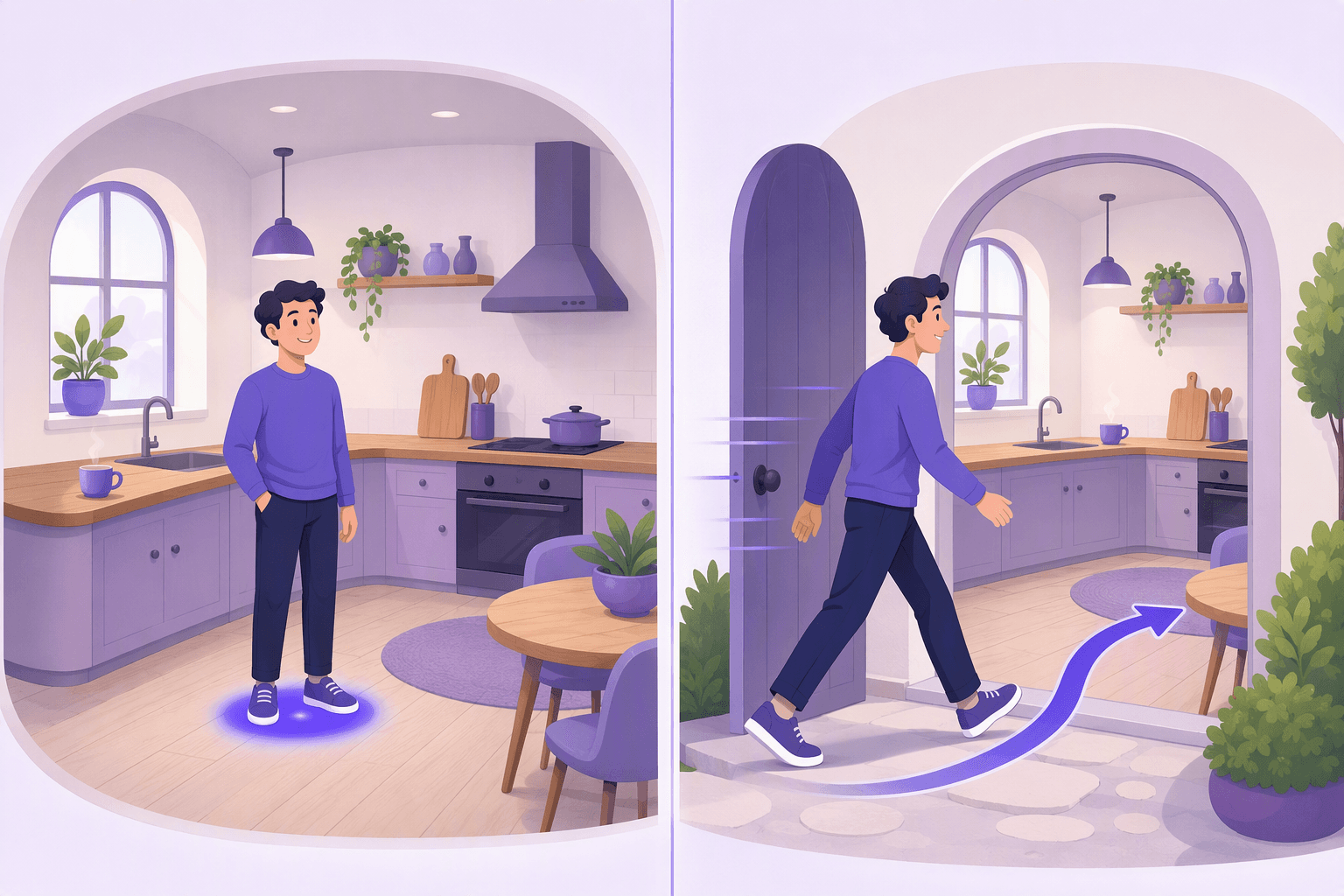
Two-way prepositions (the location vs direction trap)
These take dative for location (where?) and accusative for direction (where to?).
- in, an, auf, unter, über, vor, hinter, neben, zwischen
Examples:
- Ich bin in der Küche. (location, dative)
- Ich gehe in die Küche. (direction, accusative)
Goethe-Institut explanations of Wechselpräpositionen are clear and classroom-tested (Goethe-Institut, accessed 2026).
Contractions you will hear constantly (and should use)
German often merges preposition + article. These are not slang, they are standard.
| Full form | Common contraction | Pronunciation |
|---|---|---|
| zu dem | zum | tsoom |
| zu der | zur | tsoor |
| in dem | im | im |
| an dem | am | ahm |
| bei dem | beim | bime |
| von dem | vom | fohm |
If you memorize these as chunks, your speech becomes smoother fast. You also reduce the mental load of “which case is this,” because the contraction already encodes it.
💡 The fastest article hack: learn chunks
Instead of drilling der/die/das alone, drill mini-phrases you actually say: "im Hotel", "zum Bahnhof", "mit dem Auto", "für die Arbeit". Your brain stores them as ready-made building blocks, which is closer to how fluent speakers produce grammar.
Gender guessing: what rules are worth learning
You cannot reliably “logic” your way to gender, but you can use patterns to reduce uncertainty. Treat these as probability rules, then confirm.
Useful suffix rules (high reliability)
- -ung, -heit, -keit, -schaft, -tion: usually feminine
die Zeitung, die Freiheit, die Möglichkeit, die Freundschaft, die Situation - -chen, -lein (diminutives): usually neuter
das Mädchen, das Häuschen - -er (many agent nouns): often masculine
der Lehrer, der Fahrer
Category tendencies (helpful, not perfect)
- Many days, months, seasons are masculine: der Montag, der Januar, der Sommer
- Many trees and flowers are feminine: die Eiche (but not all)
- Many metals are neuter: das Gold (but again, not all)
For a deeper look at how German builds meaning through morphology, you will see these suffixes everywhere in compounds, especially in news and workplace German.
The “Mädchen” problem: when meaning and gender disagree
Mädchen (girl) is neuter: das Mädchen. That surprises learners because it refers to a female person.
The reason is morphological: -chen is a diminutive suffix, and diminutives are neuter. This is a good example of why German gender is a grammatical category, not a biological one.
In real usage, you may also notice pronoun choices that follow grammar rather than semantics, especially in formal writing. In conversation, speakers sometimes choose pronouns based on the person, but the article stays grammatical.
Genitive: important, but not where beginners should spend most time
Genitive is alive in German, especially in:
- formal writing
- fixed expressions (eines Tages)
- certain prepositions (trotz, während, wegen in more formal registers)
But in everyday speech, possession is often expressed with von + dative:
- Formal: das Auto des Mannes
- Common spoken: das Auto von dem Mann (often vom Mann)
Learn genitive forms for high-frequency phrases, but do not let it block progress on nominative, accusative, and dative.
Articles in real-life dialogue: what movies and TV teach well
Authentic dialogue is where article patterns become automatic, because you hear the same frames repeated:
- mit dem for companionship and tools
- im for locations
- zum/zur for destinations
- für den/die/das for purpose
This is one reason “input” matters in language learning. Stephen Krashen’s work on second-language acquisition argues that learners improve when they get lots of understandable input. In German, that input is packed with article cues, so repeated exposure helps your brain predict the right form without conscious rule-checking.
If you want phrases that naturally include articles, practice greetings and relationship language too. Even a simple line like “I love you” can pull in pronouns and forms around it, see how to say I love you in German.
Common mistakes (and how to fix them fast)
Mistake 1: Treating “die” as always feminine
Fix: Remember die is also plural.
- die Frau (feminine singular)
- die Frauen (plural)
When you see die, check the noun ending and context.
Mistake 2: Forgetting accusative masculine (der → den)
Fix: Drill a few sentences until it is automatic:
- Ich sehe den Mann.
- Ich habe den Schlüssel.
- Ich kaufe den Kaffee.
This is one of the highest-impact corrections for sounding more natural.
Mistake 3: Dative plural without -n
Fix: When you use den in dative plural, look for the noun’s plural form and add -n if it can take it:
- mit den Kindern
- bei den Freunden
- in den Städten
There are exceptions, but this rule covers a lot of daily German.
Mistake 4: Two-way prepositions, guessing randomly
Fix: Ask the question:
- Wo? (where, location) → dative
- Wohin? (where to, direction) → accusative
Then build pairs:
- im Park vs in den Park
- am Tisch vs an den Tisch
A compact practice plan (15 minutes a day)
Day 1-3: High-frequency chunks only
Memorize and use these as whole units:
- im Hotel, im Büro, im Zug
- zum Bahnhof, zur Arbeit
- mit dem Auto, mit der Familie
Say them out loud. Articles are motor memory as much as intellectual knowledge.
Day 4-7: Add one case contrast
Pick one contrast and drill it:
- der vs den (nominative vs accusative masculine)
- dem vs den (dative masculine vs accusative masculine)
- im vs in die (location vs direction)
Week 2: Expand nouns, keep frames stable
Keep the same frames, swap nouns:
- mit dem + 10 nouns you use
- für die + 10 nouns you use
- im + 10 places you go
This is how you turn grammar into something you can say under time pressure.
🌍 Why Germans notice articles quickly
In German, articles carry a lot of information early in the noun phrase, especially case. That matters in long sentences where the verb comes late, or where word order shifts for emphasis. Native speakers subconsciously use article cues to predict the structure, so consistent article use makes you easier to follow.
How this connects to other “small words” learners overlook
Articles are part of a bigger system: pronouns, prepositions, and word order all work together. If you are also working on sentence structure, our German word order guide pairs well with this article.
And if you are learning informal speech, remember that slang and swearing often play with grammar, but still rely on correct article frames. If you are curious, read our guide to German swear words for cultural context and what to avoid in polite settings.
A final checklist you can use while speaking
- Is it the (definite) or a/an (indefinite)?
- What is the noun’s gender (learn it with the noun)?
- What is the case (verb role or preposition trigger)?
- Is there a contraction (im, am, zum, zur) that makes it easier?
If you want to turn these patterns into listening skill, learning through short, repeatable scenes helps. Wordy’s movie and TV clips make article frames stick because you hear them in the same emotional, situational contexts that native speakers use every day.
For more German learning guides, browse the Wordy blog or start practicing directly on /learn/german.
Frequently Asked Questions
What is the easiest way to learn der, die, das?
Is there a rule to always know a noun’s gender in German?
Why does der change to den or dem?
When do I use ein vs eine vs einen?
Do Germans care if I say the wrong article?
Sources & References
- Duden, 'Artikel' and 'Kasus' entries, accessed 2026
- Institut für Deutsche Sprache (IDS), grammis information system, accessed 2026
- Goethe-Institut, German grammar resources on articles and cases, accessed 2026
- Ethnologue, 27th edition, 2024
Start learning with Wordy
Watch real movie clips and build your vocabulary as you go. Free to download.


