Quick Answer
German pronunciation is predictable once you learn a small set of sound rules: vowel length, the ich vs ach sounds, final devoicing, and how German stress works. This guide gives English-friendly pronunciations for key sounds, explains regional variation (Germany, Austria, Switzerland), and shows how to sound clearer in real conversations.
German pronunciation becomes straightforward once you learn the core sound rules and a few high-impact contrasts: vowel length, the two German "ch" sounds, how "r" behaves, and where stress falls. This guide gives you English-friendly pronunciations for every key sound, plus the mistakes that most clearly mark non-native speech.

| English | German | Pronunciation | Formality |
|---|---|---|---|
| Hello | Hallo | HAH-loh | casual |
| Good day (polite hello) | Guten Tag | GOO-ten tahk | polite |
| Goodbye | Tschüss | chooss | casual |
| Goodbye (formal) | Auf Wiedersehen | owf VEE-der-zayn | formal |
| Please | Bitte | BIT-tuh | polite |
| Thank you | Danke | DAHN-kuh | polite |
| Sorry / excuse me | Entschuldigung | ent-SHOOL-dee-goong | polite |
| I love you | Ich liebe dich | ikh LEE-buh dikh | polite |
💡 Fastest way to improve
Pick one short clip and shadow it: listen, pause, repeat, then record yourself. Movie and TV dialogue forces you to match rhythm and vowel length, not just individual sounds. If you want ready-made clips, start on the German learning page and practice with subtitles you can slow down.
German in the real world: why pronunciation matters
German is a major world language with tens of millions of native speakers, and it is used across multiple countries and regions. Ethnologue (27th ed., 2024) lists German as having around 75 million native speakers and many more L2 speakers, with official status in Germany, Austria, Switzerland, Liechtenstein, Luxembourg, and Belgium.
That geographic spread creates variation, but it also means there is a strong shared standard used in education, national media, and most professional settings. If your goal is to be understood quickly, mastering the standard sound system pays off more than chasing a specific regional accent.
"Learners benefit most from focusing on contrasts that carry meaning, especially vowel length and final devoicing, because these features are systematic and perceptually salient in German."
Professor J. C. Wells, phonetician and author of Accents of English (Cambridge University Press)
The pronunciation mindset: German is more consistent than English
German spelling is not perfectly phonetic, but it is far more regular than English. Once you know the rules, you can usually predict how a new word is pronounced, and you can often predict spelling from hearing it.
The tradeoff is that German uses a few sounds English does not, and it uses timing (especially vowel length) more strictly. If you learn those early, your accent improves dramatically.
🌍 Why German sounds 'crisp' in films
German dialogue in TV and cinema often features clear consonant releases and strong stress beats, especially in news-like or formal scenes. That is not because Germans always speak that carefully, it is because Standard German diction is a cultural marker of competence in many public contexts, similar to broadcast English.
Vowels: the single biggest lever (short vs long)
German vowels are the main place English speakers lose clarity. The key concept is length: many vowel pairs differ mostly by duration, and length often correlates with spelling patterns.
Long vs short vowels (what to listen for)
Long vowels are held longer and often sound "tenser". Short vowels are quicker and often slightly more open.
Here are high-impact examples (pronunciations are approximations, not perfect IPA):
| Contrast | Short (approx) | Long (approx) | Meaning note |
|---|---|---|---|
| i | "IH" | "EE" | bitten vs bieten |
| u | "OO" but short | "OO" held | muss vs Mus |
| a | "AH" short | "AH" held | Mann vs Mahnen |
⚠️ The spelling trap
Do not rely on English instincts like "double consonant means stress" or "silent e means long vowel". In German, double consonants often signal a short vowel before them (for example, "ss", "tt", "mm"), while "h" after a vowel often signals a long vowel (for example, "sehen" is ZAY-en).
ä, ö, ü (umlauts) without pain
Umlauts are not decorations, they are different vowels. Mispronouncing them can cause confusion, especially with minimal pairs.
- ä: often like "EH" (as in "bed"), sometimes close to "AY" depending on region. Example: spät (SHPAYT).
- ö: like saying "EH" while rounding your lips. Example: schön (shern, with rounded lips).
- ü: like saying "EE" while rounding your lips. Example: für (fyur, with rounded lips).
A practical hack: start with the English-ish vowel, then keep the tongue position and only change the lips to rounded.
Diphthongs: ei, ie, eu, au
German diphthongs are consistent and show up constantly in names and everyday words.
| Spelling | Sounds like | Example | Approx pronunciation |
|---|---|---|---|
| ei / ai | "EYE" | mein | MYNE |
| ie | long "EE" | Liebe | LEE-buh |
| eu / äu | "OY" | heute | HOY-tuh |
| au | "OW" | Haus | howss |
Notice ie is not a diphthong in modern standard pronunciation, it is a long vowel.
Consonants that define a German accent
German consonants are not inherently "harsher", but they are more systematically articulated than many English consonants. Three areas matter most: "ch", final devoicing, and "s" clusters.
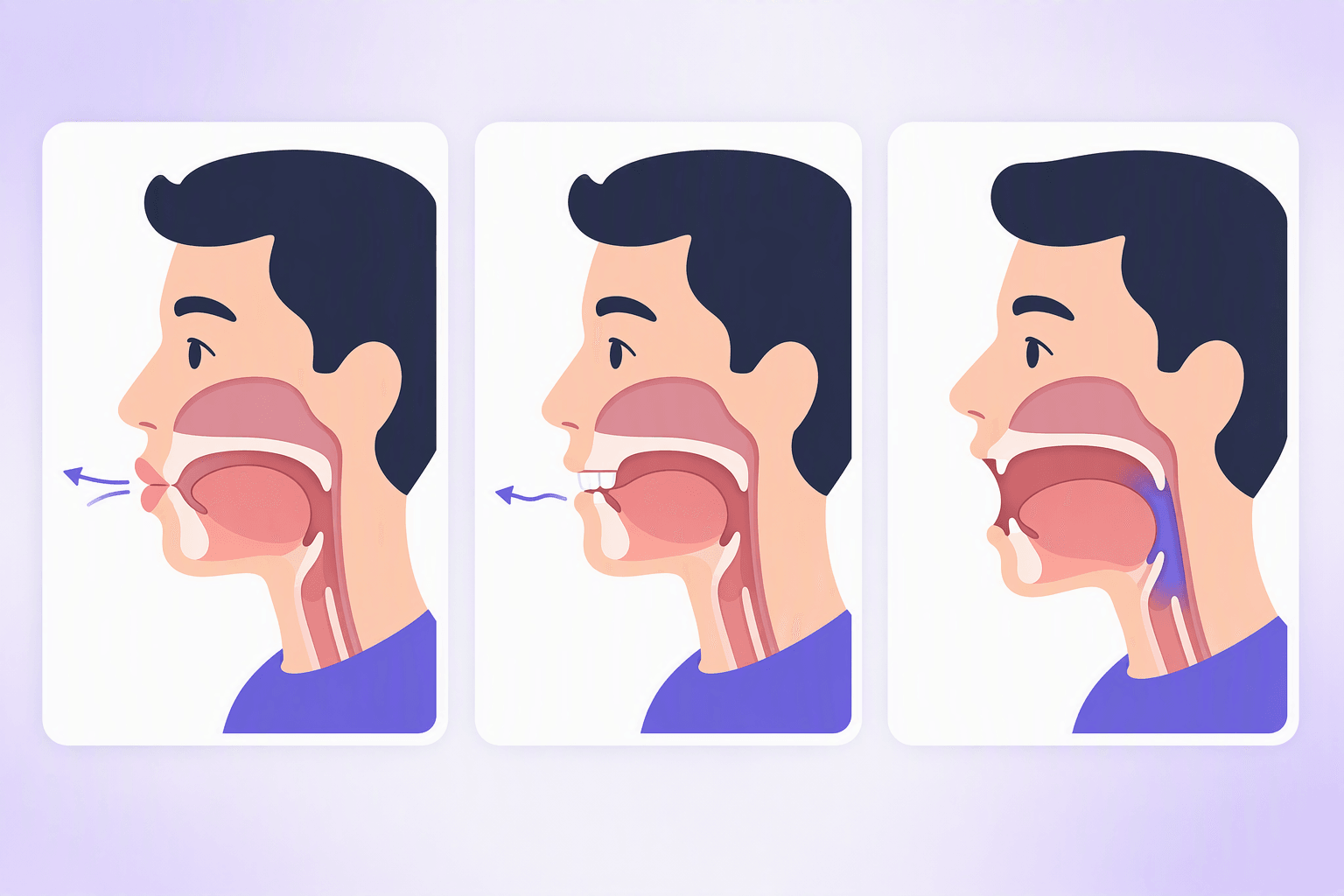
ch: the famous ich vs ach contrast
German "ch" has two main pronunciations in Standard German (Duden pronunciation guidance is the reference point here).
ich-Laut (soft)
After i, e, ä, ö, ü, and after consonants like l, n, r, "ch" is usually the soft sound.
- ich: (ikh), a soft hiss made with the tongue close to the hard palate.
- nicht: (nikht), keep it light, not "nisht".
English approximation: imagine a very soft "HYIH" sound, then friction, not a full "sh".
ach-Laut (throaty)
After a, o, u, au, "ch" is usually the throaty sound.
- Bach: (bahkh)
- Buch: (bookh)
English approximation: like the "kh" in Scottish "loch", with air friction in the back of the throat.
💡 A movie-clip trick for 'ch'
Find a clip where a character says "ich" many times (arguments and confessions are great for this). Shadow only the word "ich" in rhythm, then expand to the full sentence. If you can nail "ich", your German instantly sounds more grounded.
Final devoicing: why b, d, g sound like p, t, k
In Standard German, voiced obstruents (b, d, g, v, z) typically become voiceless at the end of a syllable or word. This is one of the most reliable rules in German phonology (covered widely in reference works and teaching materials, including Goethe-Institut resources).
Examples:
- Tag is pronounced (tahk), not (tahg).
- und is pronounced (oont), not (oond).
- lieb ends like (leep), not (leeb).
This matters because learners often keep voicing, which sounds foreign even when every vowel is correct.
s, ss, ß, and the "shp/sht" rule
German "s" changes depending on position:
- At the start of a word before a vowel, s is often voiced, like "z": Sonne (ZON-nuh).
- ss and ß are voiceless, like "s": Straße starts with (SHTRAH-suh), but the ß is (s).
The famous cluster rule:
- sp at the start of a word is pronounced "shp": Spiel (SHPLEEL).
- st at the start of a word is pronounced "sht": Stadt (SHTAHT).
r: throat R, rolled R, and the "uh" ending
German "r" varies by region, but three patterns are common:
- Uvular R (back of throat): common in Germany’s standard-oriented speech.
- Rolled R (tongue trill): heard in some regions and in careful or expressive speech.
- Vocalized R (vowel-like): at the end of syllables, it can sound like "uh".
Examples:
- besser often sounds like (BESS-uh).
- für can sound like (fyur) with a weakened R.
Aim for consistency, not perfection. If you can produce a light uvular R and vocalize it at endings, you will sound natural in most standard contexts.
Stress and rhythm: why Germans understand you faster
German is stress-timed like English, but the stress placement is often more predictable. Stress errors can make words hard to recognize, even if every sound is close.

Default stress rules (practical, not exhaustive)
- Many native German words stress the first syllable: Mutter (MOO-ter), Wasser (VAH-ser).
- Many words with common prefixes are stressed on the root, not the prefix: verSTEHEN (fer-SHTAY-en), beKOMMEN (beh-KOM-men).
- Many loanwords keep stress near the end: HoTEL (hoh-TELL), MuSIK (moo-ZEEK).
Sentence melody: German "sounds direct" for a reason
German often uses a firm falling intonation in statements, especially in formal settings. In English, speakers sometimes soften statements with rising intonation or extra politeness markers.
In German, clarity is frequently conveyed through direct syntax and confident cadence, not through extra hedging. This is one reason German can sound "serious" in subtitles, even when the content is neutral.
For real greetings and openings, compare your rhythm to native speech in how to say hello in German. You will notice how short many greetings are, and how the stress carries the friendliness.
Minimal pairs that train your ear (and fix your accent)
Minimal pairs are pairs of words that differ by one sound. They are the fastest way to build perception, which then improves production.
| English | German | Pronunciation | Note |
|---|---|---|---|
| short i vs long i | bitten vs bieten | BIT-ten vs BEE-ten | Length changes meaning. |
| u vs ü | musste vs müsste | MOOS-tuh vs MYOOS-tuh | Umlaut changes vowel quality. |
| a vs ä | Mann vs Männer | MAHN vs MEN-ner | Common plural pattern. |
| ch types | ich vs ach | ikh vs ahkh | Front-vowel vs back-vowel environment. |
| final devoicing | Rad vs Rat | raht vs raht | Often sounds identical in isolation. |
| s voicing | Saal vs Zahl | ZAHL vs TSAHL | Initial 's' can be voiced; 'z' is 'ts'. |
💡 How to practice minimal pairs
Do not repeat a word 20 times in a row. Alternate: A, B, A, B. Record yourself and check only one feature, for example vowel length. Your brain learns contrasts faster than isolated targets.
The German sounds English speakers misread
Some German letters look familiar but behave differently. Fixing these gives you quick wins.
v and w
- w is like English "v": Wasser (VAH-ser).
- v is often like "f" in native German words: Vater (FAH-ter).
- In some loanwords, v can be "v": Video (VEE-deh-oh).
z and tz
German z is "ts":
- Zeit (TSYTE)
- Zug (tsoog, with final devoicing not relevant here because it is already voiceless)
tz is also "ts", often signaling a short vowel before it: Katze (KAT-tsuh).
j
German j is like English "y":
- ja (yah)
- Jahr (yahr)
h
German h is pronounced at the start of a syllable, but often silent when it marks a long vowel:
- Haus (howss), pronounced
- sehen (ZAY-en), the h lengthens the vowel
Regional variation you will actually hear
Standard German is a shared reference, but real speech varies. The key is knowing what variation is normal so you do not overcorrect.
Germany (Germany-wide standard vs local color)
In Germany, you will hear the uvular R frequently in standard-oriented speech, especially in news, education, and many workplaces. In casual settings, vowels may reduce more, and endings can get softer.
Austria
Austrian German often has a different melody and some vowel qualities that sound "warmer" to learners. Some consonants can be less strongly released, and certain words differ, but pronunciation remains highly mutually intelligible in most contexts.
Switzerland
Swiss German dialects can differ substantially from Standard German, and many Swiss switch depending on context. In formal situations, Swiss speakers use Swiss Standard German, which is close to the standard but with recognizable accent features.
If you are traveling, pairing pronunciation with survival phrases helps. Learn your farewells in how to say goodbye in German and mimic the rhythm you hear locally.
Common mistakes (and the exact fix)
Mistake 1: treating every vowel like English
Fix: decide if the vowel is short or long, then commit to the timing. If you only change one thing, change duration.
Mistake 2: turning "ich" into "ish"
Fix: move the tongue slightly forward and higher, and reduce lip rounding. Aim for a lighter, hiss-like friction.
Mistake 3: voicing final consonants
Fix: at the end of words, stop voicing and let the consonant be crisp: Tag (tahk), und (oont).
Mistake 4: flattening stress
Fix: exaggerate stress slightly in practice. German listeners use stress to segment words, especially in longer compounds.
Mistake 5: overdoing the "R"
Fix: use a gentle uvular R or vocalize it at endings. A harsh gargle is not required and can reduce intelligibility.
⚠️ A note on swear words and pronunciation
Swear words are often where learners copy the wrong accent because emotion changes rhythm and volume. If you are curious, treat it as listening practice, not a script. Word choice also varies by region and context, as explained in our guide to German swear words.
A practical 10-minute routine (works with any clip)
- Warm up vowels (2 minutes): say long vowels clearly: "a, e, i, o, u, ä, ö, ü" with steady timing.
- Target one contrast (3 minutes): pick one: ich vs ach, short vs long i, or final devoicing.
- Shadow a clip (3 minutes): copy rhythm first, then consonants.
- Record and compare (2 minutes): listen for only one feature, not everything.
For emotionally loaded lines, love confessions are great because they repeat core sounds like "ich" and "liebe". Practice with how to say I love you in German and focus on vowel length in liebe (LEE-buh) and the soft ich (ikh).
Using Wordy to train pronunciation with real dialogue
Pronunciation improves fastest when your ear is trained on authentic speech at your level. Research on listening input and phonological learning consistently shows that repeated exposure to clear, meaningful speech helps learners build more accurate sound categories, especially when paired with focused attention and feedback.
On Wordy, you can loop short scenes, slow them down, and replay the same line until your timing matches. That is exactly what German needs, because timing is where most learners drift.
If you want a structured path, start at the blog index and build a routine: greetings, travel phrases, then longer scenes with faster speech.
Summary: what to master first
If you want the highest return on effort, prioritize these in order:
- Vowel length (short vs long)
- ich vs ach
- Final devoicing (b, d, g become p, t, k at the end)
- Stress and rhythm (strong beats, clear compounds)
- Regional tolerance (do not panic when accents shift)
German pronunciation is a system. Once you treat it like a system, your accent stops being a collection of guesses and starts sounding intentional.
For more everyday lines you can copy, start with how to say hello in German and how to say goodbye in German, then move to longer scenes where characters speak fast and overlap.
Frequently Asked Questions
Is German pronunciation hard for English speakers?
How do you pronounce 'ch' in German?
Do Germans roll the R?
Why does German sound like it has lots of 'sh'?
What is the biggest pronunciation mistake in German?
Sources & References
- Goethe-Institut, Aussprache (German Pronunciation) resources, accessed 2026
- Duden, Das Aussprachewörterbuch (German Pronunciation Dictionary), latest edition
- Institut für Deutsche Sprache (IDS), resources on Standard German and variation, accessed 2026
- Ethnologue, German (Standard) language entry, 27th edition, 2024
- International Phonetic Association, Handbook of the IPA, 1999
Start learning with Wordy
Watch real movie clips and build your vocabulary as you go. Free to download.


